The oracle that cities listened to
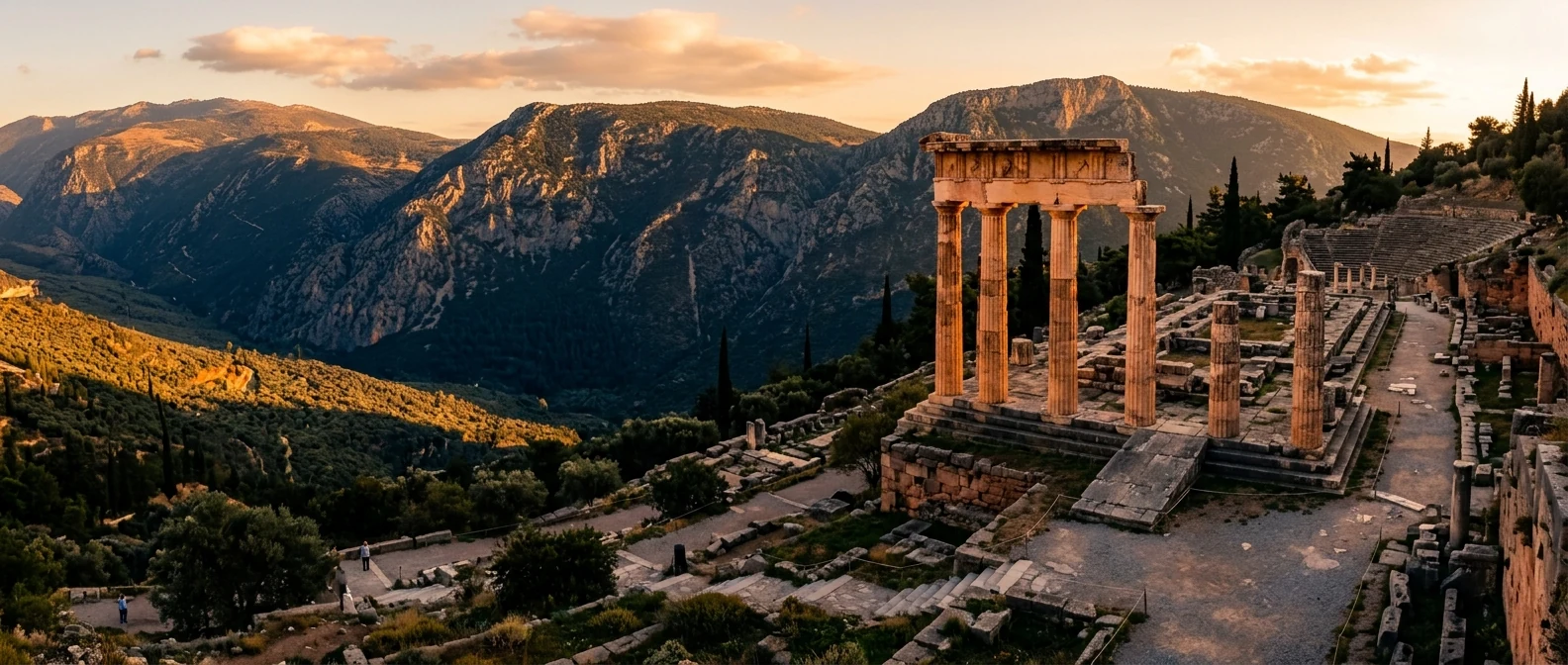
The Oracle of Delphi was already operating in the 8th century BCE, perhaps earlier. The sanctuary spread above the Pleistos valley, beneath Parnassus, in a landscape of stone, light, steep slopes, and wide views.
For the Greeks, Delphi was the navel of the earth. Myth said that Zeus released two eagles from the two ends of the world, and they met there. At the centre of the sanctuary stood the temple of Apollo. Inside it, on specific days of the year, the Pythia spoke.
The oracle was not a local cult on the margins. It was a Panhellenic institution. Cities asked for approval before founding colonies. Rulers consulted it before wars. Private individuals brought family, financial, or legal anxieties. Its reputation lasted until the late 4th century CE, when the decrees of Theodosius closed the pagan sanctuaries and oracles.
Who the Pythia was
- The Pythia was not a "witch" in the modern sense. She was a priestess of Apollo.
- She usually came from a local family of Delphi and had to be of unblemished reputation.
- At first, according to tradition, the role was given to young virgins. Later it passed to women over 50, who dressed ritually as virgins.
In periods of high demand, more than one Pythia seems to have served, but the image that remained is of one woman in the adyton. She did not speak as a private individual. She spoke as the mouth of the god. That distinction mattered for her authority.
A few names survived in tradition: Phemonoe, the legendary first Pythia; Aristonike, linked to the Persian Wars; Themistoclea, later associated with Pythagoras. Most individuals disappeared. The institution remained.
The day of consultation
The Pythia did not give oracles every day. The sanctuary received questions on the seventh day of the month, for nine months of the year. In winter Apollo was thought to be absent, among the Hyperboreans, and the sanctuary followed a different rhythm.
The process began before the question itself. The petitioner paid the pelanos, a sacred offering. Priests sprinkled a goat with cold water. If the animal trembled, the day was judged suitable. If not, the question had to wait.
The adyton
Before entering the temple, the Pythia purified herself at the Castalian spring. She drank water from Kassotis, chewed laurel leaves, and sat on a tripod in the adyton. Ancient sources describe a state of enthousiasmos, literally "the god inside the body." The phrase did not mean simple inspiration. It meant an altered consciousness, broken speech, and a voice that priests had to turn into an answer.
The answers were often written in verse, in dactylic hexameter. It is not certain that the Pythia always spoke that way. More likely, priests processed her words. That does not reduce her role. It shows that Delphi was an institution, not a solitary scene of ecstasy.
The gases beneath the temple
Plutarch, who served as a priest at Delphi around 95 CE, speaks of a sweet smell and a pneuma rising from the ground. For decades archaeologists treated this description with suspicion. No clear chasm was found beneath the temple, so the theory seemed weak.
In 2001, research involving geologists and chemists changed the discussion. Two intersecting fault lines were identified beneath the temple. The rocks of the region can release methane, ethane, and above all ethylene. Ethylene has a sweet smell and, in low doses, can produce euphoria or altered perception.
The theory does not explain everything. It does not turn the Pythia into a chemical experiment. But it shows why ancient testimony about smell, dizziness, and ecstasy does not need to be dismissed as fantasy. At Delphi, ritual, politics, psychology, and perhaps geology met in one place.
The oracles that remained
- The most famous oracle concerns Croesus, king of Lydia. He asked whether he should cross the Halys River and attack the Persians. The answer was that, if he did, "a great empire would fall." Croesus crossed the river. The empire that fell was his own.
- In 480 BCE, faced with the Persian invasion, the Athenians received an oracle about "wooden walls." Themistocles interpreted the phrase as a fleet. The naval choice led to Salamis.
- For Socrates, the oracle arrived indirectly. His friend Chaerephon asked whether anyone was wiser than Socrates. The answer was no. Socrates took it not as praise, but as a reason to test what wisdom meant.
- On the temple were written two Delphic maxims that became philosophical rules: "Know thyself" and "Nothing in excess."
The sanctuary of Delphi
- The modern visitor climbs the Sacred Way with much the same orientation as ancient pilgrims. On both sides stood city treasuries, dedications, statues, and political monuments. Delphi was not only a place of prayer. It was also a display of power.
- The temple of Apollo visible today belongs to the classical phase of the 4th century BCE. Higher up stands the theatre, with about 5,000 seats. Higher still is the stadium, one of the best preserved in antiquity.
- In 1987 Delphi entered the UNESCO list. The site's value is not limited to its monuments. It is the combination of landscape and institution. Without Parnassus, Delphi loses half its force.
At a glance
~1,200 years
The life of the oracle, from about the 8th century BCE to the late 4th century CE.
9 months
The oracle received questions only during nine months of the year.
180 km
The distance from Athens. The drive usually takes around three hours.
5,000 seats
The approximate capacity of the theatre at Delphi.
The Pythian Games
- The Pythian Games were held every four years at Delphi, together with the other great Panhellenic festivals: Olympia, Nemea, and Isthmia.
- Their form was stabilised in 582 BCE after the First Sacred War.
- The distinctive feature of the Pythian Games was music. Alongside athletic contests, there were competitions in kithara, aulos, and singing.
- The prize was a laurel wreath, because laurel belonged to Apollo.
Delphi as power and display
- Cities displayed themselves at Delphi through treasuries, dedications, statues, and monuments.
- Rulers and cities consulted the oracle before wars, colonies, and major political decisions.
- The answer did not replace political judgment. It forced interpretation and pushed the decision back onto those asking.
- The sanctuary combined oracle, politics, competition, and art in one place.
The decline
- The oracle did not disappear suddenly. In the Hellenistic and Roman periods it continued to function, but with less political weight.
- Sulla looted the sanctuary in 86 BCE. Nero took hundreds of statues in 67 CE. Some emperors plundered; others restored.
- Plutarch writes in a period when the oracle had already lost part of its former movement. Out of three Pythias, only one remained.
- The last known oracle is linked with the emperor Julian, around 363 CE. The message speaks of a fallen house, an extinguished Apollo, and a lost prophetic laurel.
How the answers worked
- Answers were often written in verse, in dactylic hexameter.
- It is not certain that the Pythia always spoke in that form. Priests probably shaped the wording.
- Many responses were deliberately open to interpretation. Their force often lay in ambiguity rather than direct instruction.
- Memory kept the successes most clearly, while failures were forgotten or reinterpreted.
Practical information for visiting today
- Delphi is about 180 km from Athens. By car, the drive takes around three hours.
- For guests starting from 50 Ioulianou, KTEL Liosion is very close: about 10 minutes on foot. Buses for Delphi leave from there, but schedules should be checked the day before departure.
- A day trip is possible, but Delphi gains a great deal from an overnight stay.
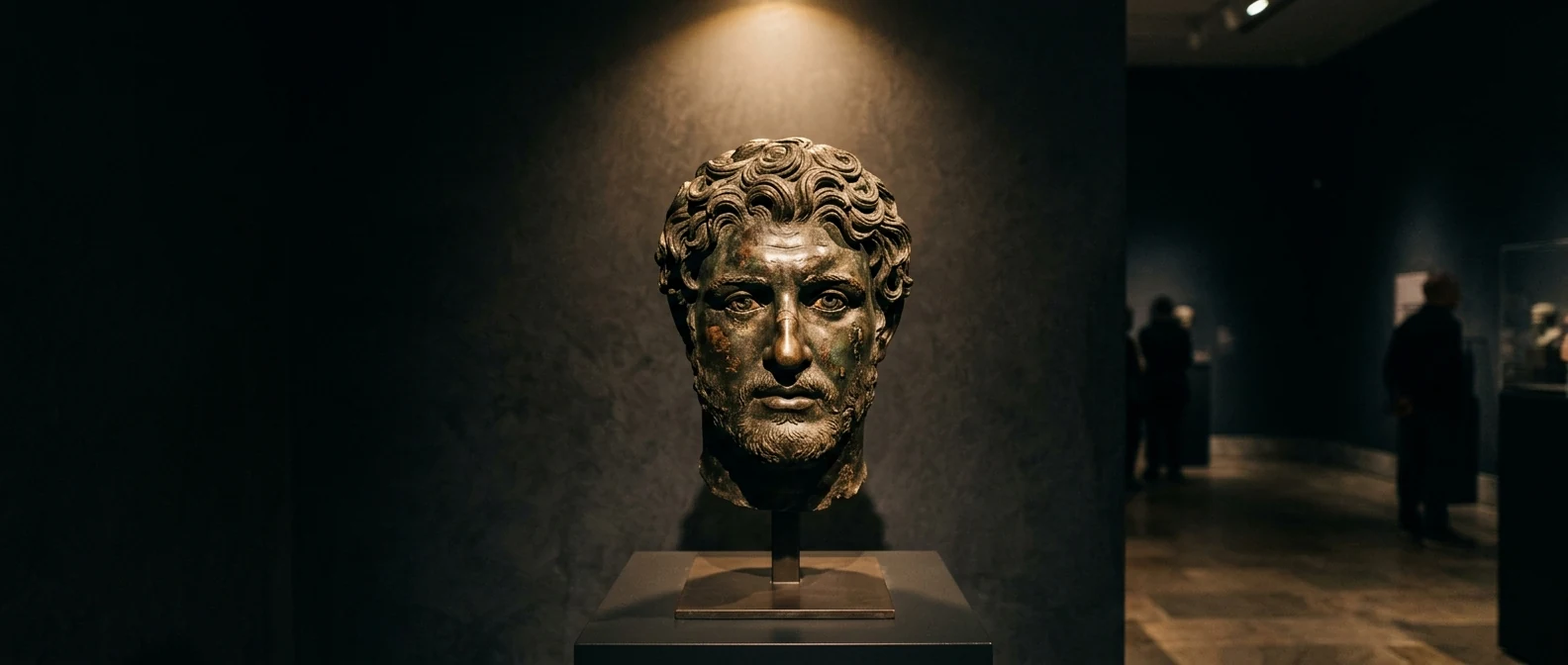
- The museum needs time. The Charioteer of Delphi, the Naxian Sphinx, Antinous, and the architectural members of the temple are not an appendix to the site. They are the second half of the visit.
- Spring and autumn are the gentlest seasons. In summer the site is exposed and the climbs are tiring after midday.
Frequently asked questions
Was the Pythia really hallucinating?
She was probably in an altered state of consciousness. Ritual, fasting, laurel, water, and perhaps gases from the faults all contributed. There is no need to choose simply between fraud and "miracle."
Did the oracle's predictions come true?
Some fit later events. Many were deliberately ambiguous. Memory kept the successes most clearly, while failures were lost or reinterpreted.
Could anyone consult the oracle?
In theory yes. In practice, cities, kings, and foreign envoys had priority. Private individuals asked about marriage, inheritance, travel, illness, and everyday dilemmas.
What is the omphalos?
A stone symbol marking the centre of the earth. The well-known marble omphalos survives in the Delphi Museum, while a copy stands in the archaeological site.
Best time of day to visit?
Early morning or late afternoon. The site faces south, has climbs, and the summer sun is hard in the middle of the day.
Sources:
— Kathy