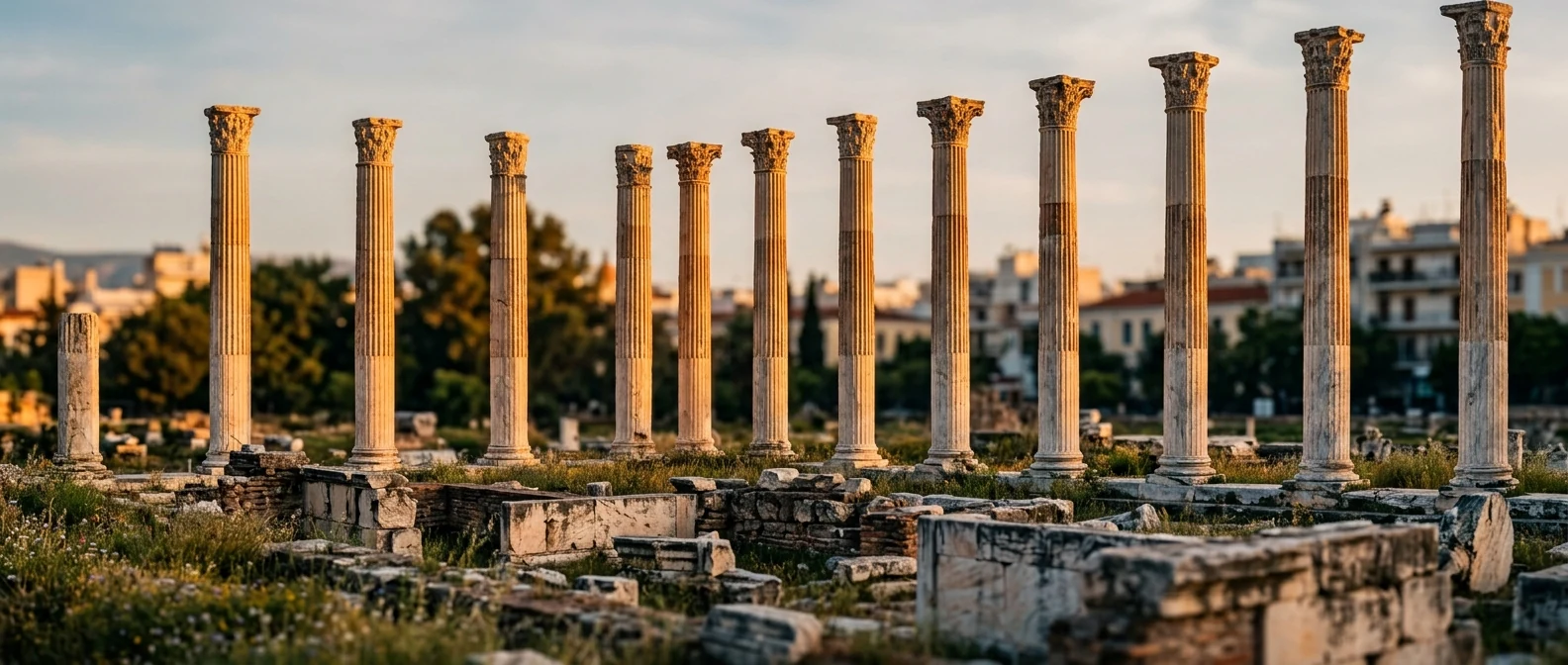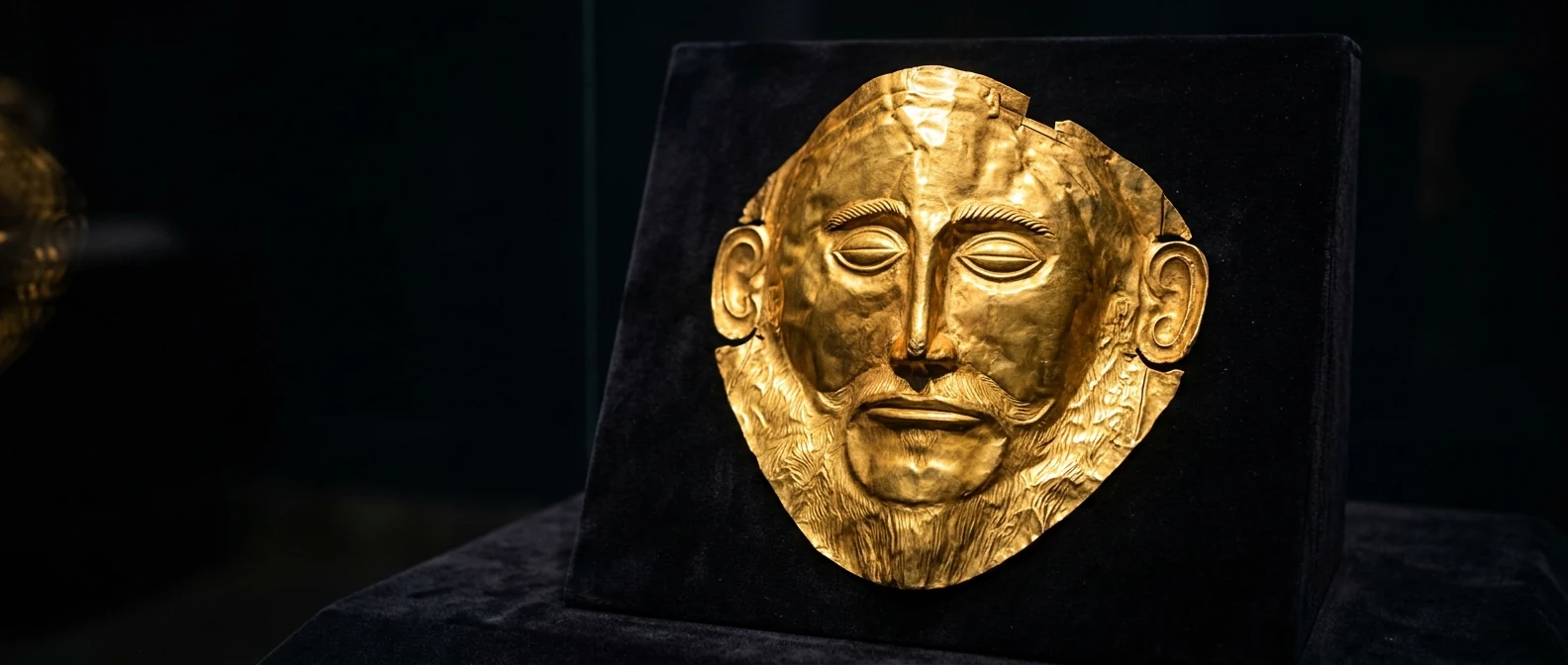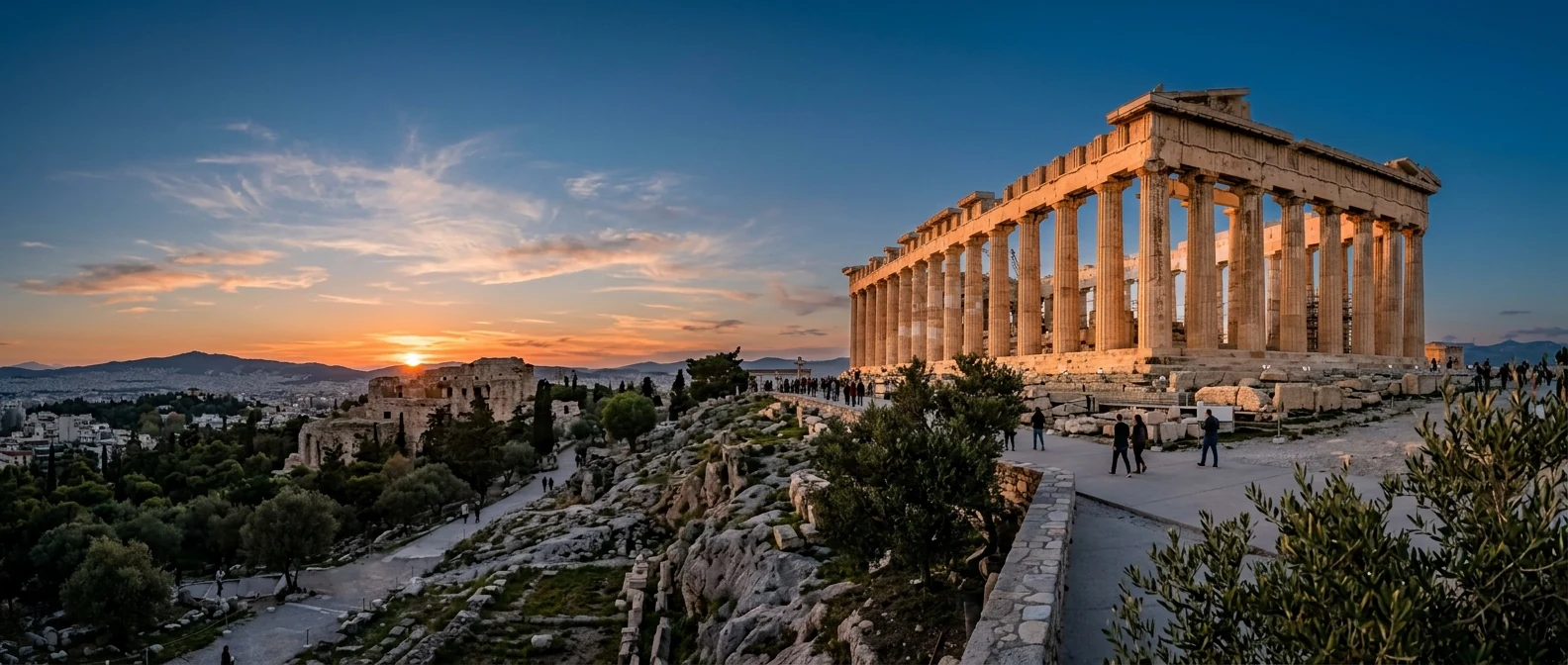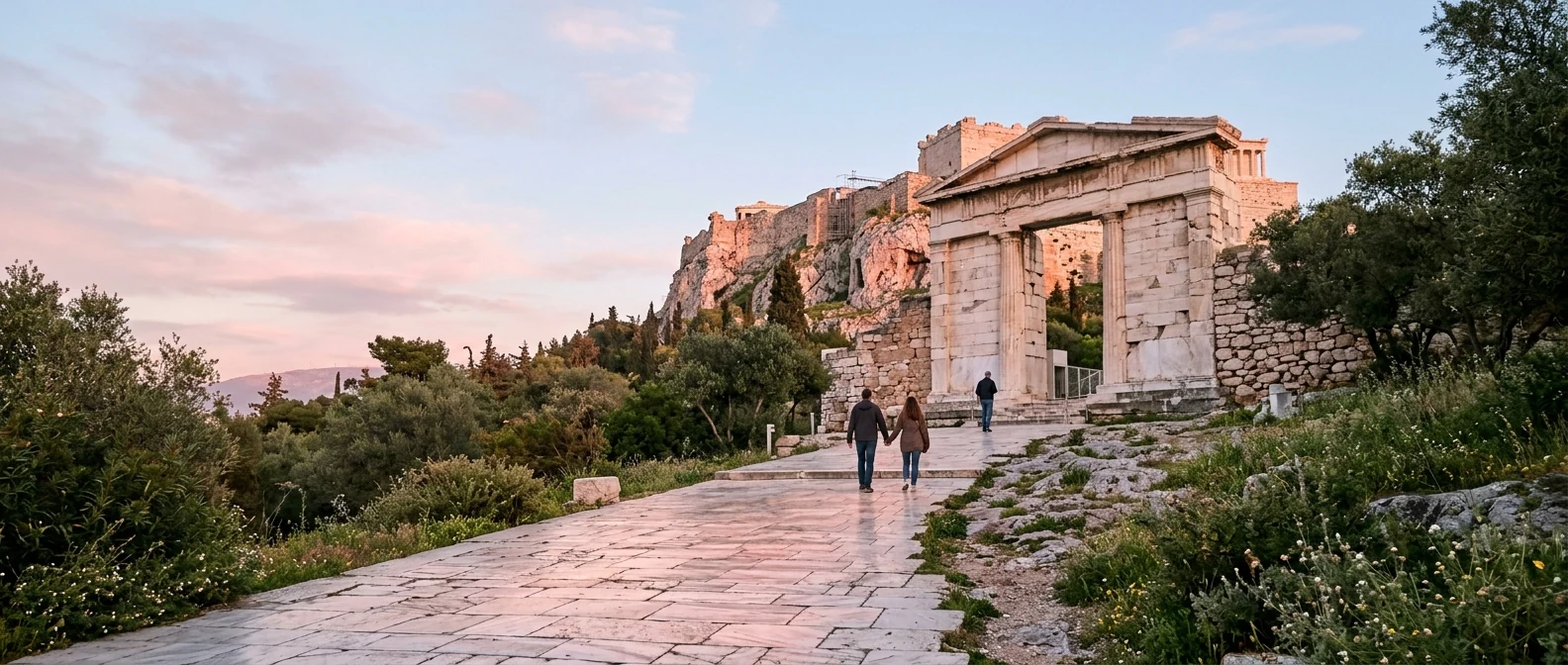
Stand near the Hephaisteion and look down across the site. The Agora was not just a market. This is where institutions of Athenian democracy worked, and where citizens, magistrates, speakers, judges, and philosophers moved through the city. Inside the Stoa of Attalos you will see objects that make that public life easier to picture: ballots, ostraka, measuring vessels, inscriptions, and everyday tools.
The temple itself
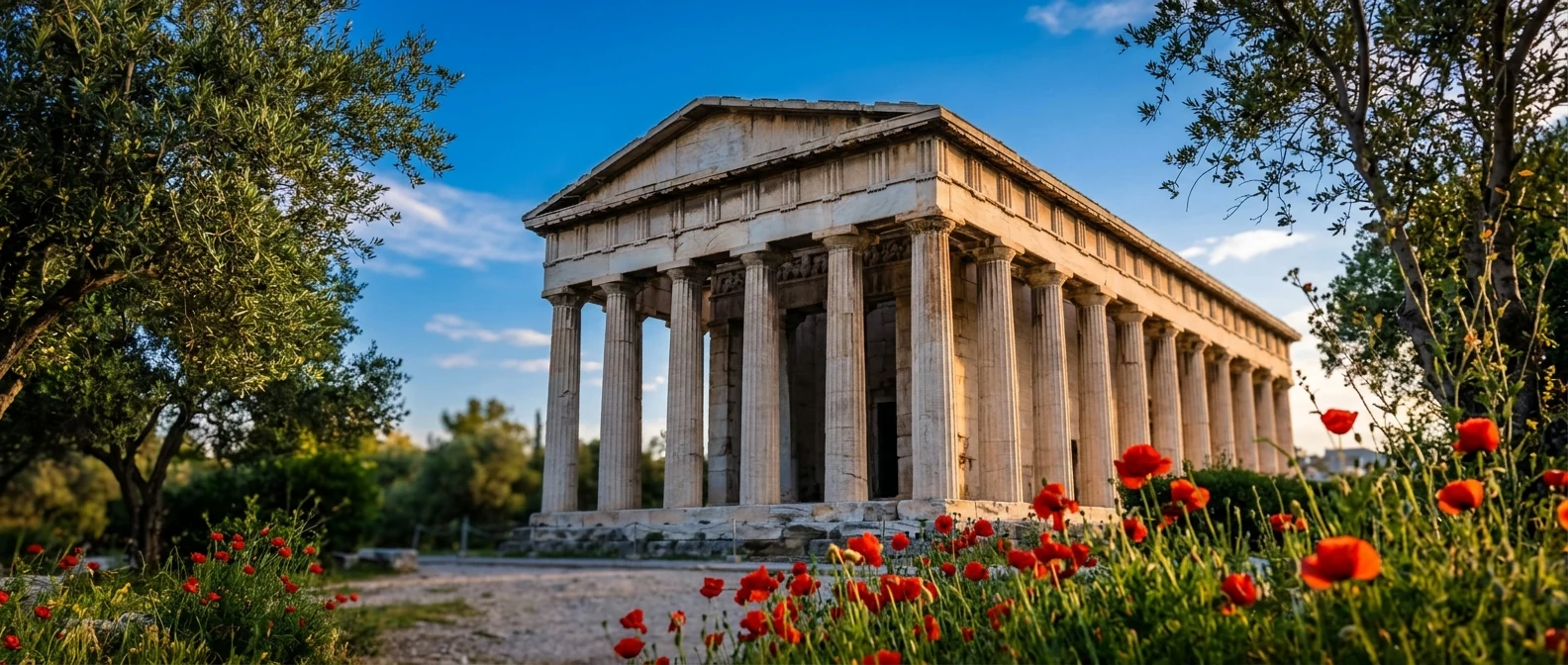
The Temple of Hephaestus, also known as the Hephaisteion and traditionally as the Theseion, began to be built in the middle of the 5th century BC. It is smaller and quieter than the Parthenon, but it survives in remarkable condition: all 34 outer columns still stand, along with much of the entablature and roof. That makes it one of the clearest places to understand how a Doric temple would have stood in its setting.
Its good condition is due in part to its later use as a Christian church, dedicated to Saint George Akamatis. Continued use helped preserve the roof and the structure. In the early years of the modern Greek state it also served as a place for archaeological finds before Athens developed the large museums visitors know today.
Walk up to the area where access is allowed and look carefully at the metopes on the east side, which show labours of Theseus and Heracles. Inside the temple once stood bronze cult statues of Hephaestus and Athena, usually linked to the sculptor Alkamenes. The statues are gone, but the space still helps you imagine their scale.
What to look for in the Agora
The site is large and many of the remains survive low to the ground, at foundation level. Without a plan it can feel like scattered stone. If you follow it in a sensible order, it becomes one of the clearest places in Athens for understanding how the ancient city worked.
- Stoa of Attalos — the long building on the east side. What you see today is a reconstruction from the 1950s on the ancient foundations. It houses the Museum of the Ancient Agora, with ballots, ostraka, measures, inscriptions, and objects that explain the public life of the city.
- Tholos — the circular foundation linked to the daily work of the prytaneis, the group responsible for administration during specific periods of the year.
- Bouleuterion — the area associated with the Council of Five Hundred, the body that prepared matters for the Assembly.
- Heliaia — a part of the site connected with the popular law courts. The exact topography of some judicial spaces is still discussed, so the information panels are worth reading carefully.
- Panathenaic Way — the diagonal road crossing the Agora toward the Acropolis, associated with the Panathenaic procession.
- Church of the Holy Apostles — the Byzantine church on the southeast side, a useful reminder that the Agora continued to change long after antiquity.
Practical details
Entrance: Adrianou 24, just off Monastiraki square. Use this entrance rather than the southern one, since it gives you the most logical route through the site.
Hours: they change by season, so check before you go.
Ticket: there is a standalone ticket and, when available, a combined archaeological sites ticket.
Metro: Monastiraki (Lines 1 and 3), 200m walk.
Time needed: 90 minutes for a full visit. 60 if you skip the museum in the Stoa.
📍 From Angels Athens to Ancient Agora · Temple of Hephaestus
See at a glance how to get from the apartment at Iouliánou 50. Drag the map and zoom in for details.
Where to take the photo everyone takes
The classic view of the Hephaisteion with the Acropolis behind it comes from the path on the east side of the temple, slightly higher up. Late afternoon usually gives softer light, and the lines of the temple are easier to read.
Another good angle is from the upper floor of the Stoa of Attalos, looking west with the temple in the distance. From there, the relationship between the Agora and the Acropolis becomes much clearer.
What it feels like in practice
The Acropolis is a monument. The Agora is a place where life happened. Here Athenians bought, argued, judged, voted, listened to speakers, and moved through the routines of the city. When you stand in the Agora, ancient Athens stops feeling abstract and starts to read as paths, dust, shade, and distance.
Many visitors are also surprised by how green the site feels. Cypress trees, olives, pomegranates, and, in spring, poppies between the stones make the Agora feel less dry than people often expect from an archaeological plan.
Where to eat afterwards
The Adrianou exit brings you straight into an area full of cafes and tavernas. If you do not want to sit at the first table you see, walk a few minutes toward Psyrri or Plaka and compare menus. After the Agora, a light meal is usually enough before another walk.
FAQ
Should I do the Agora before or after the Acropolis?
Both orders work. If you go after the Acropolis, the Agora shows you the everyday side of the city. If you go first, the Temple of Hephaestus gets room to stand on its own before the Parthenon takes over the day.
Is the Stoa of Attalos genuine?
The present Stoa is a reconstruction from the 1950s on the ancient foundations. It is not an ancient building in the strict sense, but it helps visitors understand the scale of a stoa in the ancient city.
Can I touch the temple?
Follow the signs and the instructions of the site staff. Do not touch the columns or climb on marble surfaces. For photography, follow the rules in place on the day of your visit.
Sources:
— Kathy