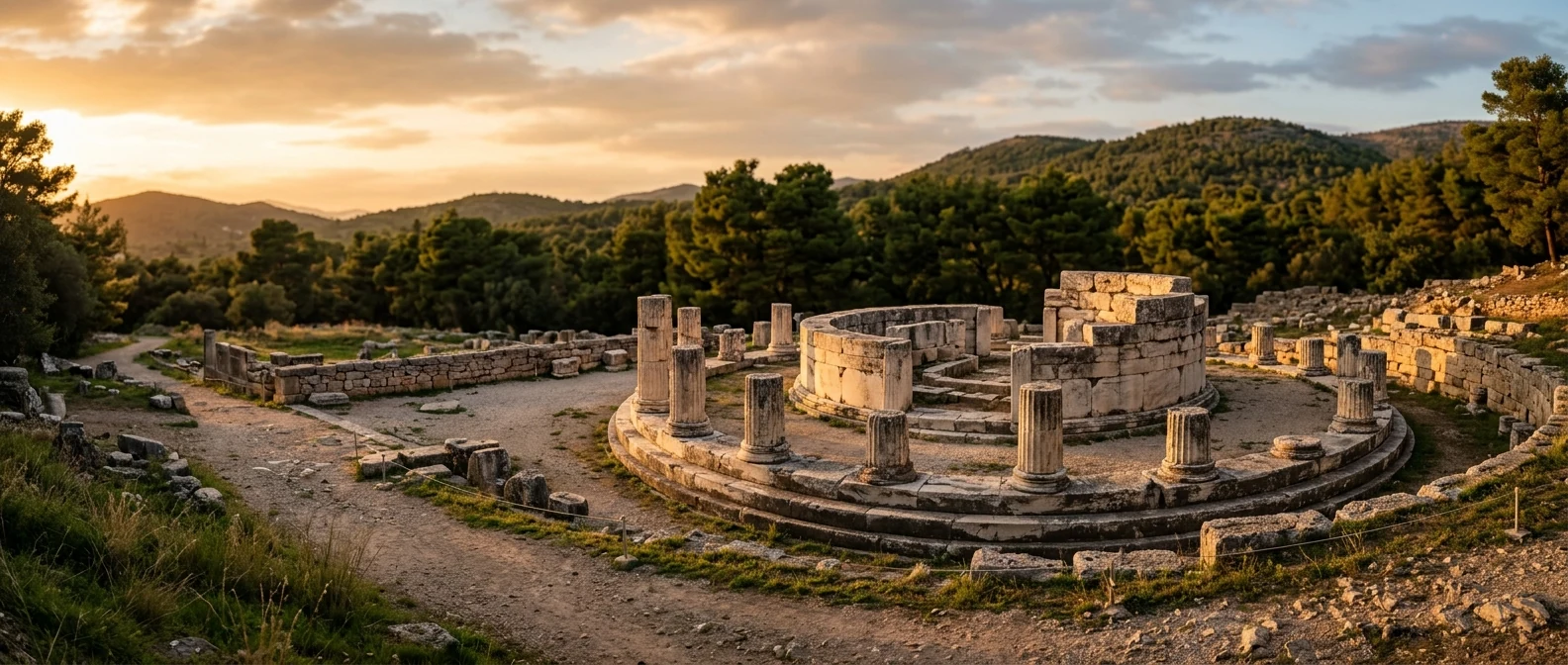
Two systems in parallel
Greeks of the 5th and 4th centuries BCE had options when they fell ill. They could consult a physician trained in the Hippocratic tradition, with observation of symptoms, diagnosis, diet, drugs, and in some cases surgery. But they could also travel to an Asklepieion, a healing sanctuary, for fasting, purification, dream incubation, sacred snakes, and dogs. The two systems coexisted for centuries, and many people used both. The Hippocratic tradition left ways of thinking and clinical observation that shaped western medicine for a very long time.
Hippocrates of Cos
- Lived ~460-370 BCE on Cos island.
- He is associated with a medical school on Cos and with students from across the Greek world.
- The Hippocratic Corpus: around 60 medical texts attributed to him. Today scholars think not all were written by Hippocrates himself, but by different physicians of his school and tradition, probably over several decades.
- Key contributions: he helped separate medicine from religion and magic, emphasised observation and prognosis, and insisted on detailed notes for each case.
- The "Hippocratic Oath": an ethical code on non-harm, confidentiality, and professional conduct. It is still recited in adapted form by medical graduates around the world.
🩺 Hippocratic theory
The four humours
Hippocratic medicine held that the body contained four humours: blood, phlegm, yellow bile, and black bile. Health meant balance (krasis), while disease meant imbalance (dyskrasia). Each humour was linked to an element, a season, and a temperament: blood to spring and the sanguine type, phlegm to winter and the phlegmatic, yellow bile to summer and the choleric, black bile to autumn and the melancholic. Treatment aimed to restore balance through diet, exercise, drugs, bloodletting, and purging. The theory was mistaken, but the framework encouraged serious empirical observation. Humourism dominated western medicine until the 19th century, when germ theory and cellular pathology displaced it.
📜 Hippocratic case histories
- Epidemics (Books I and III of the Corpus): 42 individual case histories with clinical observations day by day. About 25 of the 42 patients died, and the Hippocratic writers recorded failures as well as successes.
- Prognosis mattered greatly: predicting the course of a disease was almost as important as diagnosis.
- "Hippocratic facies": a set of facial signs in a patient close to death, such as a sharp nose, hollow eyes, and cold ears. The observation is still recognizable.
- Public health: the treatise Airs, Waters, Places connects environment and climate with patterns of disease.
Asklepios and the medicine of the sanctuaries
- Asklepios: the god of healing, son of Apollo and the mortal Coronis. He is often shown with a staff around which a snake is coiled.
- Temples (Asklepieia): around 300 in the Greek world, with famous examples at Epidaurus, Cos, Pergamon, and Athens.
- Family and companions: Hygeia, Iaso, Aceso, Aigle, and Panacea. Their names became linked to important medical ideas.
Dream incubation
- The visitor arrives at the sanctuary and makes the first offerings and sacrifices.
- Ritual purification: bathing, fasting, sometimes days of preparation.
- They sleep in the abaton, the sacred dormitory.
- Asklepios appears in a dream, prescribing a treatment or healing directly.
- The priests interpret the dream and give the treatment on the following day.
- Treatments: diet, exercise, baths, herbal medicine, sometimes minor surgery.
- If healing came, the visitor left a votive offering and an inscription of thanks.
🎯 At a glance
~460-370 BCE
Hippocrates of Cos, a key figure in the medical tradition.
~60 works
Hippocratic Corpus. Foundational medical texts.
~300 Asklepieia
Temple-sanatoria across Greek world.
~2,400 years
Continued influence of Hippocratic Oath.
🐍 Serpents + dogs in healing
- Sacred serpents lived in Asklepieia. Non-venomous Aesculapian snakes (still found in Mediterranean). Believed to embody healing power.
- Sacred dogs: these too were kept in the sanctuaries. Pilgrims sometimes believed they were healed when a dog licked a wound. A cautious modern reading is that the ritual may have cleaned the surface of a wound, without implying real medical safety.
- Rod of Asklepios versus caduceus: one snake on a staff belongs to Asklepios and is the proper medical symbol. The caduceus, Hermes' staff with two snakes and wings, is often confused with it but belongs to merchants and travellers.
🏥 The famous Asklepieia
Epidaurus
The largest and most famous Asklepieion. The theatre still hosts performances each summer. UNESCO. See our guide.
Cos
The home island of Hippocrates. The Asklepieion survives in substantial ruins. He is said to have taught under the famous plane tree, though the present tree is later.
Athens (south slope of Acropolis)
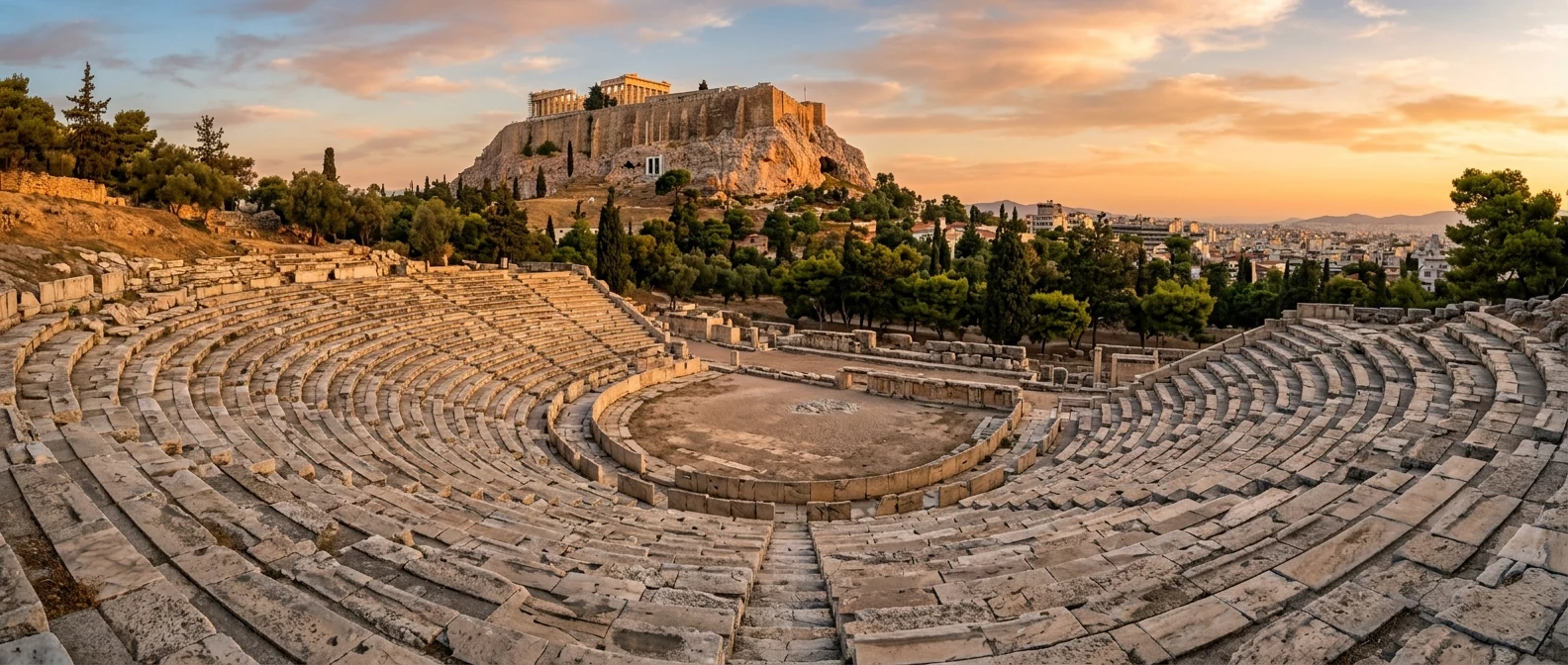
Founded ~419 BCE during Plague. Ruins visible today during Acropolis visit. Sacred spring still flows.
Pergamon (modern Turkey)
Major Hellenistic + Roman healing centre. Galen worked here briefly. Famous library + medical innovations.
📈 Galen + the Roman synthesis
- Galen of Pergamon (129-216 CE): one of the most important physicians of the Roman period; he combined Hippocratic theory with anatomical research.
- Court physician to emperors: Marcus Aurelius, Commodus, Septimius Severus.
- He wrote around 500 works, of which about 125 survive. It is one of the largest surviving bodies of work by an ancient writer.
- Anatomical work: he dissected animals, since Roman law forbade human dissection. Many conclusions were then applied incorrectly to humans, and some of those errors lasted around 1,500 years.
- Galenic and Hippocratic medicine together dominated western and Islamic medicine until the 16th century. Andreas Vesalius, in De humani corporis fabrica (1543), finally challenged Galenic anatomy.
🏥 Did Asklepieia work?
- Inscription evidence: thousands of votive tablets at Epidaurus thank Asklepios for cures of paralysis, blindness, infertility, etc.
- Modern interpretation: the combination of placebo effect, rest, good diet, hydrotherapy, and supportive guidance could help in many psychosomatic or chronic conditions.
- Some genuinely effective measures: dietary advice, hot and cold baths, exercise, mountain air, and sleep regulation could all help in certain cases.
- Limits: serious injuries, acute infections, and cancers found no real help there.
📋 Common Hippocratic treatments
- Diet (regimen): foundational. Fish, mild wines, vegetables, restrictions during illness.
- Exercise: walking, gymnasium training.
- Bloodletting: meant to remove excess blood, one of the humours. It survived into the 19th century and was generally harmful.
- Purgatives: emetics and laxatives used to expel the "bad humours."
- Surgery: limited, including setting fractures, draining abscesses, and trepanation. Mortality was high.
- Pharmacology: around 250 plant, animal, and mineral remedies. Some were genuinely effective, such as willow bark, a precursor of aspirin.
🚶 Where to encounter ancient Greek medicine today
- Athens, south slope of Acropolis: ruins of the Asklepieion. Visible during Acropolis visit.
- Epidaurus: about two hours from Athens. Sanctuary and theatre. UNESCO, and one of the best-preserved Asklepieia.
- Cos: reachable by ferry from Piraeus or by plane. The home of Hippocrates and its Asklepieion.
- National Archaeological Museum, Athens: Greek medical instruments and statues of Asklepios.
🎯 FAQ
Did Hippocrates write the Hippocratic Oath?
Probably not. Most scholars think it was written by his school, perhaps later. Today it is usually given in a modified form to medical graduates.
Was Greek medicine more advanced than other ancient systems?
It was especially systematic and observational. Egyptian medicine had pharmacology and surgery, and Babylonian medicine had documented lists of diseases. The Greeks combined empirical observation with a theoretical framework and an ethical code.
What is Hygeia?
Asklepios's daughter, goddess of health. Origin of word "hygiene." Often shown with serpent.
Did Asklepieia really cure people?
Some practices had a real basis: rest, diet, hydrotherapy, and a stable environment. Many outcomes were probably psychological or belonged to mild and chronic conditions. The inscriptions, of course, mostly advertised successes.
What's the rod of Asklepios vs caduceus?
The Rod of Asklepios has one snake around a staff and is the genuine medical symbol. The caduceus has two snakes and wings and belongs to Hermes, commerce, messengers, and travel. The two are often confused, but they are not the same.
How long did Hippocratic medicine last?
Around 2,000 years, until the germ theory and cellular pathology of the 19th century. Some Hippocratic values still remain embedded in modern medicine.
Sources:
— Kathy