First the festival, then the building
Greek theatre was born within religious festivals in honour of Dionysus. Tragedies were not staged every evening, and there was no permanent theatre season. They were performed at specific civic and religious festivals: the City Dionysia in March-April and the Lenaea in January-February. Plays competed for public prizes, poets were selected through public procedure, and attendance carried something of a civic duty. Even poorer citizens could receive the theorikon, a state subsidy that allowed them to attend.
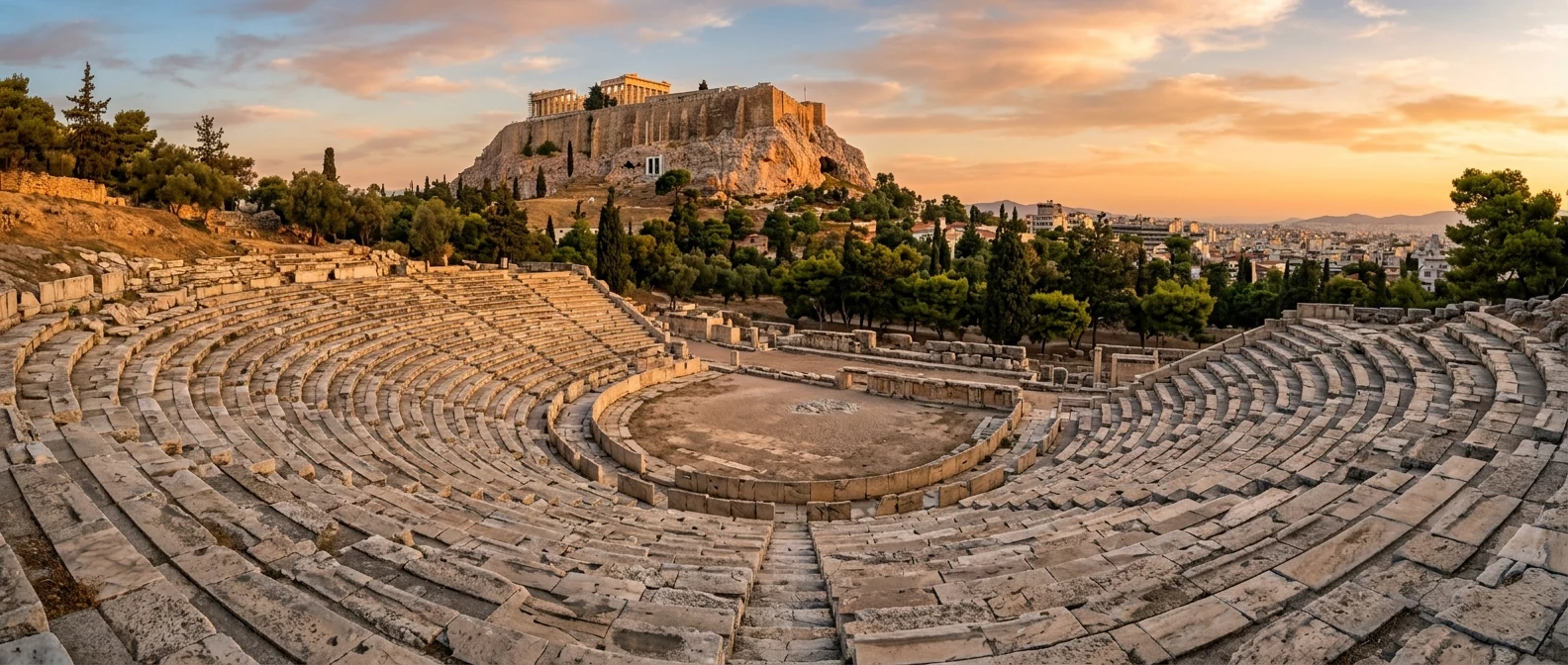
The Theatre of Dionysus on the south slope of the Acropolis held around 17,000 spectators. Performances began in the morning and could continue into the afternoon, with several plays on the same day and over successive days. Athens watched as a community. The plays opened political, religious, and moral questions in front of everyone.
The structure of tragedy
Prologue
The opening scene that sets the frame, usually with one or two characters.
Párodos
The entrance of the chorus, usually 12 to 15 members, entering the orchestra while singing.
Episodes and stasima
An alternation between dialogue scenes and choral songs, usually in three to five cycles.
Exodos
The final scene and the departure of the chorus, leading either to resolution or ruin.
Actors and chorus
- Up to three actors: this was the norm by the time of Sophocles. Each actor could take several roles by changing mask.
- All male: women's roles were performed by men.
- Masks: large, painted, and readable from a distance. They helped one actor change roles and made each character clear even from the upper seats.
- A chorus of 15: in tragedy, or 12 in early Aeschylus. The chorus sang and danced complex choreography and trained for months with the poet and the sponsor.
- Costumes: long chitons and himatia, more emphatic than everyday dress. The stage needed figures that could be seen from far away.
- Acting style: stylised, vocally strong, and built on clear gestures. Spectators in the highest seats had to see and hear.
The three great tragedians
Aeschylus, Sophocles, Euripides
- Aeschylus (~525-456 BCE): the earliest of the three. He added the second actor and wrote around 90 plays, of which 7 survive, including the Oresteia trilogy, the only complete tragic trilogy still preserved. His themes include justice, divine punishment, and civic order. He fought at Marathon in 490 BCE.
- Sophocles (~497-406 BCE): the middle figure. He added the third actor and developed scenic painting. He wrote around 120 plays, of which 7 survive, including Antigone, Oedipus Rex, Oedipus at Colonus, and Electra. His work turns on fate and individual conscience before the state.
- Euripides (~480-406 BCE): the youngest and most restless. He wrote around 92 plays, of which 19 survive, more than from any other tragedian. Medea, Bacchae, Trojan Women, and Hippolytus show a gaze often turned toward women, enslaved people, and foreigners, with a psychological intensity that still feels alive.
Comedy: the other half of the story
- Aristophanes (~446-386 BCE): the main representative of Old Comedy. Eleven plays survive, including Lysistrata, Clouds, Frogs, Birds, Wasps, and Acharnians.
- Old Comedy: political, satirical, obscene, and surreal. It named living politicians and philosophers, including Cleon and Socrates, and mocked them openly. Athens accepted this as part of the festival licence.
- Middle Comedy (~400-320 BCE): less directly political and transitional in character.
- New Comedy: Menander (~342-291 BCE). More domestic, situational, and romantic, with lost relatives, mistaken identities, and parental resistance. It shaped Roman comedy and, through that, much of later comedy.
At a glance
~17,000 seats
The approximate capacity of the Theatre of Dionysus. A large part of adult Athens could watch together.
March-April
The season of the City Dionysia, the main tragic festival, with several days of performances.
3 actors max
Several roles were covered through mask changes. The limit shaped the writing itself.
Choregia
Wealthy citizens financed the chorus and costumes as a civic duty, under public scrutiny and competition.
The theatre itself
- Theatron: the space for the spectators, semicircular and cut into the slope. Stone seating belongs mostly to the 4th century BCE; earlier seating was wooden.
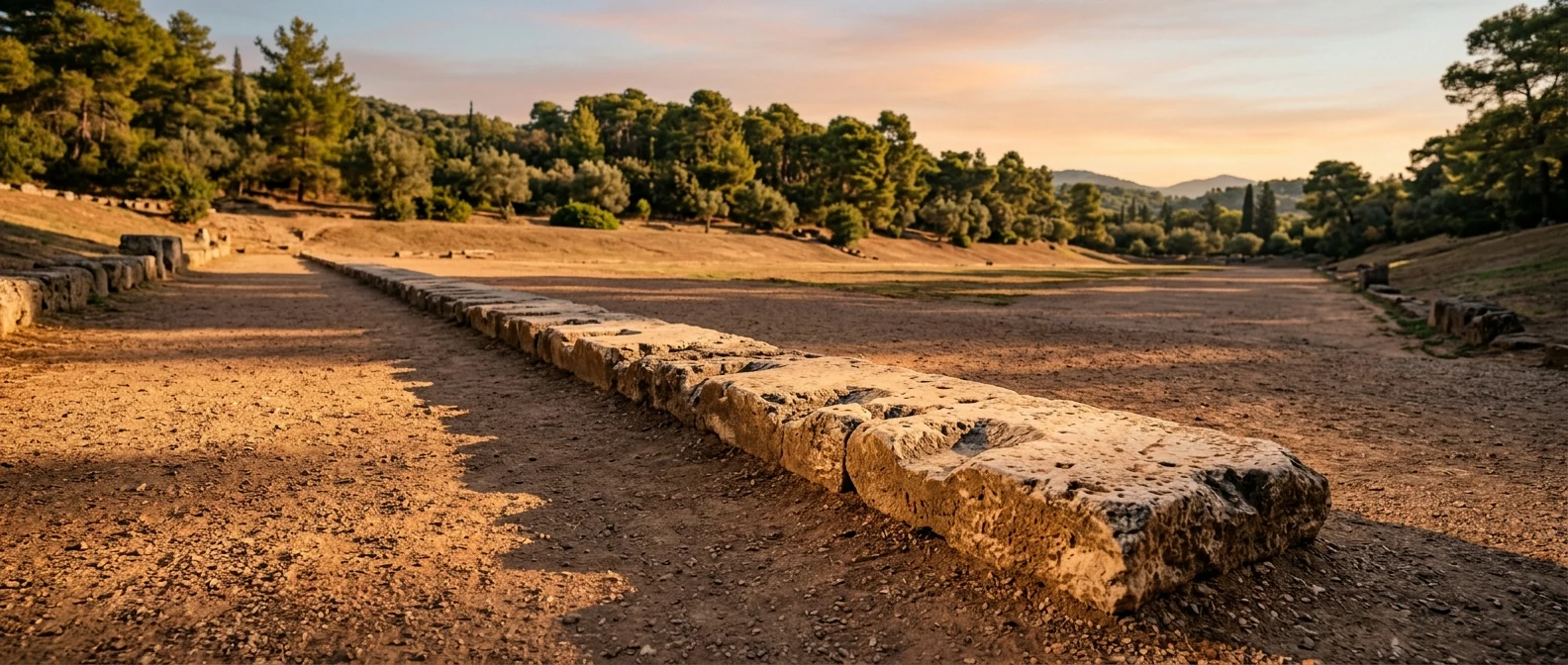
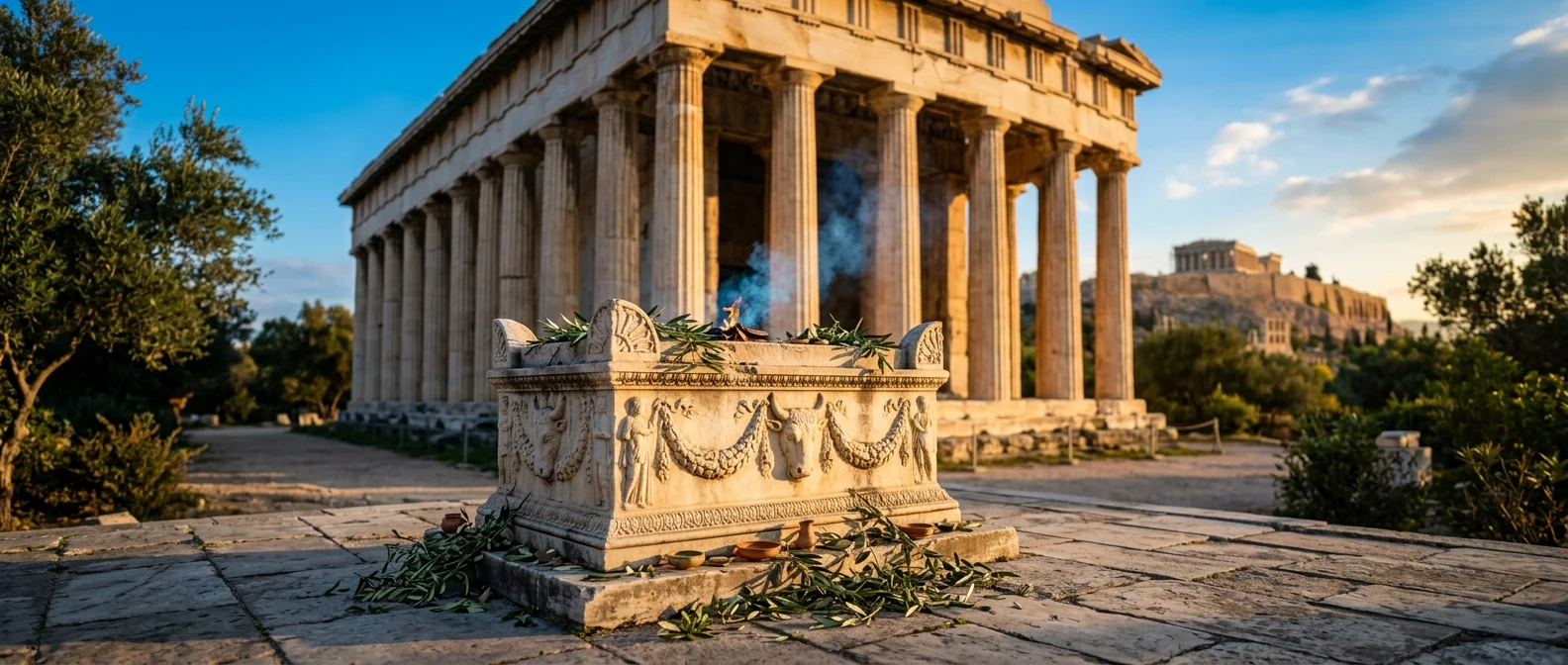
- Orchestra: the round area for the chorus, with the altar of Dionysus at the centre.
- Skene: the structure behind the orchestra, with painted background and doors for entrances, exits, and settings such as palaces or caves. The word "scene" comes from it.
- Mechane: a crane used to lower actors as gods, hence the phrase deus ex machina.
- Ekkyklema: a wheeled platform used to reveal interior scenes, often after a killing, since Greek convention avoided violence on stage.
- Acoustics: carefully designed and impressive for an open-air space. The later theatre at Epidaurus shows how far this technique developed.
How it was funded
Choregia and liturgy
Each tragic poet was assigned a choregos, a wealthy citizen who paid for the training of the chorus, the costumes, and the scenic needs. This was part of a liturgy, a form of public service. Wealthy Athenians were expected to finance choruses, warships, and festivals as a civic duty. The expense also brought prestige, and victorious sponsors set up monuments. The Choragic Monument of Lysicrates, from 334 BCE, still stands on Tripodon Street in Plaka because a sponsor won that year.
The competition
- Three tragic poets were selected to compete each year.
- Each presented three tragedies and one satyr play, a lighter mythological parody.
- Judging: ten judges, one from each Athenian tribe, were chosen by lot from a larger pool. Their decisions were not always beyond dispute.
- Prize: an ivy crown and civic honour. Repeated winners, such as Sophocles, became cultural heroes.
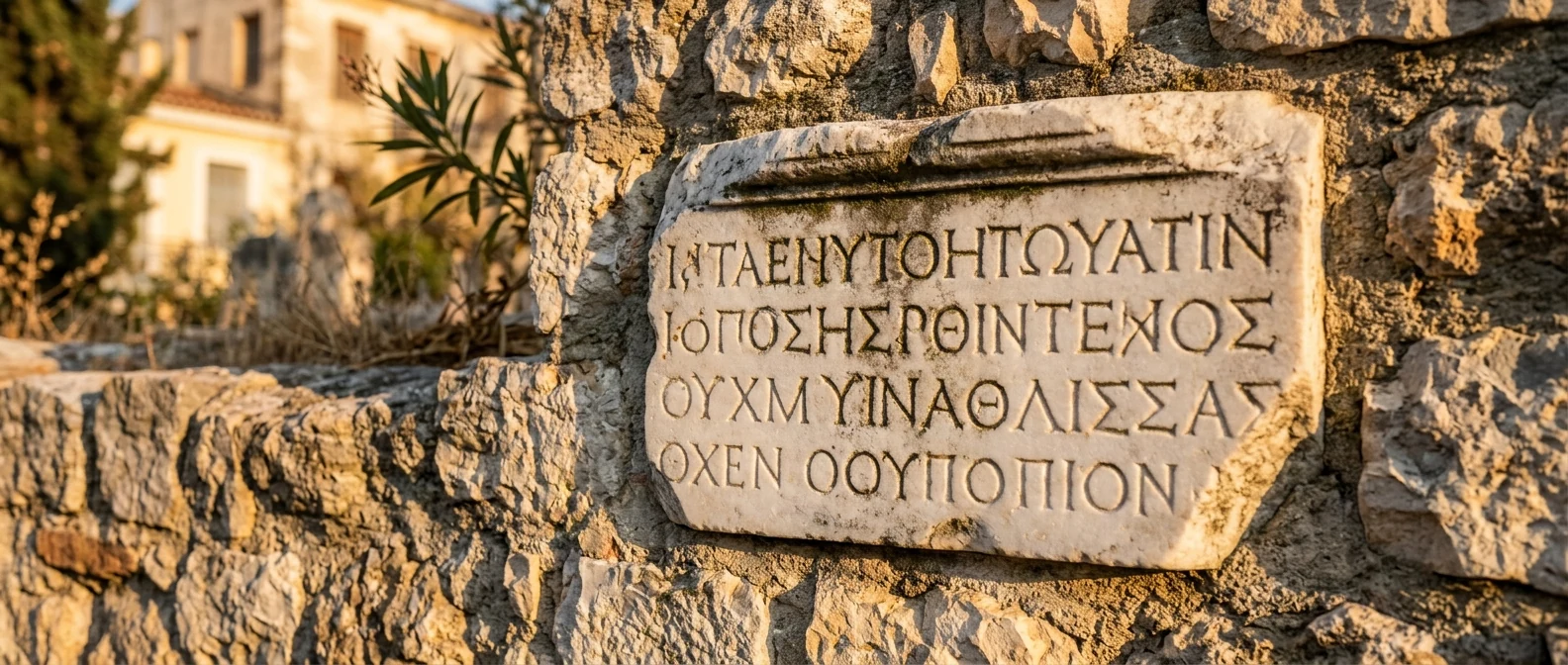
- Records: the Didaskaliai, official lists of results, some of which survive in inscriptions.
What survives and what was lost
- Tragedies: 32 plays survive, 7 by Aeschylus, 7 by Sophocles, and around 18 by Euripides, plus fragments, out of what may have been more than 1,000.
- Comedies: 11 complete plays by Aristophanes and 1 by Menander, Dyskolos, survive along with substantial fragments.
- Lost works: Sophocles' Achilles, almost all of Aeschylus' output, and much more. Many details survive only through references in the texts that remain.
- Why these works survive: late antique and Byzantine teachers chose certain plays as school texts. What reached us depends on selection, copying, and a fair amount of luck.
Music and dance
- Tragedy was sung and recited, not simply spoken. The choral sections were highly musical, while the episodes mixed sung and spoken parts.
- Aulos (double pipe): the main instrument accompanying the chorus, with a reed-like and urgent sound.
- Dance: the movements of the chorus were complex and meaningful, a gestural language now largely lost.
- Music: it was organised in modes such as Dorian and Phrygian, each carrying emotional and ethical associations.
The legacy
- Aristotle's Poetics codified the theory of tragedy: catharsis, hamartia, recognition, and reversal. It shaped Western dramatic theory ever since.
- Roman theatre (Plautus, Terence, Seneca) reworked Greek drama.
- Renaissance and after: rediscovery and imitation followed. Shakespeare knew Seneca, and later periods returned directly to the Greeks.
- Modern stage: ancient tragedies are still performed worldwide. The annual Athens and Epidaurus Festival stages them in their historic settings.
Where you can still encounter Greek theatre today
Theatre of Dionysus
On the south slope of the Acropolis. Plays first performed here are still read today. It is included in the Acropolis combined ticket.
Odeon of Herodes Atticus
Nearby and Roman in date. It hosts summer performances of the Athens Festival, including ancient drama.
Theatre of Epidaurus
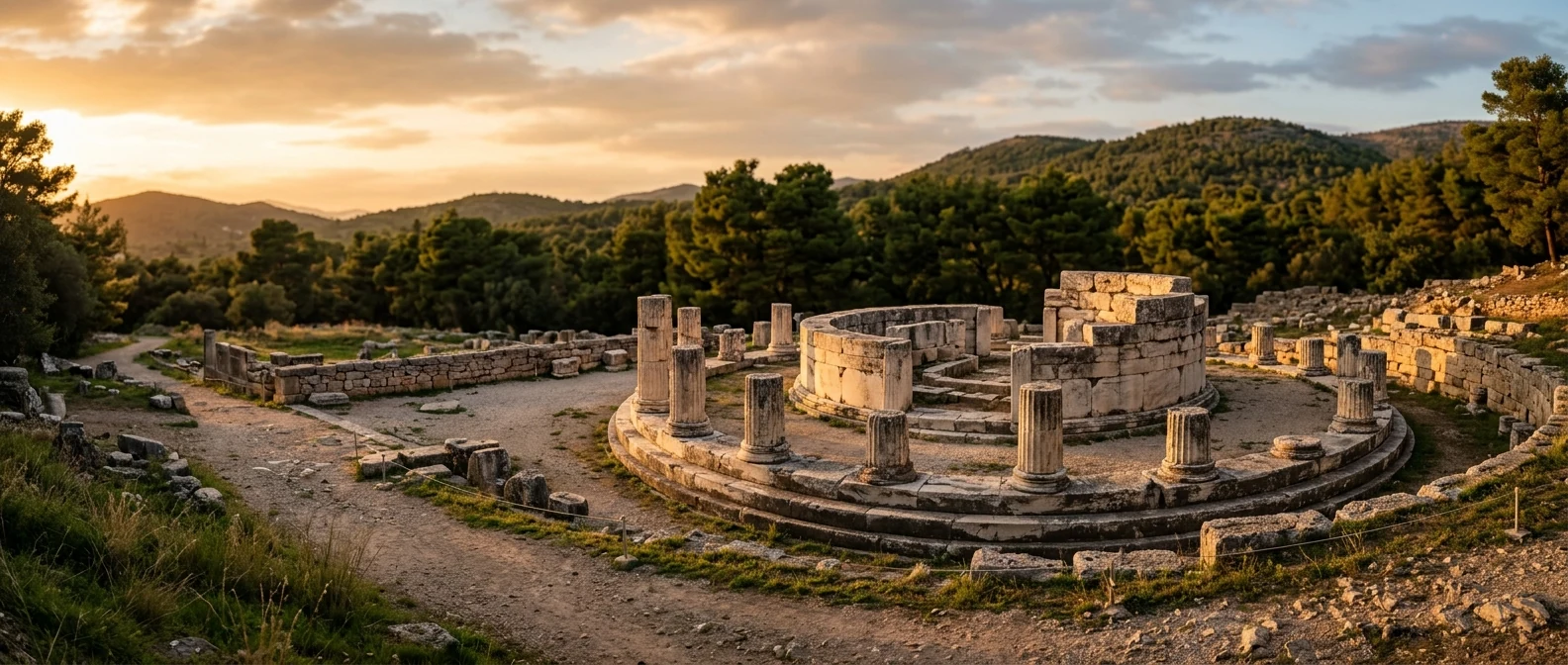
A 4th-century BCE theatre and one of the best preserved, famous for its acoustics. It is about two hours from Athens by car and still hosts festival performances.
Choragic Monument of Lysicrates
In Plaka. The only surviving choregic monument from 334 BCE, and free to see.
FAQ
Were women allowed to attend?
The question is debated, but probably yes by the 4th century BCE. For the early 5th century the evidence is less clear. Enslaved people and metics could attend.
Were the actors paid?
Yes. Leading actors became professionals and sometimes public figures. Smaller roles were paid much more modestly.
Why masks?
They allowed quick role changes, helped project the performance, and made characters legible from a distance. They expressed recognizable types more than inward psychology.
Is "drama" a Greek word?
Yes. Drama means "action" or "deed." "Tragedy" is linked to "goat-song," though the etymology is debated, and "comedy" to the song of a revel.
What should I read first?
Sophocles' Oedipus Rex for tragedy and Aristophanes' Lysistrata for comedy. Both are still very approachable.
Can I watch ancient drama in Athens today?
Yes. The Athens and Epidaurus Festival stages performances every summer at Herodes Atticus and Epidaurus. Tickets are available through aefestival.gr.
Sources:
— Kathy