At a glance
🚇 Thiseio
Line 1 from Victoria, three stops, no change.
🌅 Sunset
The best time. Head up Philopappos Hill half an hour early.
🎟️ Free
The pedestrian street and the hills need no ticket.
👟 Uphill
The hills are dirt and stone. Wear shoes with good grip.
Thiseio in a nutshell
Thiseio spreads west of the Acropolis, between the Ancient Agora and the hills of the Nymphs, the Pnyx and Philopappos. It takes its name from the Temple of Hephaestus in the Agora, which for centuries Athenians believed was dedicated to Theseus. Built in the 5th century BC, the temple is one of the best-preserved temples of ancient Greece, and you can see it from the pedestrian street.
The heart of the neighbourhood is Apostolou Pavlou. Together with Dionysiou Areopagitou, it forms a long car-free promenade around the Acropolis. On one side you have cafés and neoclassical houses, on the other the Agora, the Temple of Hephaestus and, above it all, the Rock.
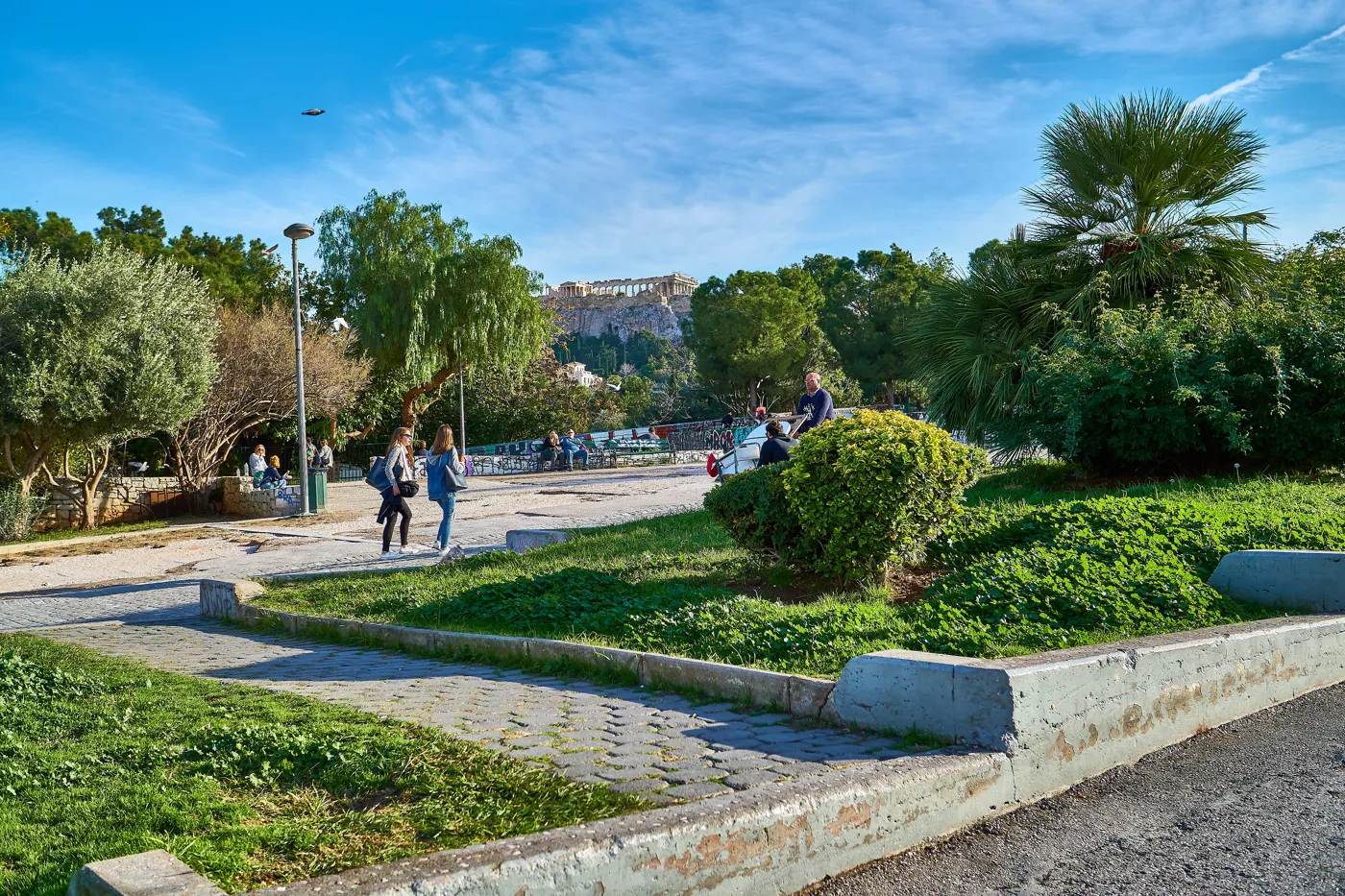
The pedestrian street with the Acropolis in the distance.
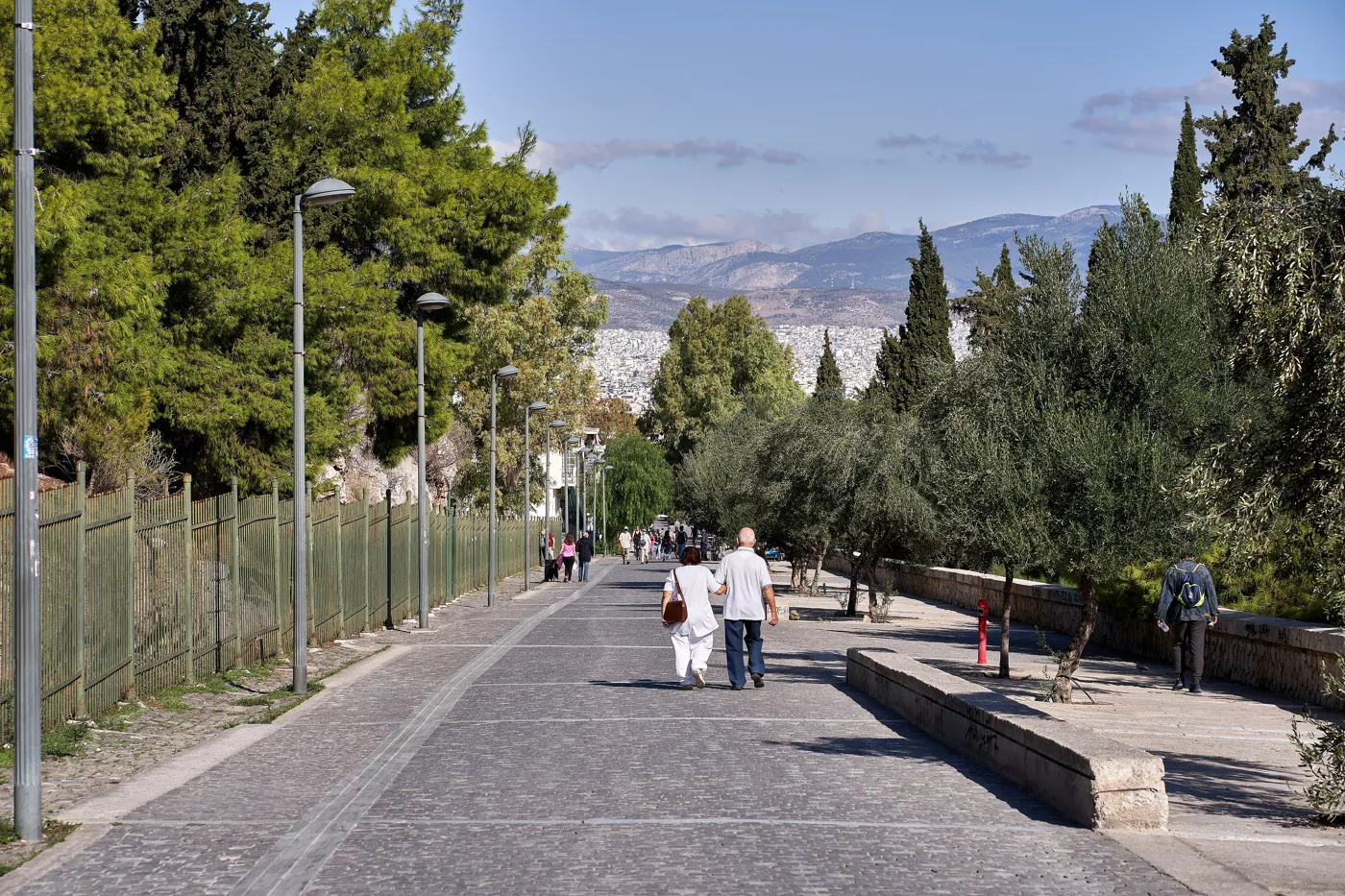
Car-free, from Thiseio to the Acropolis.
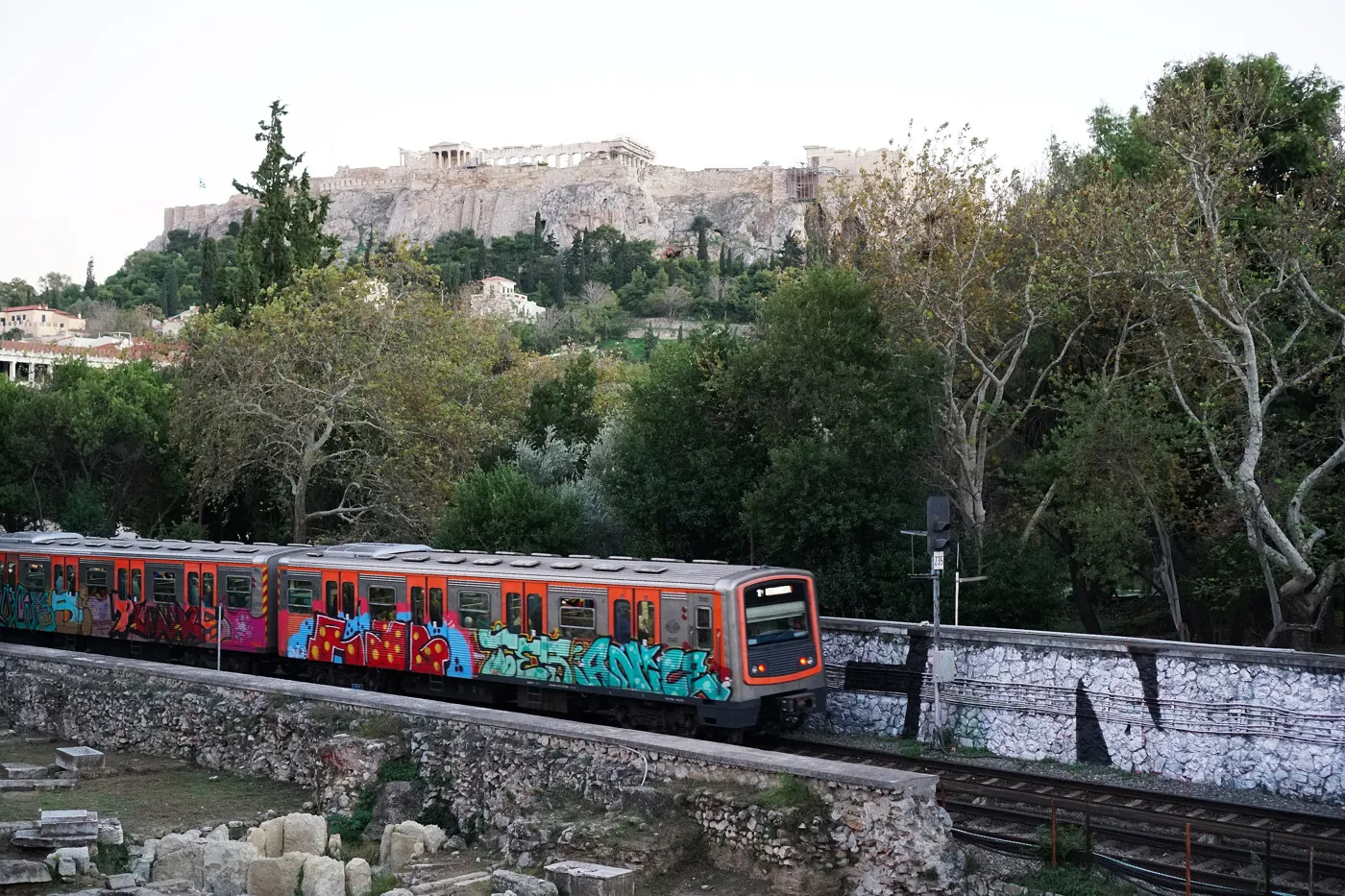
Line 1 runs in the open air, beside the Agora.
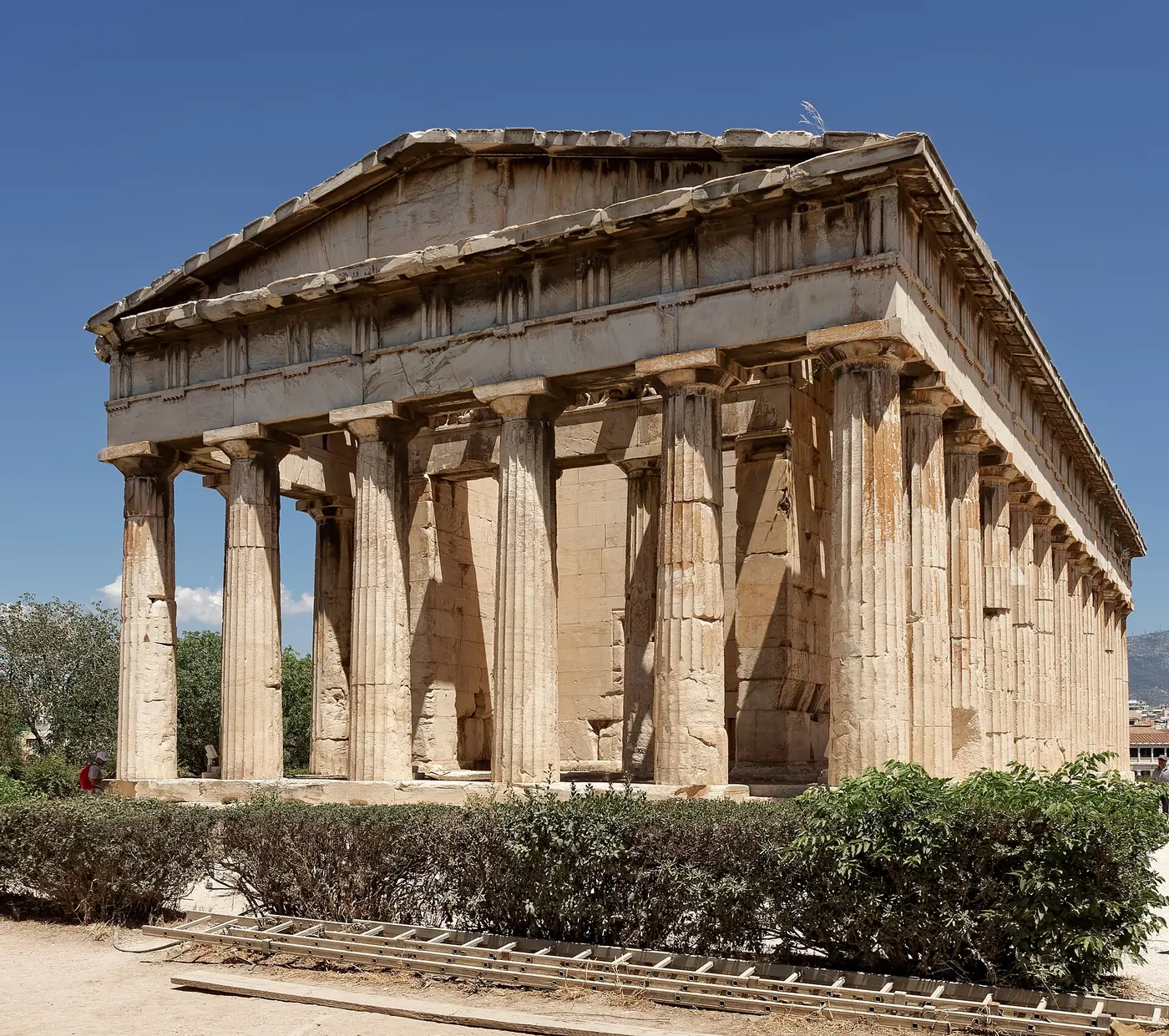
The neighbourhood is named after it.
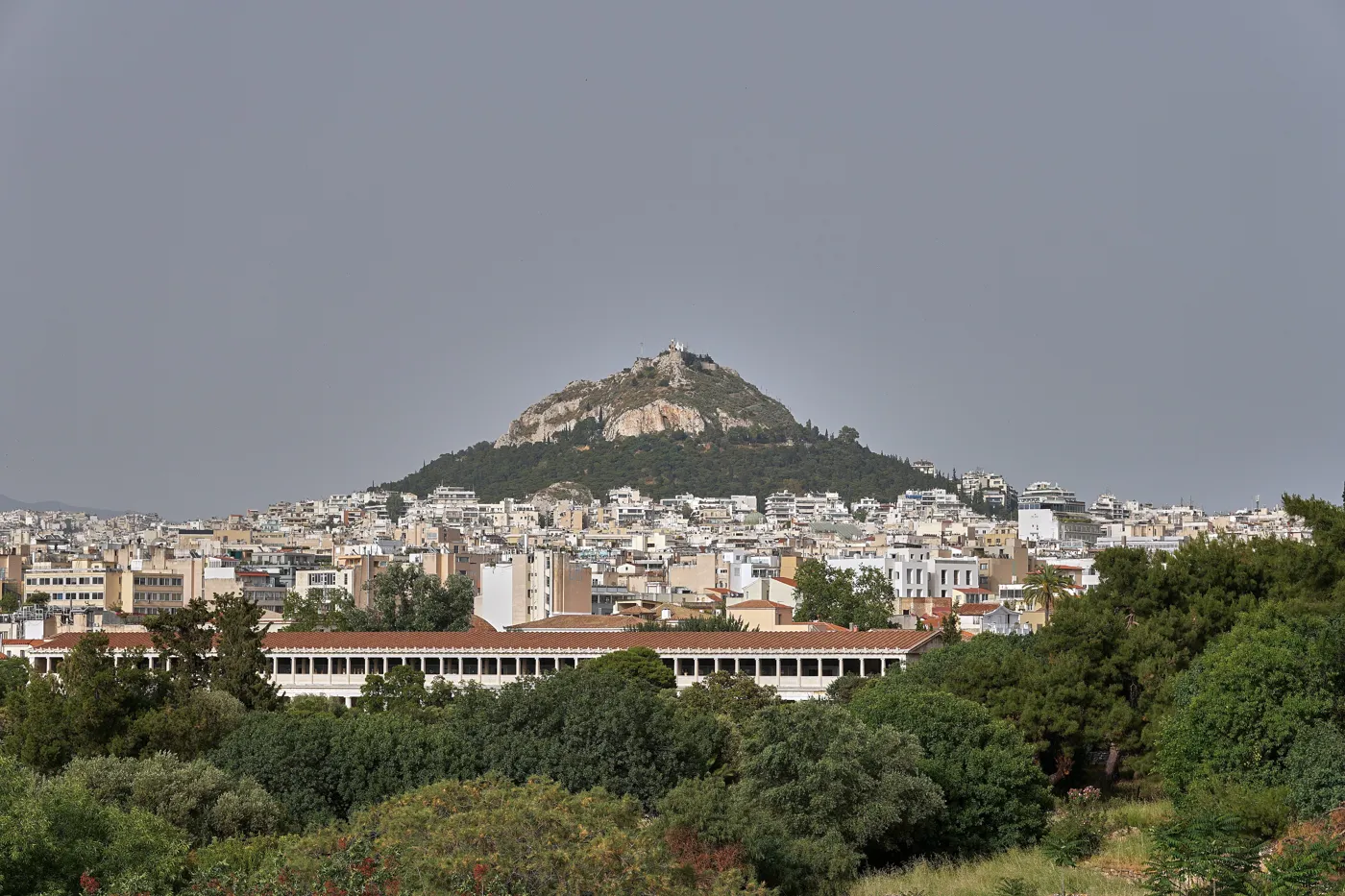
Over the Stoa of Attalos, all the way to Lycabettus.
Photos: George E. Koronaios (CC BY-SA 4.0) · Wikimedia Commons
🗺️ The walk: from Thiseio to Philopappos
This route starts on the pedestrian street, climbs the three hills west of the Acropolis and comes down at Akropoli station. If you want the sunset, set off two and a half hours before.
- Thiseio station. Come out on the square, next to the pedestrian street.
- Apostolou Pavlou. Walk south, with the Agora and the Temple of Hephaestus on your left. For the temple, see our guide to the Ancient Agora.
- Agia Marina. Climb right onto the Hill of the Nymphs. The church looks out over the whole city.
- Observatory. The old building with the dome, at the top of the hill.
- Pnyx. The plateau where the ancient Athenians voted.
- Agios Dimitrios Loumbardiaris. The church and the Pikionis paths, with a little café next door.
- Philopappos Monument. The summit, with the finest view of the Acropolis.
- Akropoli station. Come down to Dionysiou Areopagitou and walk east.
🗺️ The Thiseio and hills walk, stop by stop
From Thiseio station, up over the hills and down to Akropoli station: about 3.5 kilometres, an hour and a half on foot, two and a half to three hours with stops. There are slopes and dirt paths. Tap each number to see what it is.
The hills: Nymphs, Pnyx, Philopappos
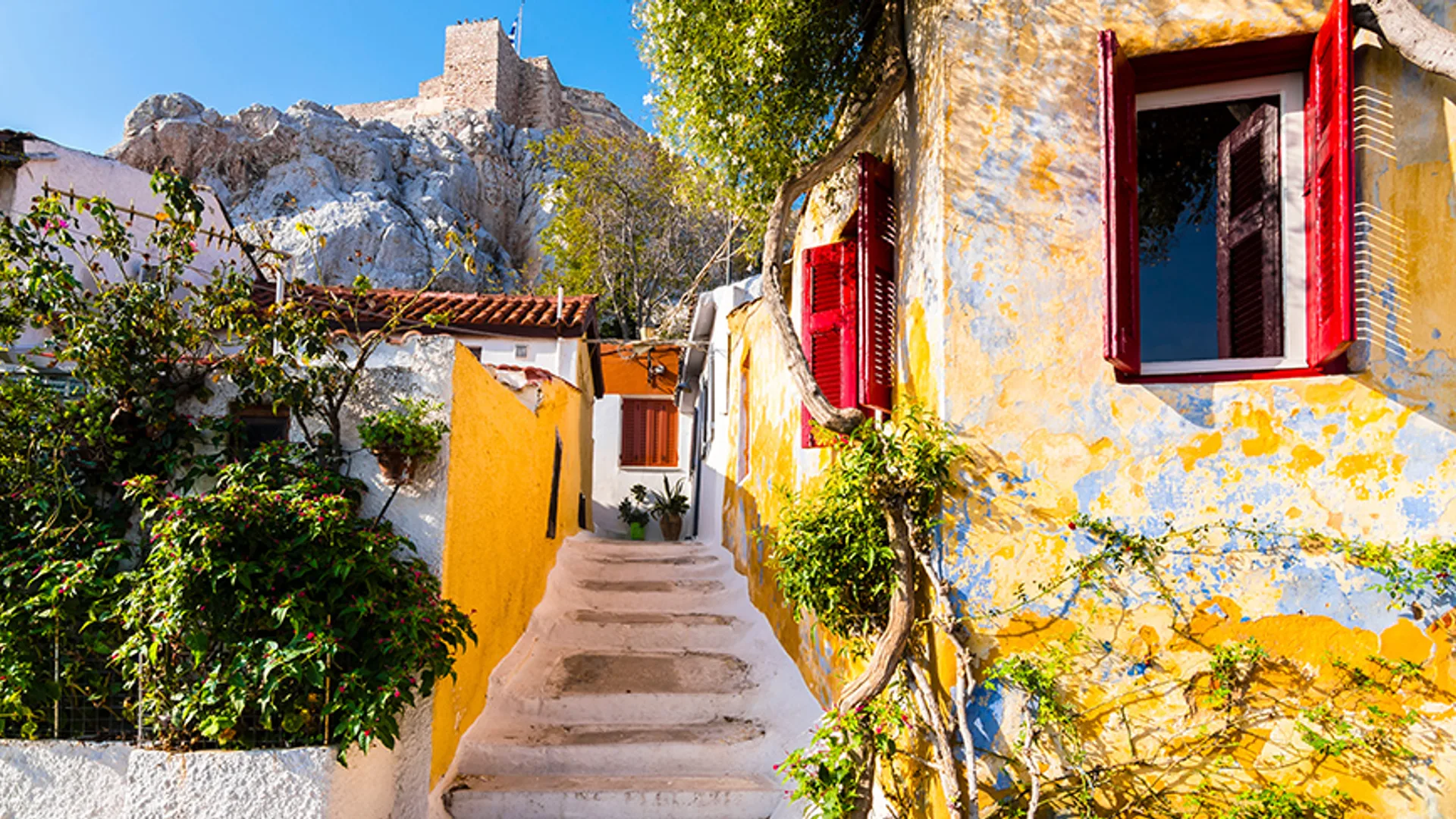
West of the Acropolis rise three hills with pines, olive trees and paths. They’re among the quietest spots in the centre, and most of the paths are free to walk.
On the Hill of the Nymphs stands Agia Marina. The big church with the red domes was built in the 1920s, but next to it survives a much older little chapel cut into the rock. On 17 July, its feast day, there’s a big festival. A little higher is the National Observatory, founded in 1842 as the first research centre in Greece. Theophil Hansen designed the main building, which today houses a museum with the old instruments.
The Pnyx is a stone plateau with a view of the Acropolis. Here, in the 5th century BC, the assembly of the citizens of Athens met to vote. You can stand where the speakers spoke, on a step cut into the rock.
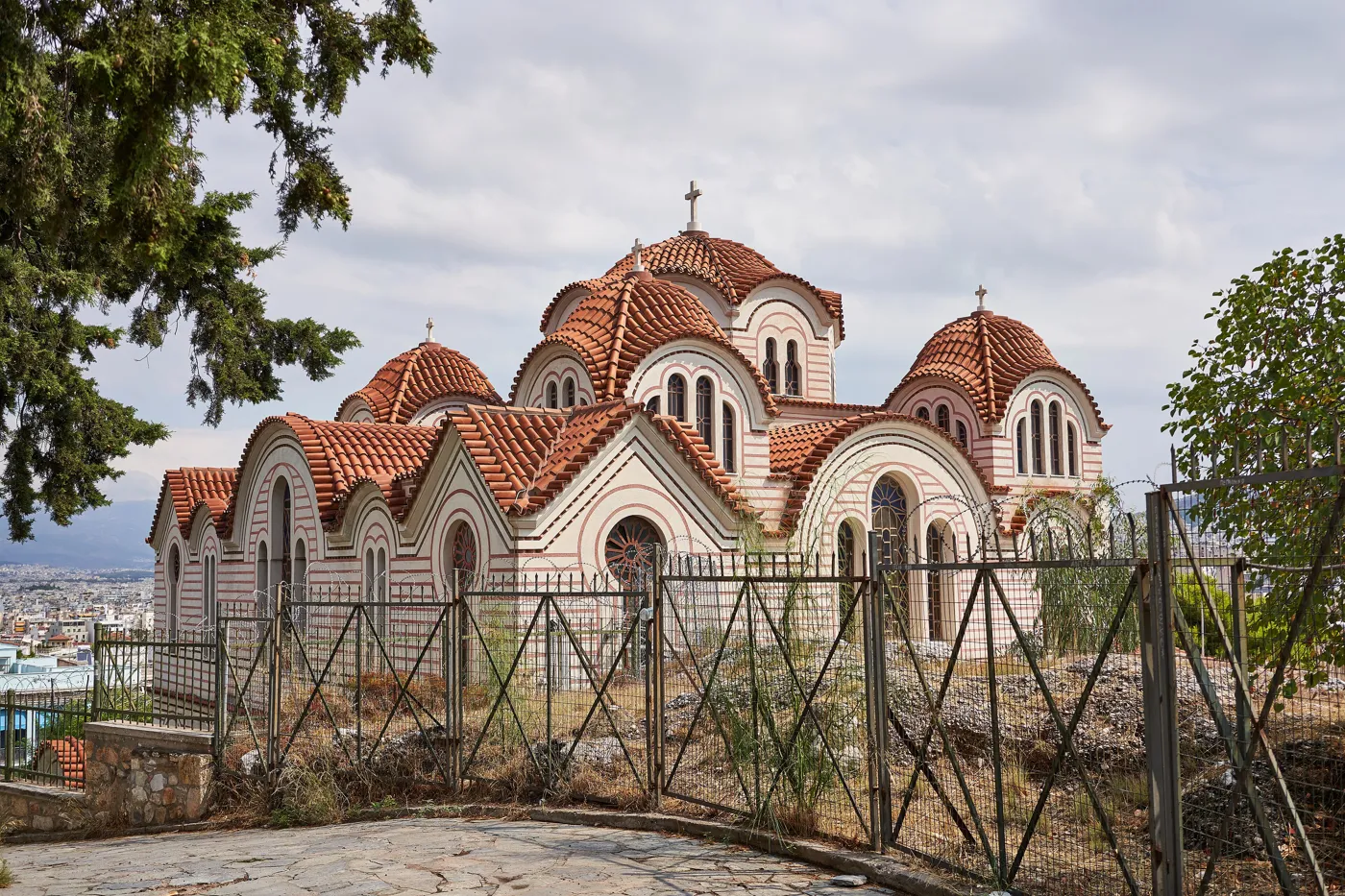
The big church dates from the 1920s. Next to it, an old chapel cut into the rock.
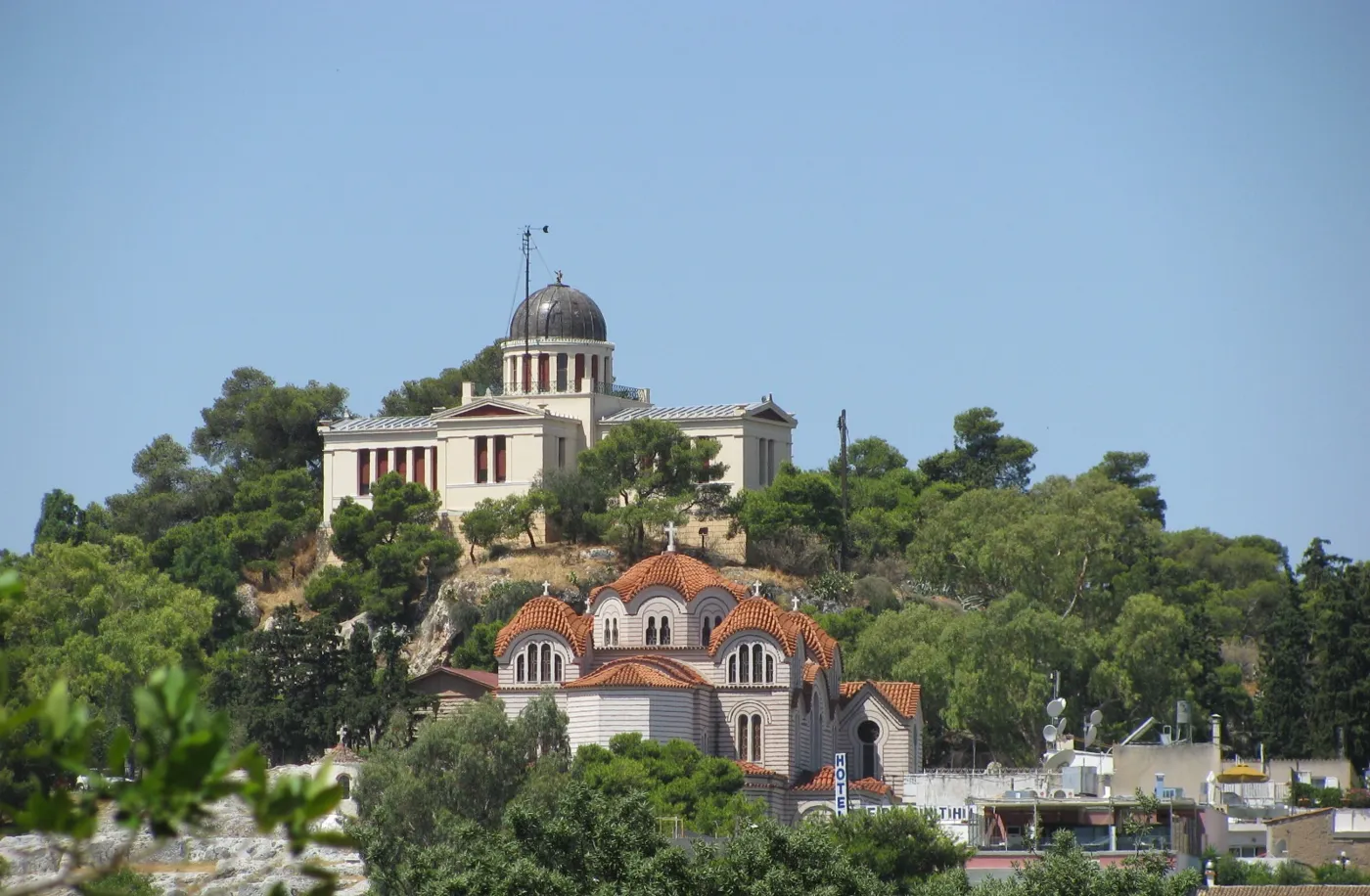
The first research centre in Greece, from 1842.
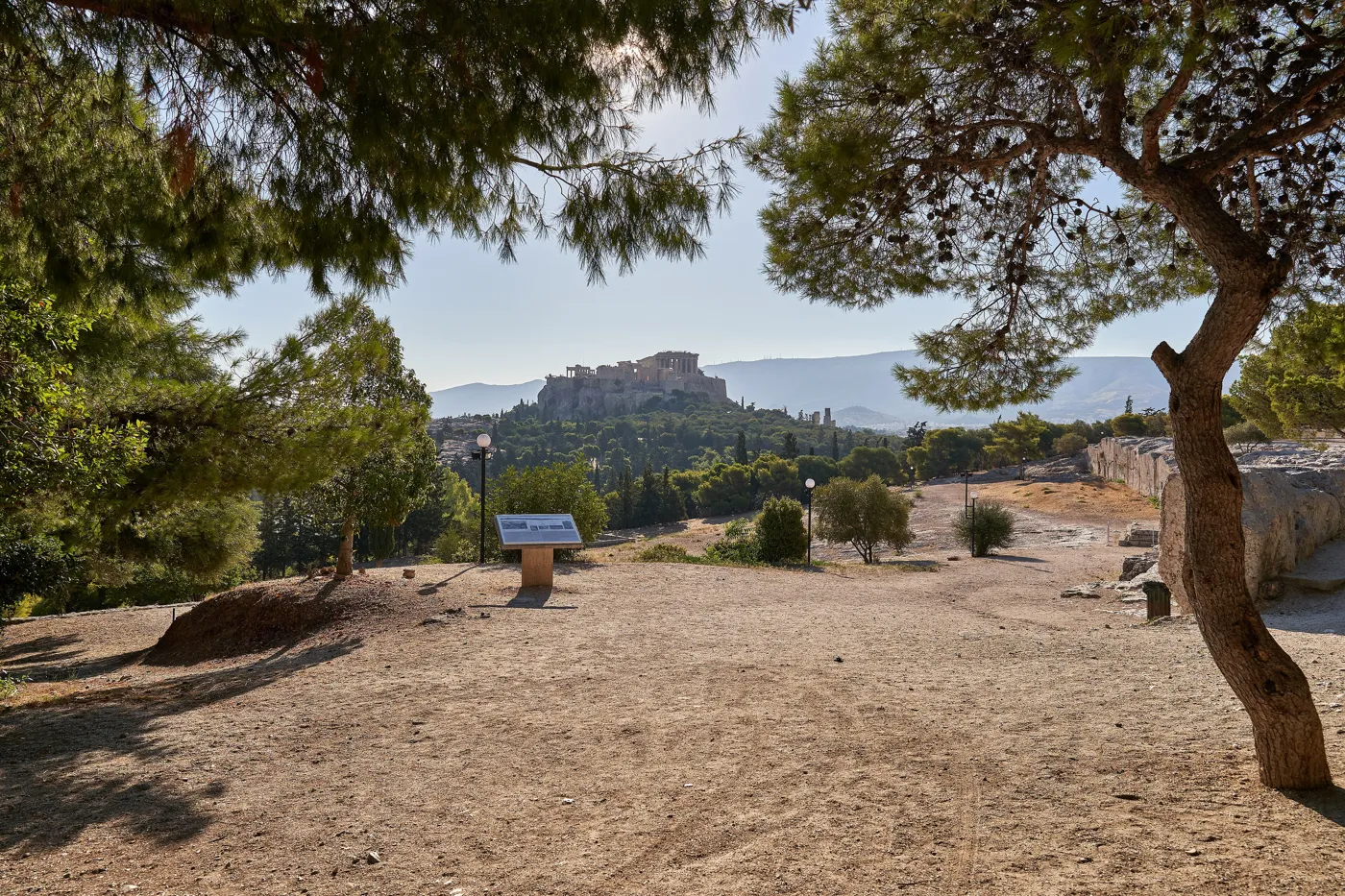
This is where the assembly of the Athenians met.
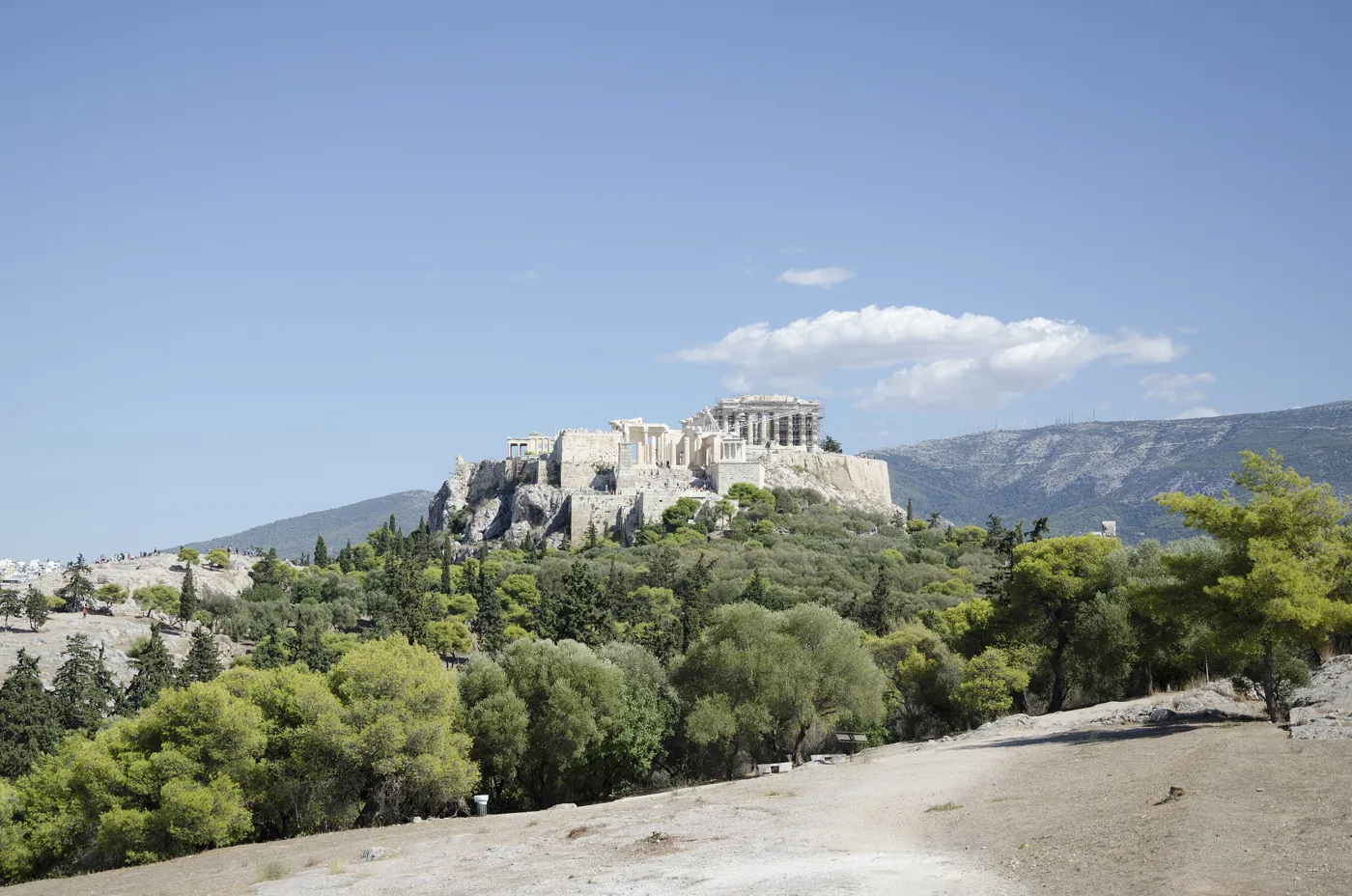
A quiet view, usually without crowds.
Photos: George E. Koronaios (CC BY-SA 4.0), Miłośnik Podróży (CC BY-SA 4.0), Peulle (CC BY-SA 4.0) · Wikimedia Commons
Loumbardiaris and the Pikionis paths
At the foot of Philopappos Hill hides Agios Dimitrios Loumbardiaris, a small stone church with a wooden roof. The name comes from the “loumbarda”, the great cannon. Tradition says that in the 17th century the Ottoman commander of the Acropolis set up cannons to fire on the church on the eve of the feast, but that night lightning struck the powder store and killed him.
In the mid-1950s the architect Dimitris Pikionis laid out the paths around the Acropolis and Philopappos and renewed the church. The paving is made of stones, marbles and pieces of old roof tiles, set by hand, each one different from the next. Walk slowly and look down. Next to the church, a small café, also designed by Pikionis, is a good spot for a coffee among the pines.
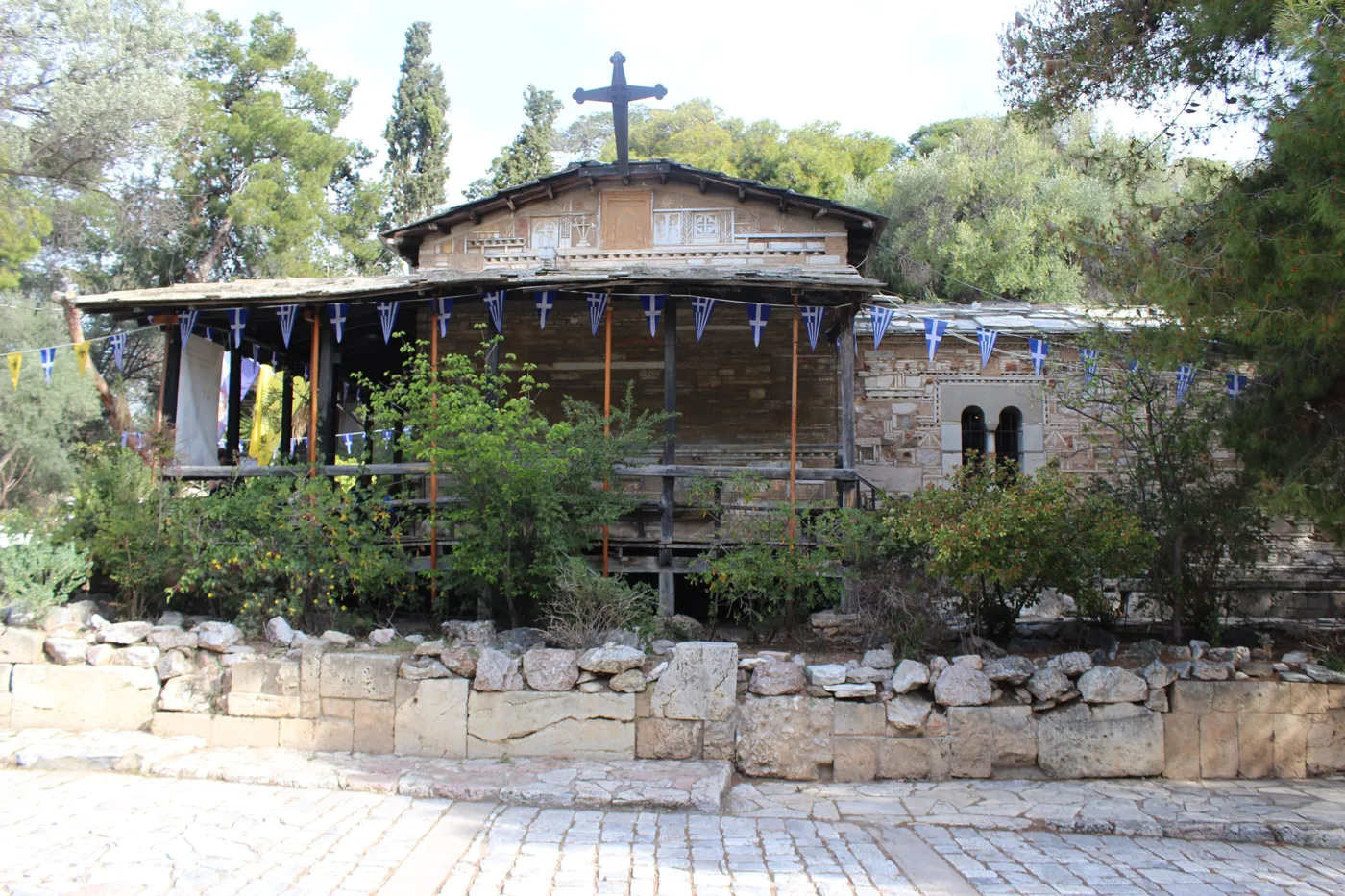
Small, a wooden roof, stone. Pikionis transformed it.
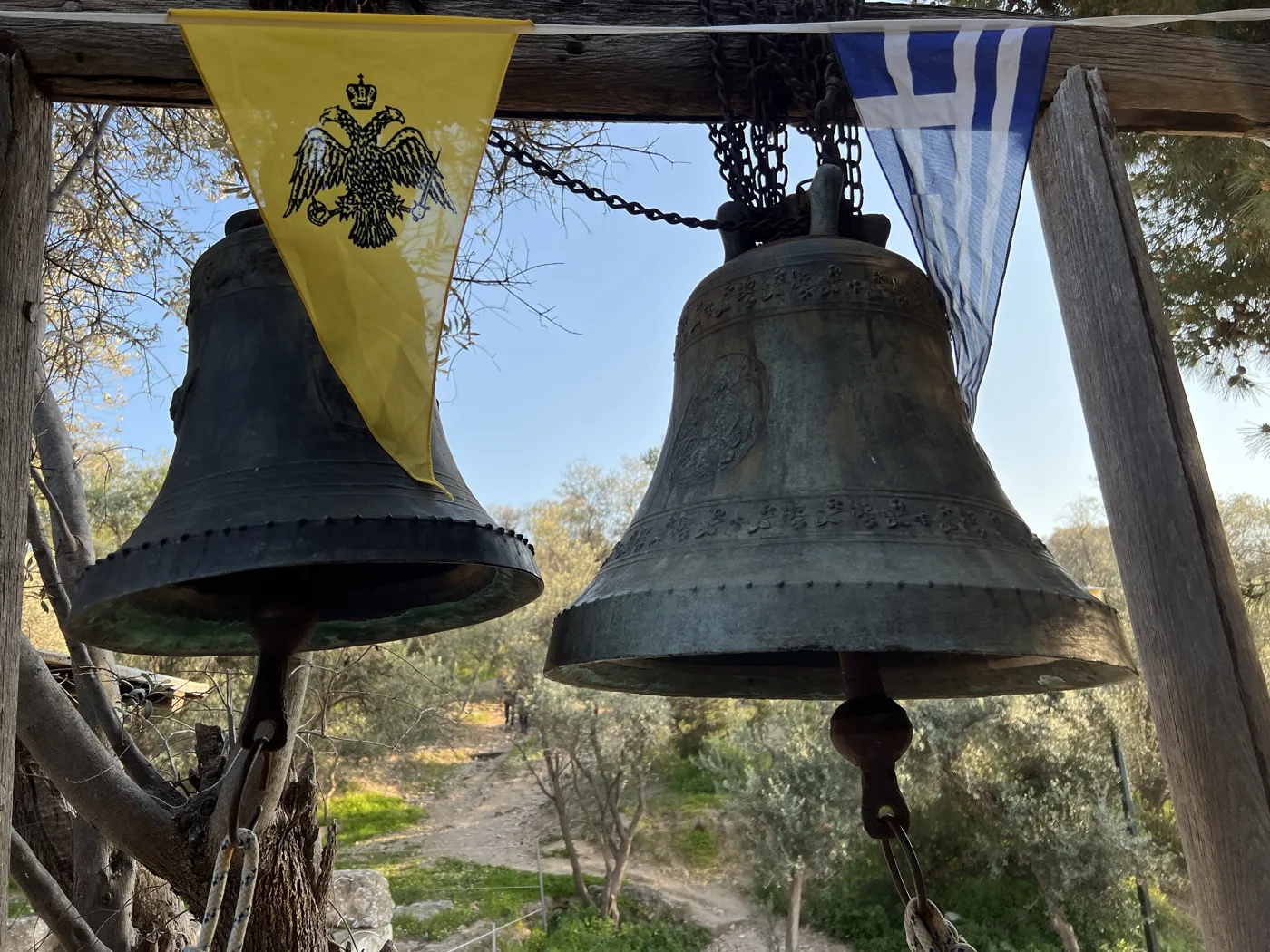
They hang from timber, outside the church.
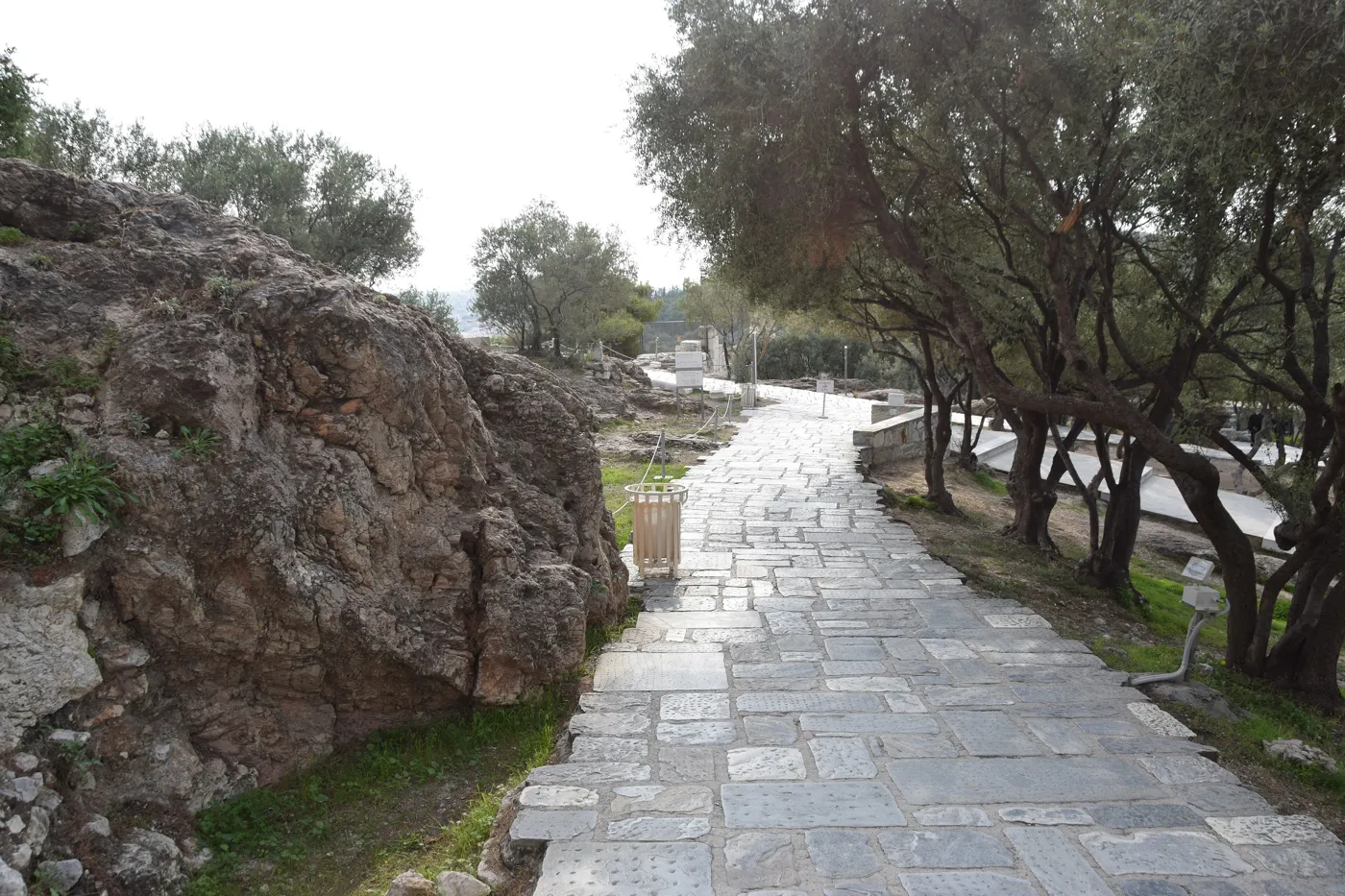
Stones, marbles and tiles, set by hand.
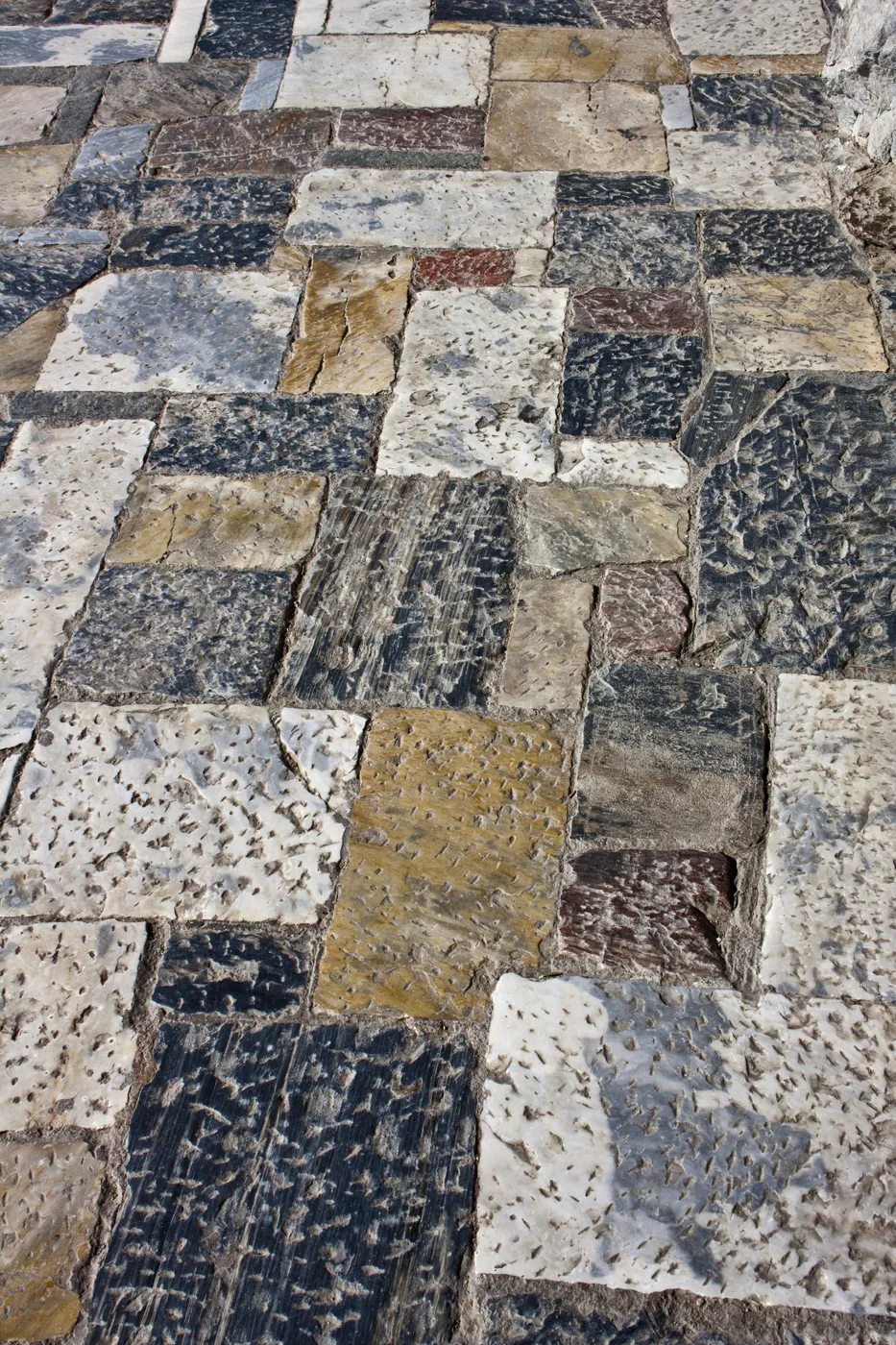
Every piece is different. Look down as you walk.
Photos: philip.mallis (CC BY-SA 2.0), Chabe01 (CC BY-SA 4.0), Jean Housen (CC BY-SA 4.0), Kell Kell (CC BY-SA 3.0) · Wikimedia Commons
The top of Filopappou
From Loumbardiaris, stone paths climb in ten to fifteen minutes to the top of the Hill of the Muses, as the ancients called it. Up there stands the Philopappos Monument, from 114–116 AD. Philopappos was a prince from Commagene, a kingdom in today’s Turkey, who lived in Athens and became a Roman consul. When he died, his sister and the Athenians built him this monument, looking straight at the Acropolis.
From the top you see the Parthenon almost at eye level, and behind it Lycabettus and Hymettus. To the west the city spreads all the way to Piraeus and the sea. The sunset here is the best in Athens, and people come for it, but there’s room for everyone.
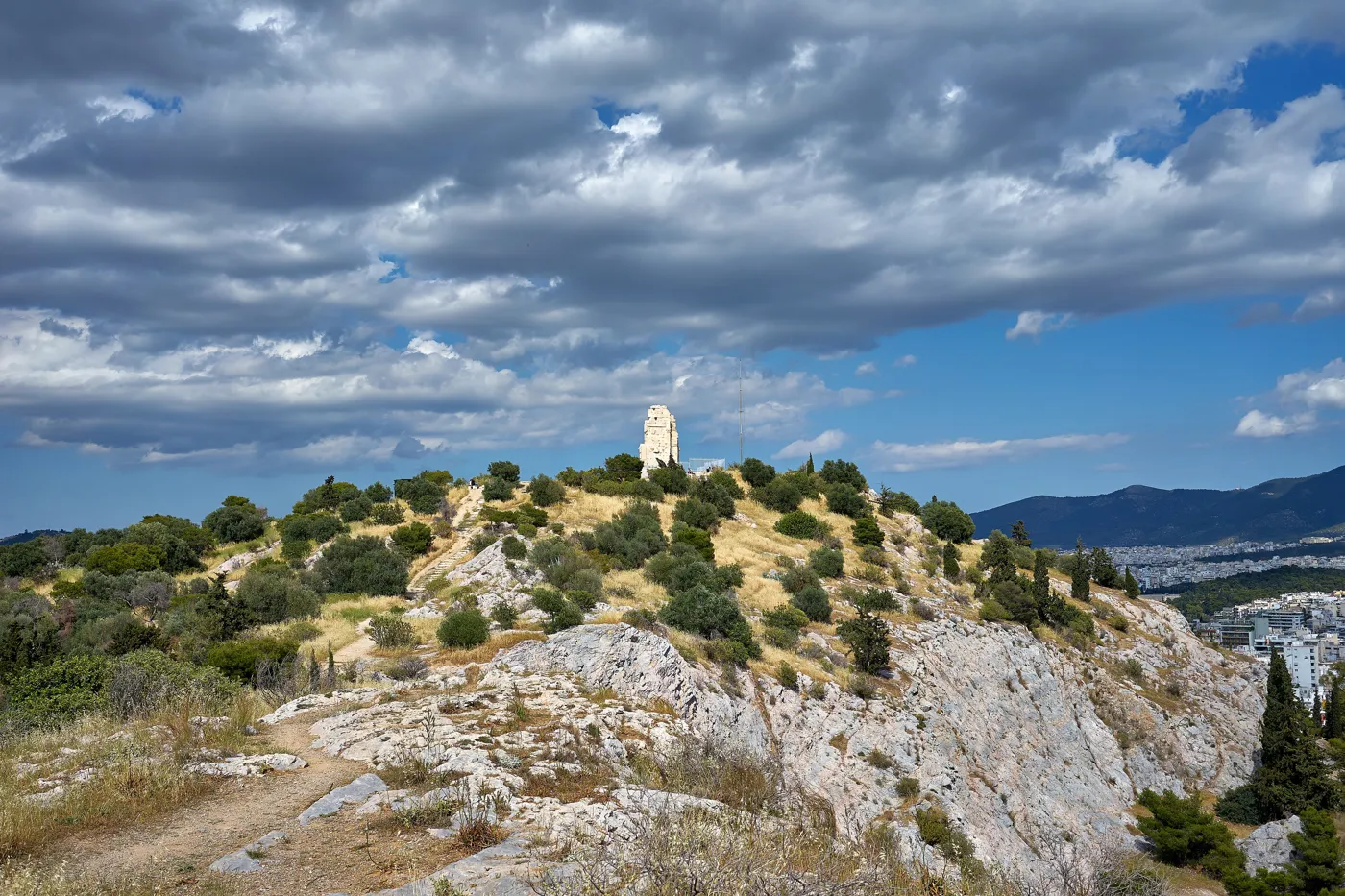
The monument stands at the top of the Hill of the Muses.
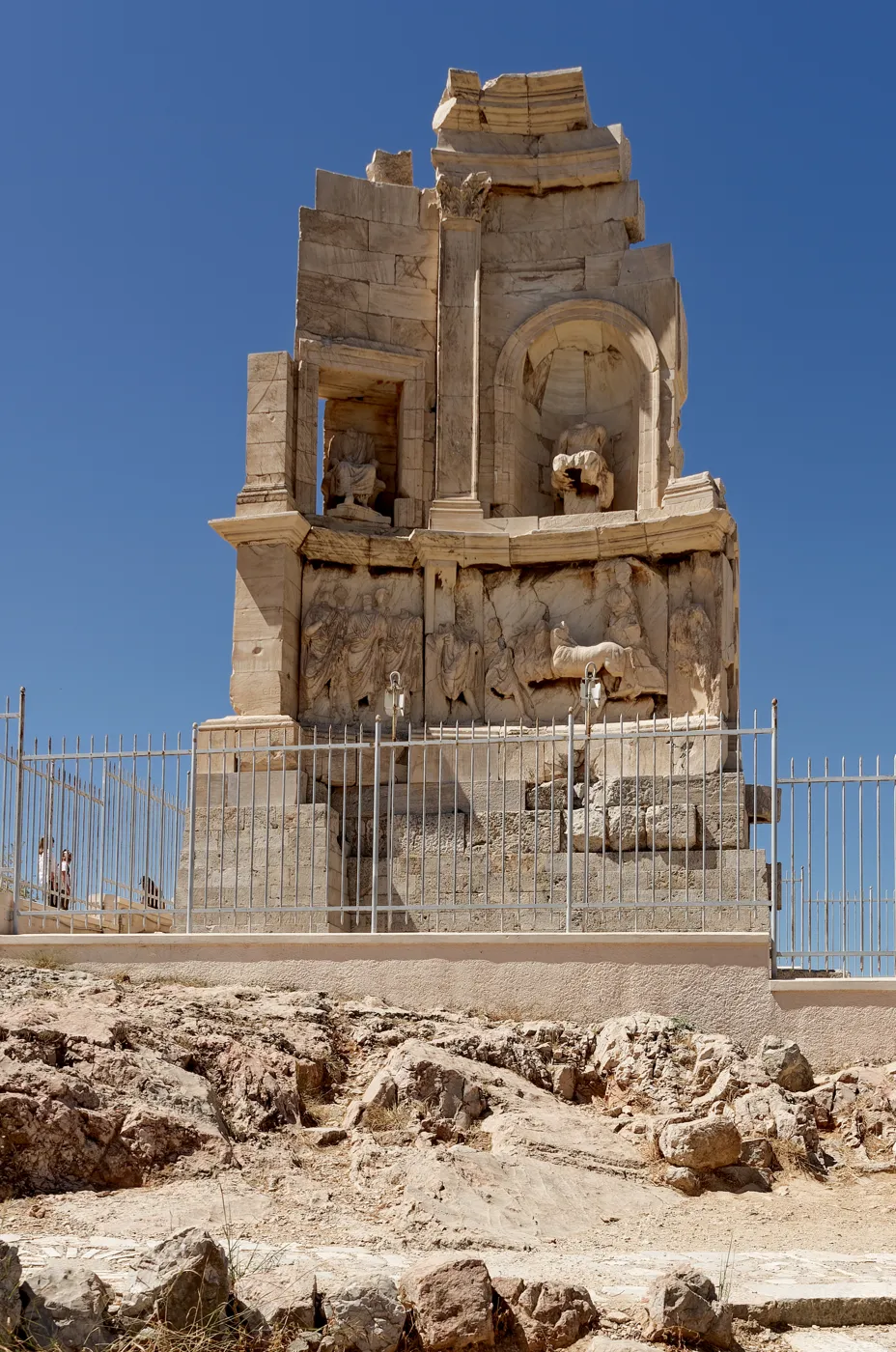
114–116 AD. A prince from Commagene, buried with a view of the Acropolis.
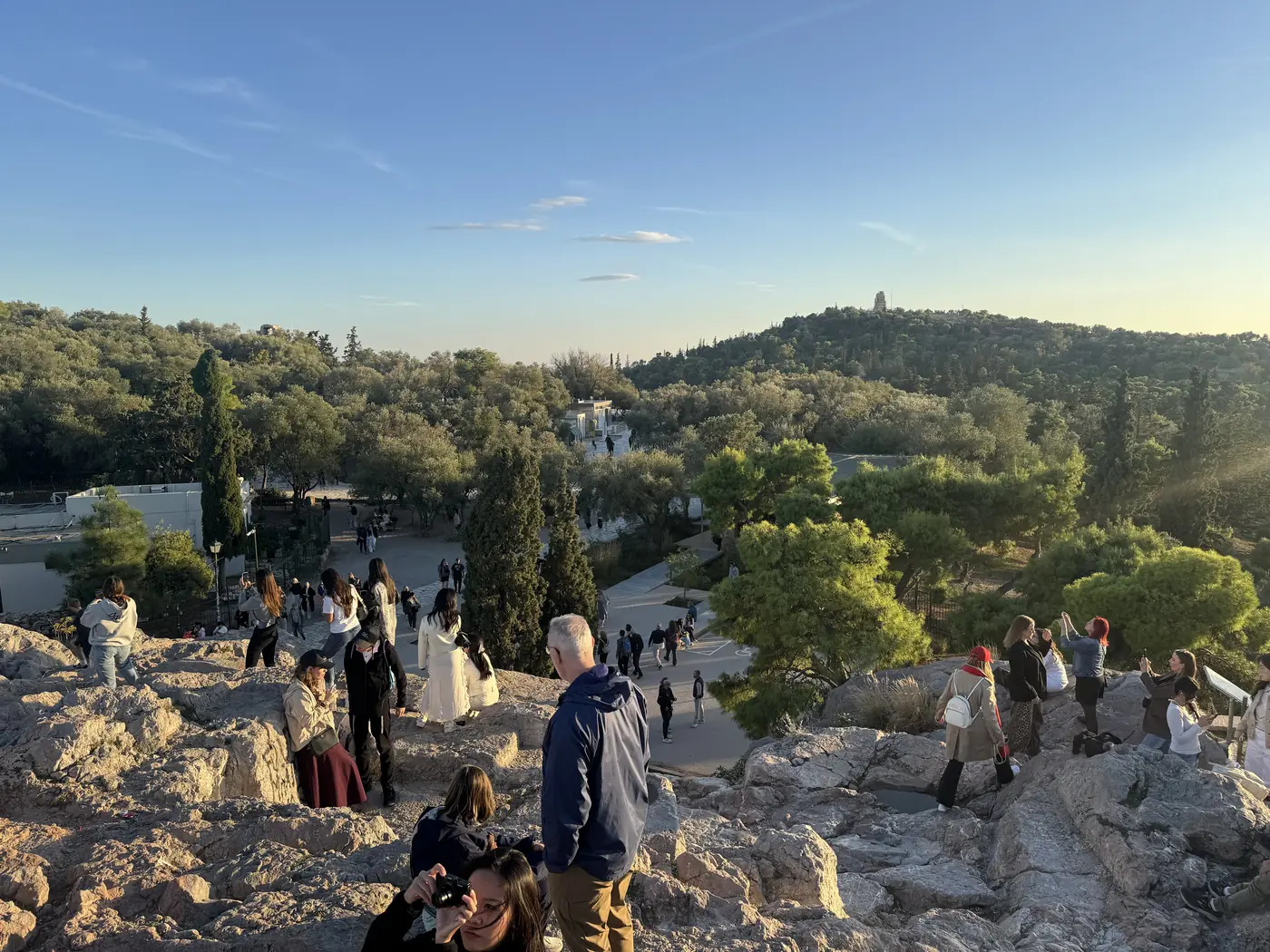
From here you see the Parthenon almost at eye level.
Photos: George E. Koronaios (CC0), Jakub Hałun (CC BY 4.0) · Wikimedia Commons
Thiseio when the sun goes down
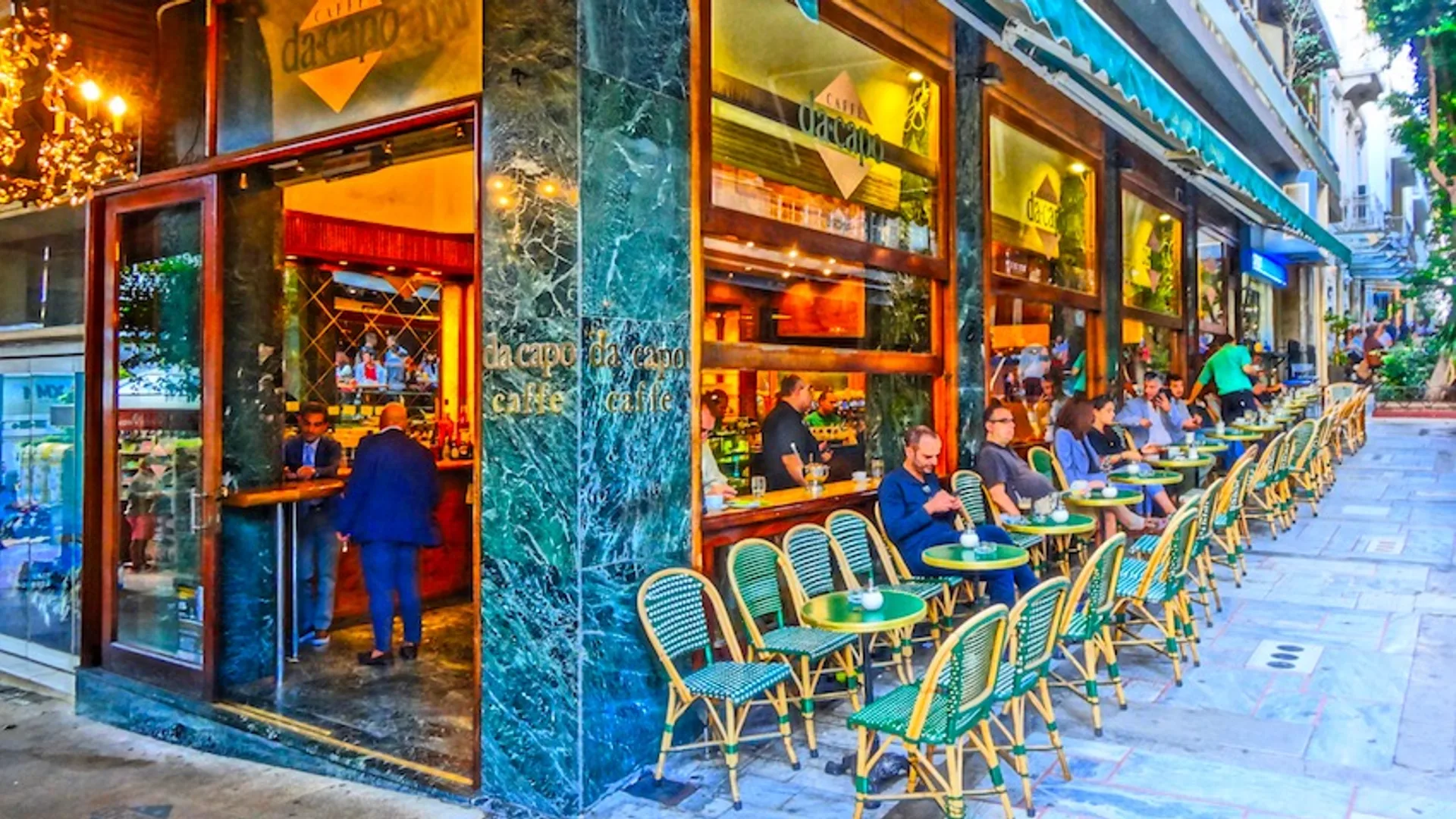
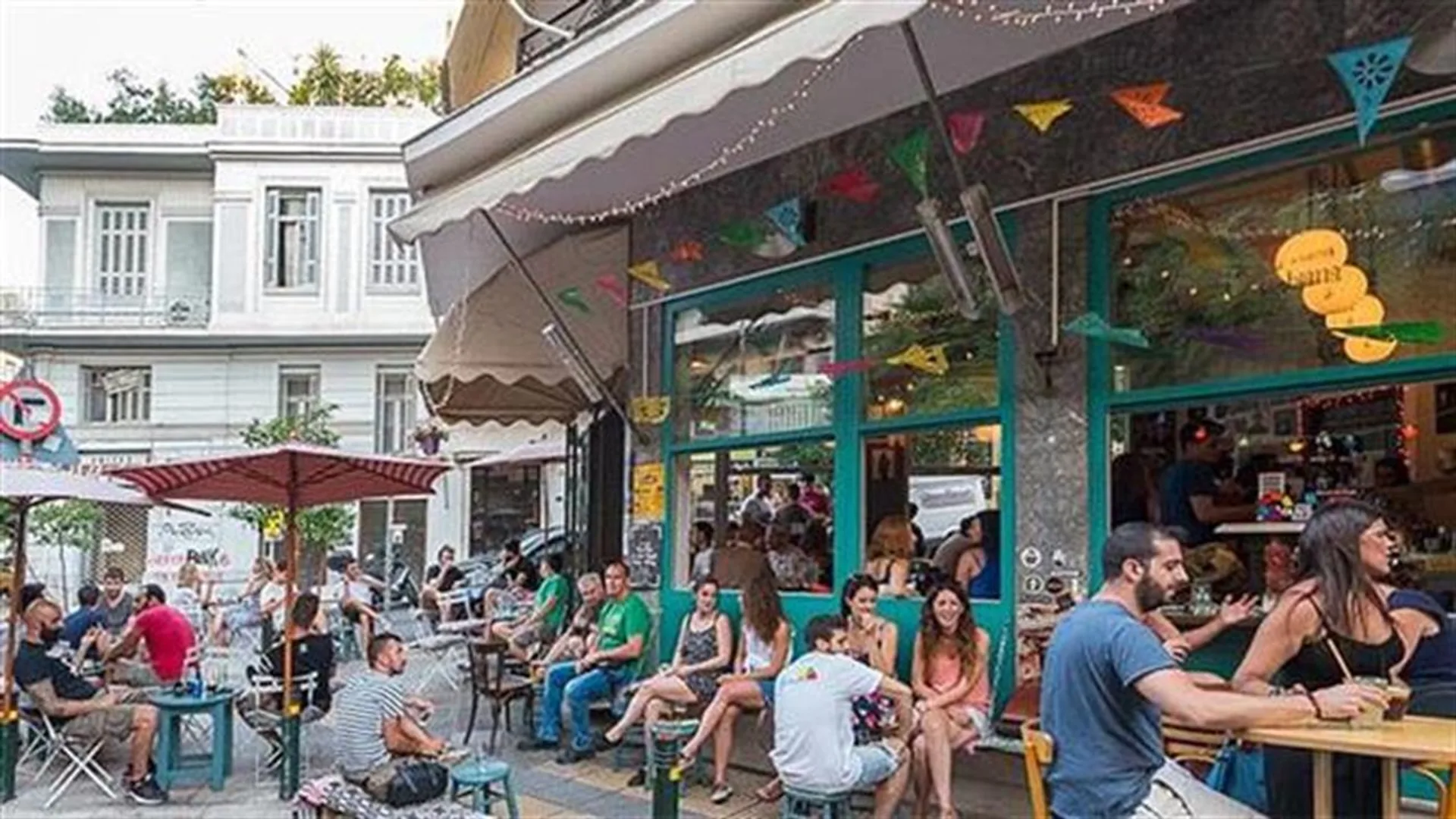
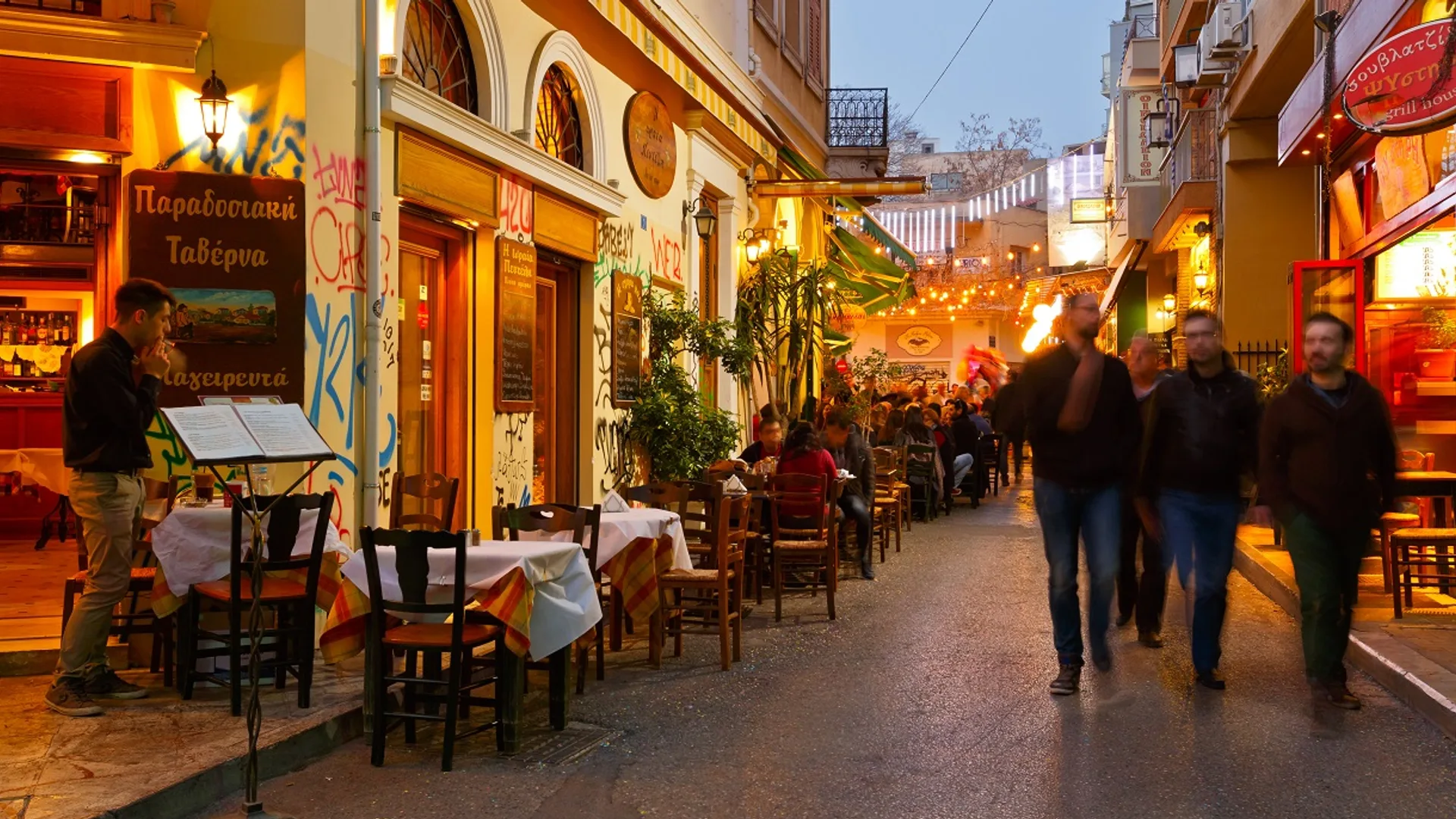
After sunset the Acropolis is lit up and Apostolou Pavlou fills with people. The cafés and bars put tables out on the pedestrian street, and many look up at the floodlit Rock. There you also pay for the view, so check the menu before you sit down. For simpler food, Petralona is ten minutes south, with neighbourhood tavernas.
In summer, at 7 Apostolou Pavlou, Cine Thission is open: an open-air cinema since 1935, with the Acropolis above the screen. It’s one of the oldest summer cinemas in Athens. Films are usually in their original language with Greek subtitles.
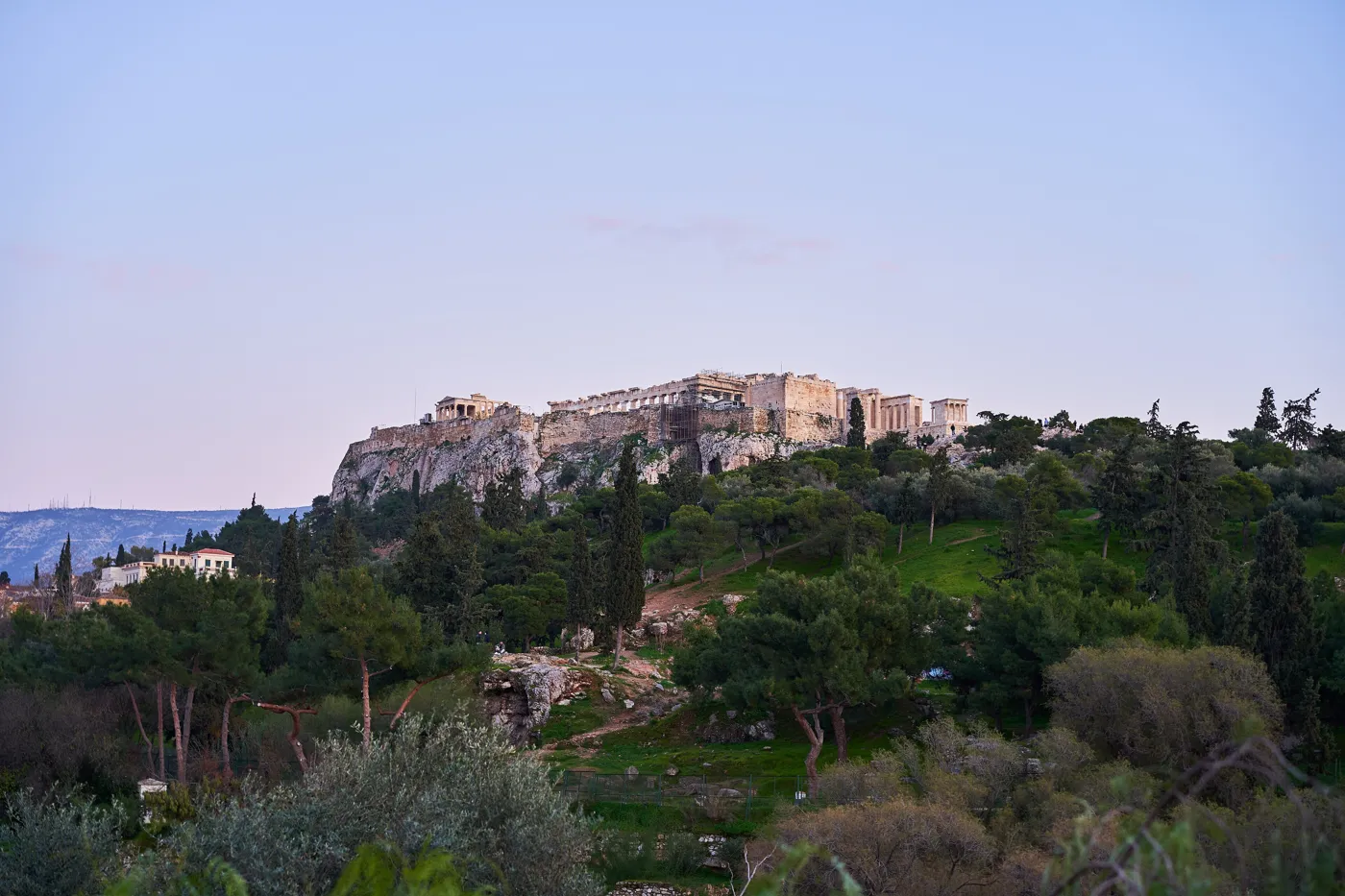
The hour when the Acropolis changes colour.
Photo: George E. Koronaios (CC BY-SA 4.0) · Wikimedia Commons
Practical tips
- Best times: early morning for a quiet walk, late afternoon for the sunset. At midday in summer there isn’t shade everywhere on the hills.
- Water: there are no shops on the hills, apart from the Loumbardiaris café. Bring your own.
- Observatory: the Visitor Centre runs scheduled tours and telescope evenings. Check the Observatory’s website for times.
- Wheelchair: Apostolou Pavlou and Dionysiou Areopagitou are flat. The hills have dirt, stone and steps.
- At night: stay on the lit pedestrian streets. The hills have no lighting.
🚇 How to get there from Ioulianou 50
- Ioulianou 50 → Victoria station: 3 minutes on foot.
- Line 1 (green), towards Piraeus: Omonia, Monastiraki, and at the third stop get off at Thissio.
- Thiseio: you come out straight onto Apostolou Pavlou.
For the way back from Akropoli station: Line 2 to Omonia, change to Line 1, one stop to Victoria. If you go back the way you came, Line 1 from Thiseio goes straight to Victoria.
🚇 Ioulianou 50 → Thiseio by metro
Line 1 to Thiseio, no change. You come out straight onto Apostolou Pavlou.
Where it is in relation to the apartment
📍 From Angels Athens to the «Thiseio» neighbourhood
See at a glance how to get from the apartment at Ioulianou 50 to the heart of the neighbourhood. Drag the map and zoom in for details.
Frequently asked questions
Do I need a ticket for Philopappos Hill?
No. The hill and the paths are free. Only the Ancient Agora and the Acropolis need tickets.
Is the climb hard?
Not if you walk comfortably. It’s ten to fifteen minutes uphill, on stone and dirt.
Where should I watch the sunset?
At the top of Philopappos or on the Pnyx, which is less crowded. The Areopagus, opposite, has a closer view, but it fills up.
Is it safe in the evening?
The pedestrian street, yes, because it’s busy until late. Don’t go up the hills after dark.
— Kathy