🪪 The trip at a glance
📍 Where it is and how far
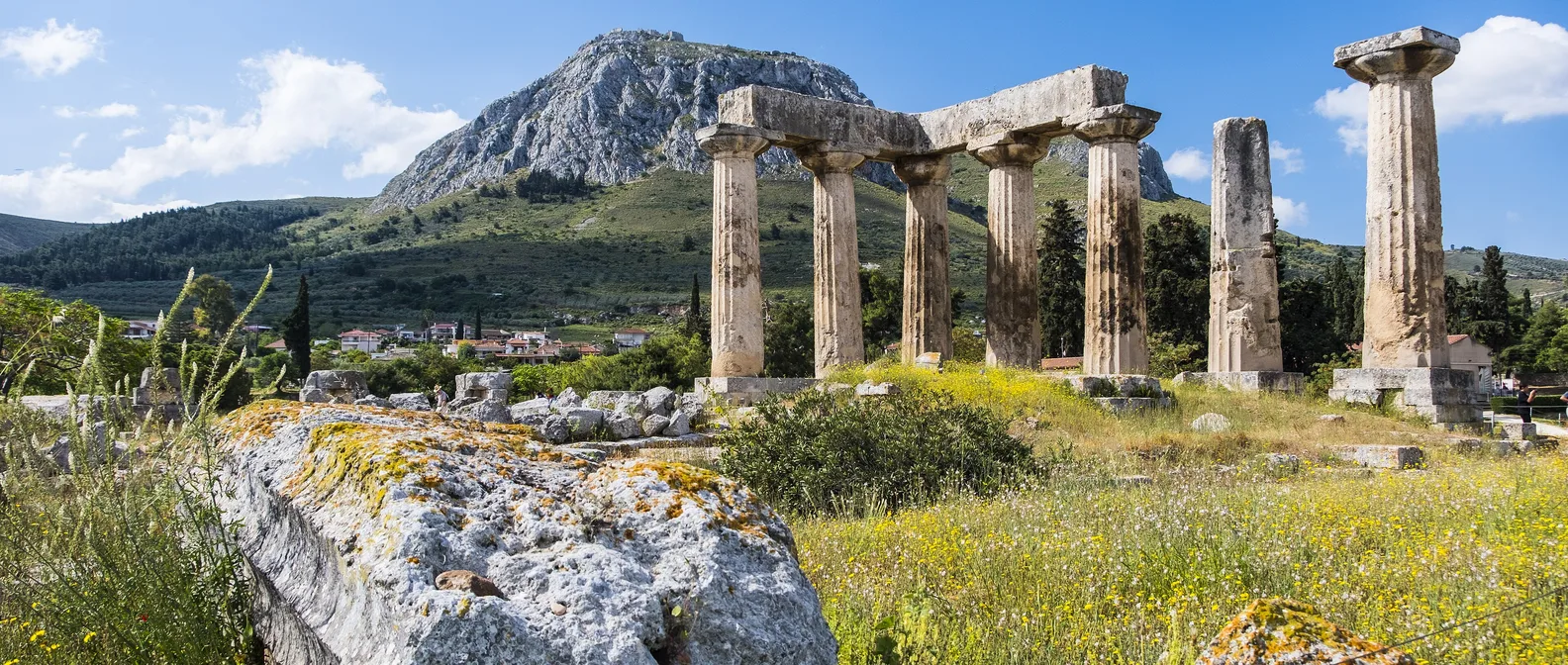
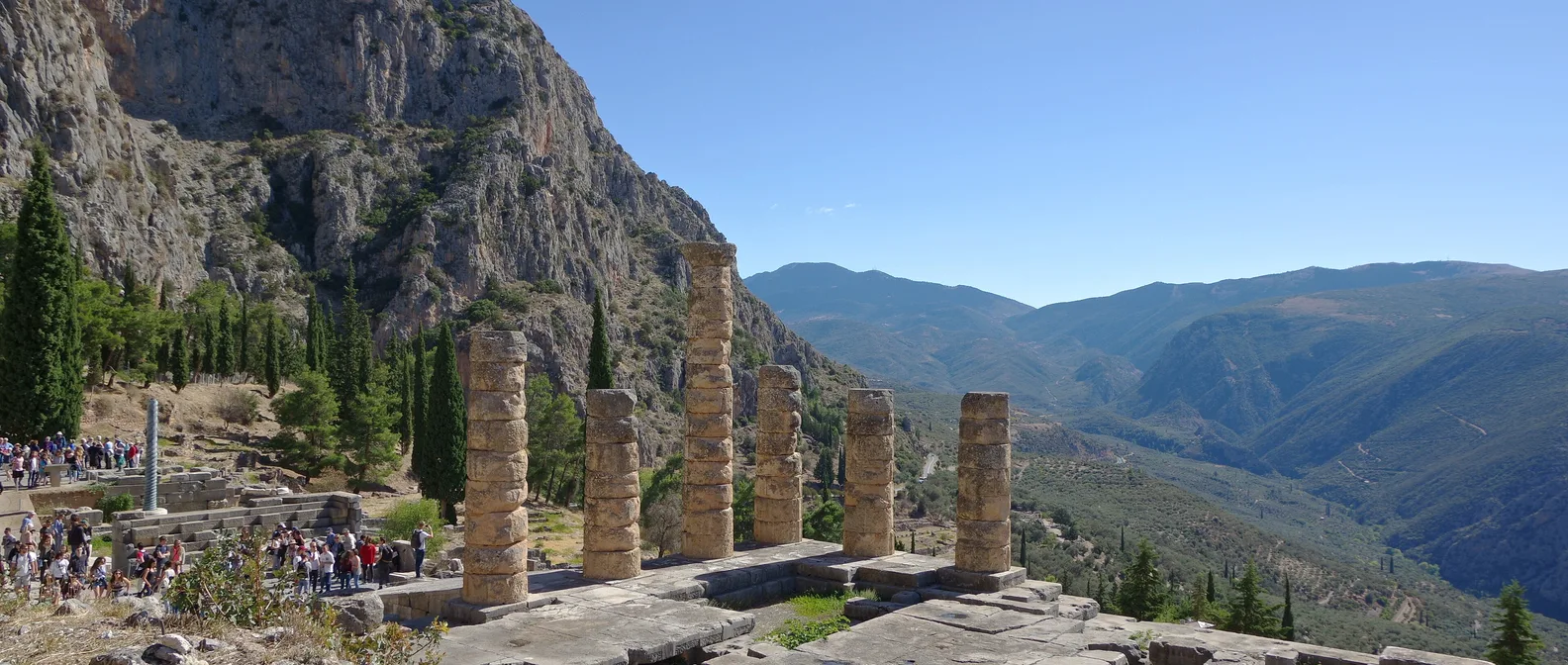
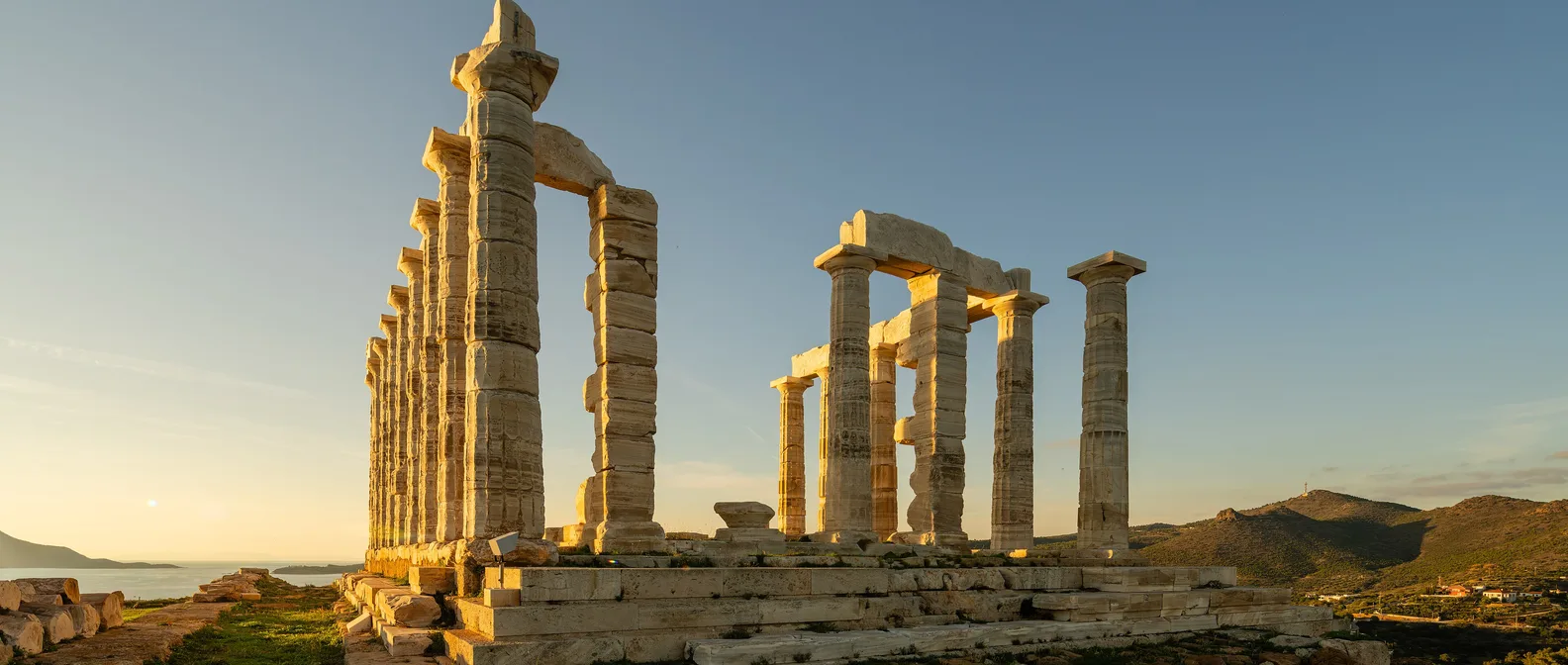
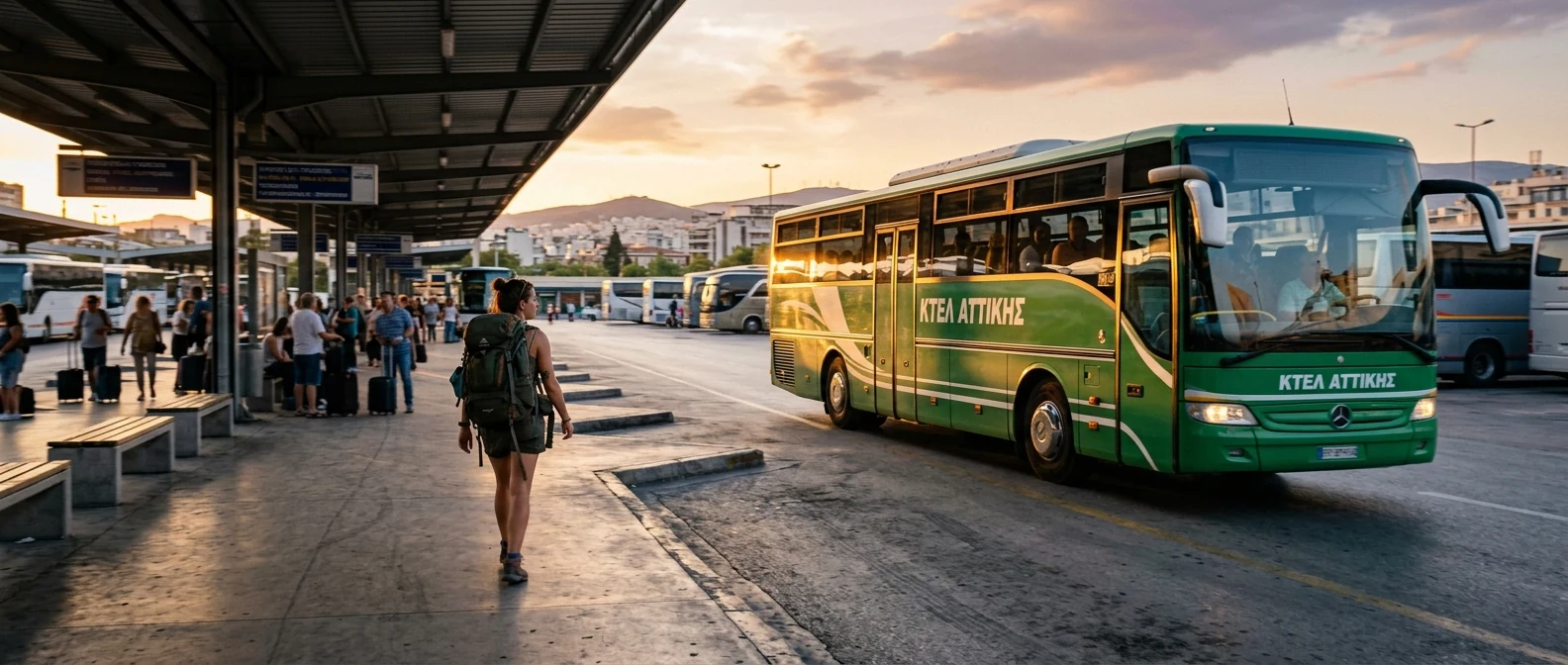
Mycenae, Epidaurus and Nafplio are all three in the Argolid, in the north-eastern corner of the Peloponnese, just past the Isthmus of Corinth. Mycenae is the closest, 130 kilometres and 1 h 45 from Ioulianou 50, right on the motorway to Tripoli. From there Epidaurus is 45 kilometres to the east, up in the mountains, and Nafplio 27 kilometres from Epidaurus, on the sea. The loop closes with the return from Nafplio, 2 hours. With the KTEL Argolida bus you reach Nafplio in 2 hours and a quarter, passing through Fichti, the junction for Mycenae.
📍 Where Mycenae, Epidaurus and Nafplio are
All three are in the Argolid, in the north-eastern Peloponnese, in a triangle of 30 to 45 kilometres. In blue the road from Ioulianou 50 to Mycenae (129 km), in dashed purple the loop Mycenae, Epidaurus, Nafplio, and in orange the return from Nafplio. In red Mycenae, in purple Epidaurus, in green Nafplio, in orange Tiryns, Argos and Nemea, and in yellow the KTEL bus stops. Tap each point.
⚖️ Is it worth it? The pros and cons
It is the trip we would recommend to anyone coming to Greece for the first time with only one day for the Peloponnese: three of the country's greatest monuments and its most beautiful town. It is also the fullest day in this guide, and it needs a car or a group. Here is an honest picture.
📊 At a glance, from 1 to 5
👍 The pros
- Three highlights in one day: Mycenae, Epidaurus, Nafplio.
- The Lion Gate and the Treasury of Atreus, 3,250 years old.
- The theatre of Epidaurus, the most perfect of antiquity.
- Nafplio, the most beautiful town in the Peloponnese, for food and a stroll.
- Two UNESCO World Heritage Sites.
👎 The cons
- A long day: 12 hours door to door by car.
- Without a car it does not fit into one day; it needs a night in Nafplio.
- Three €20 tickets: €60 per person for the entrances alone.
- Heat with no shade at Mycenae in summer.
📜 The history: from Agamemnon to Kapodistrias
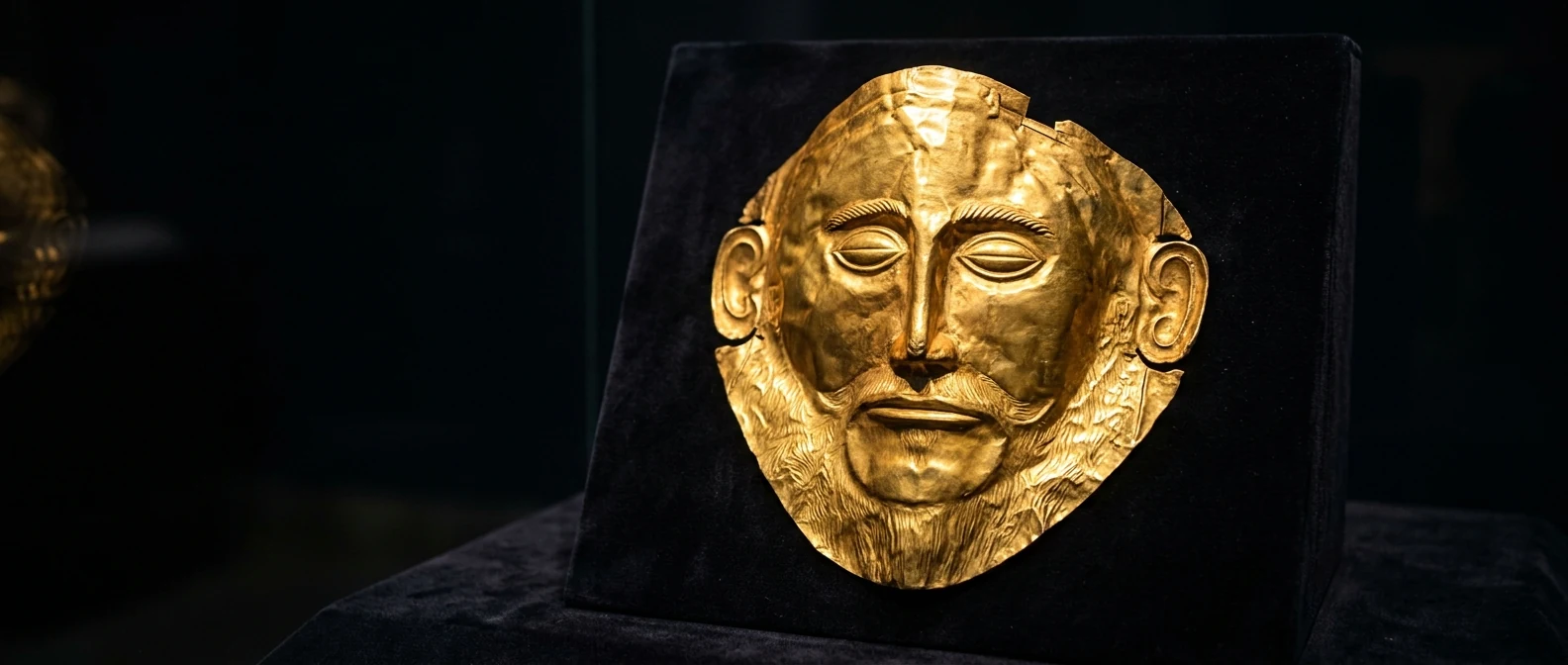
Mycenae was the centre of the first Greek civilisation, the Mycenaean, which flourished from 1600 to 1100 BC. Its kings buried their dead with gold masks, built walls of boulders that later Greeks attributed to the Cyclopes, wrote in Linear B, the first Greek script, and traded with Egypt and Asia Minor. Homer called the city «rich in gold» and made its king, Agamemnon, the leader of the Greeks at Troy. In 1876 Heinrich Schliemann, who had just found Troy, dug Grave Circle A inside the Lion Gate and found the graves with the gold masks, the swords and the jewellery: 14 kilos of gold, today in the National Archaeological Museum in Athens. The «mask of Agamemnon» is in fact 300 years older than the Trojan War, but the name stuck. Mycenae and Tiryns have been a World Heritage Site since 1999.
Epidaurus was the greatest healing centre of antiquity: the sanctuary of Asklepios, the god of medicine, where the sick came from all over Greece, slept in the Abaton and waited for the god to visit them in their dreams. In the 4th century BC, with the pilgrims' money, the Tholos and the theatre were built by the architect Polykleitos the Younger, for the games of the Asklepieia. The theatre was buried, forgotten, and excavated in 1881 almost intact. Since 1954 it has hosted the Epidaurus Festival every summer, with ancient tragedy in front of 12,000 spectators. A UNESCO site since 1988.
Nafplio is the more recent history. The castle of Akronafplia was held by Byzantines, Franks and Venetians, Bourtzi was built by the Venetians in 1473 and Palamidi, their most perfect castle, in 1711 to 1714, only to be lost to the Ottomans just a year later. In 1822 the town was liberated, in 1828 Ioannis Kapodistrias arrived, the first governor of Greece, and in 1829 Nafplio became the first capital of the free state. Kapodistrias was assassinated at the door of Agios Spyridon in 1831, the young King Otto landed here in 1833, and in 1834 the capital moved to Athens. Nafplio kept its neoclassical houses, its squares and the air of the first capital.
🦁 Mycenae: the citadel of Agamemnon
From the car park you climb in five minutes to the Lion Gate: two lions of grey limestone, without their heads, rest on a column above a lintel of 20 tons, from 1250 BC. It is the oldest monumental sculpture in Europe, and the road leading to it is deliberately narrow, so that invaders could be struck from the wall on the right. Passing through the gate, on your right is Grave Circle A, the double stone ring with the six shaft graves of the 16th century BC, where Schliemann found the gold masks. The path climbs between the foundations of the houses to the top, to the palace: the great courtyard, the megaron with the hearth and the place of the throne, and the view over the whole plain to the Argolic Gulf, from where the Mycenaeans controlled the road to Corinth.
From the other side of the summit you go down to the north gate, the smaller sister of the Lion Gate, and to the underground cistern: 99 steps descending into the rock, in total darkness, to the cistern that supplied the citadel with water during a siege. Take a torch or your phone, and go down as far as you can see. The Cyclopean walls that enclose the whole hill are up to 7 metres thick and up to 12 metres high, made of boulders weighing tons. Allow an hour to an hour and a half for the citadel: it is uphill, stony and with no shade at all.
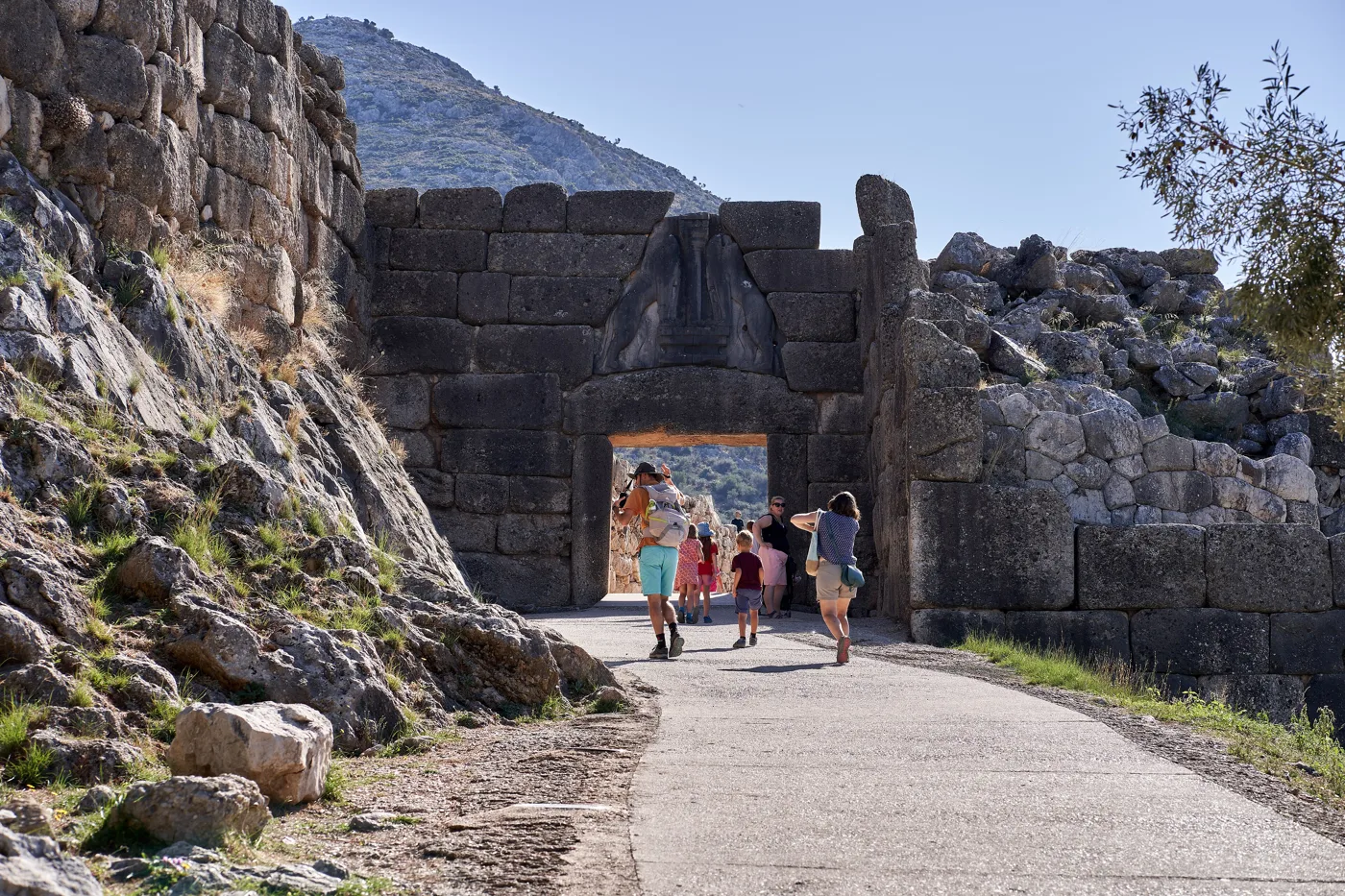
The entrance to the citadel, around 1250 BC.
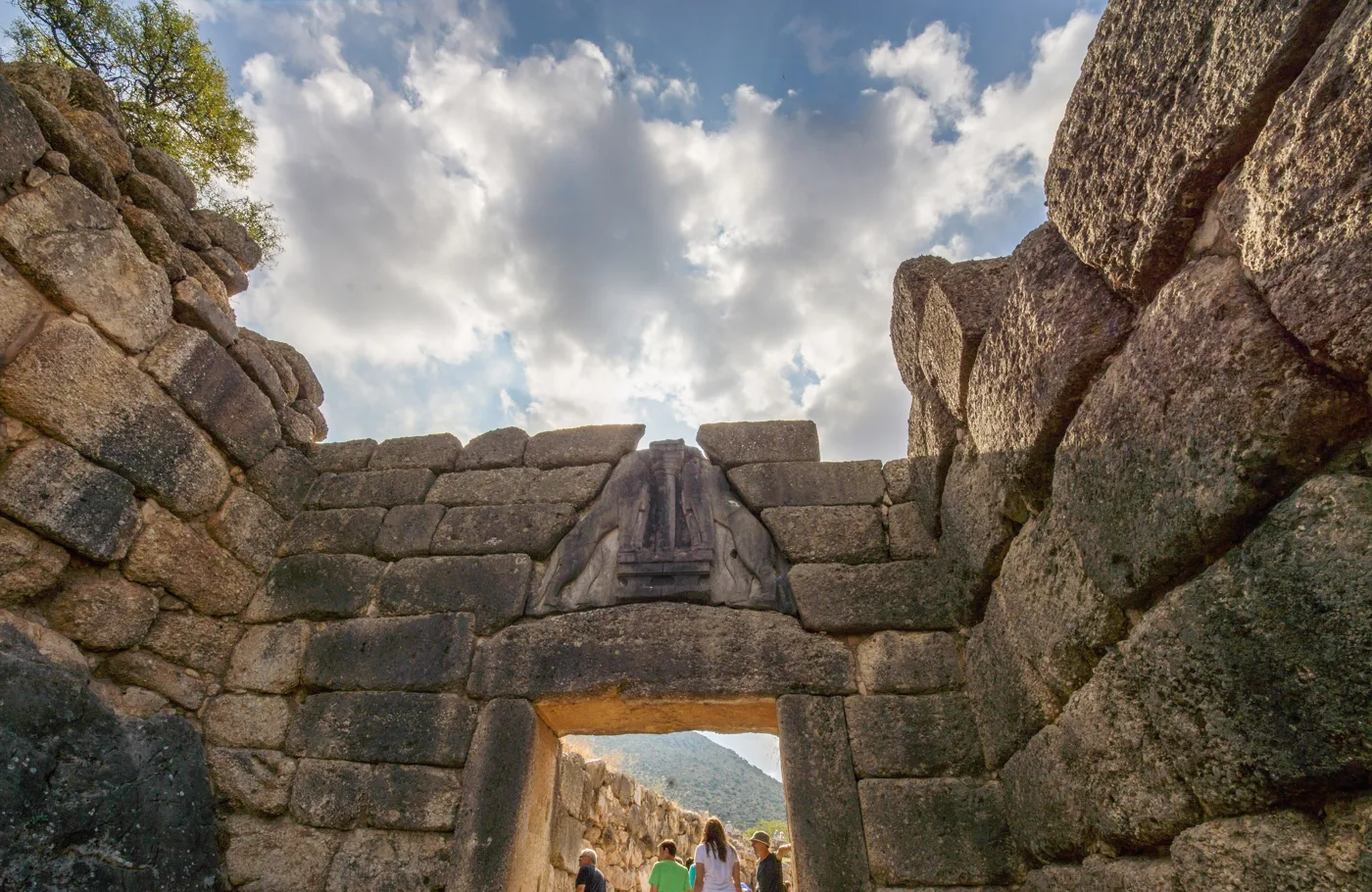
The oldest monumental sculpture in Europe.
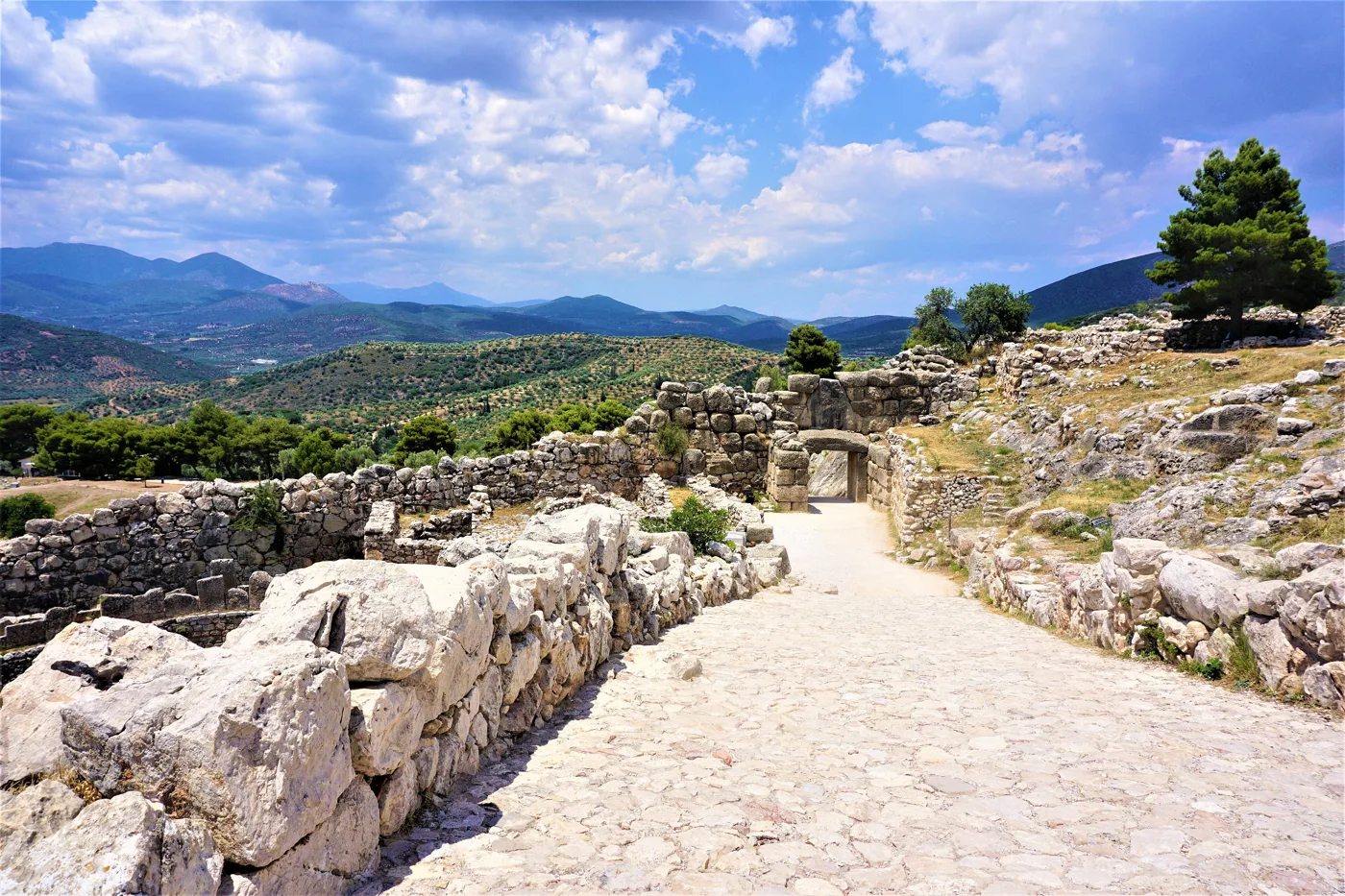
The plain of the Argolid in front of you.
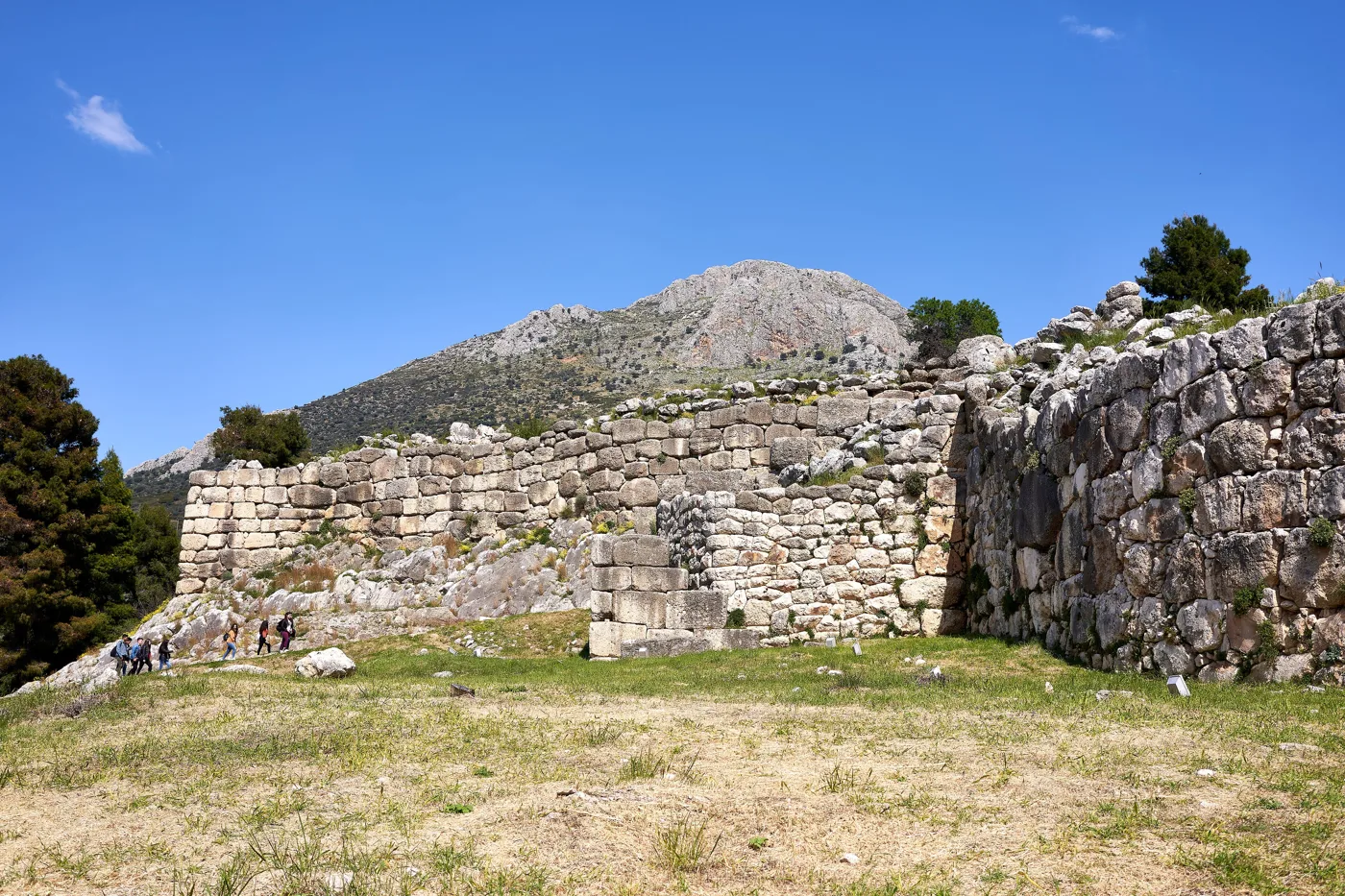
Boulders that «only Cyclopes» could lift.
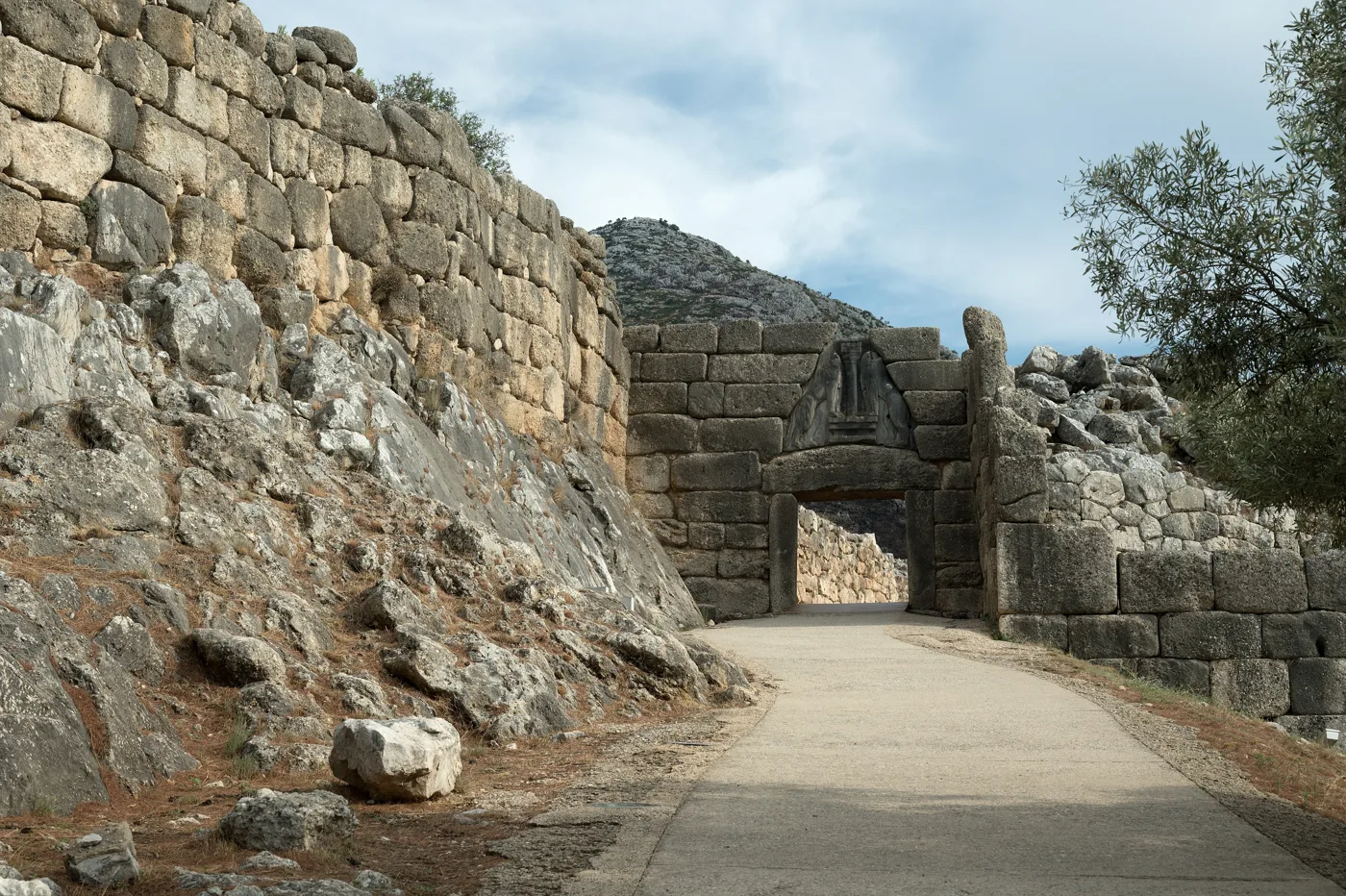
Narrow, so that invaders could be struck from the walls.
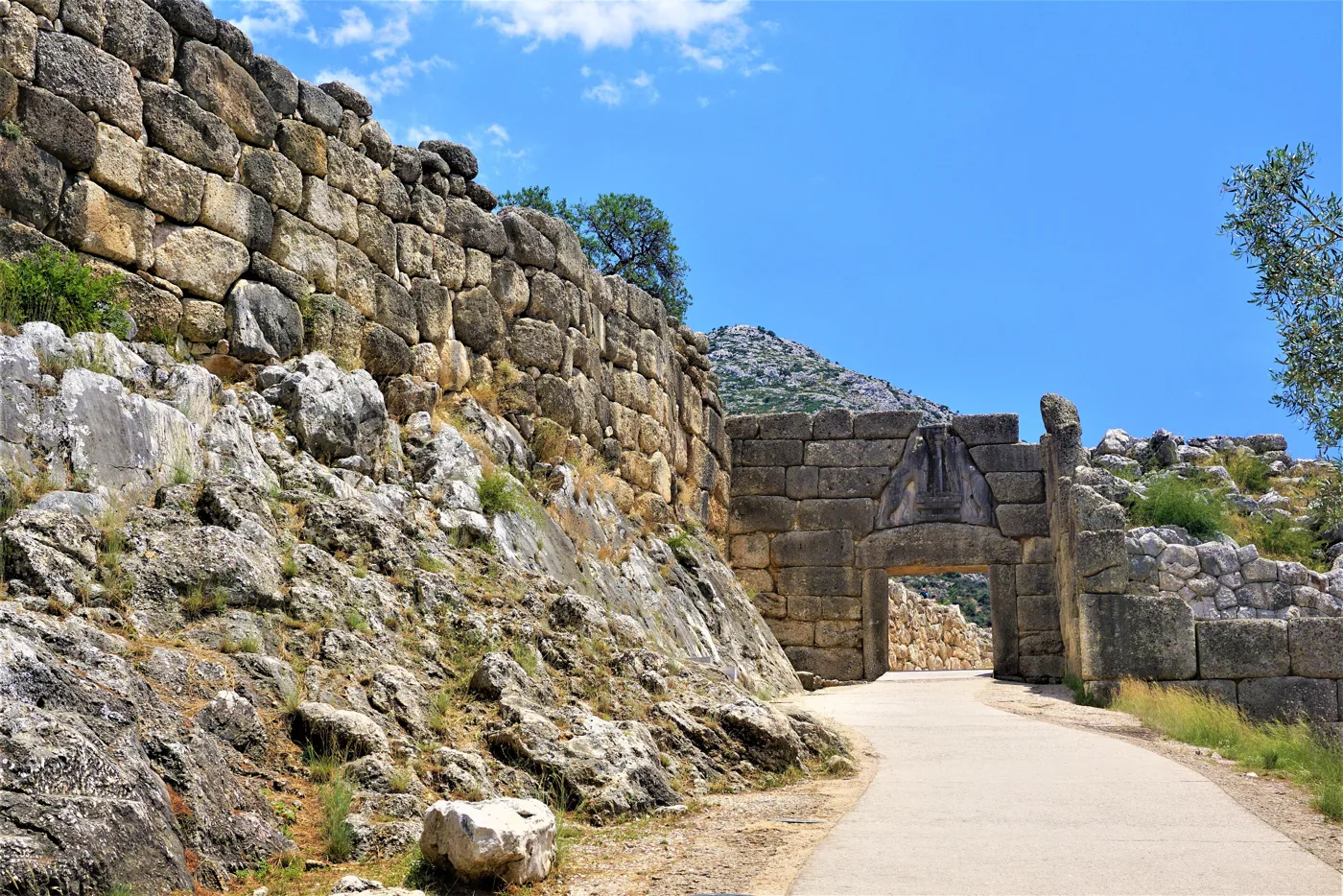
The wall on the right protected the gate.
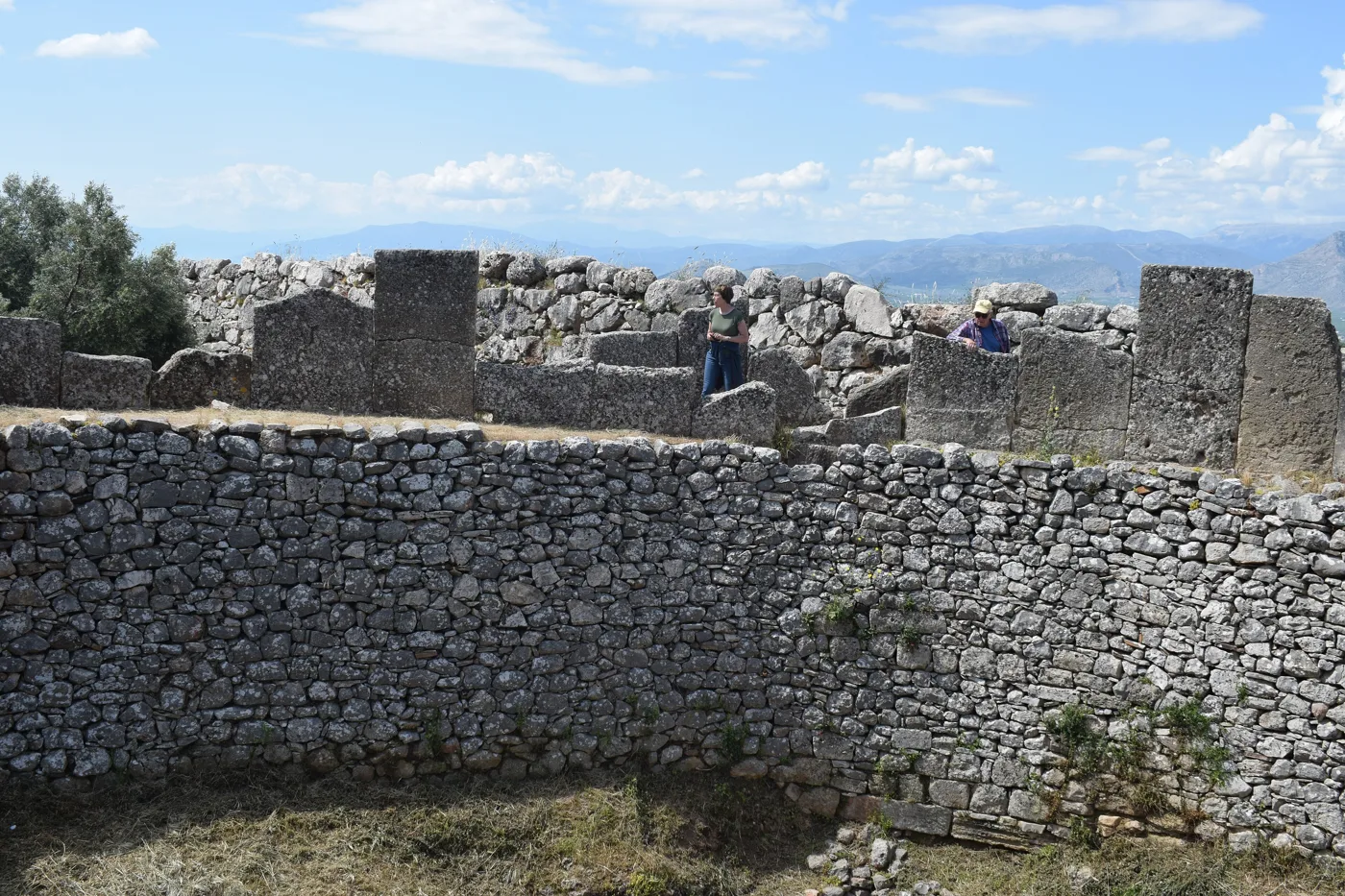
Up to 7 metres thick, up to 12 metres high.
Photos: George E. Koronaios (CC BY-SA 4.0), HerrAdams (CC BY-SA 4.0), Joyofmuseums (CC BY-SA 4.0), Zde (CC BY-SA 4.0), Jean Housen (CC BY-SA 4.0) · Wikimedia Commons
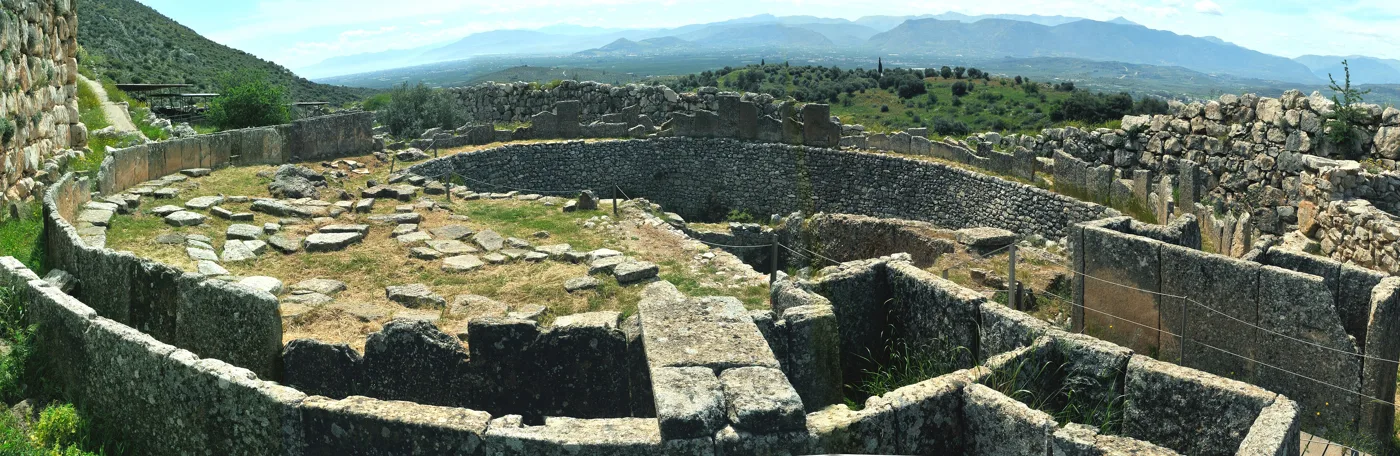
Here Schliemann found the gold masks in 1876.
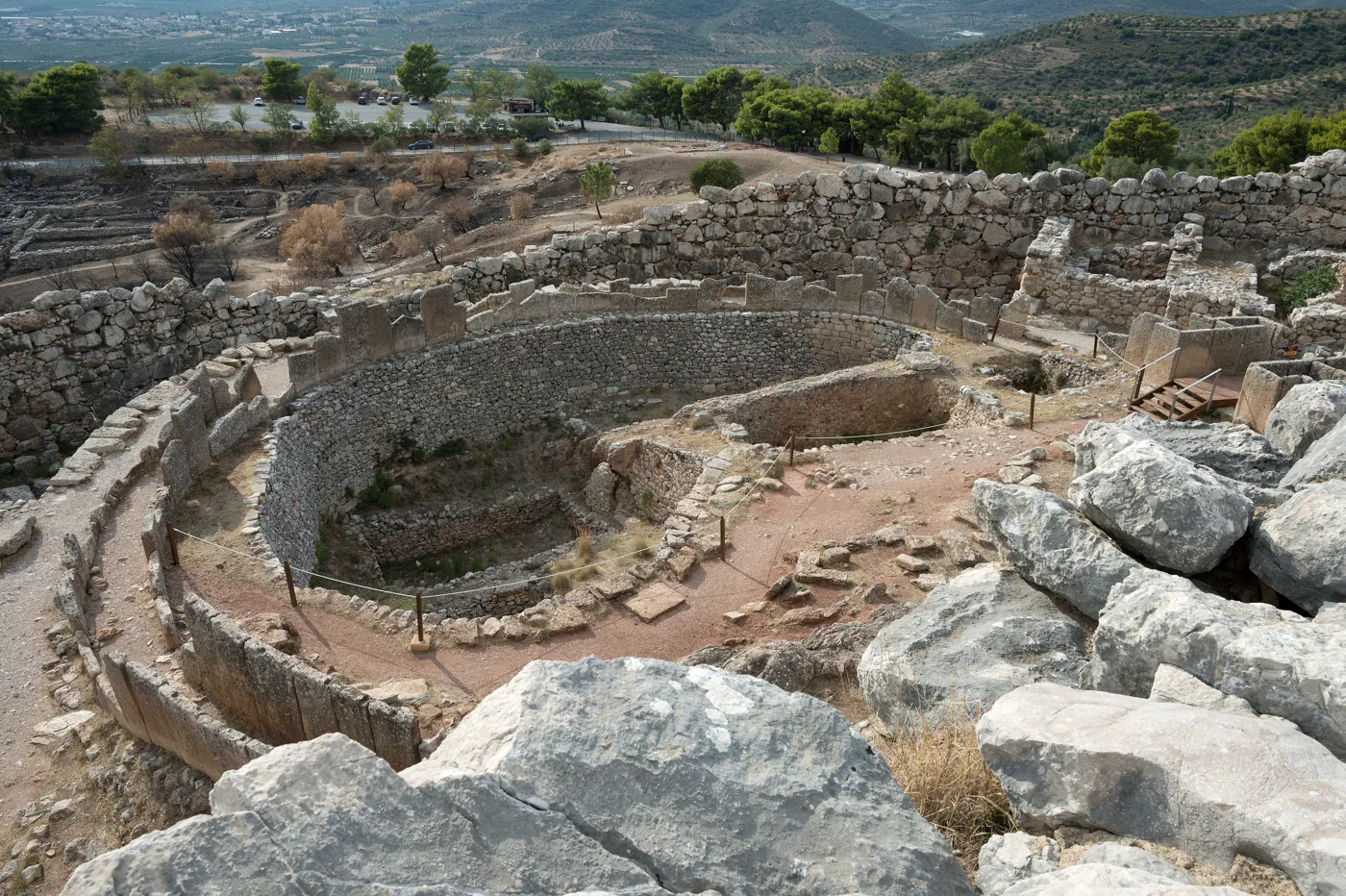
Nineteen dead, 14 kilos of gold.
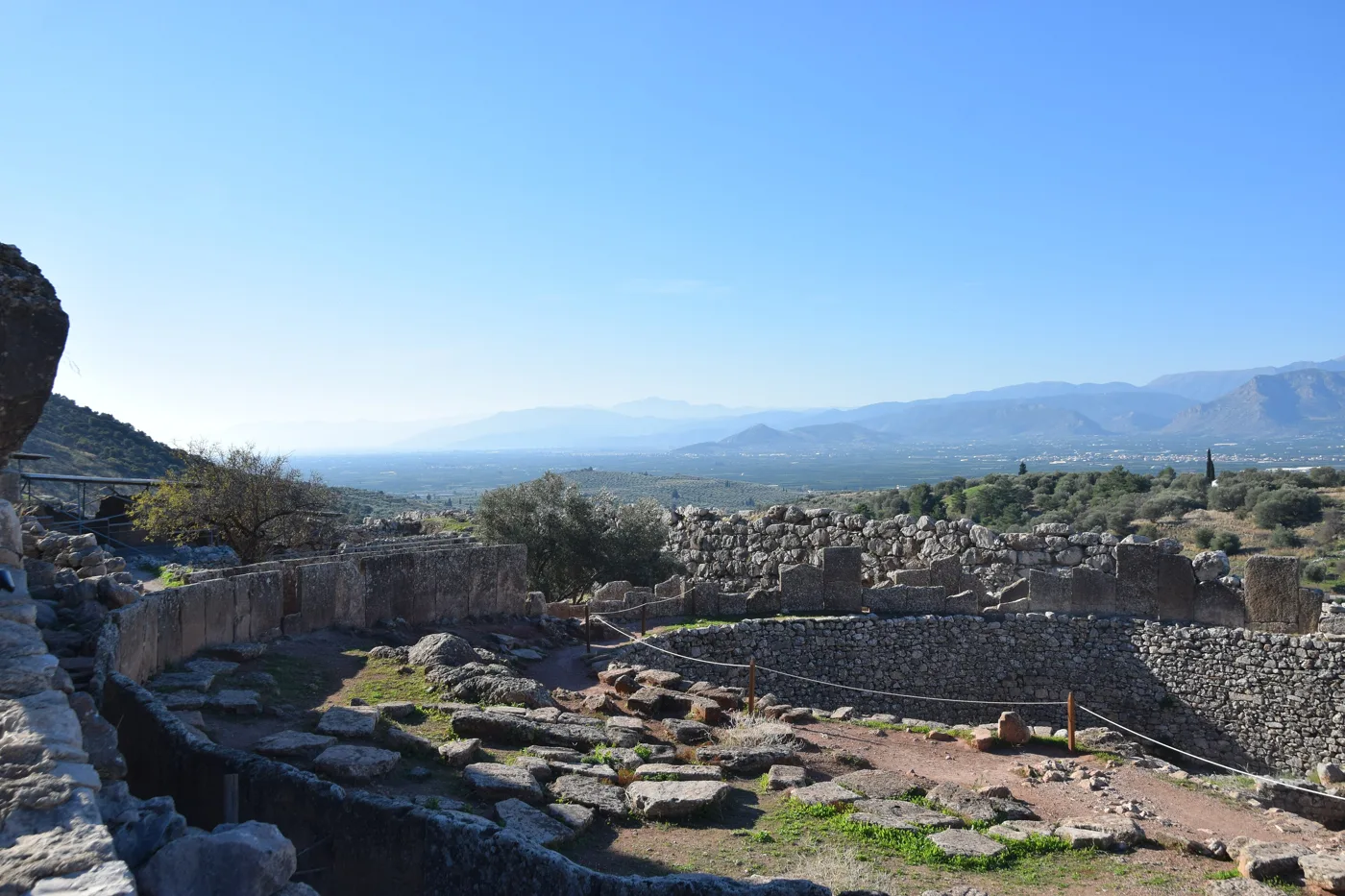
The kings were buried with a view over their kingdom.
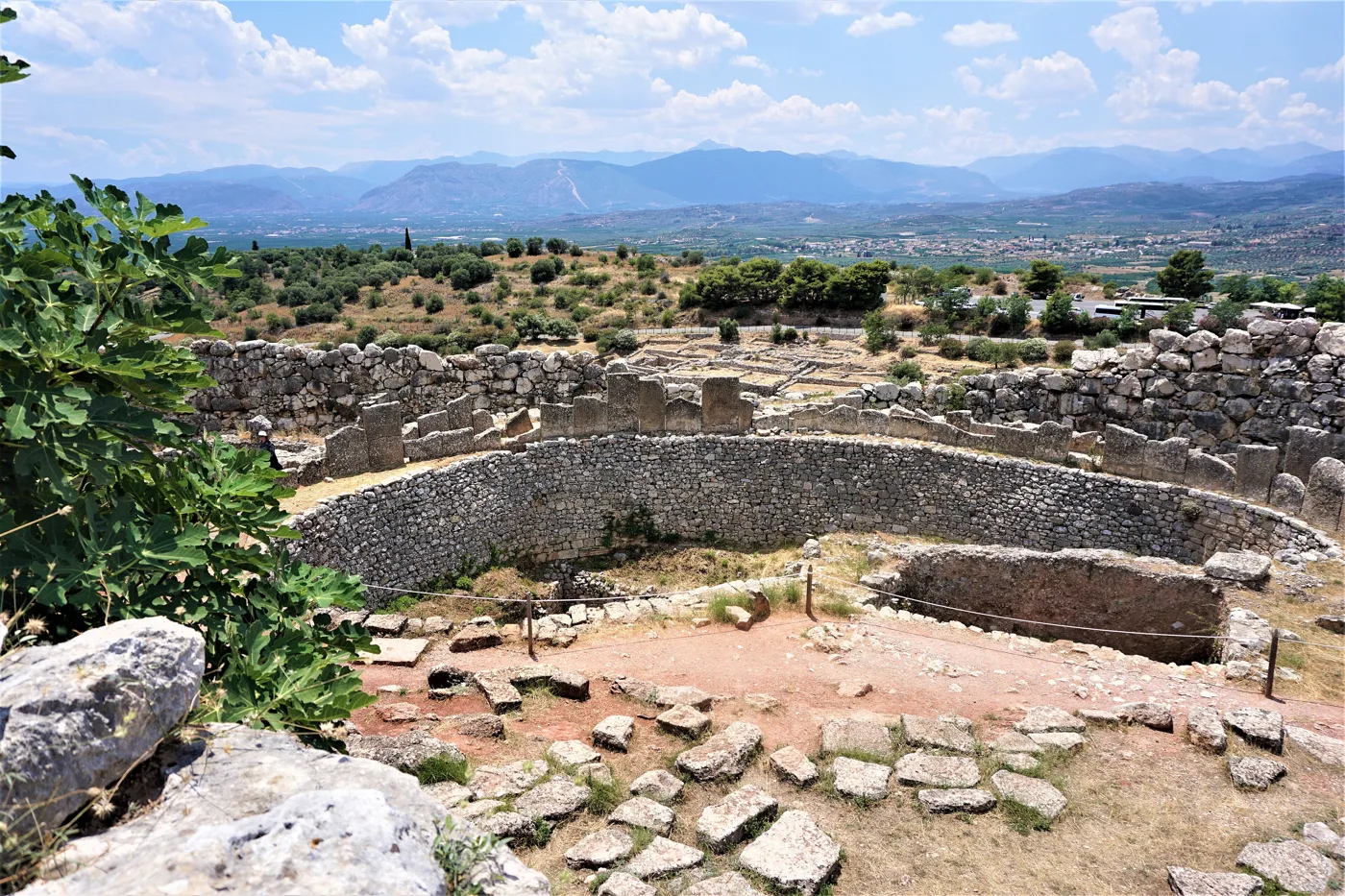
Carved stelae marked the graves.
As far as Argos and the sea.
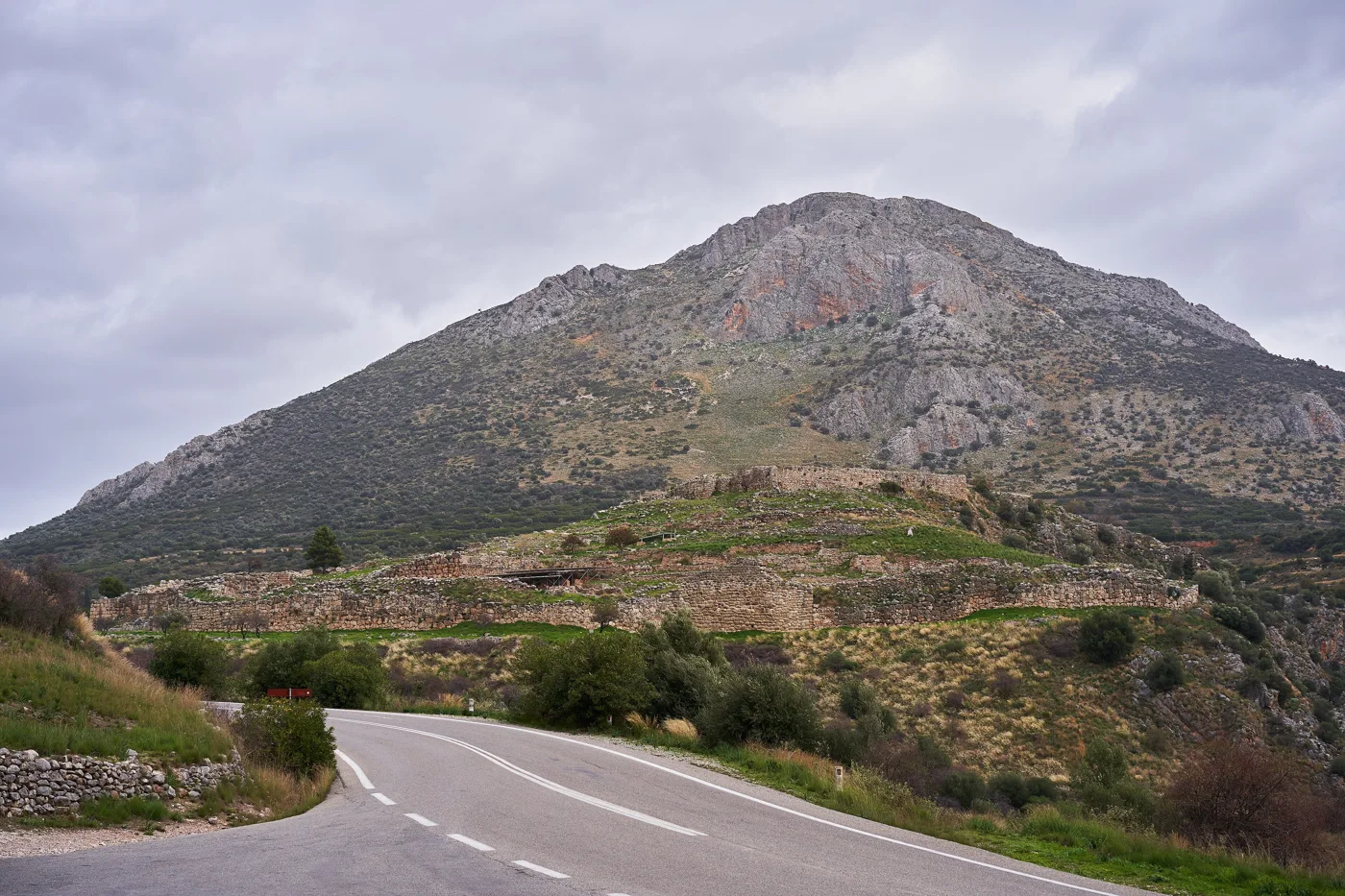
Between Profitis Ilias and Zara.
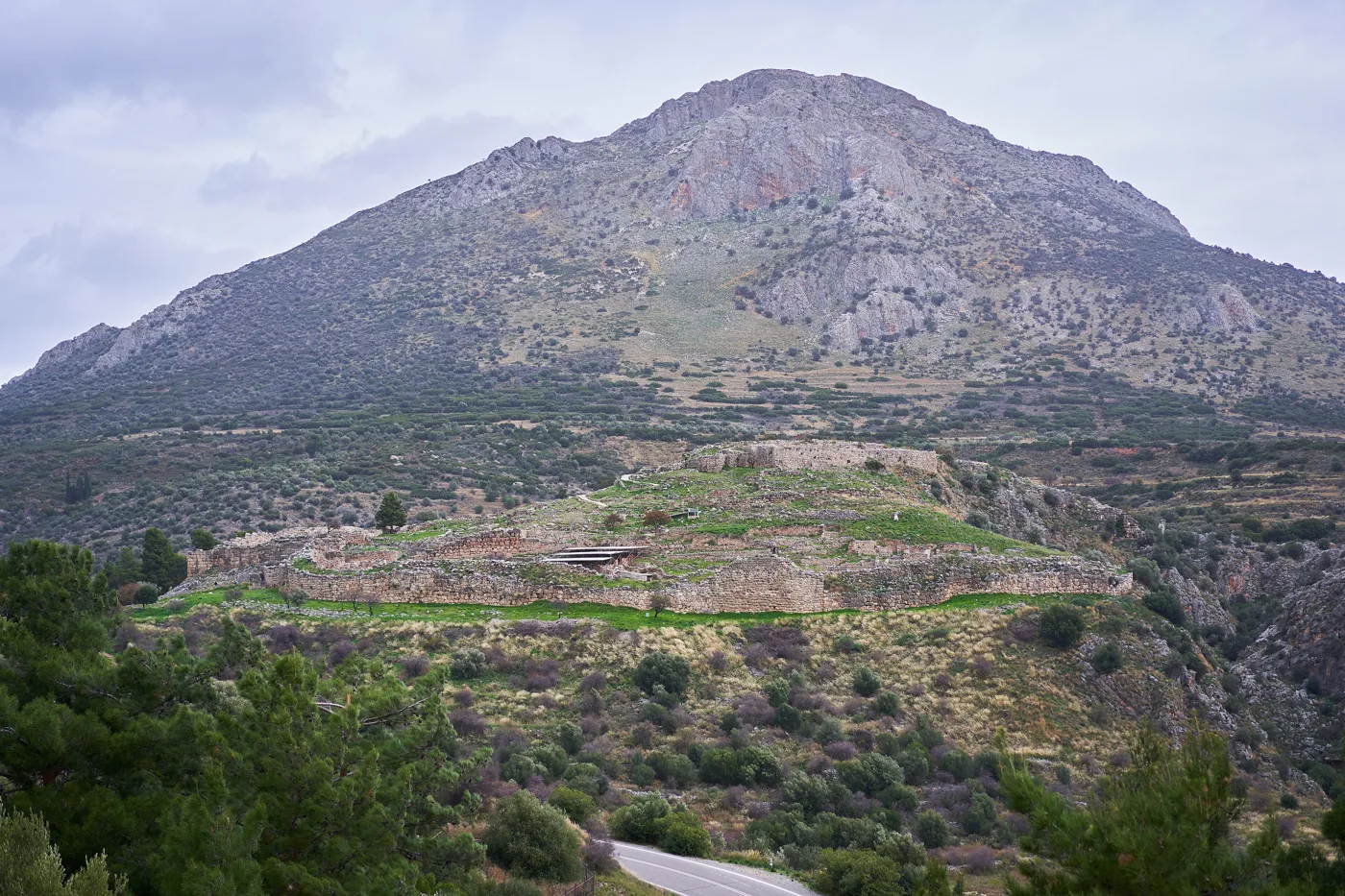
Agamemnon's castle in the ravine.
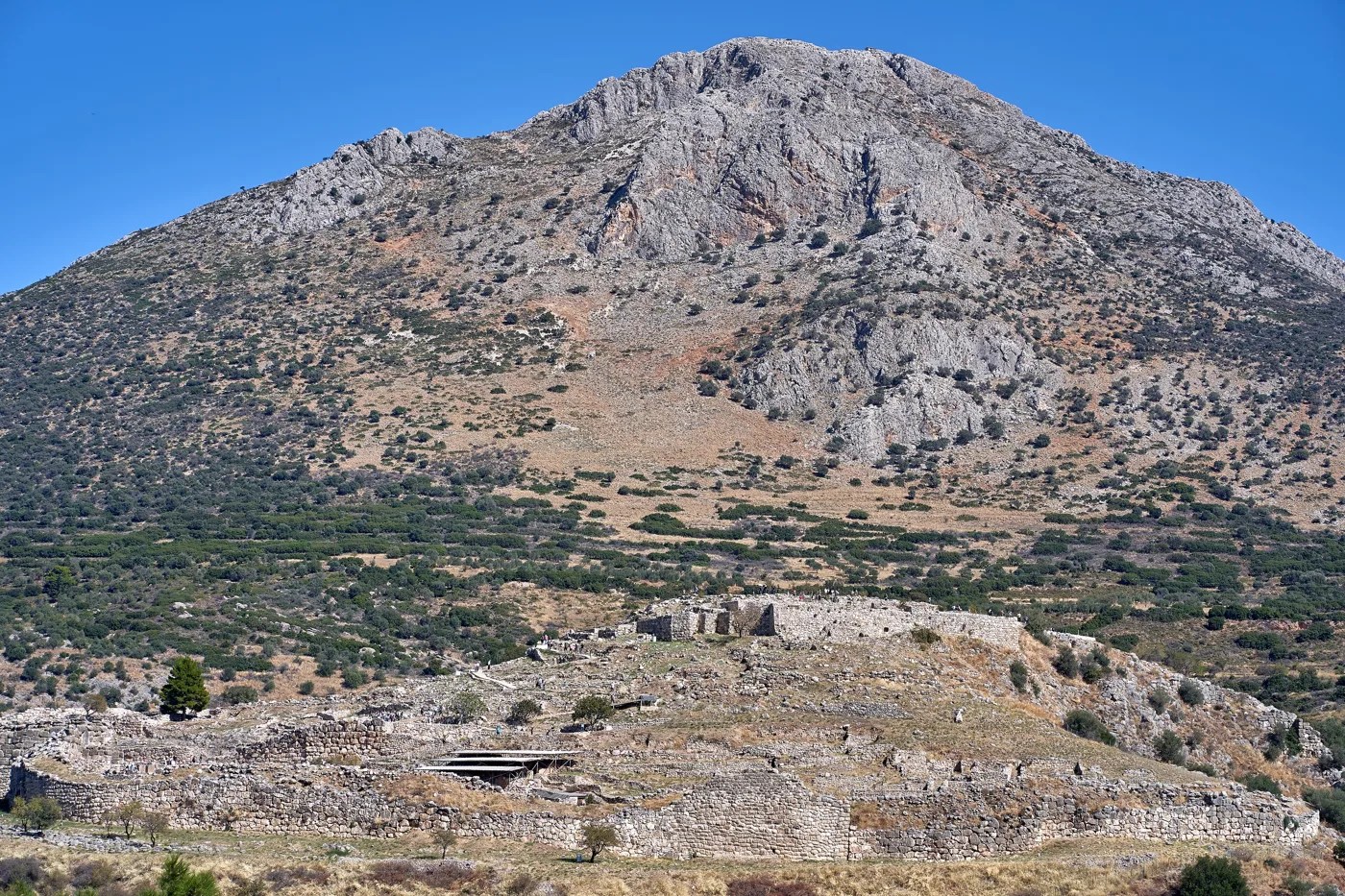
Dry, hot and without shade.
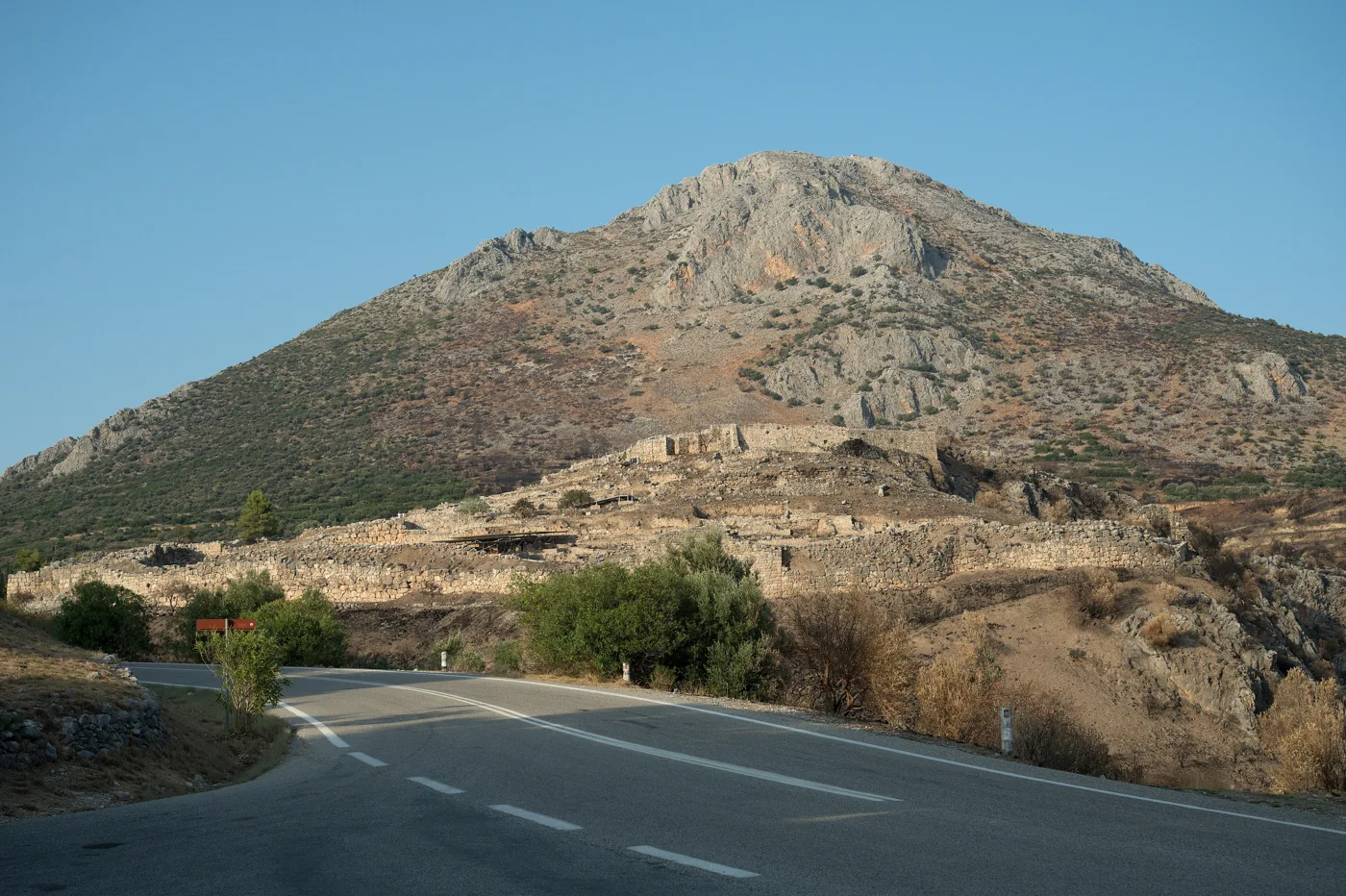
Two kilometres from the village.
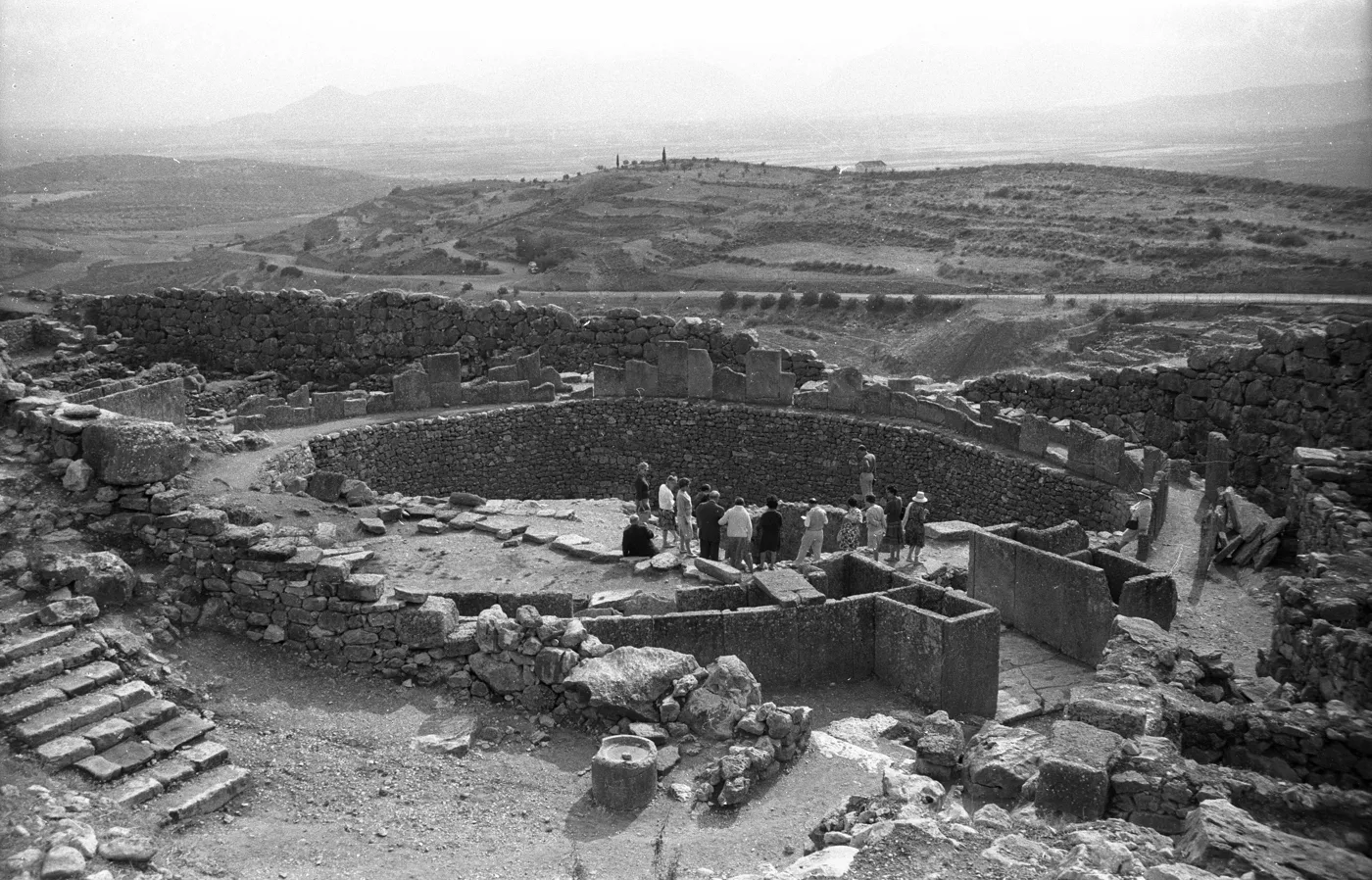
Grave Circle A sixty years ago.
Photos: LBM1948 (CC BY-SA 4.0), Zde (CC BY-SA 4.0), Jean Housen (CC BY-SA 4.0), Joyofmuseums (CC BY-SA 4.0), George E. Koronaios (CC BY-SA 4.0), Fortepan / Holenár Csaba és Edina (CC BY-SA 3.0) · Wikimedia Commons
🗺️ The map of Mycenae
From the car park and the ticket office (1) the road climbs in five minutes to the Lion Gate (2). Immediately to the right is Grave Circle A (3), and from there the path climbs to the top, to the palace (4). From the other side you go down to the north gate (5) and the underground cistern (6). The museum (7) is below the car park, and the Tomb of Clytemnestra (8) next to it. The Treasury of Atreus (9) is 500 metres before the site, on the road, with its own car park. Tap each number.
⚱️ The Treasury of Atreus
Five hundred metres before the archaeological site, with its own car park and on the same ticket, is the Treasury of Atreus or «Tomb of Agamemnon»: the largest and most perfect tholos tomb of the Mycenaean world, from around 1250 BC. You walk along a passage of 36 metres between high walls of dressed stone, through a doorway with a lintel of 120 tons, the heaviest stone in any ancient building, and enter a dome 13.5 metres high and 14.5 metres in diameter, built of 33 rings of stone narrowing to the top, without mortar. It was the largest dome in the world for a thousand years, until the Pantheon was built in Rome. Its facade had columns of green marble with carvings, which are today in the British Museum and the National Archaeological Museum in Athens. The tomb was always open and had been robbed since antiquity; nobody knows who was buried here. Beside the car park of the site is the Tomb of Clytemnestra, the second great tholos tomb.
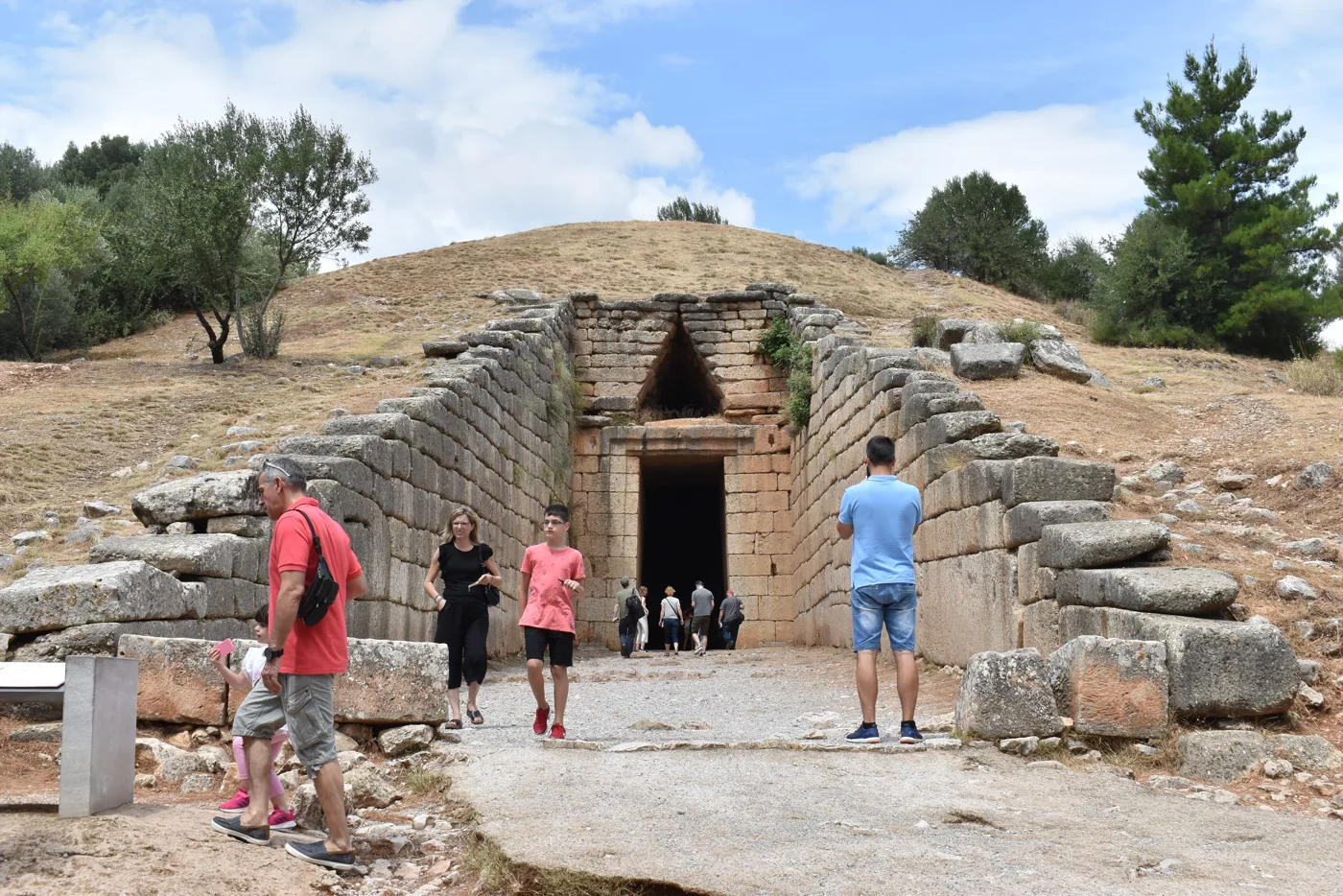
The largest tholos tomb of the Mycenaean world.
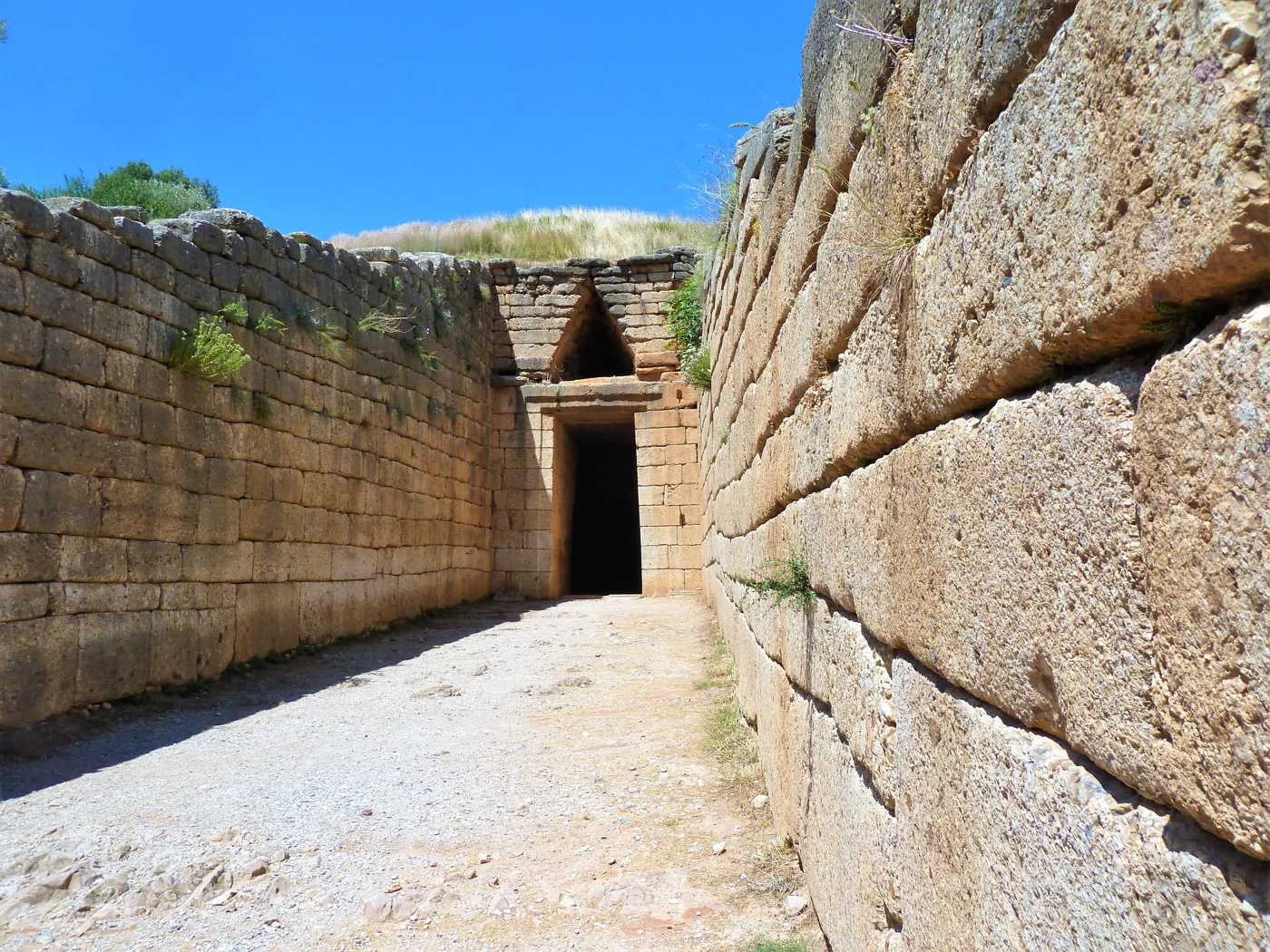
36 metres long, 6 metres wide.
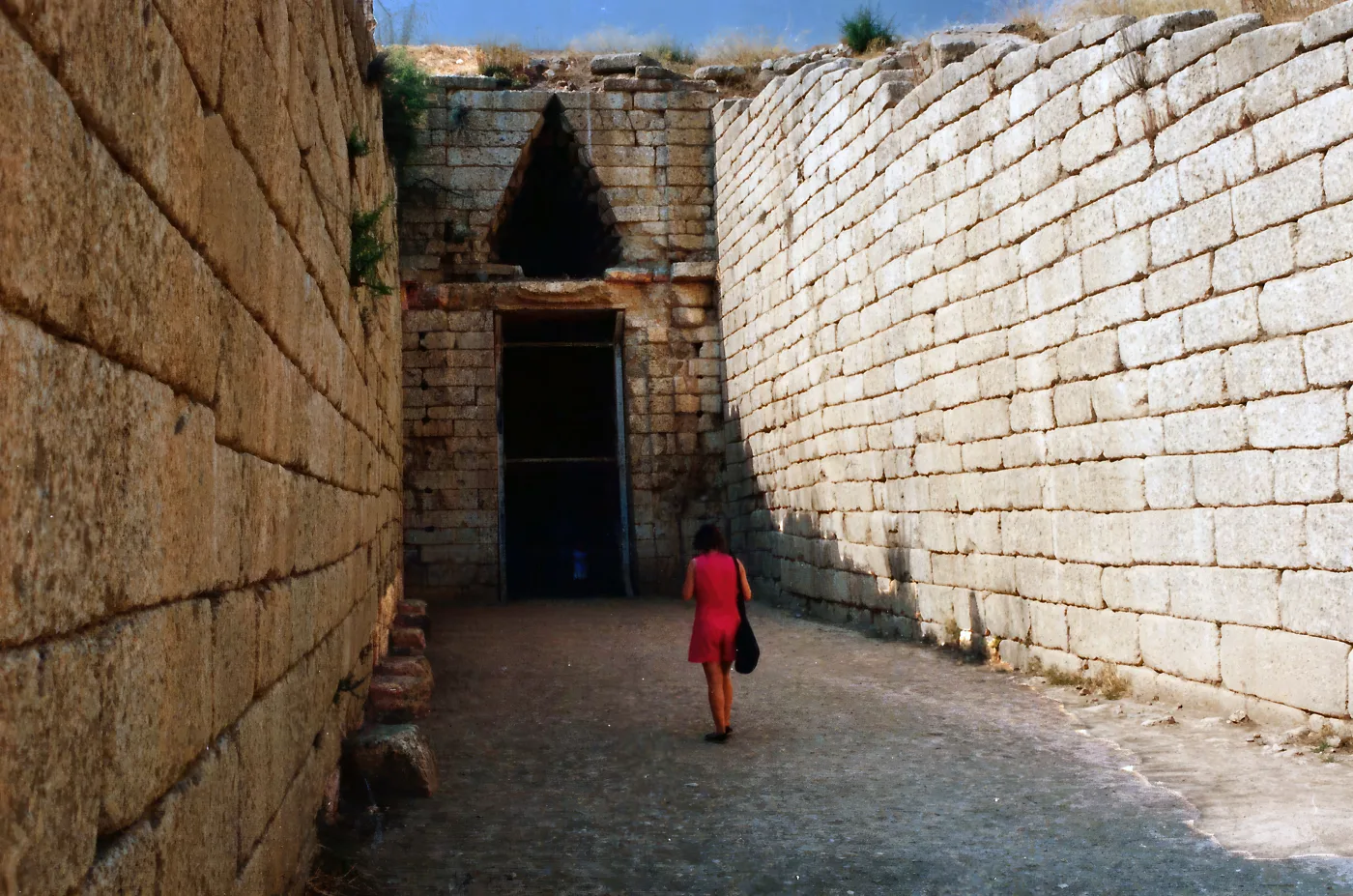
The lintel weighs 120 tons.
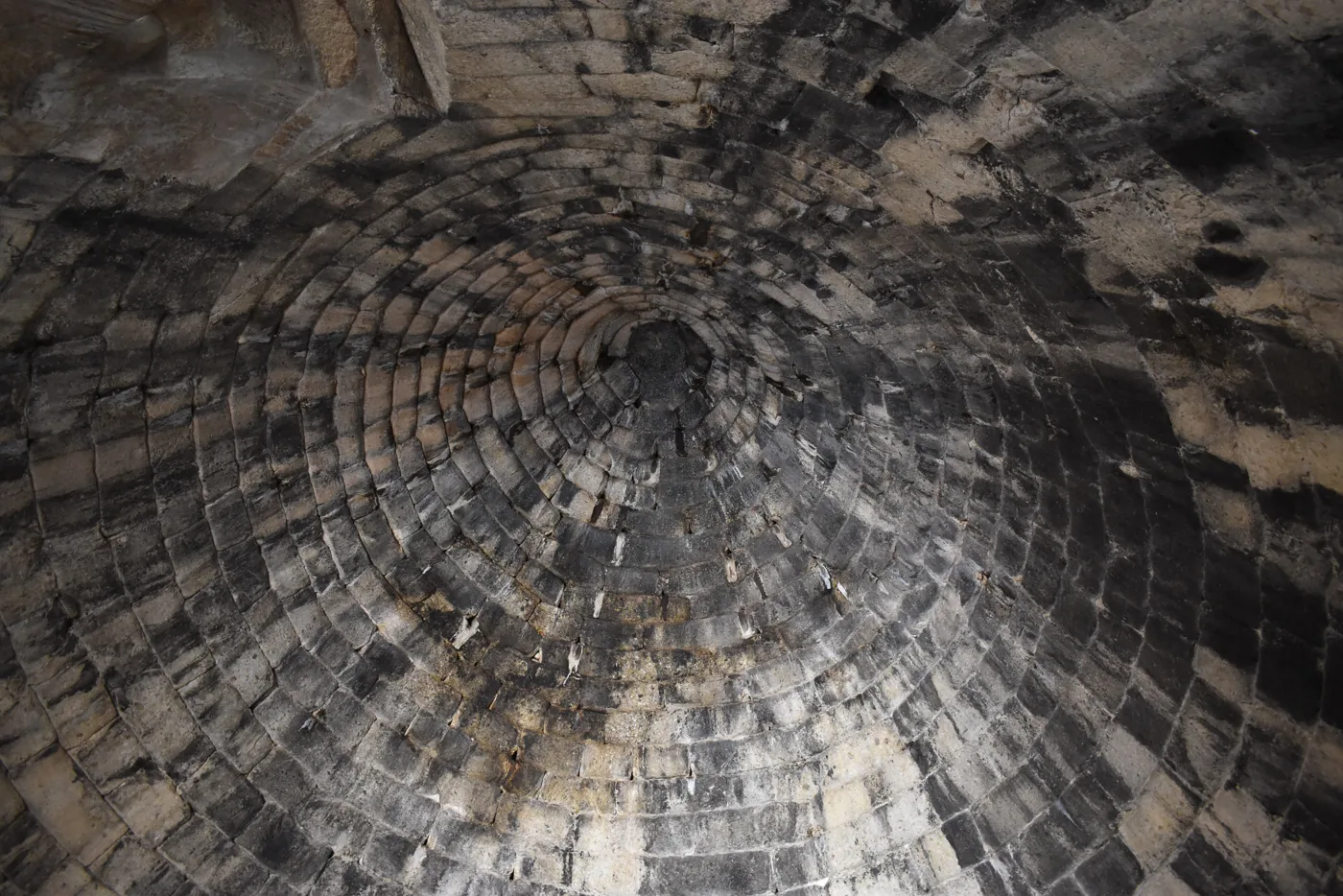
13.5 metres high, 14.5 metres in diameter.
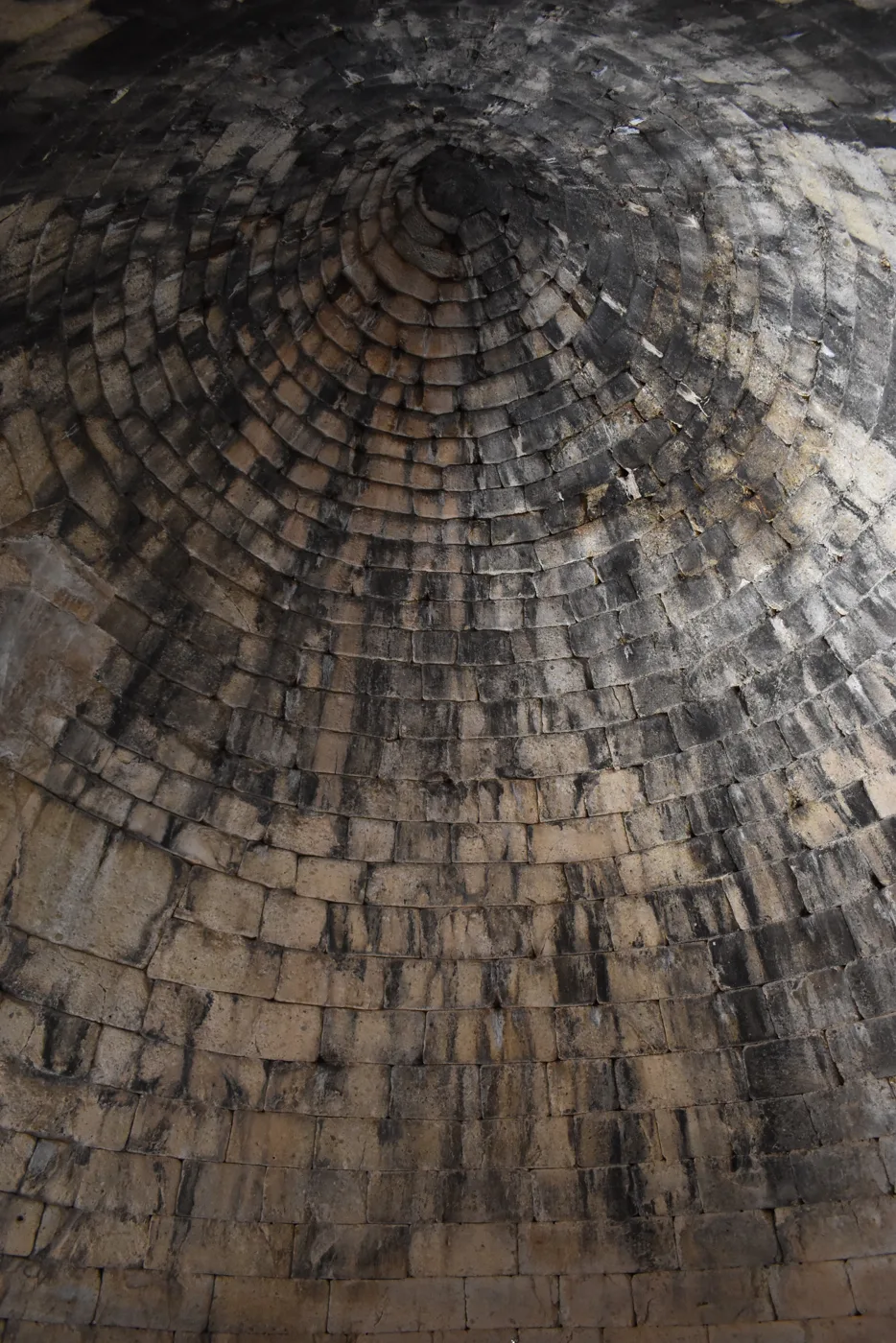
33 rings of stone, without mortar.
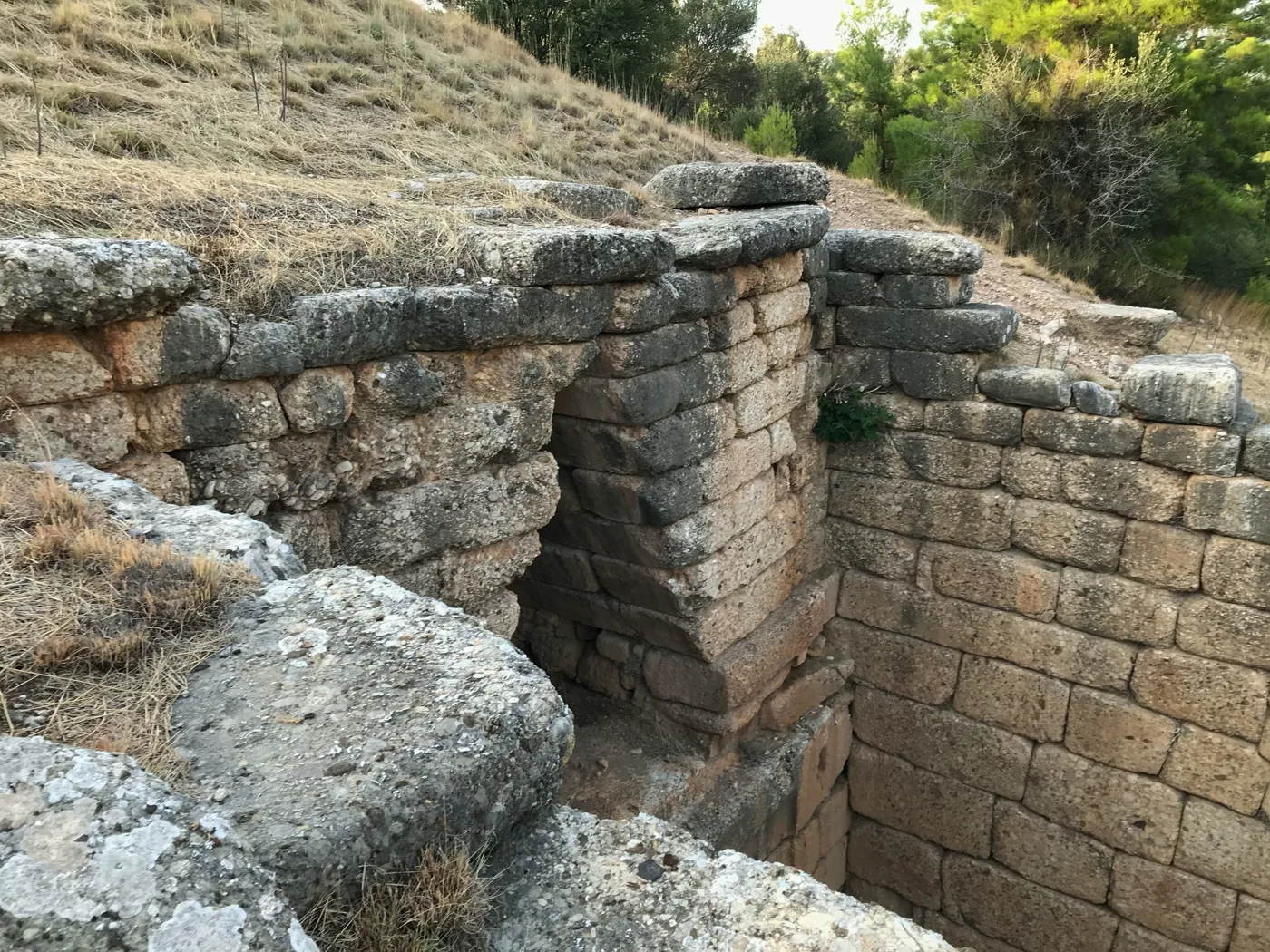
From above you can see the earth mound covering the dome.
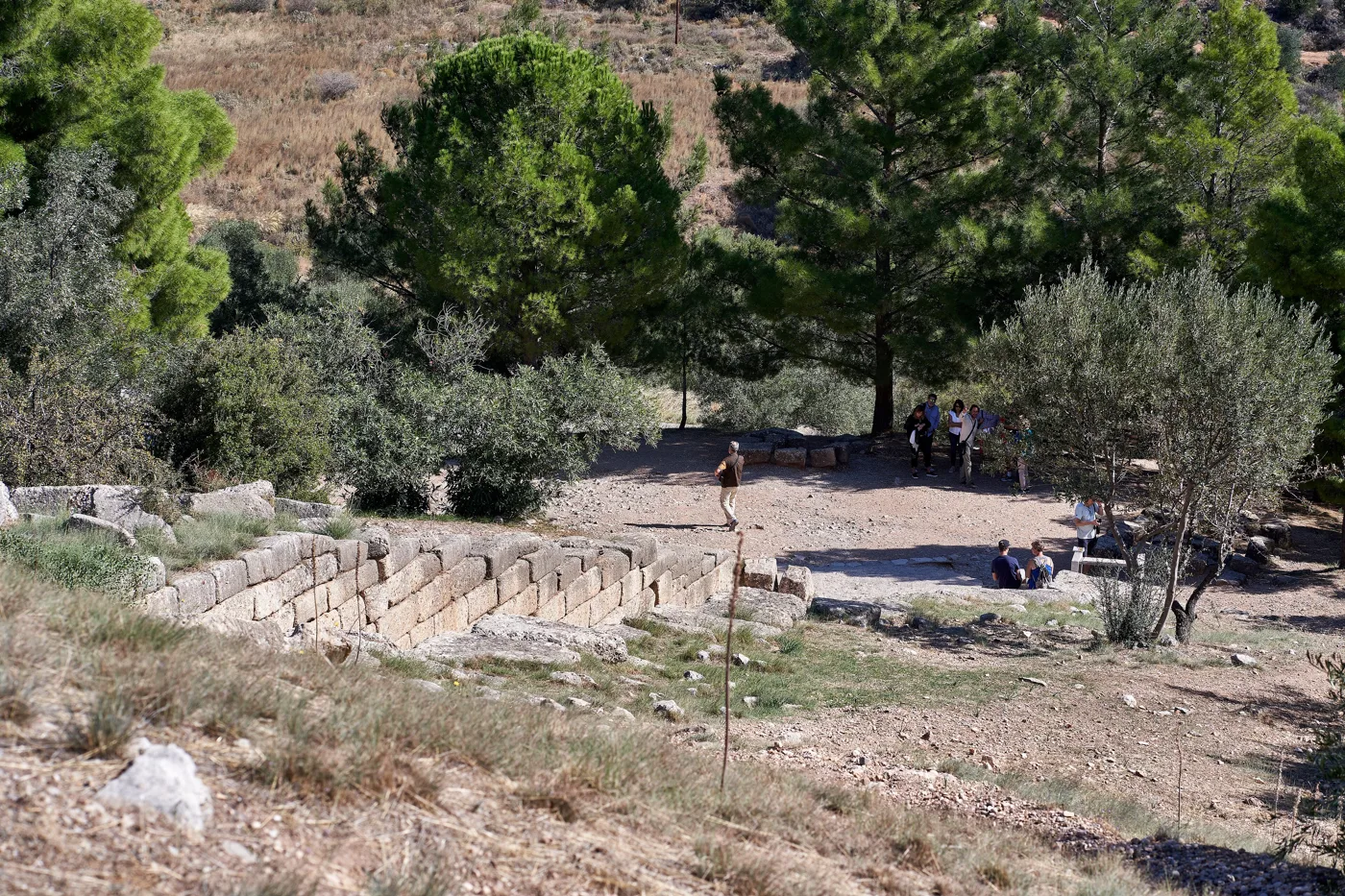
The tomb is dug into the hillside.
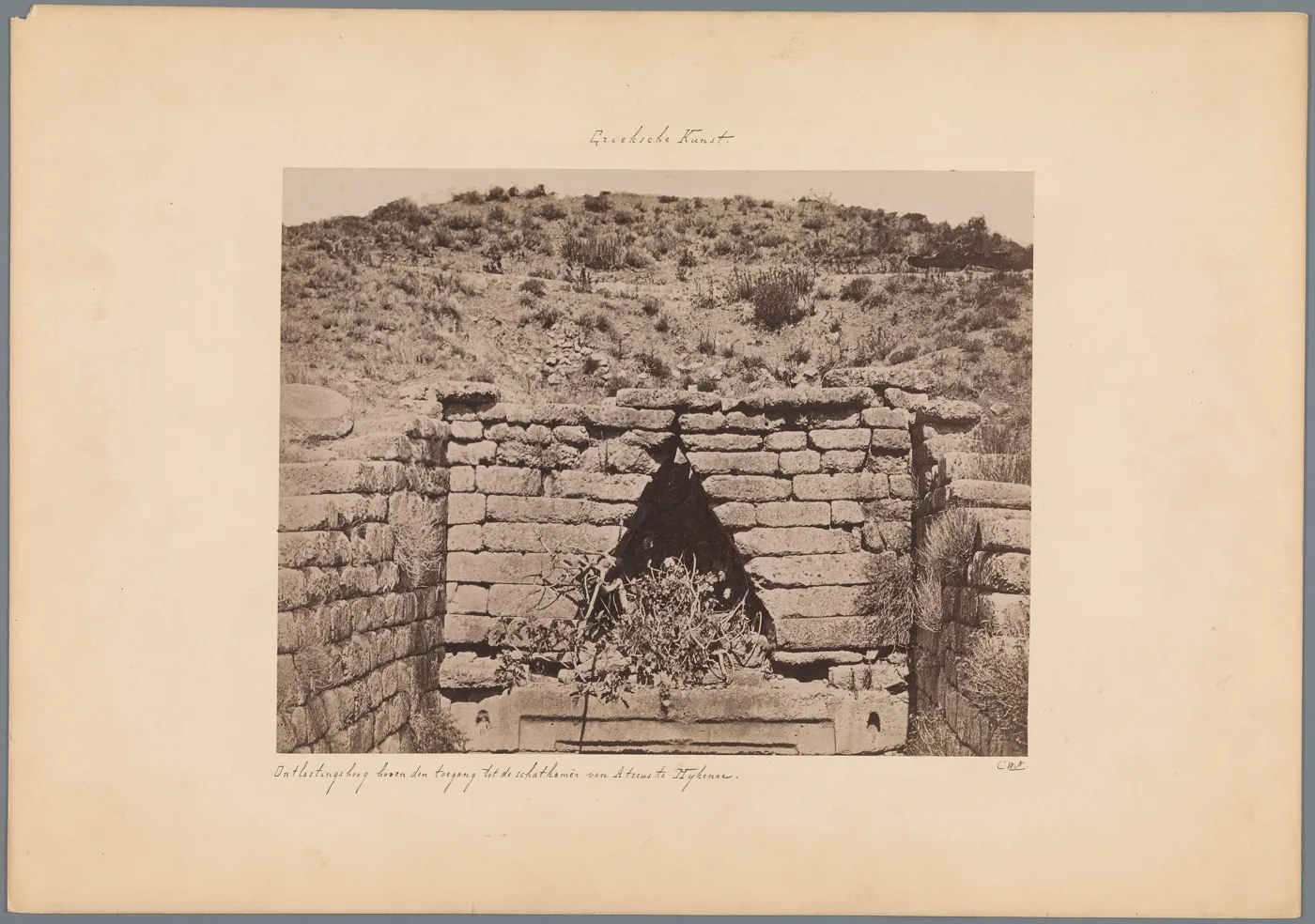
The tomb was always open, never lost.
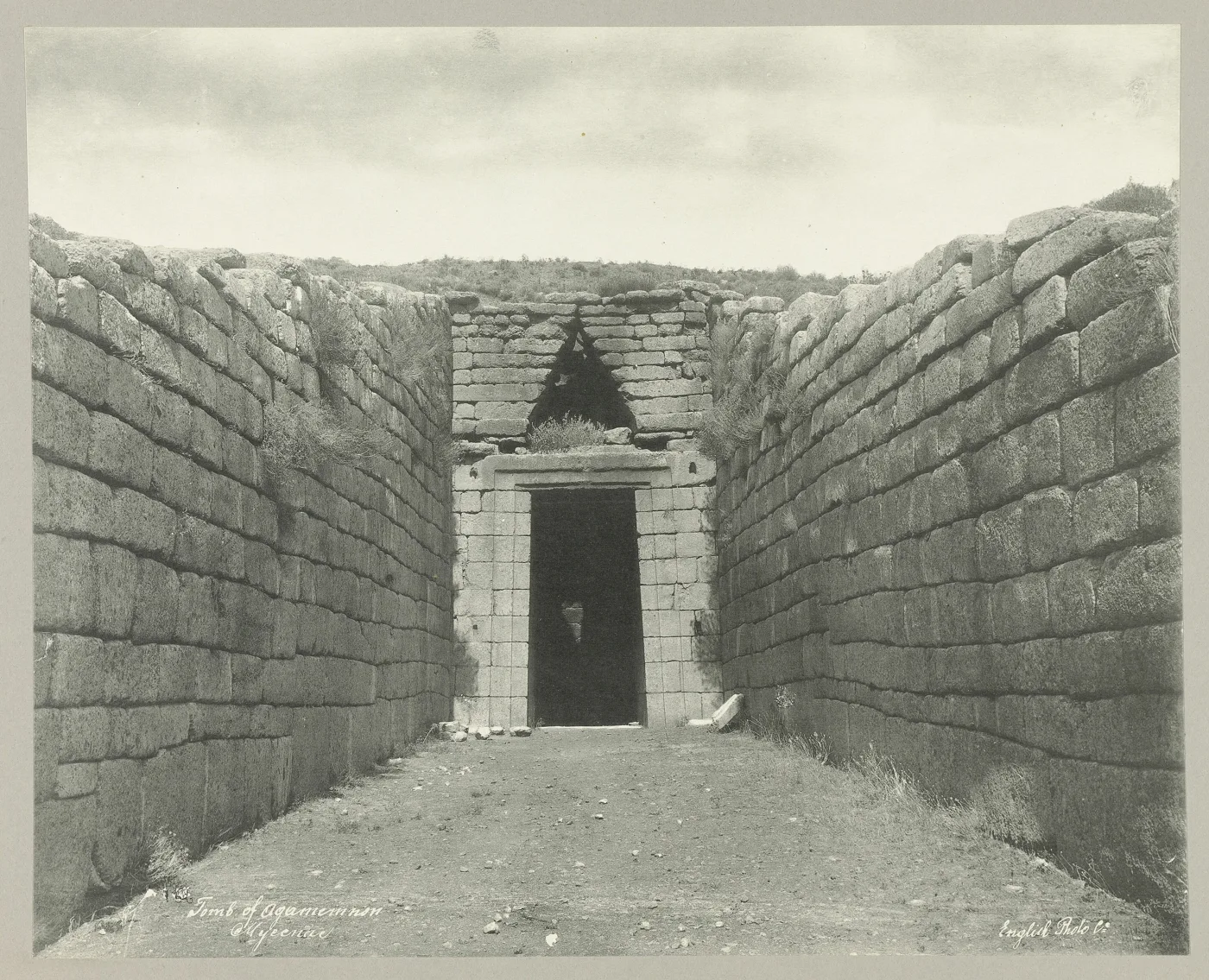
That is what the travellers called it.
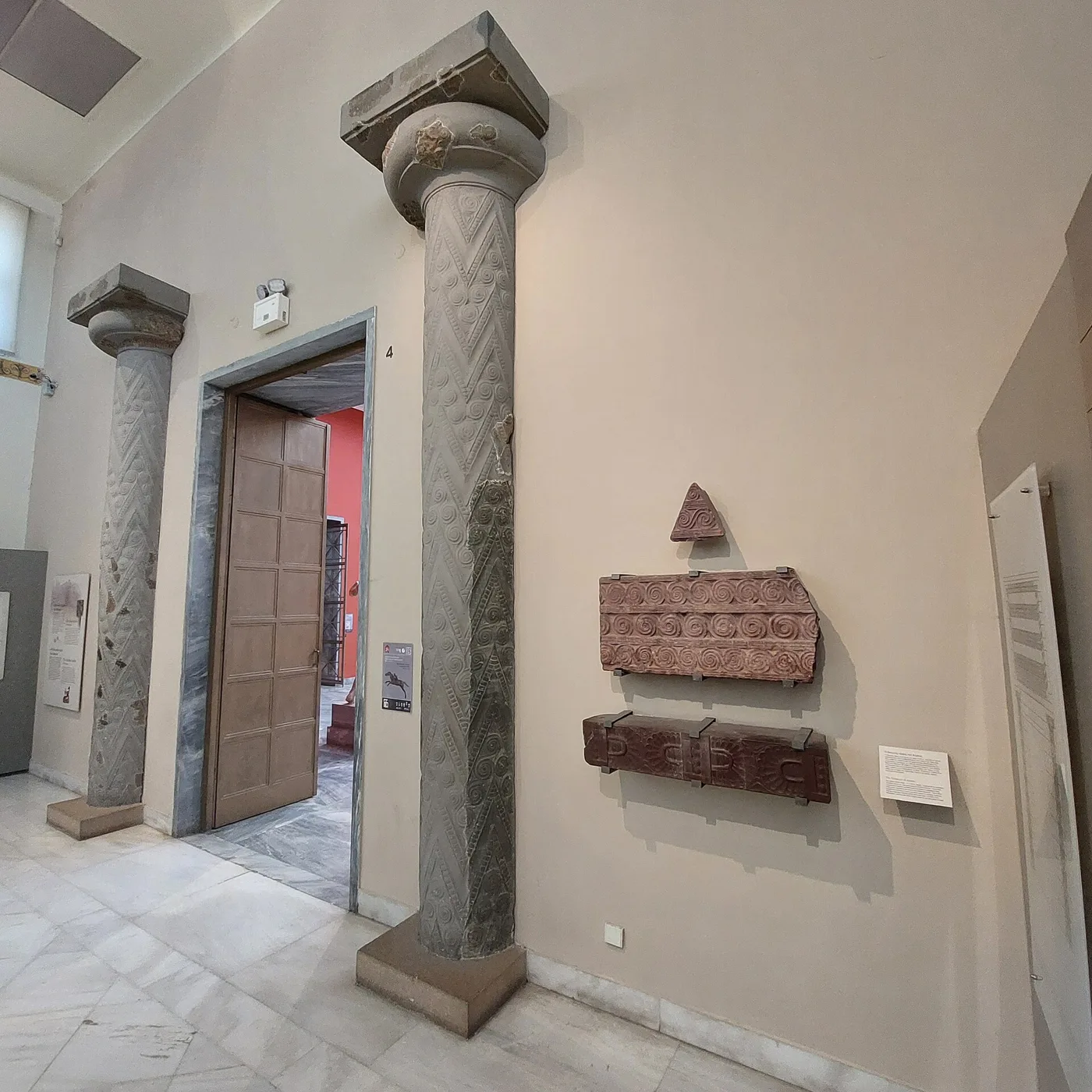
With columns of green marble, today in Athens and London.
Photos: Annatsach (CC BY-SA 4.0), Nikos Christodoulopoulos (CC BY-SA 4.0), Ángel M. Felicísimo (CC BY 2.0), Zde (CC BY-SA 4.0), George E. Koronaios (CC BY-SA 4.0), Rijksmuseum (CC0), Attar-Aram syria (CC BY 4.0) · Wikimedia Commons
🏺 The Archaeological Museum of Mycenae
The museum, low and stone-built below the car park, opened in 2003 and is the cool last stop. In three galleries you see what was found at Mycenae and did not go to Athens: the painted figurines from the cult centre of the citadel, the vases with the octopuses, the Linear B tablets with the accounts of the palace, the weapons, jewellery and tools from the graves, and copies of Schliemann's gold finds, whose originals you see in the National Archaeological Museum. Look first at the model of the citadel: it explains the site better than any sign. Half an hour to an hour.
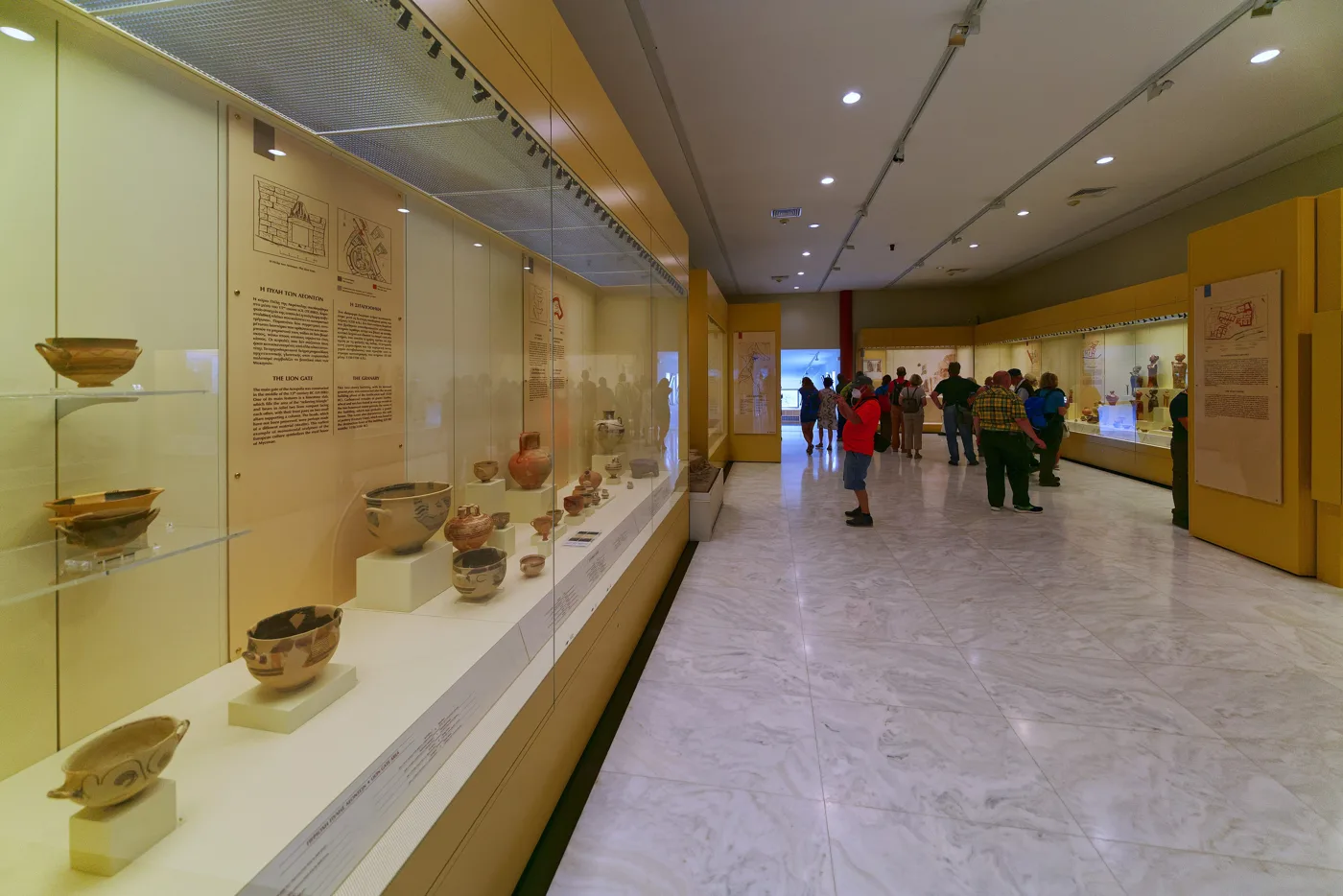
Opened in 2003, below the citadel.
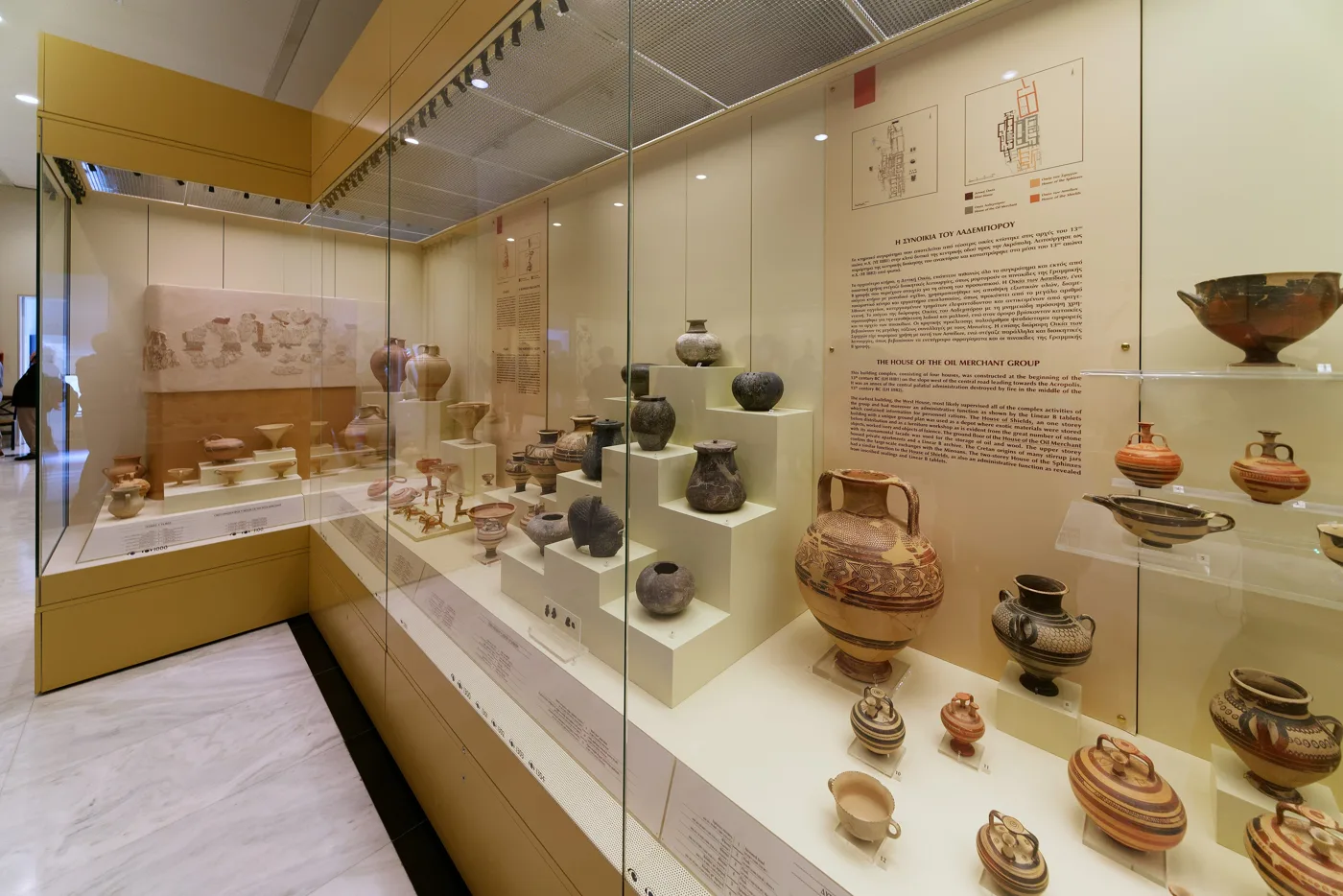
Vases from the graves and the houses.
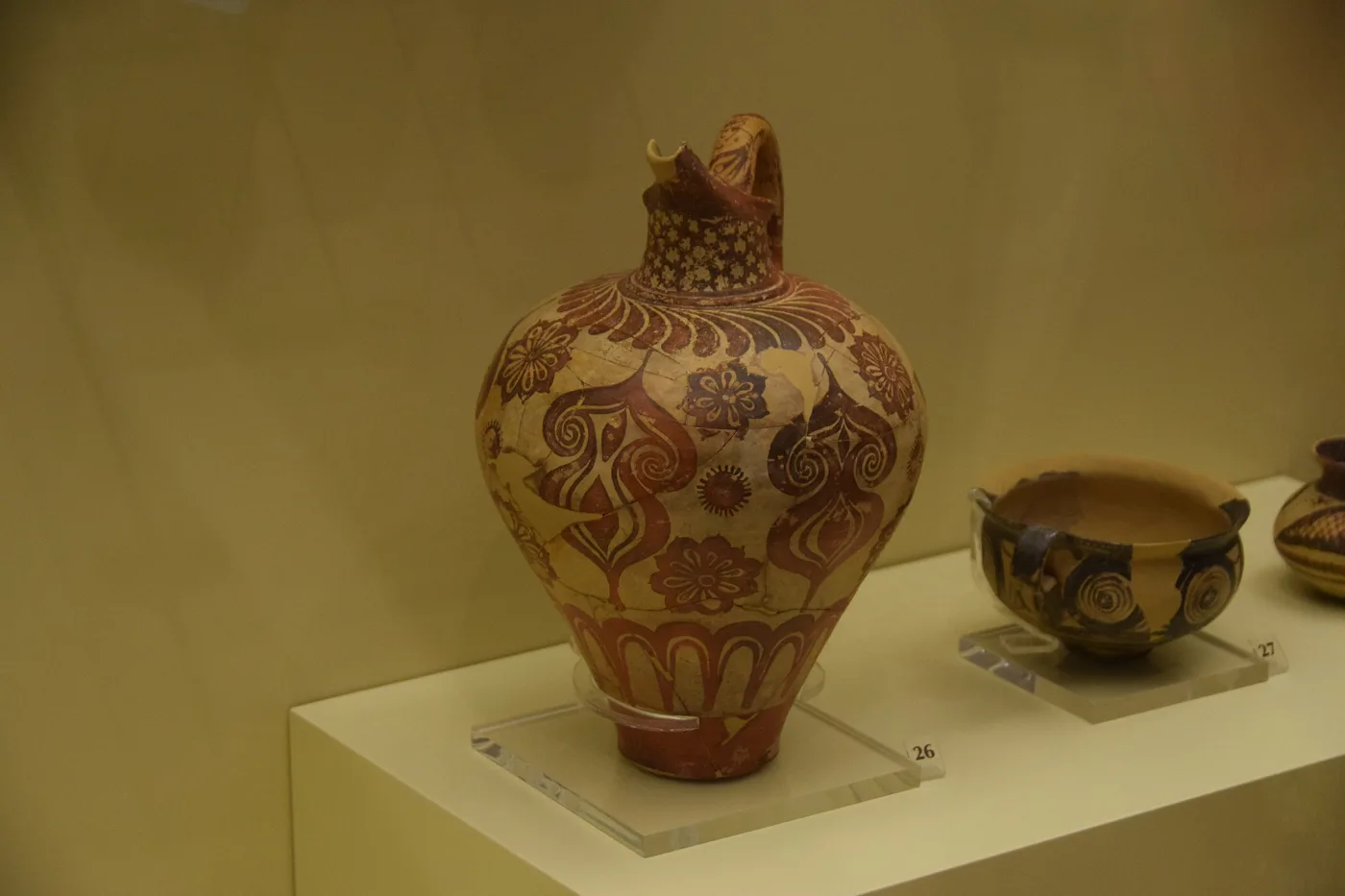
The favourite subject of the Mycenaean vase painters.
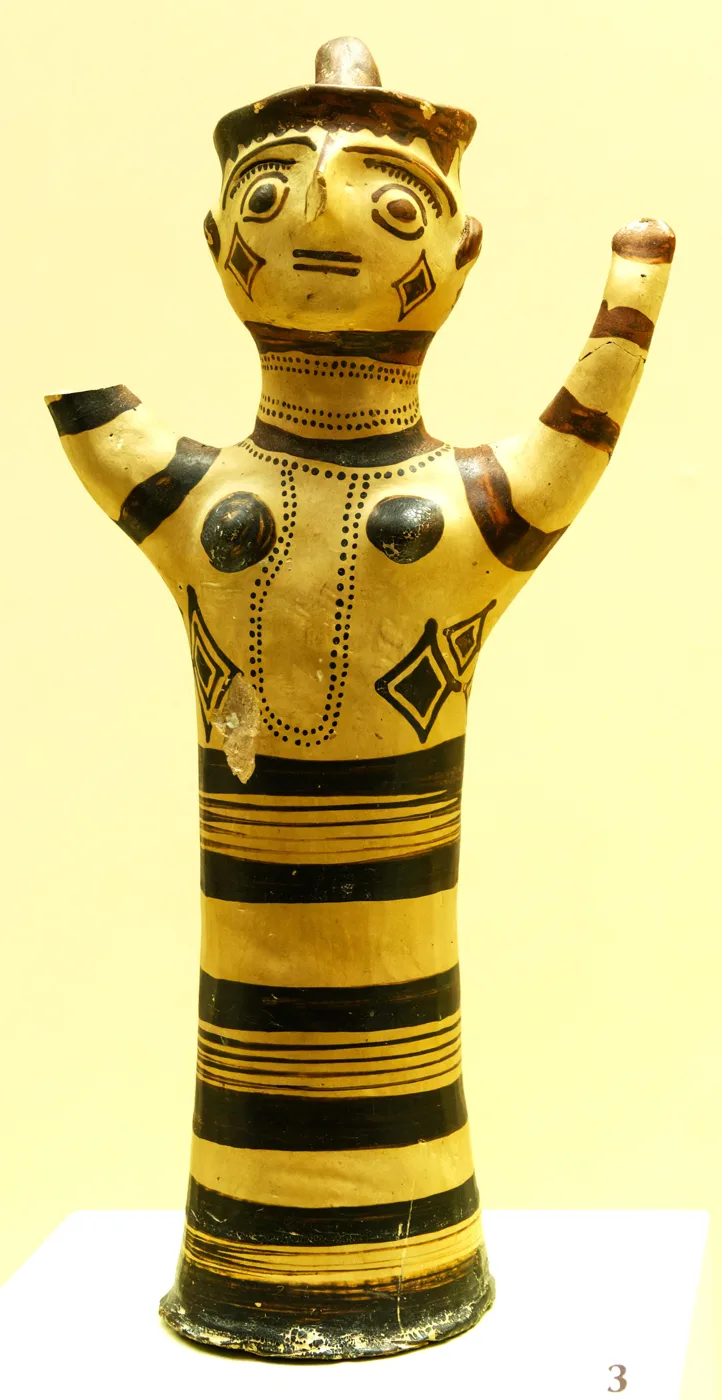
The arms raised like the letter Ψ.
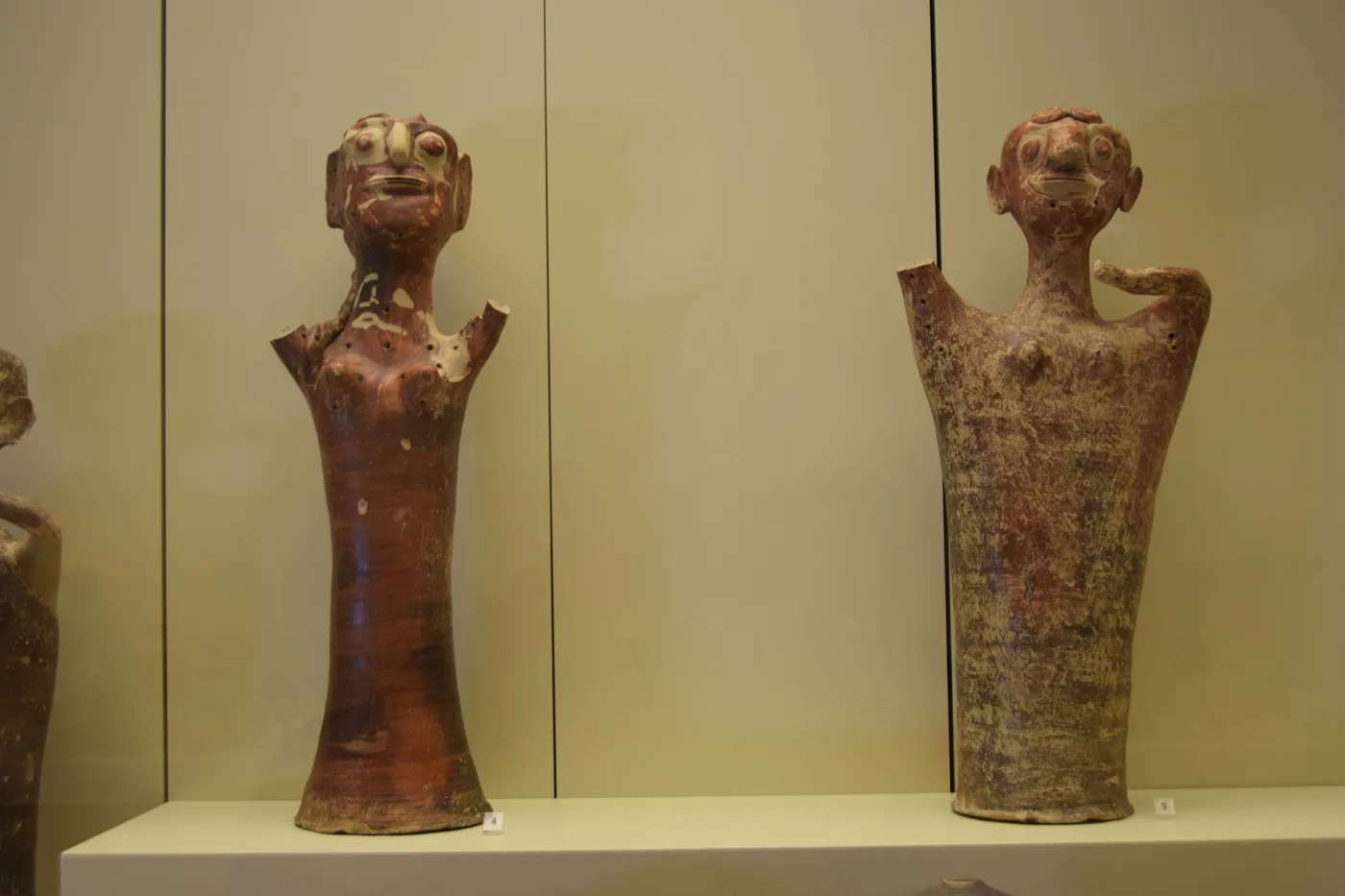
From the cult centre of the citadel.
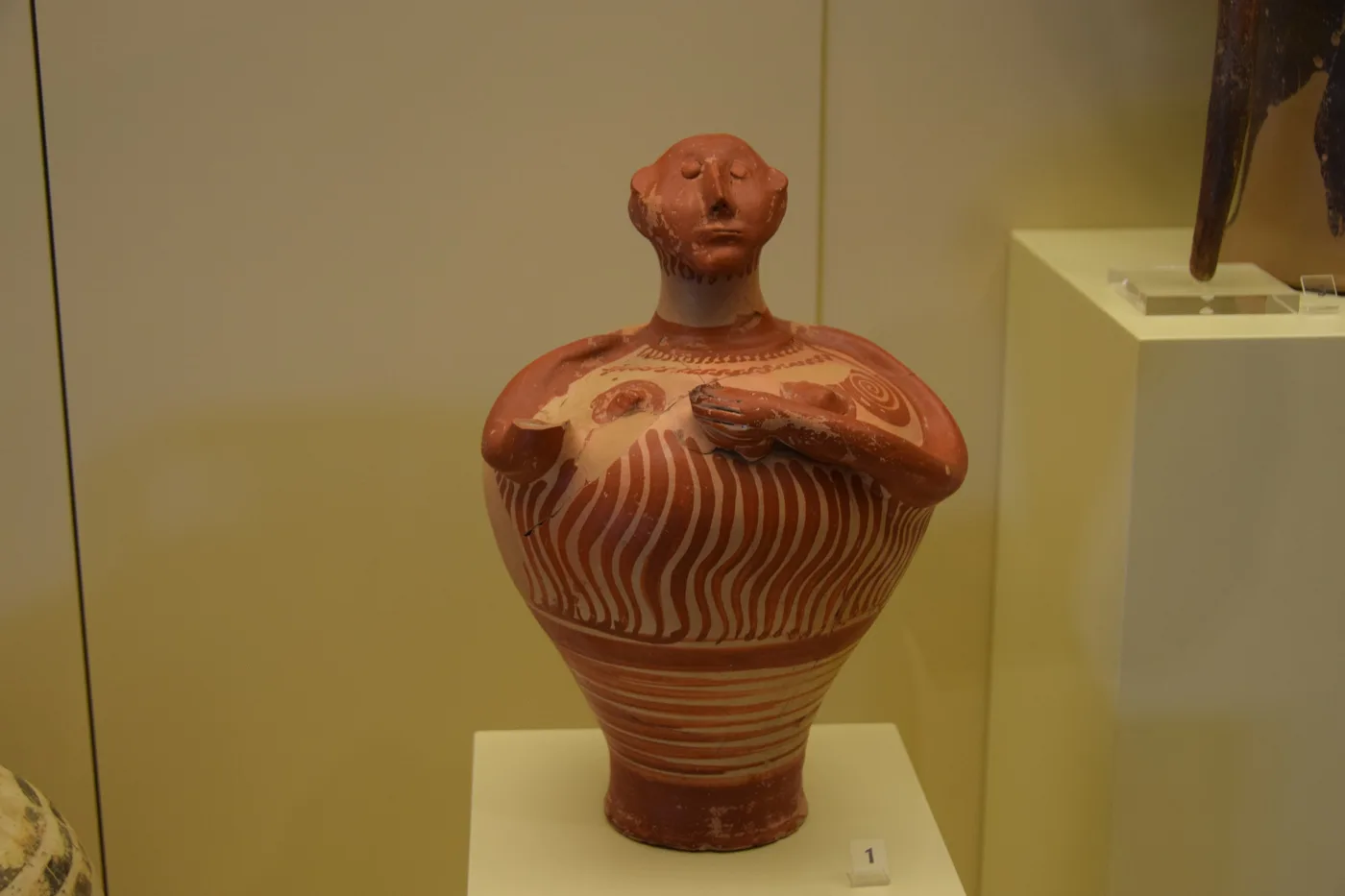
Or priestess. Nobody knows for sure.
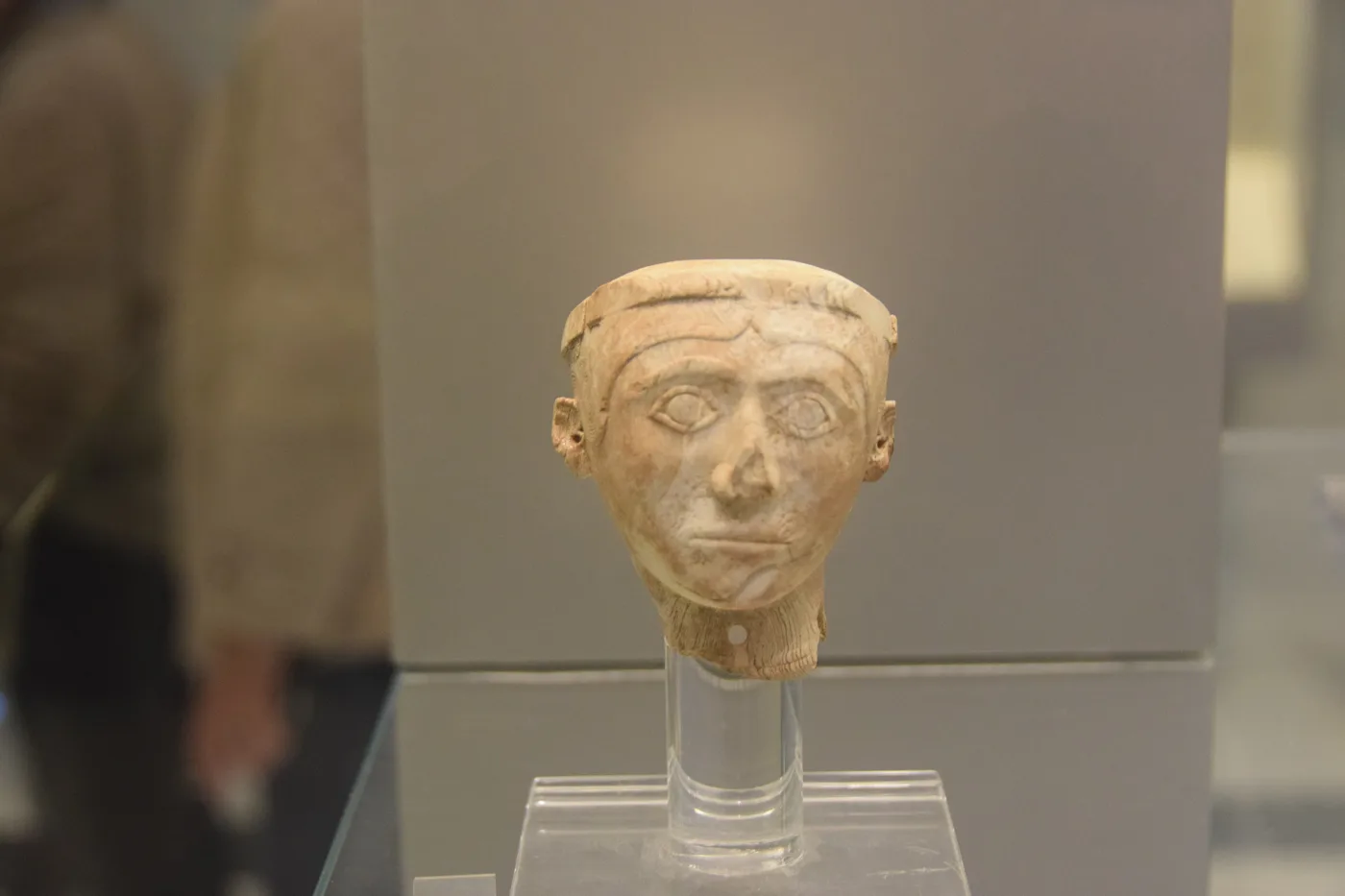
One of the few faces of Mycenaean art.
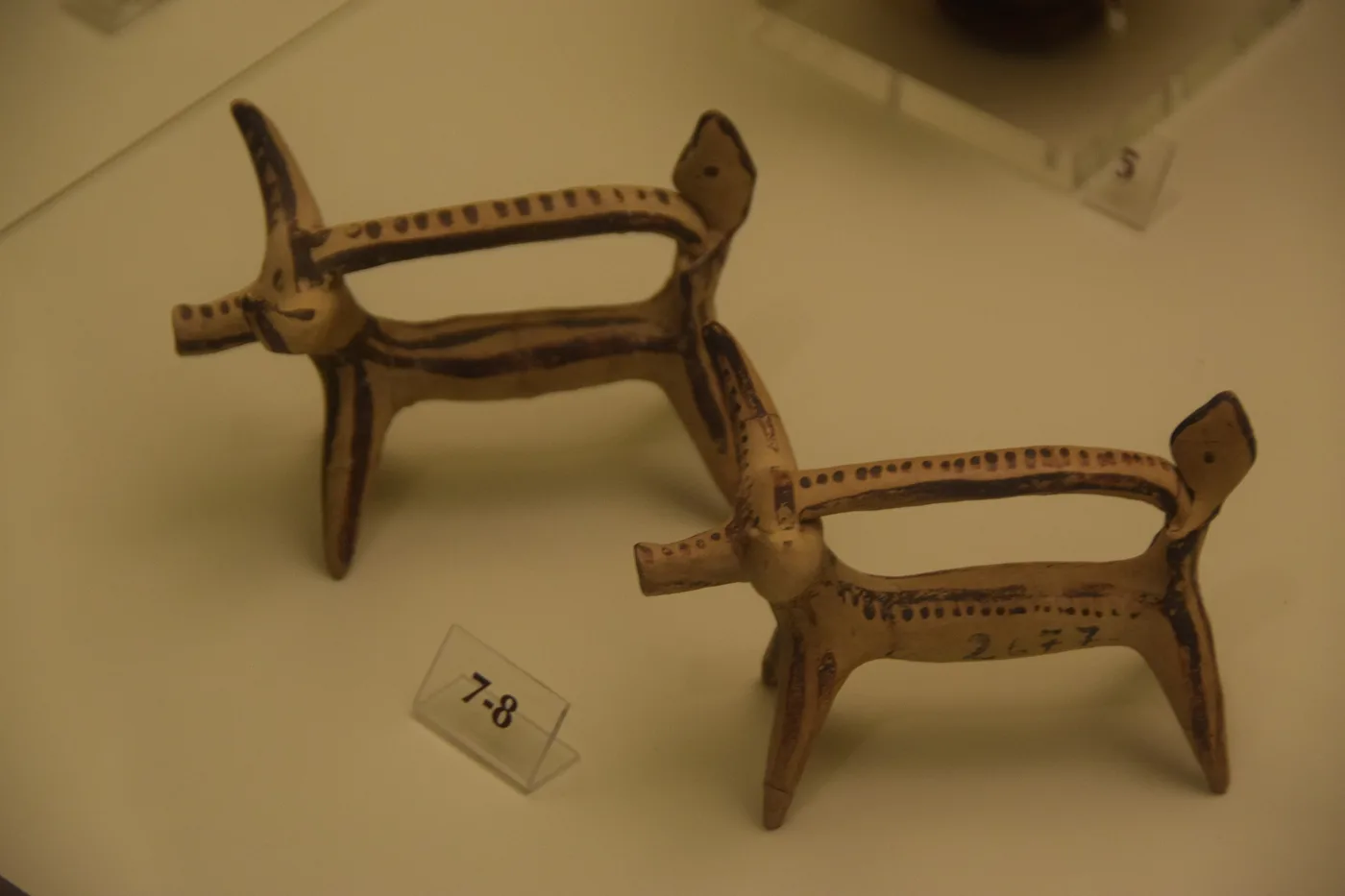
Toys or offerings.
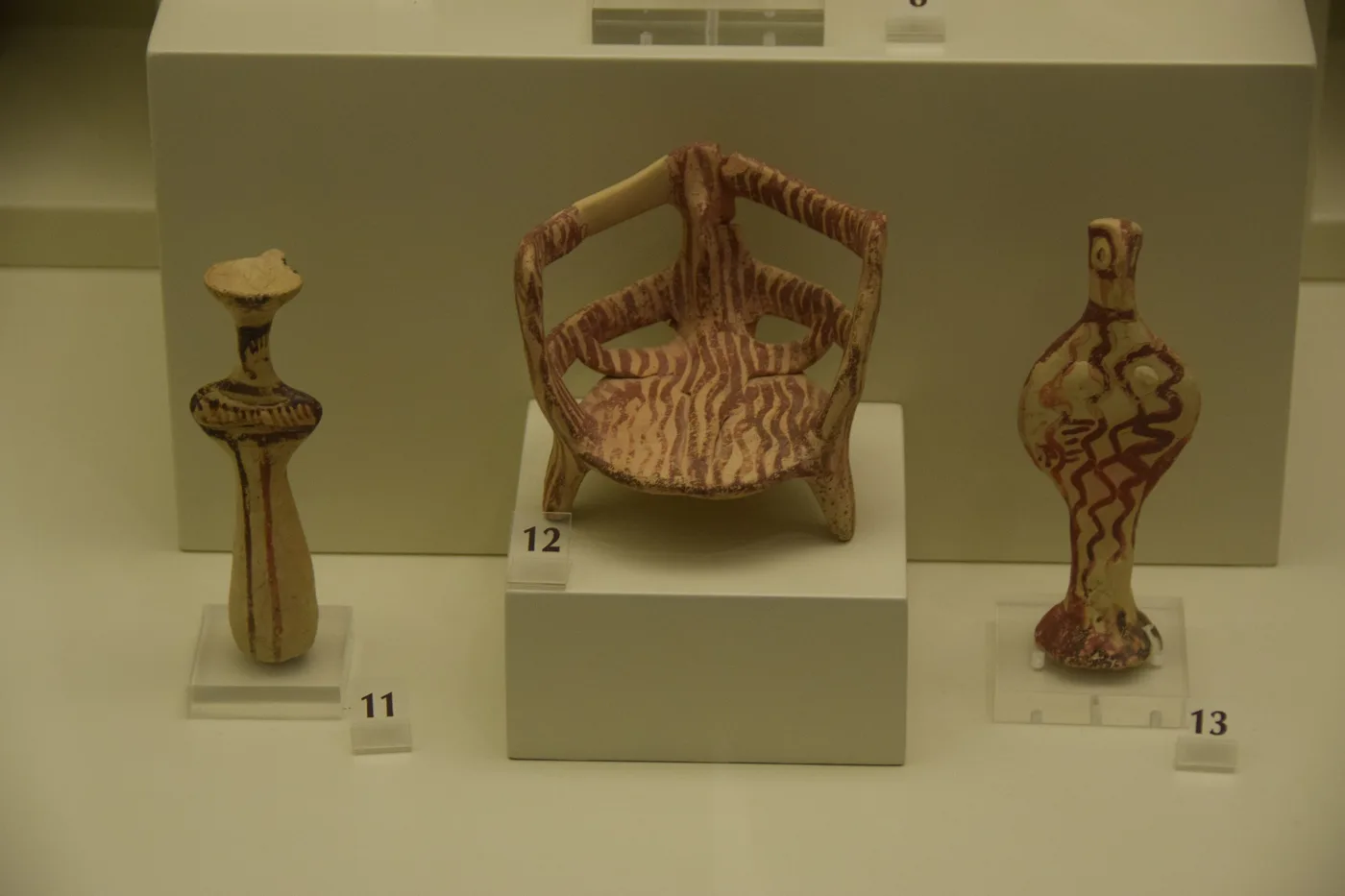
Miniature furniture for the gods.
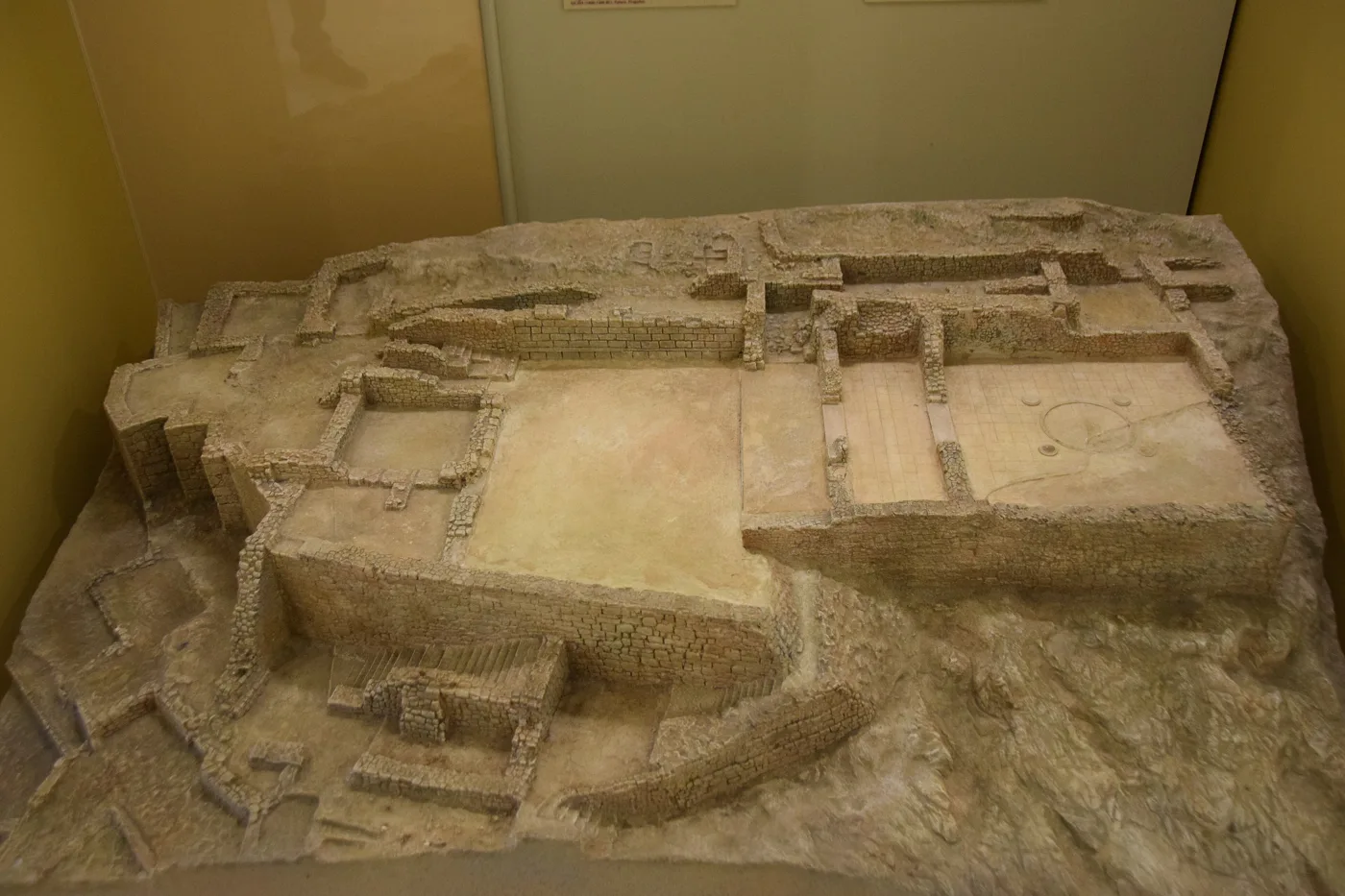
Look at it first, to understand the site.
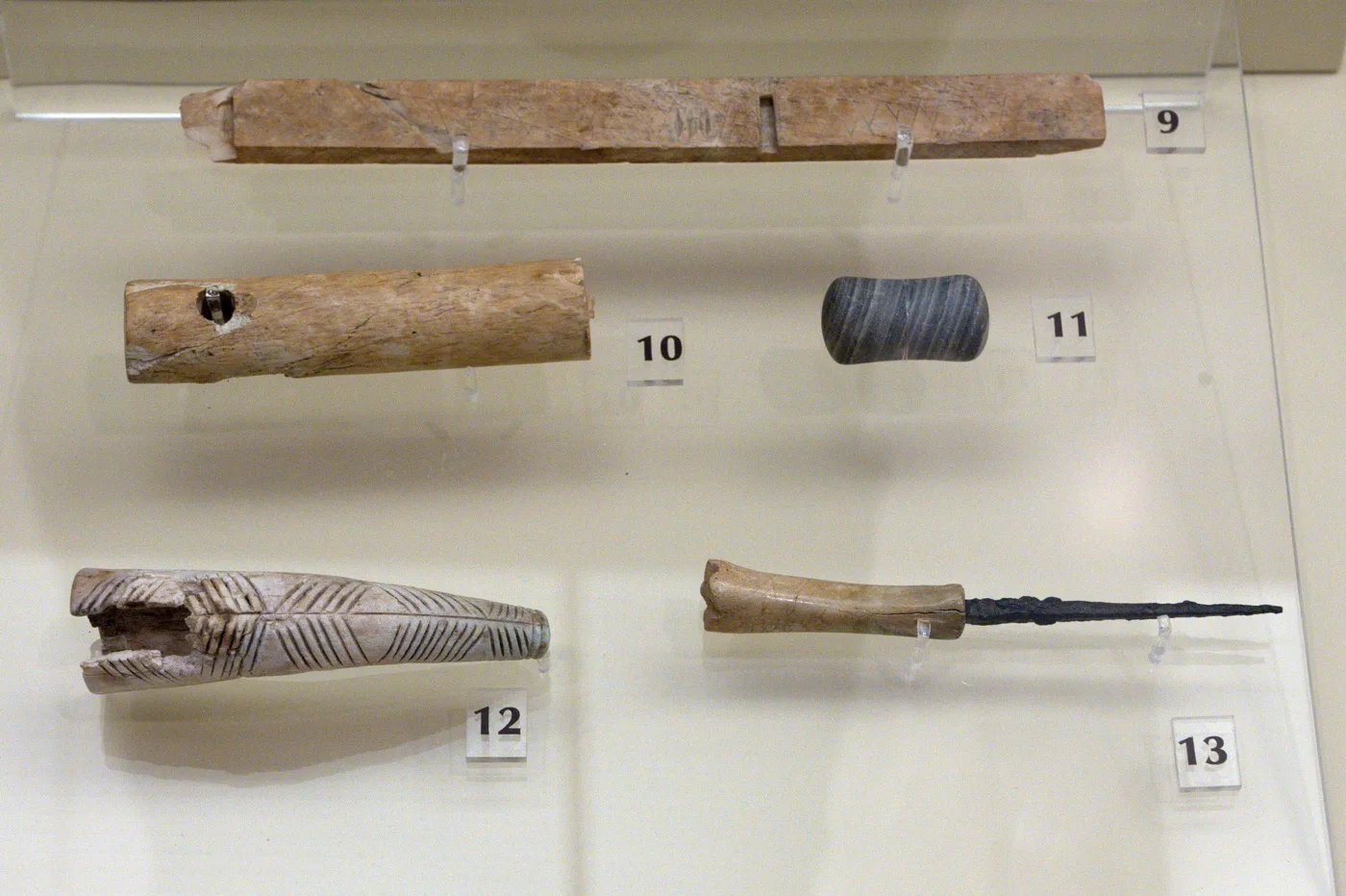
Of bone and bronze.
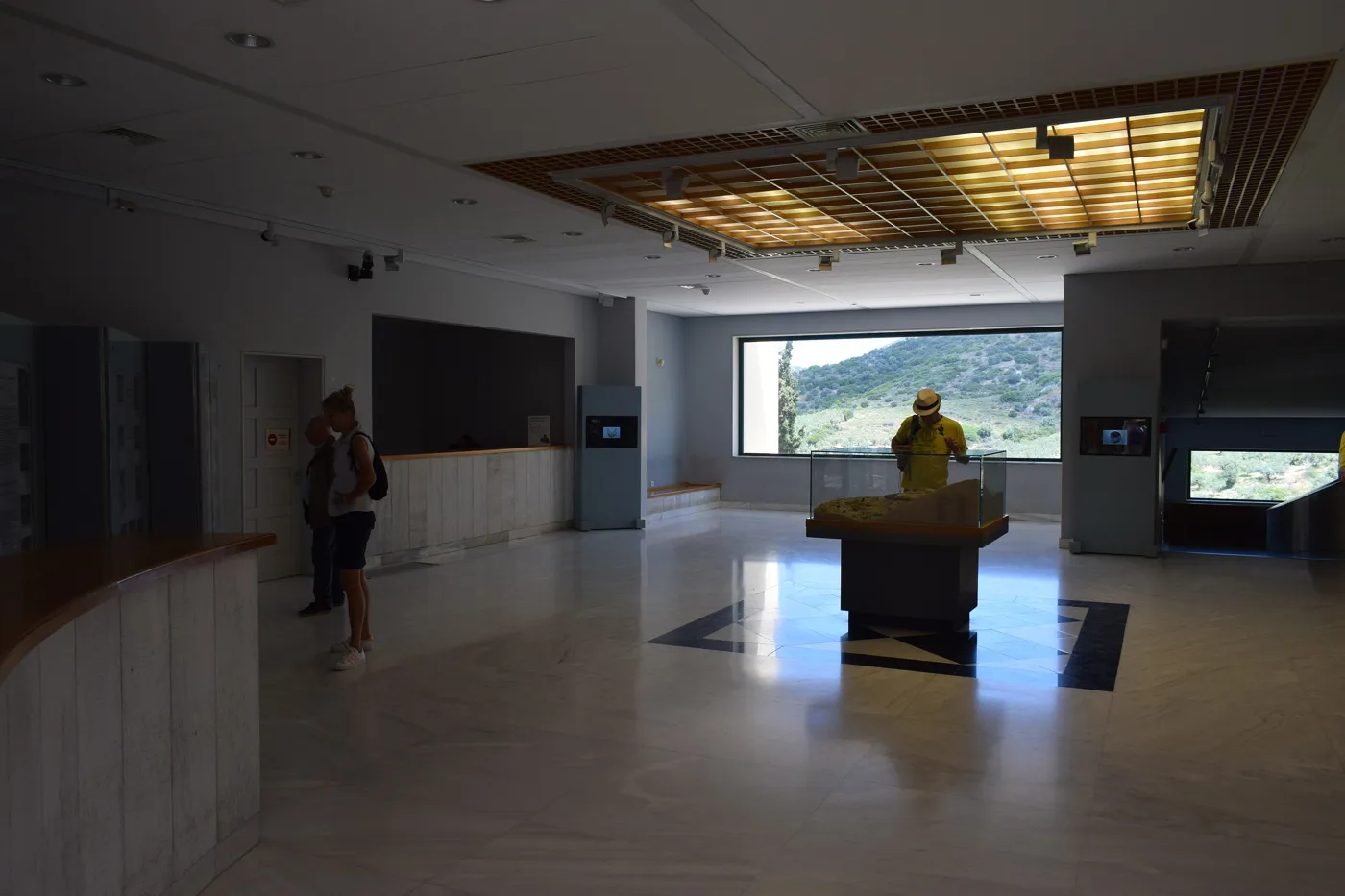
It looks out onto the citadel.
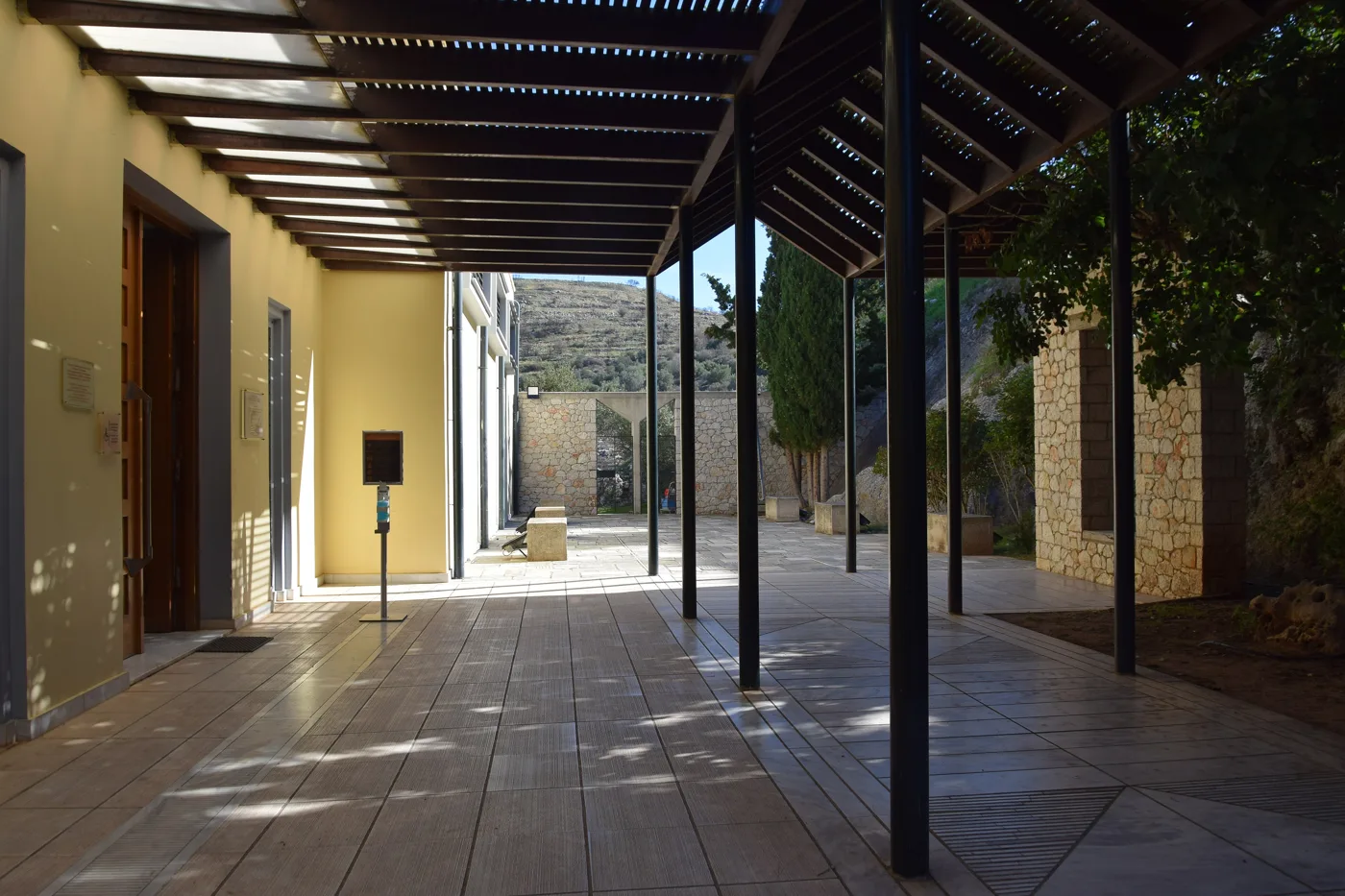
Shade and coolness after the site.
Photos: Holger Uwe Schmitt (CC BY-SA 4.0), Jean Housen (CC BY-SA 4.0), Zde (CC BY-SA 4.0) · Wikimedia Commons
The gold masks, swords and cups of Grave Circle A are not at Mycenae: they are in Room 4 of the National Archaeological Museum, 15 minutes on foot from Ioulianou 50. See them before or after the trip, and Mycenae will mean something different. We have a separate guide to the museum.
🎭 Epidaurus: the theatre and the Asklepieion
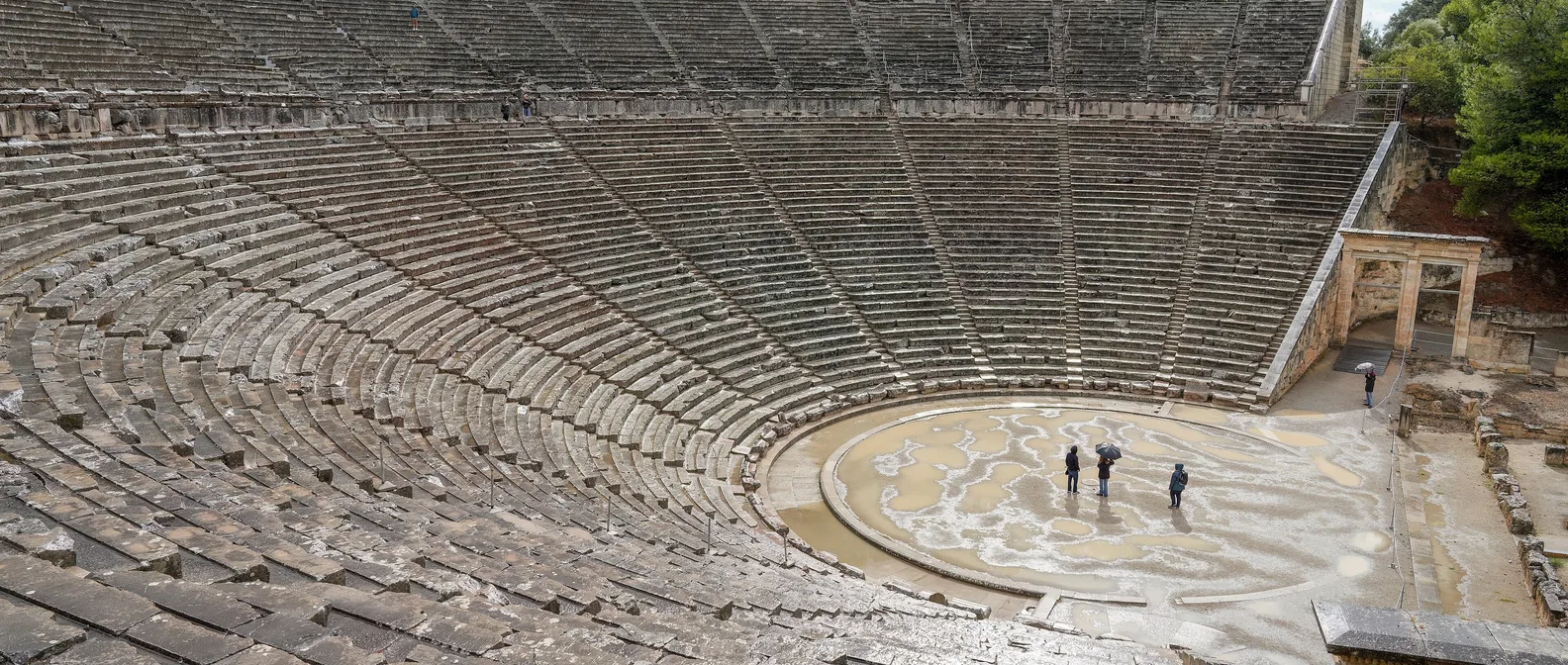
From the car park, five minutes through the pines, and suddenly the theatre opens up in front of you: 55 rows of grey limestone in a perfect semicircle, 12,000 to 14,000 seats, the circular orchestra of 20 metres, and behind the stage the mountains. It was built by Polykleitos the Younger around 340 BC, with 34 rows, and the Romans added the 21 upper ones. Its acoustics are the miracle: stand in the centre of the orchestra, drop a coin or tear a piece of paper, and whoever is sitting in the last row, 60 metres away, will hear it. The guides do it every ten minutes, and the visitors try it one after another. Climb to the top: the view from there, with the theatre at your feet and the valley behind, is the image you will keep.
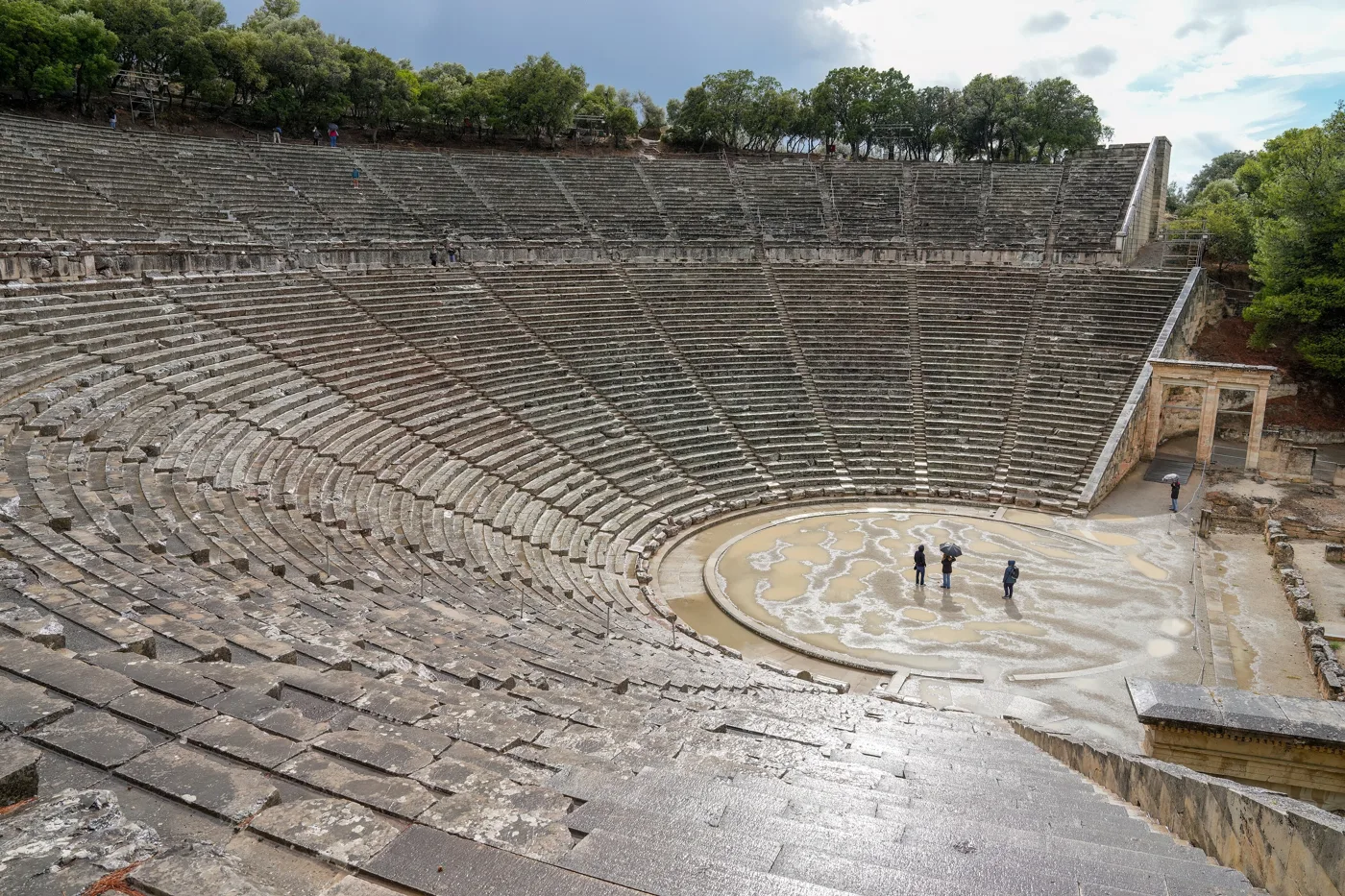
The most perfect ancient theatre, 4th century BC.
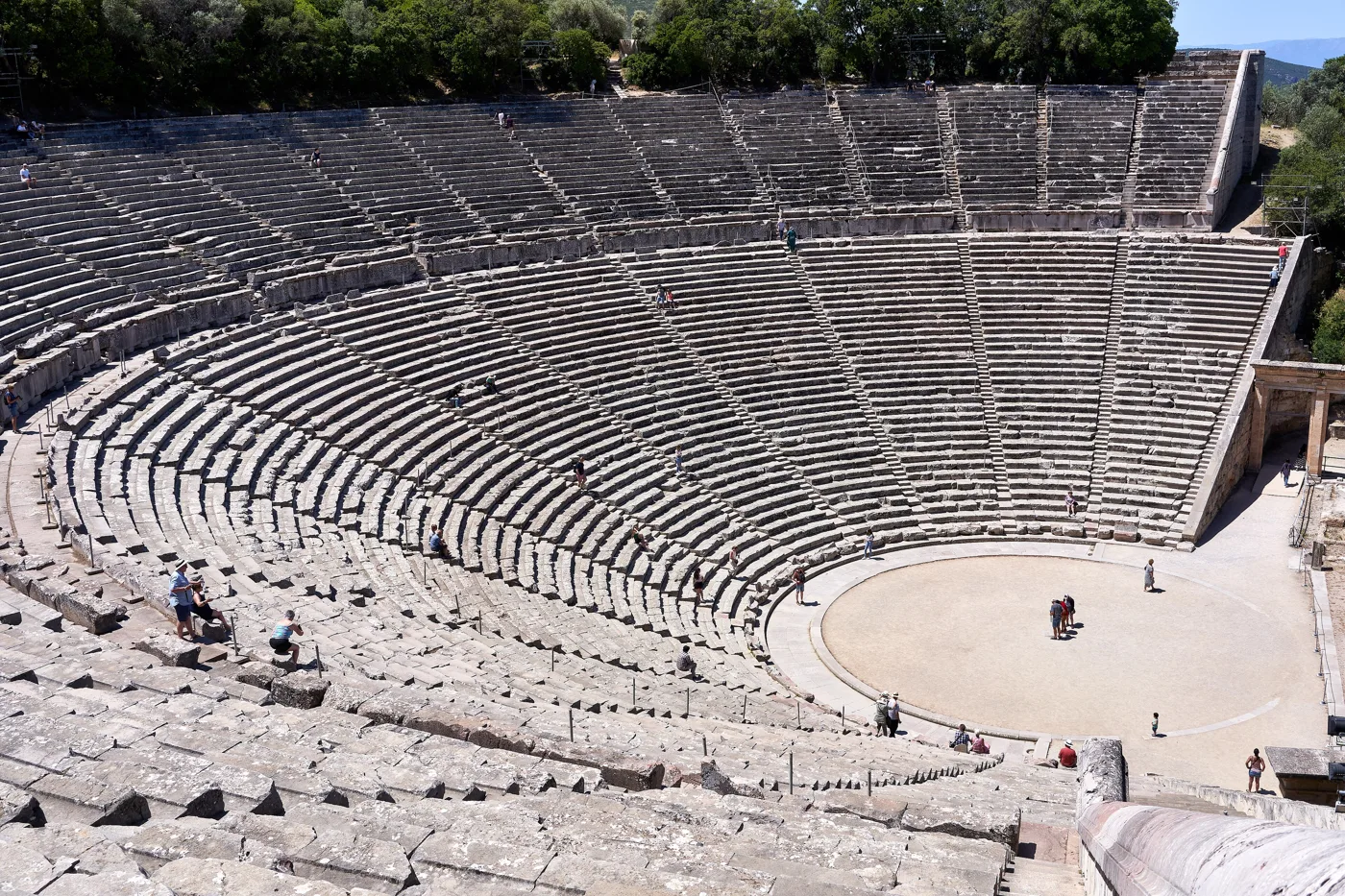
55 rows, 12,000 to 14,000 spectators.
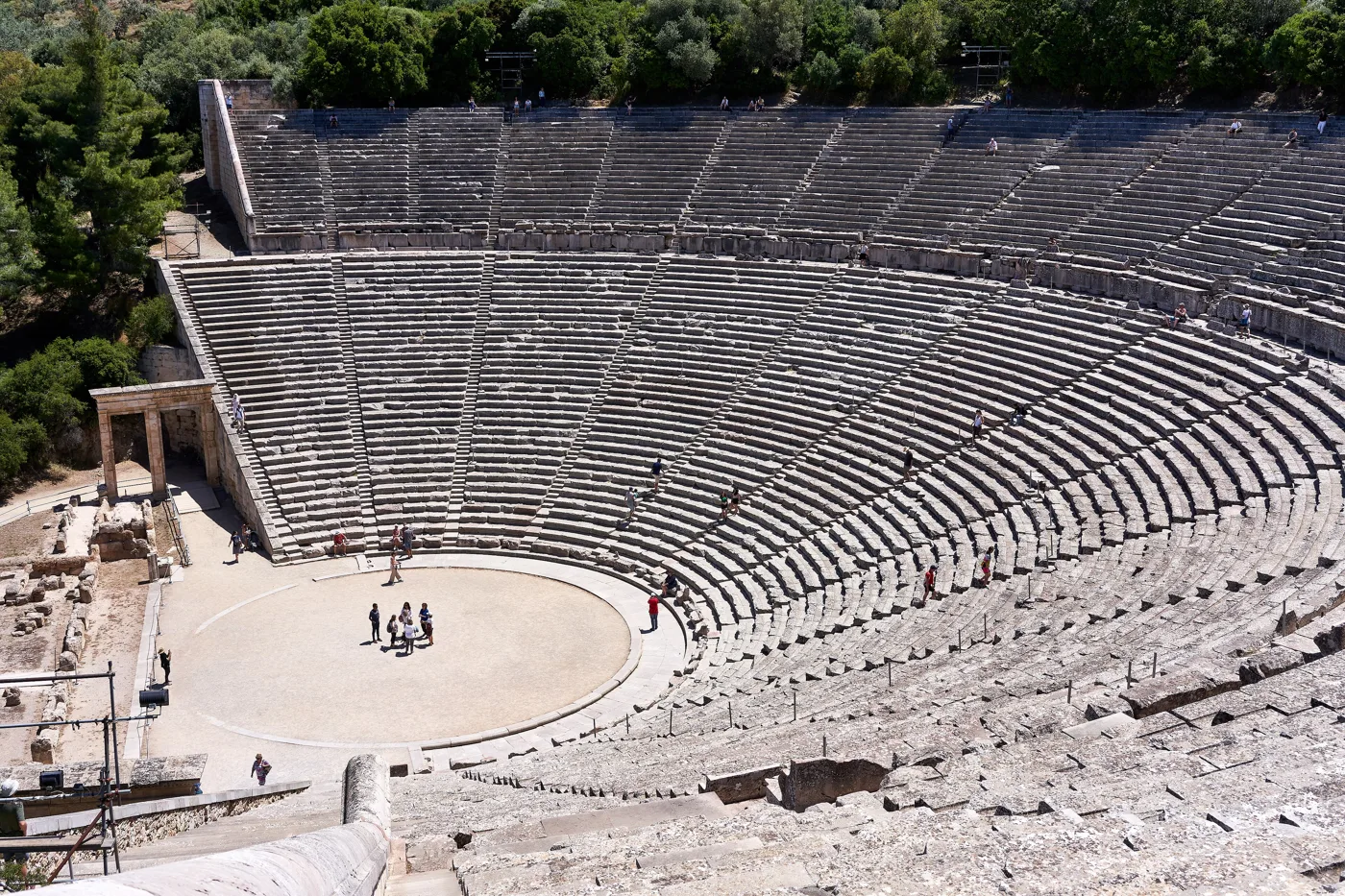
Drop a coin in the centre: it is heard in the last row.
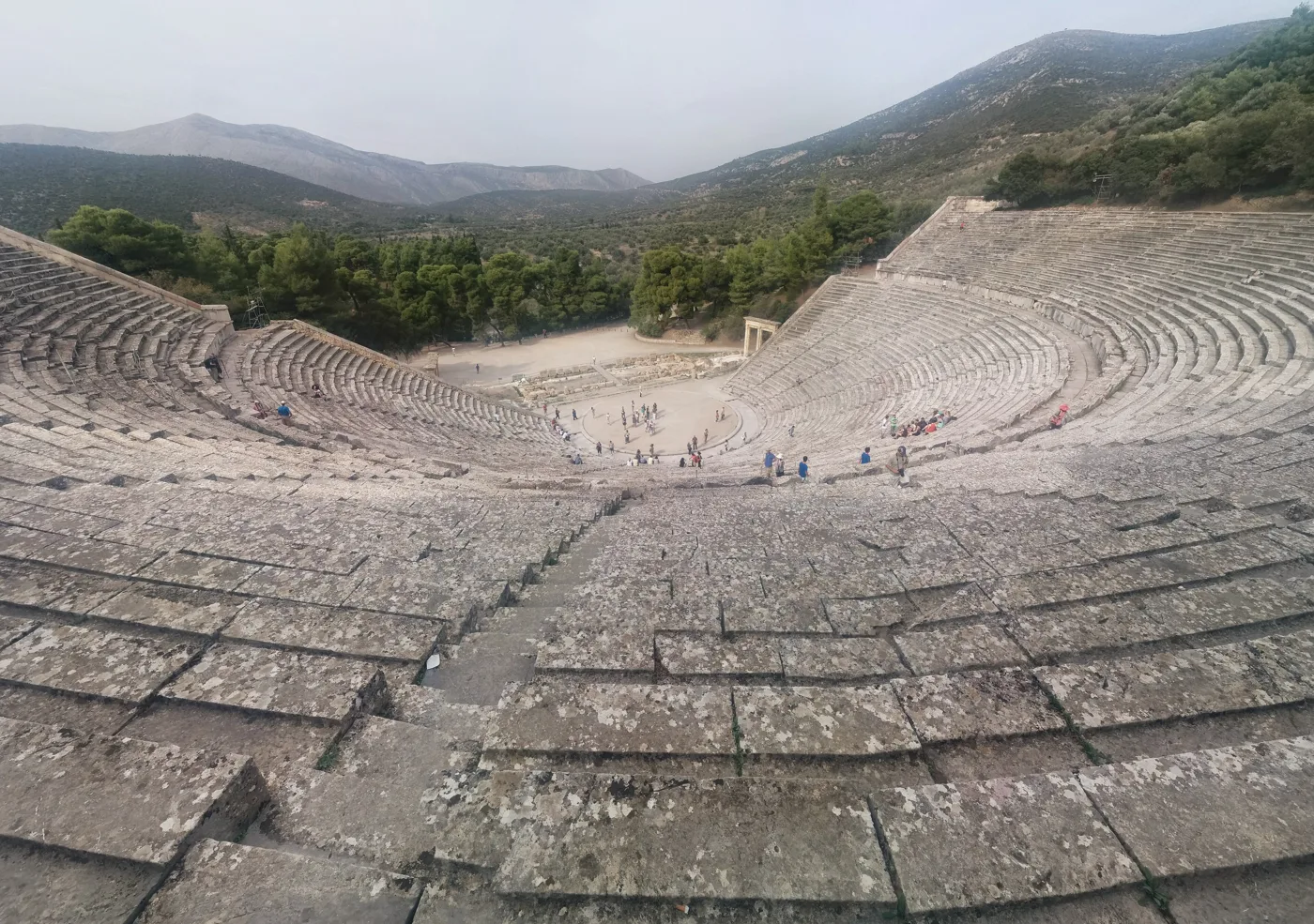
The whisper from the stage reaches up here.
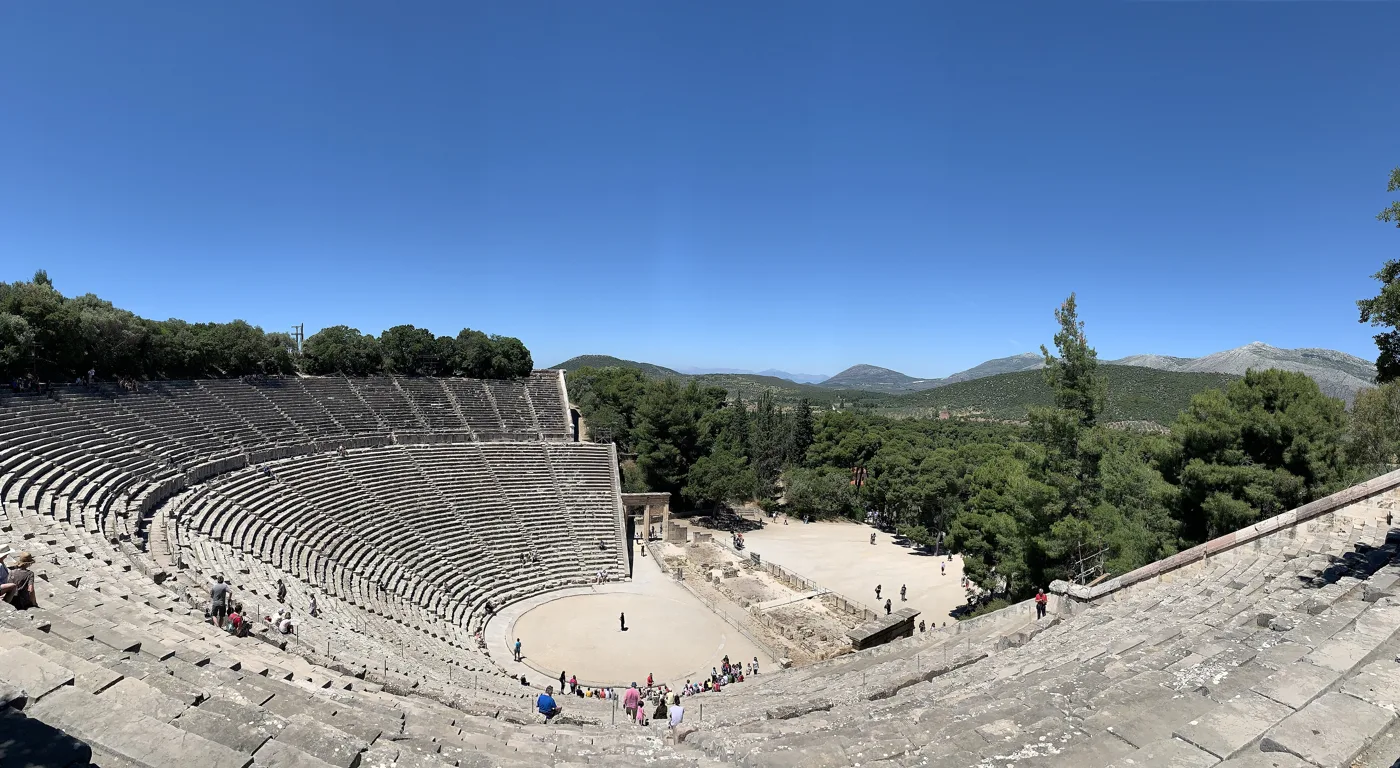
The theatre is hidden in the pines.
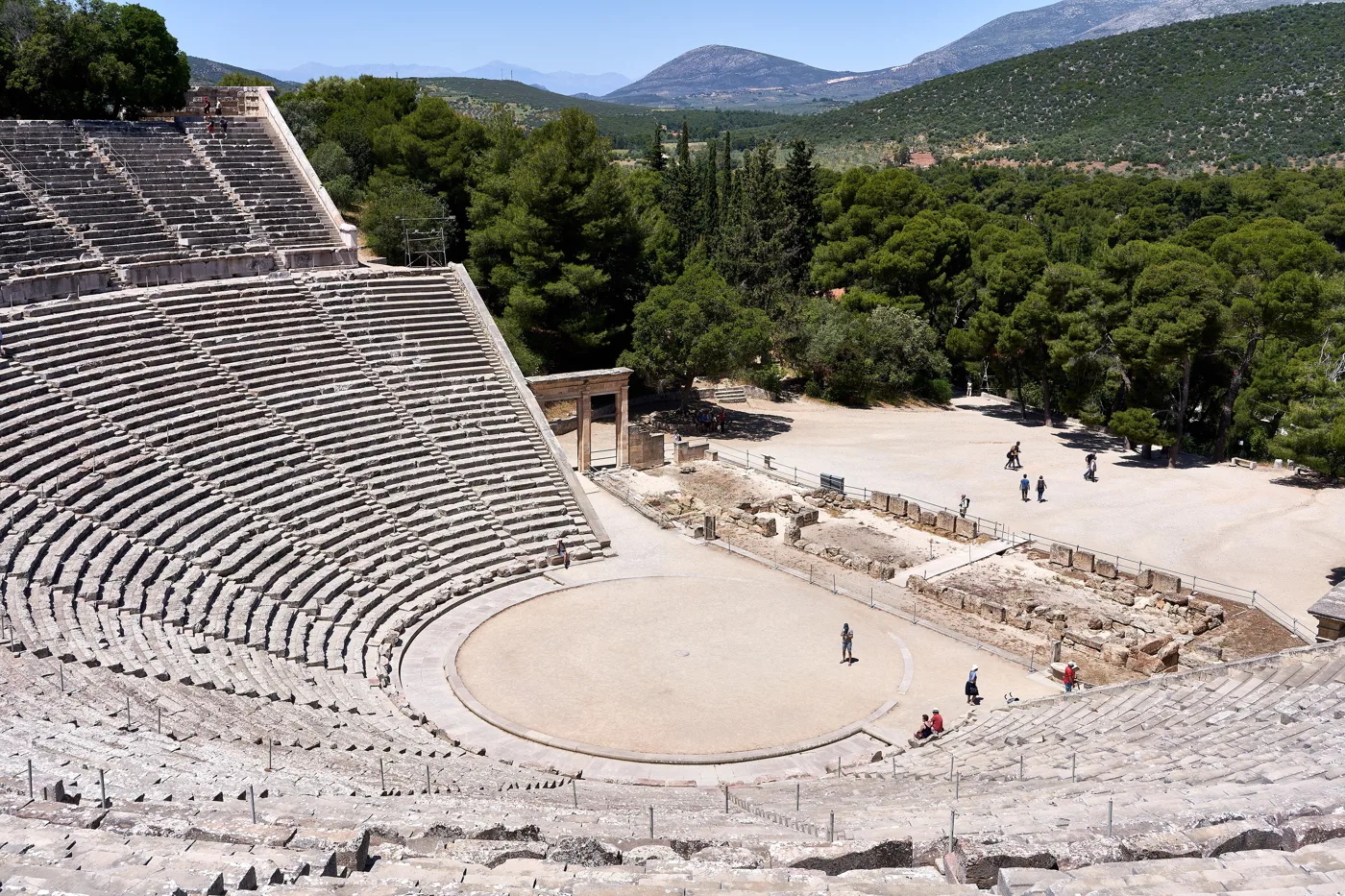
Polykleitos the Younger built it around 340 BC.
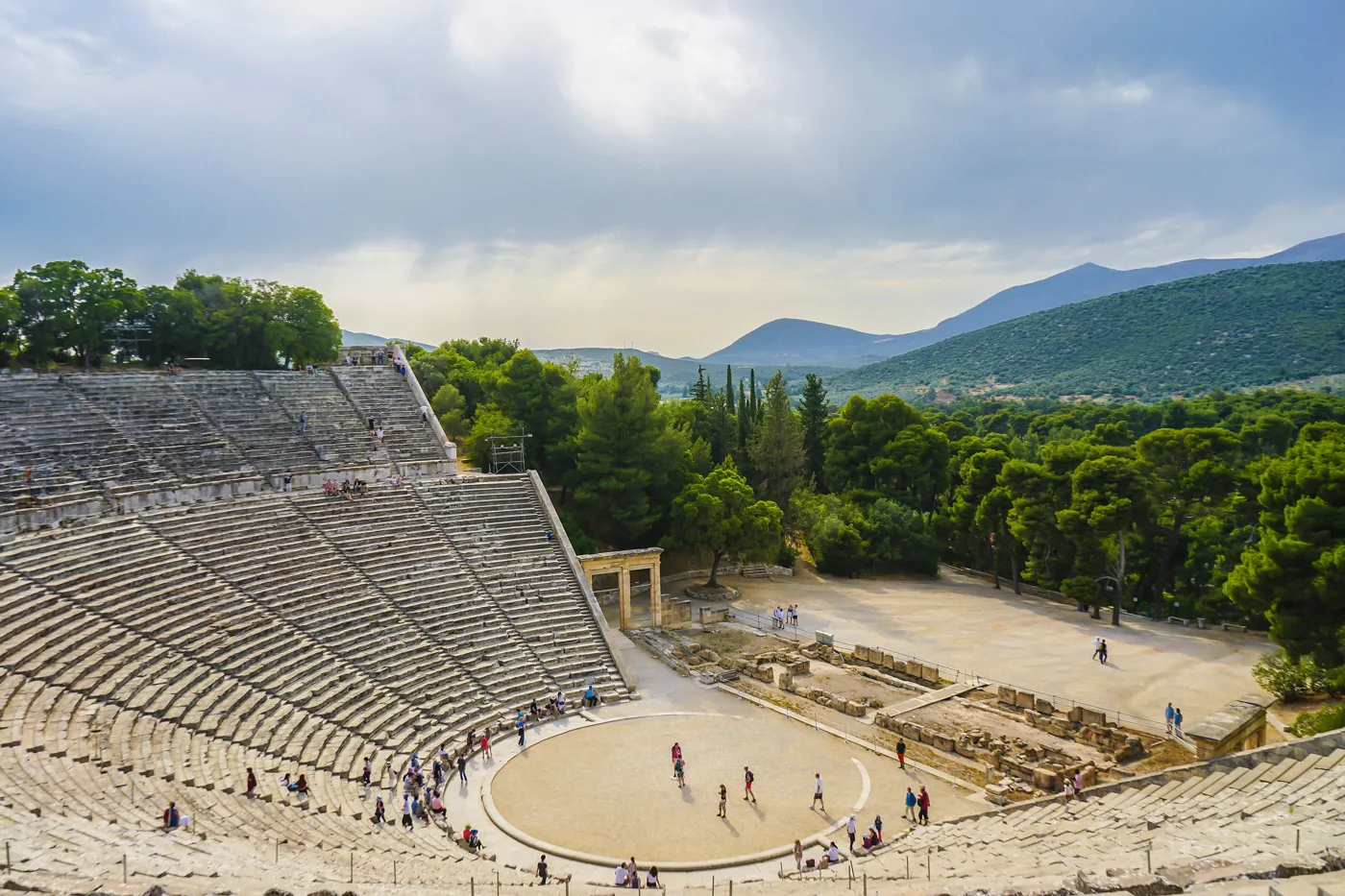
The spectators saw the mountain too.
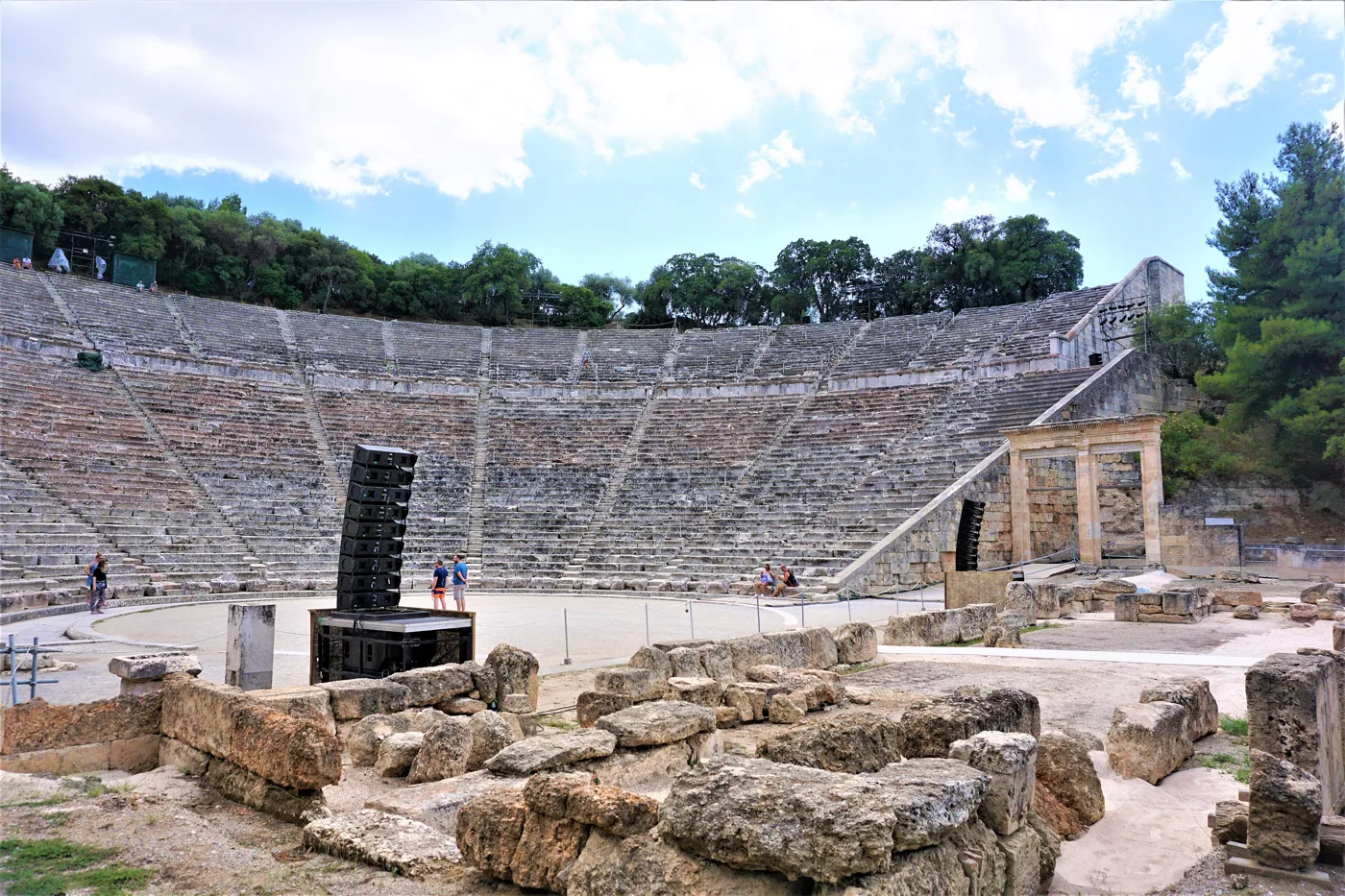
Sets and speakers in summer, for the Festival.
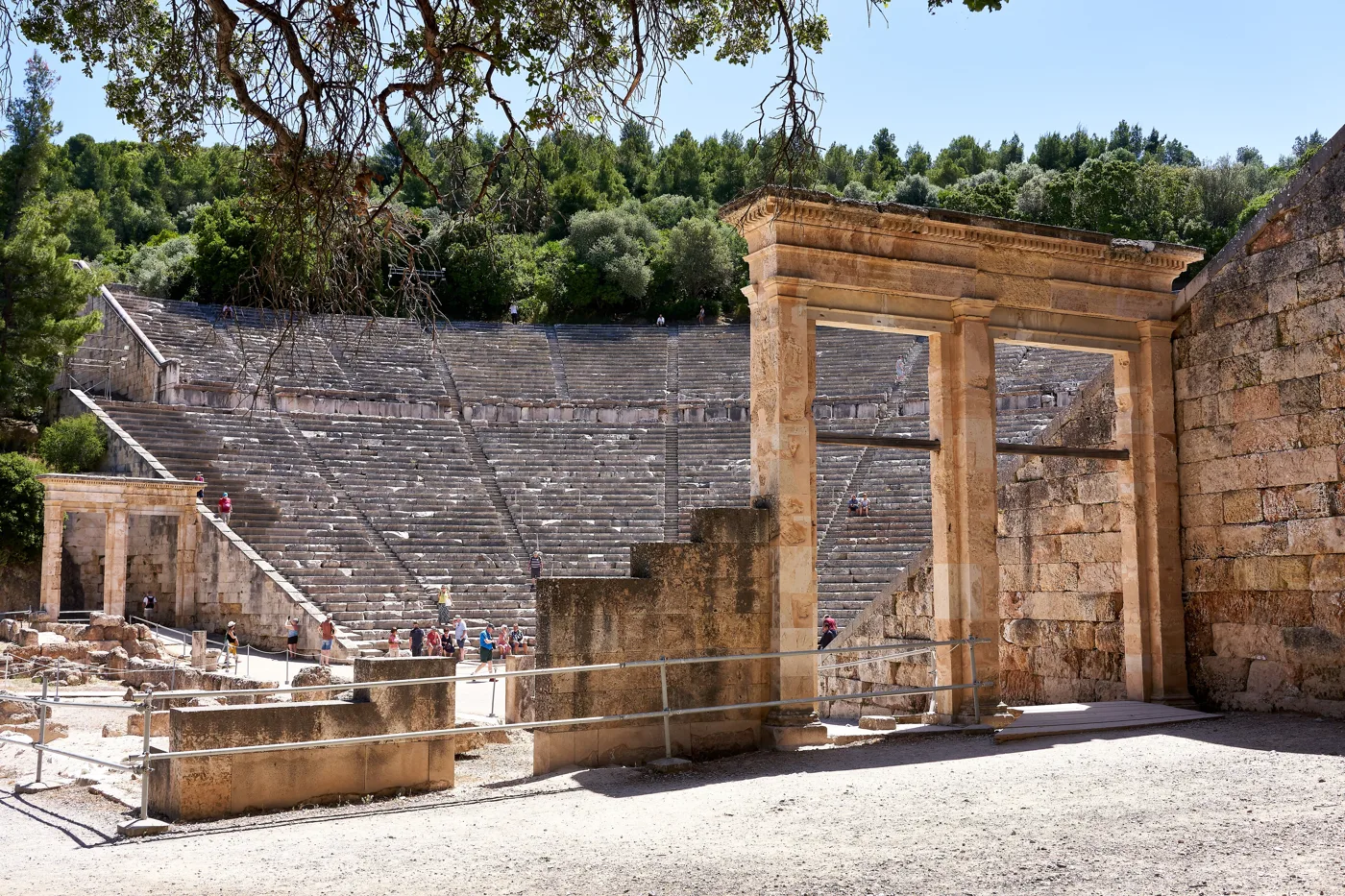
This is where the chorus came in.
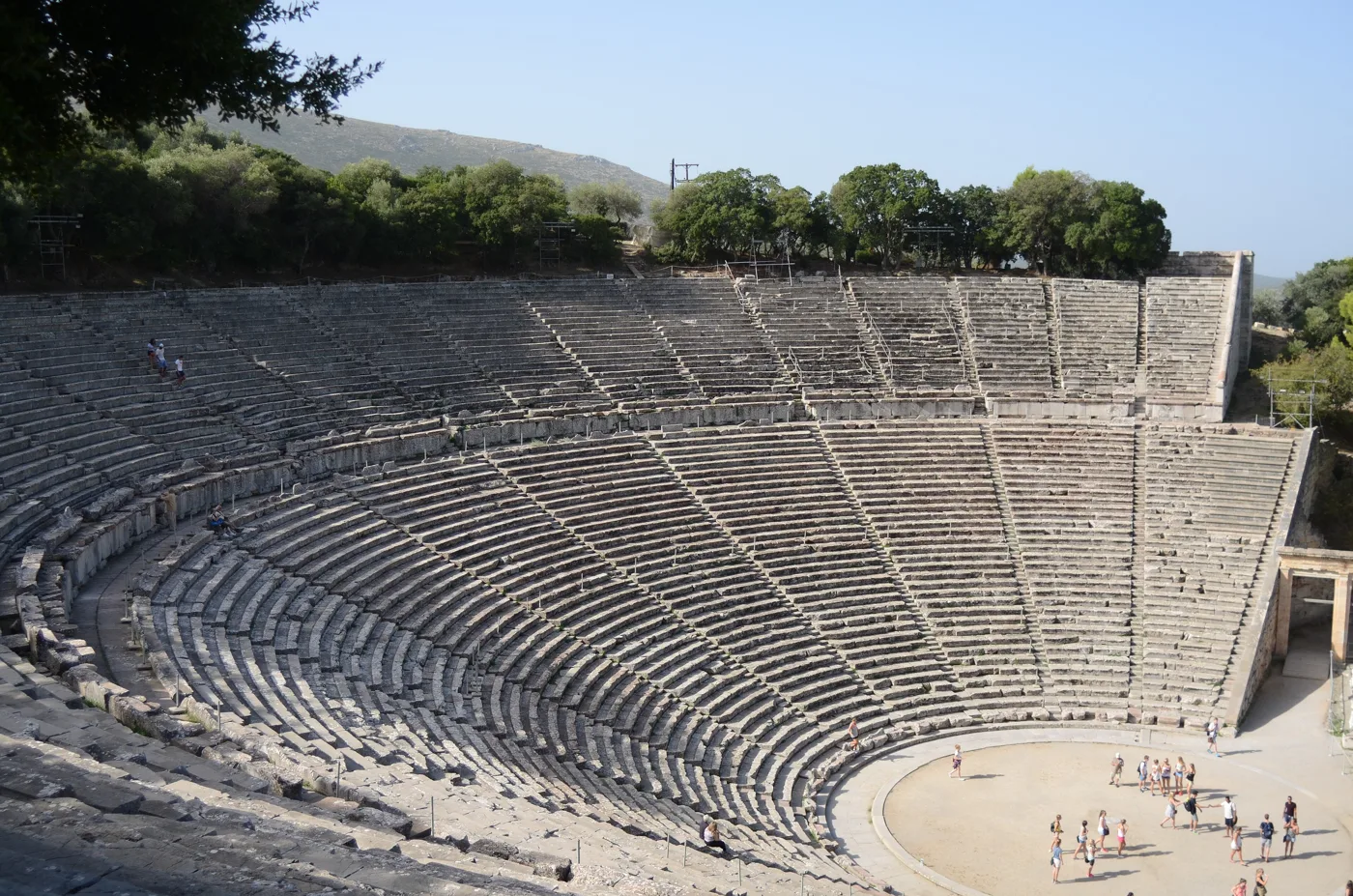
Half theatre on the mountain, half in the sky.
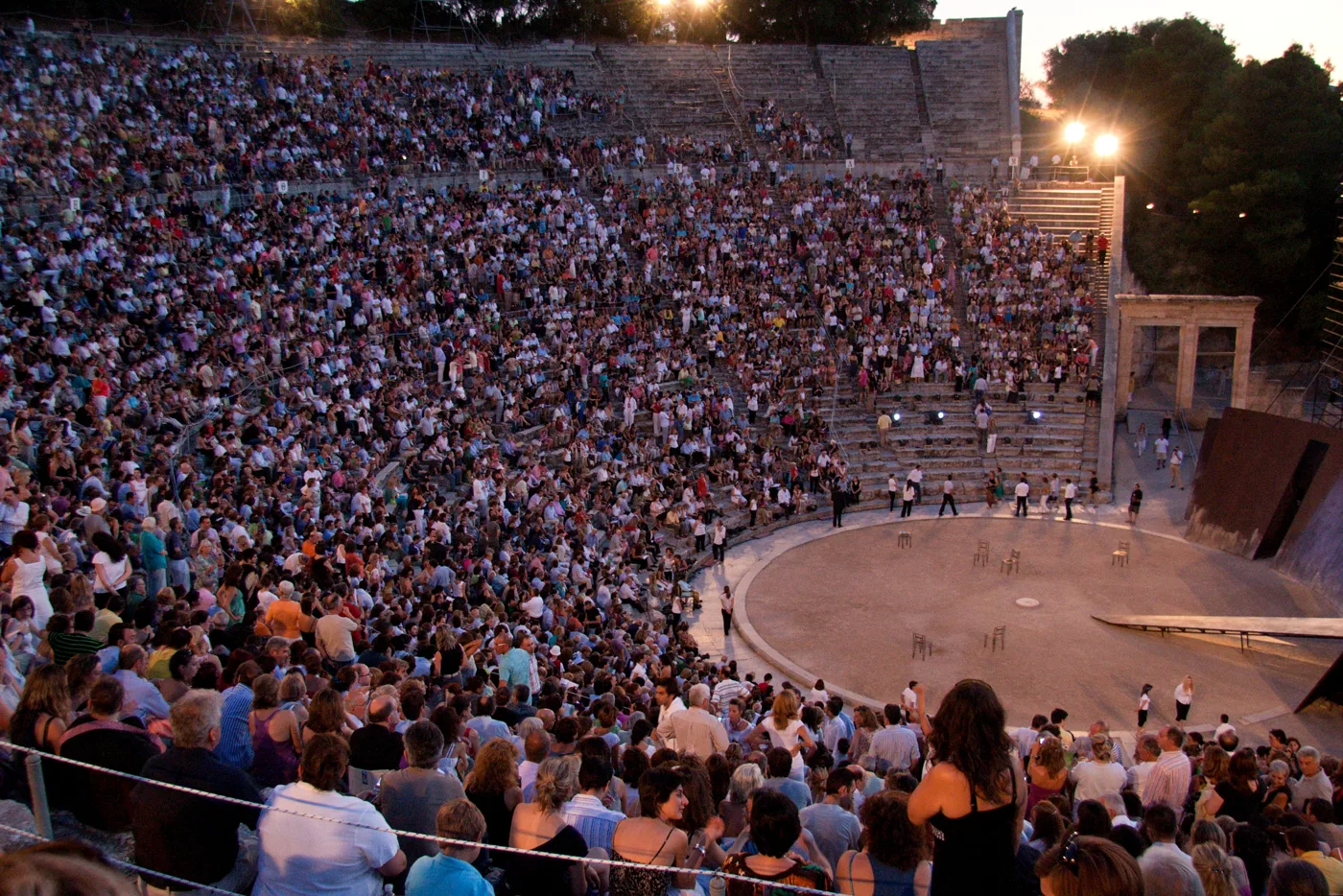
Every summer since 1954.
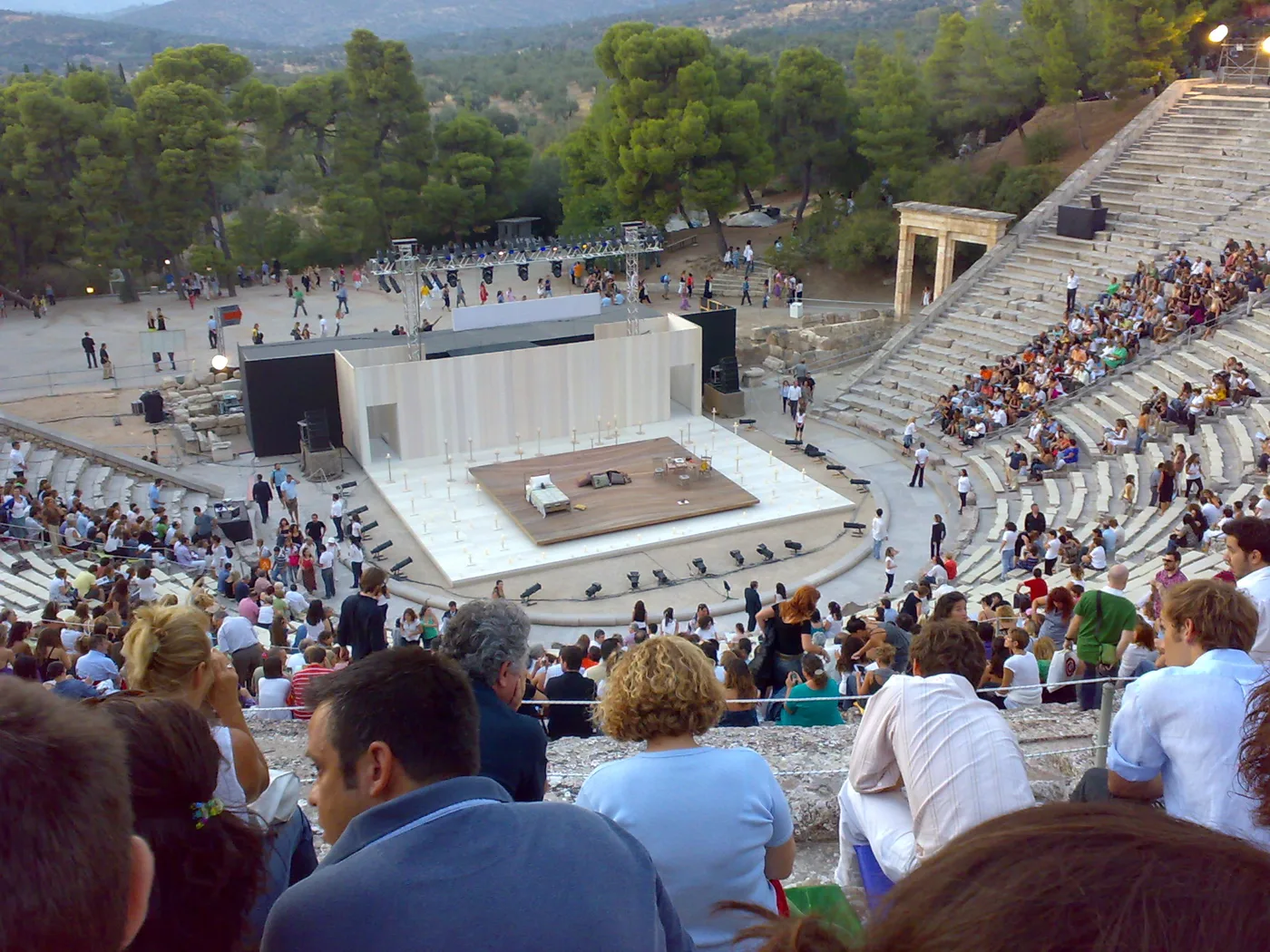
Ancient tragedy under the stars.
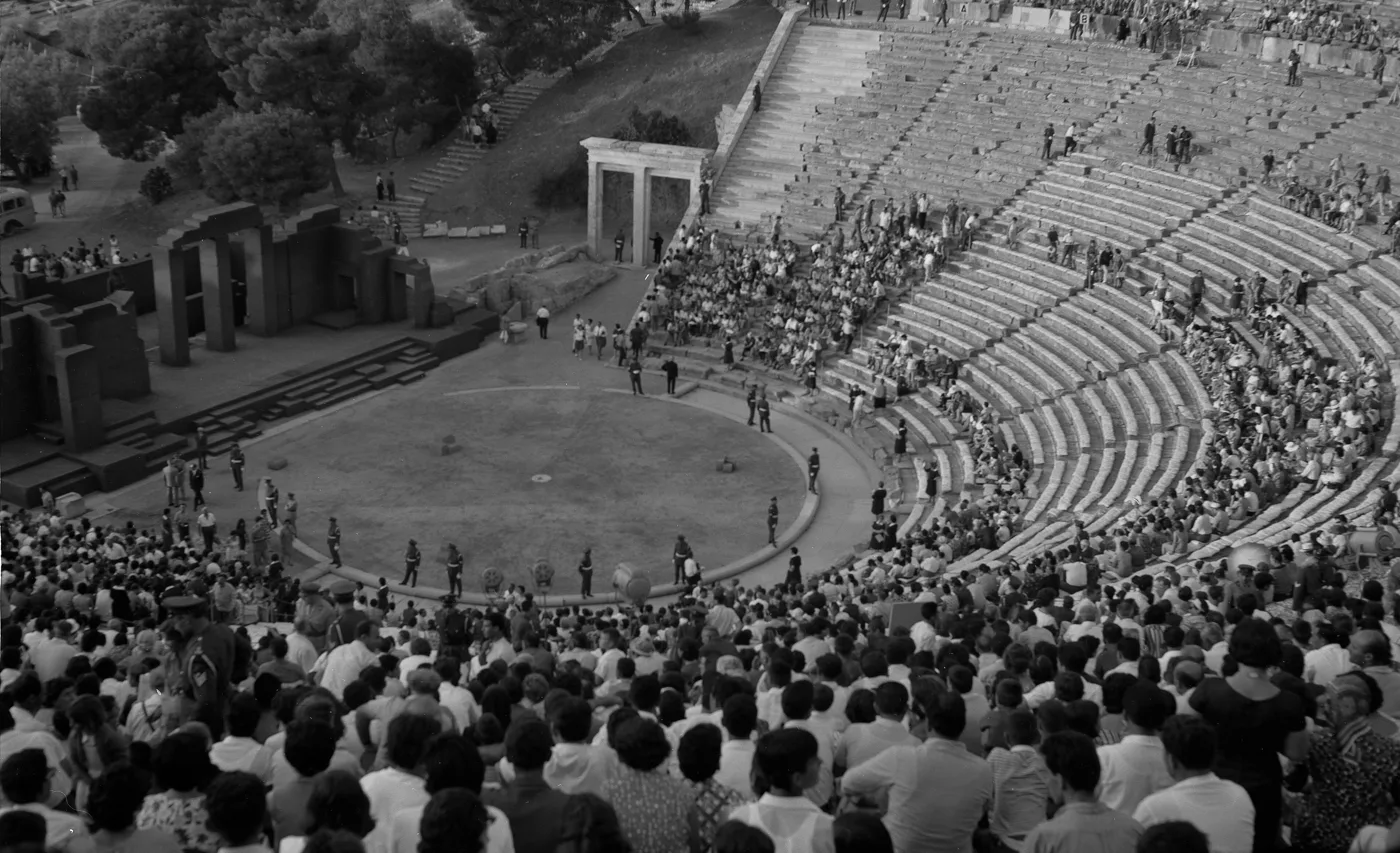
The Festival audience sixty years ago.
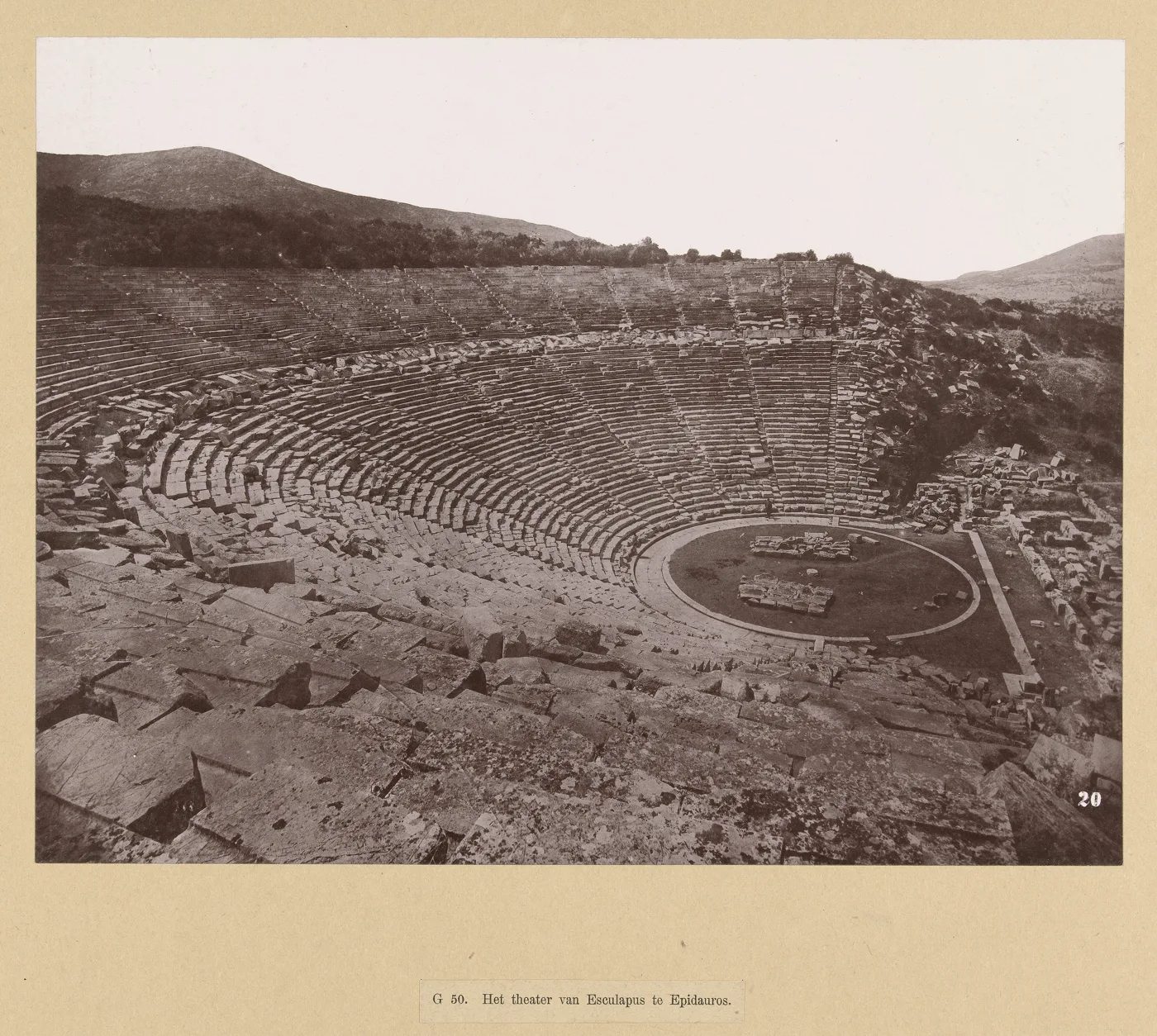
The theatre was buried until 1881.
Photos: Giles Laurent (CC BY-SA 4.0), George E. Koronaios (CC0), George E. Koronaios (CC BY-SA 4.0), Greg Schechter (CC BY 2.0), Camcool11 (CC BY-SA 4.0), Alexander954 (CC BY-SA 4.0), Joyofmuseums (CC BY-SA 4.0), Petter Ulleland (CC BY-SA 4.0), Zde (CC BY-SA 4.0), Ferengi (CC BY-SA 3.0), Codex (CC BY-SA 4.0), Rijksmuseum (CC0) · Wikimedia Commons
Every Friday and Saturday from late June to August, the theatre comes alive with ancient tragedy and comedy, at 21:00, in front of 12,000 spectators. Tickets start at €10 to €15 in the upper rows (aefestival.gr), and special KTEL buses leave Athens on the afternoon of the performance. A performance with English surtitles, a full moon and cicadas: if you are in Greece in summer, do not miss it.
The theatre is only the beginning. Behind the museum spreads the Asklepieion, the sanctuary of Asklepios: the temple of the god, the Abaton where the sick slept, the Tholos, Polykleitos' circular building with the labyrinth in its basement, which is being restored column by column, the guesthouse with 160 rooms, the Hellenistic and Roman baths, and the stadium of the games, with its 181-metre track among the pines. The sick took baths, dieted, exercised, watched theatre and music and slept in the Abaton, waiting for the god or his sacred snakes to touch them: an ancient sanatorium, where the soul was healed together with the body. The small museum of 1909, beside the theatre, holds the restored cornices of the Tholos, the medical instruments and the inscriptions recording the cures. Half an hour to an hour for the sanctuary, half an hour for the museum.
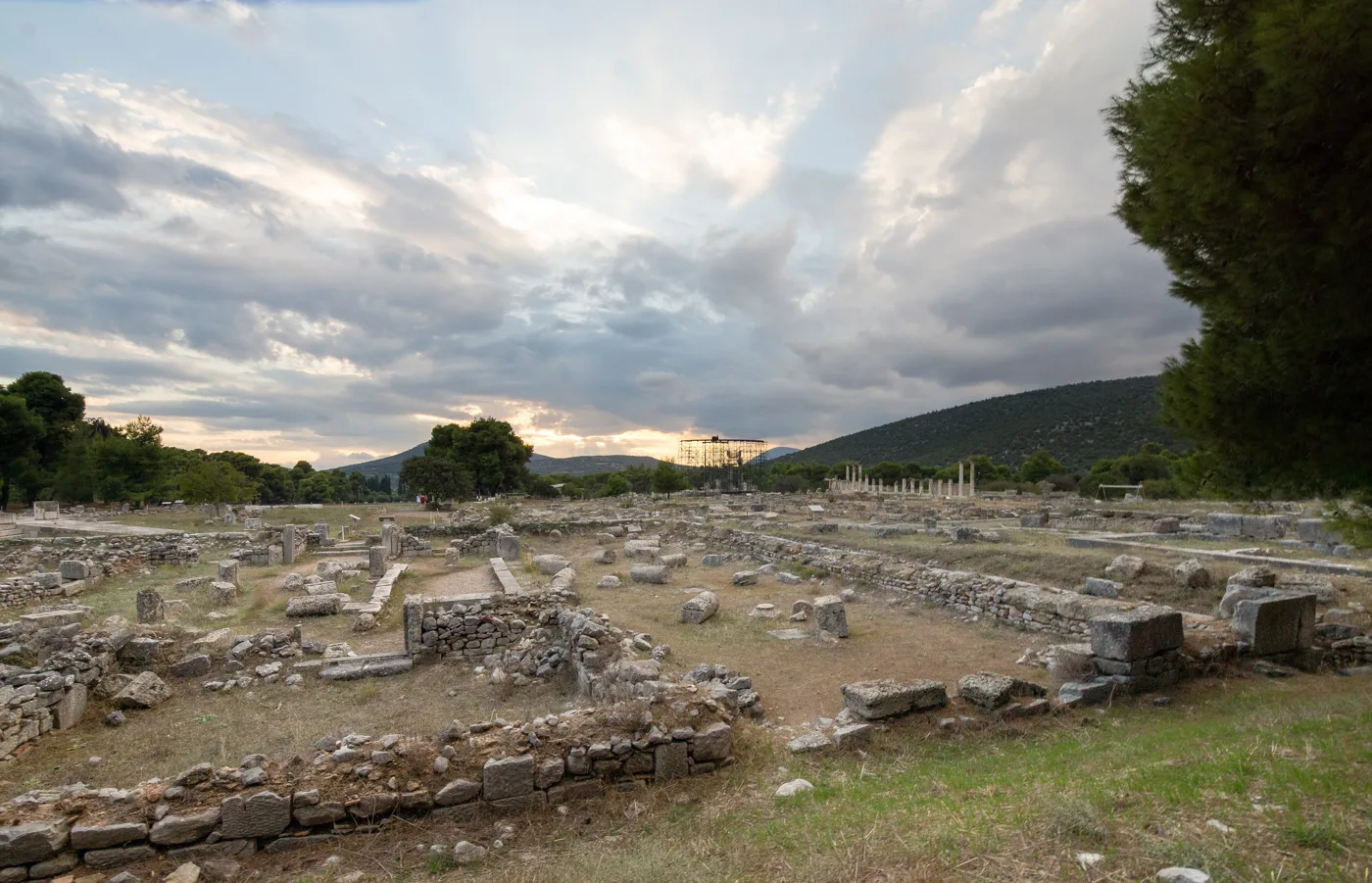
The greatest healing centre of antiquity.
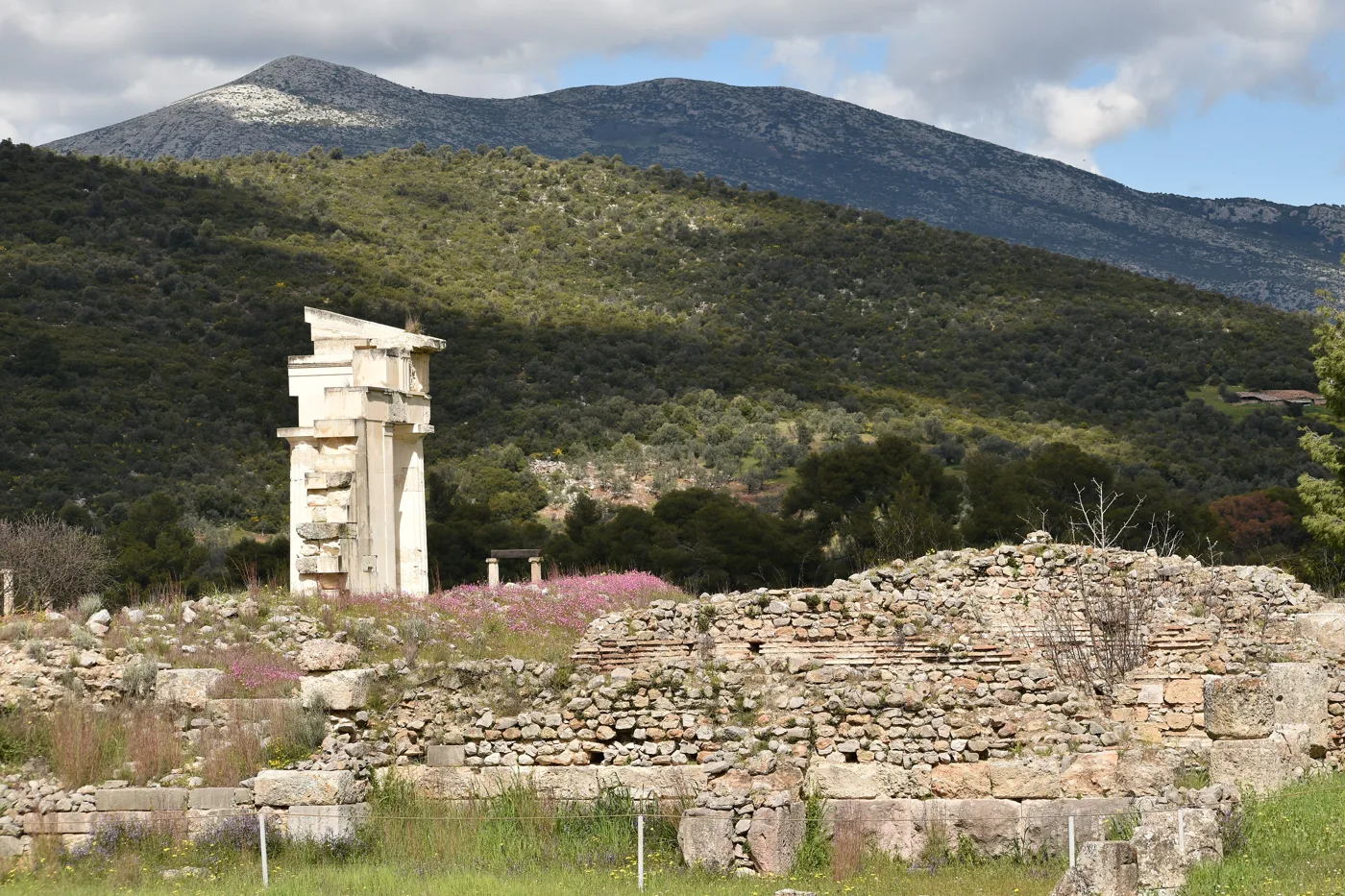
Polykleitos' circular building, 360 BC.
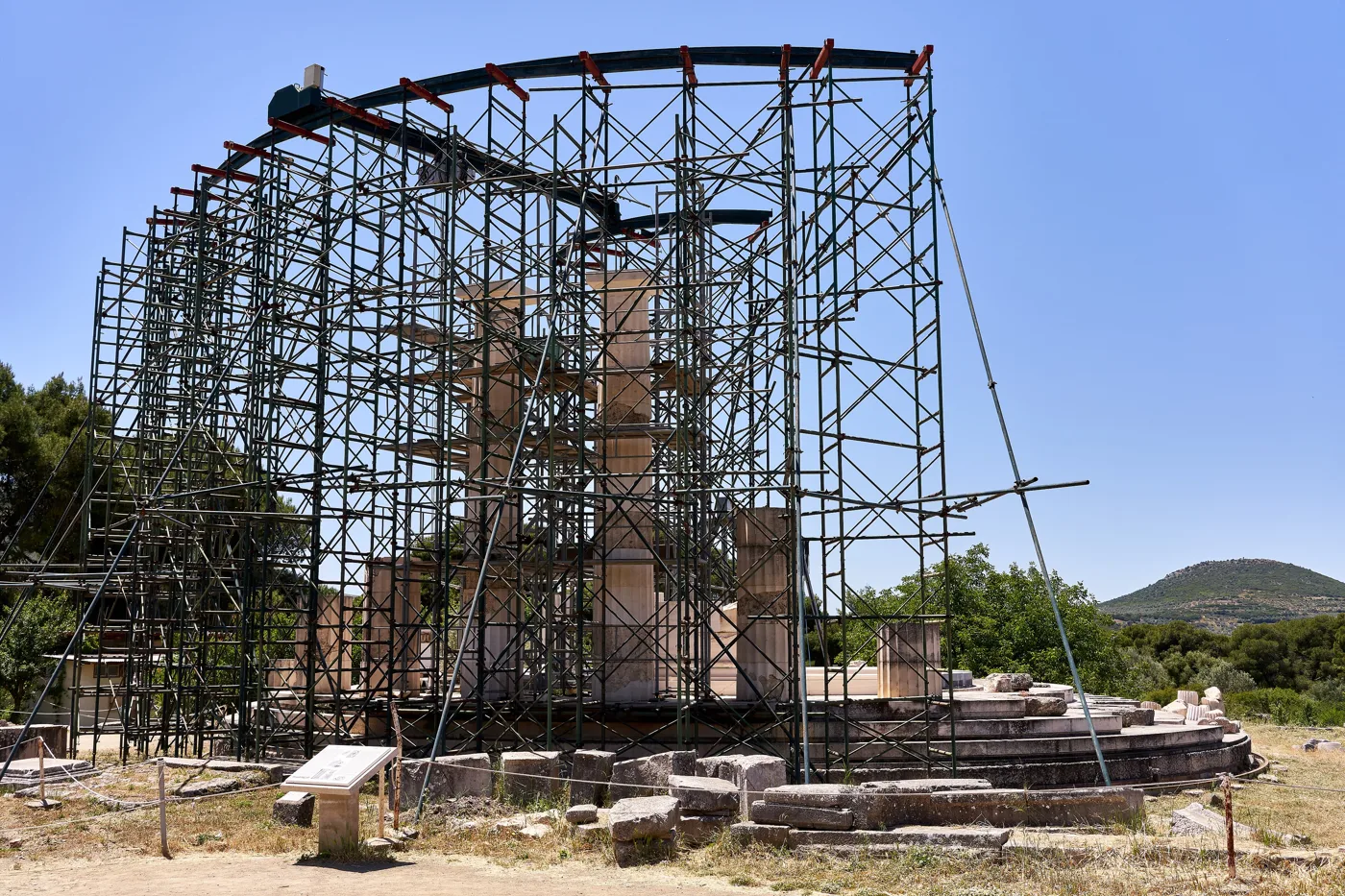
The columns are being re-erected piece by piece.
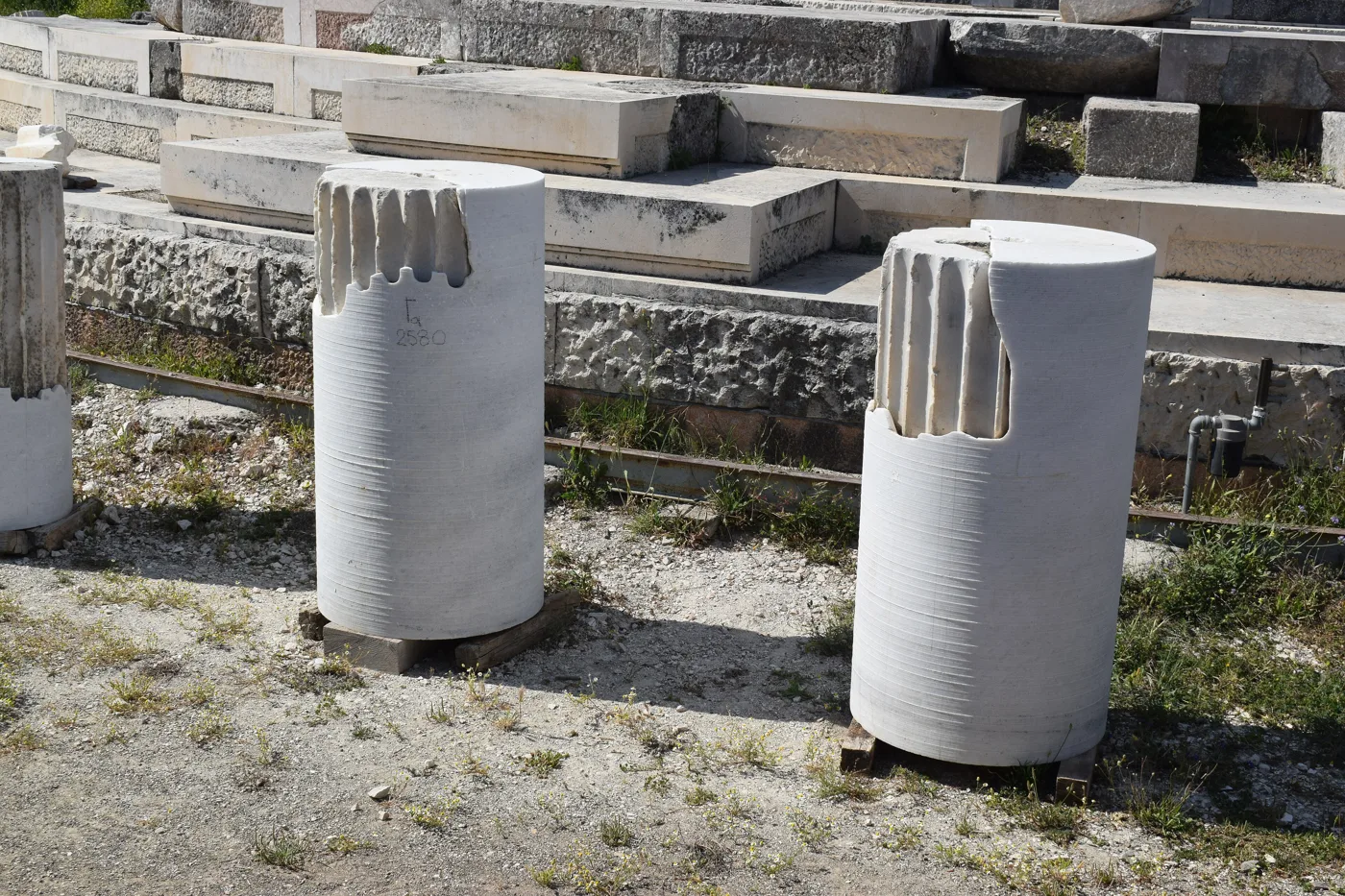
Waiting their turn.
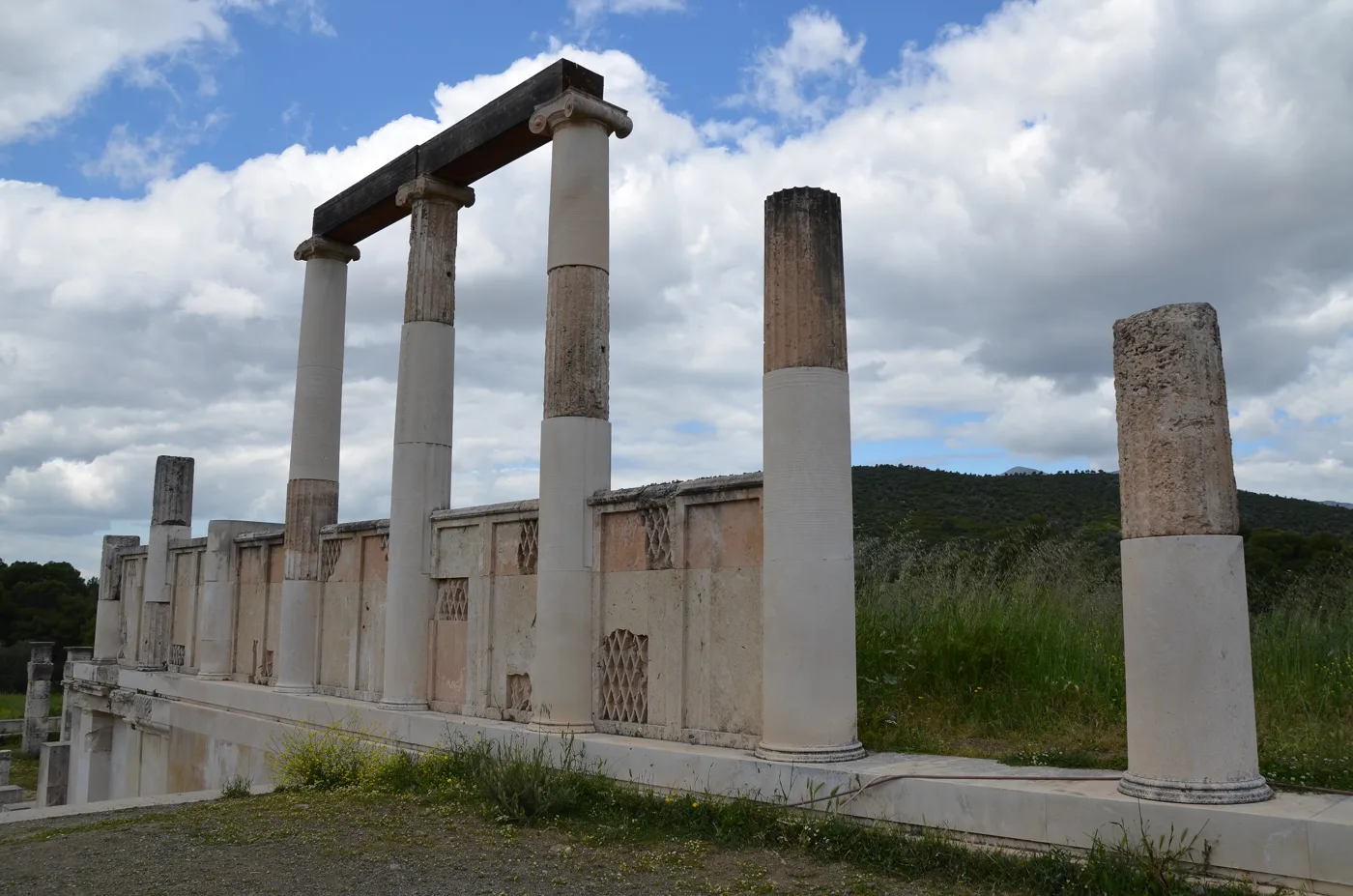
Here the sick slept and the god visited them.
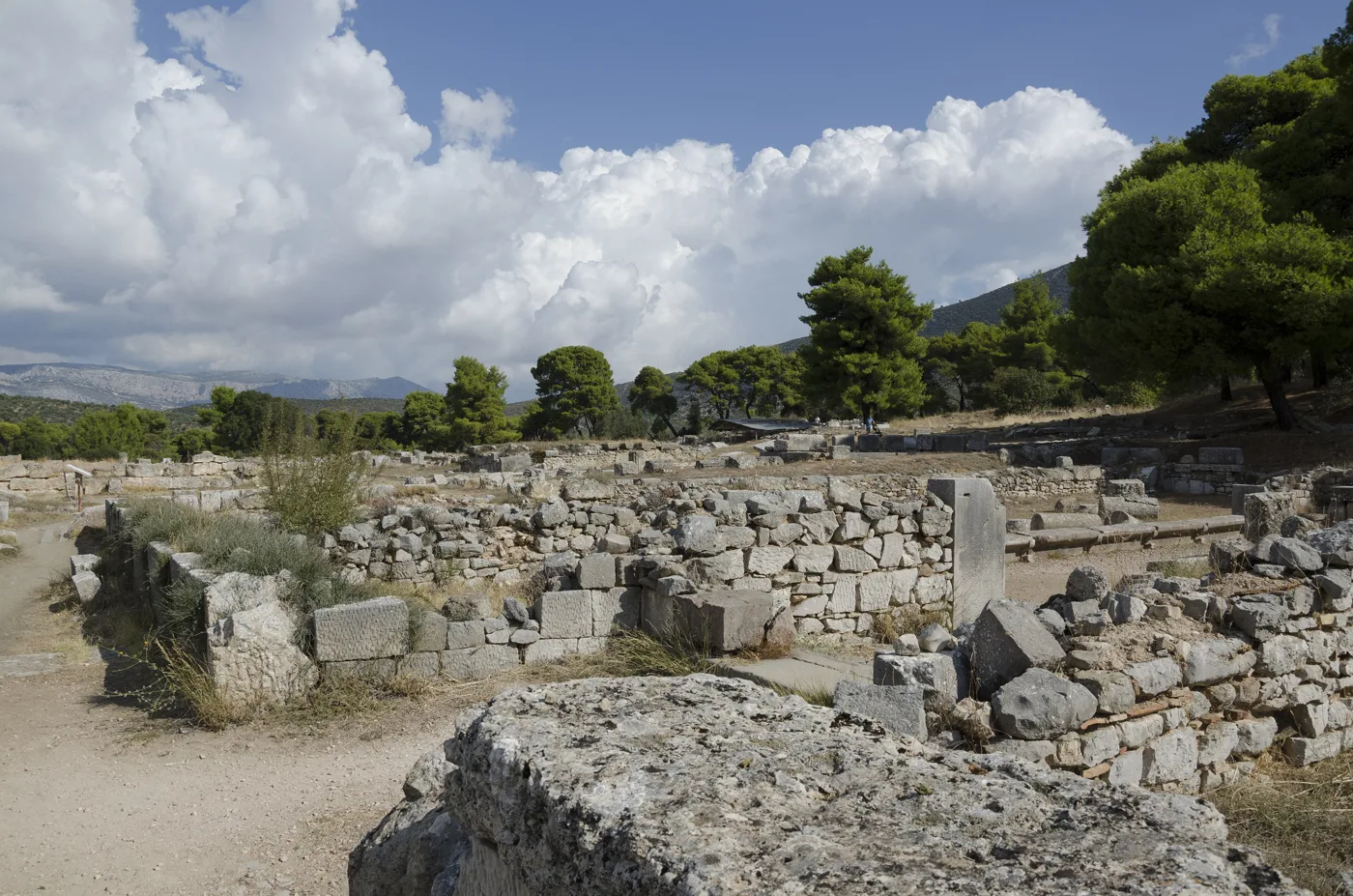
Temples, stoas, baths and guesthouses.
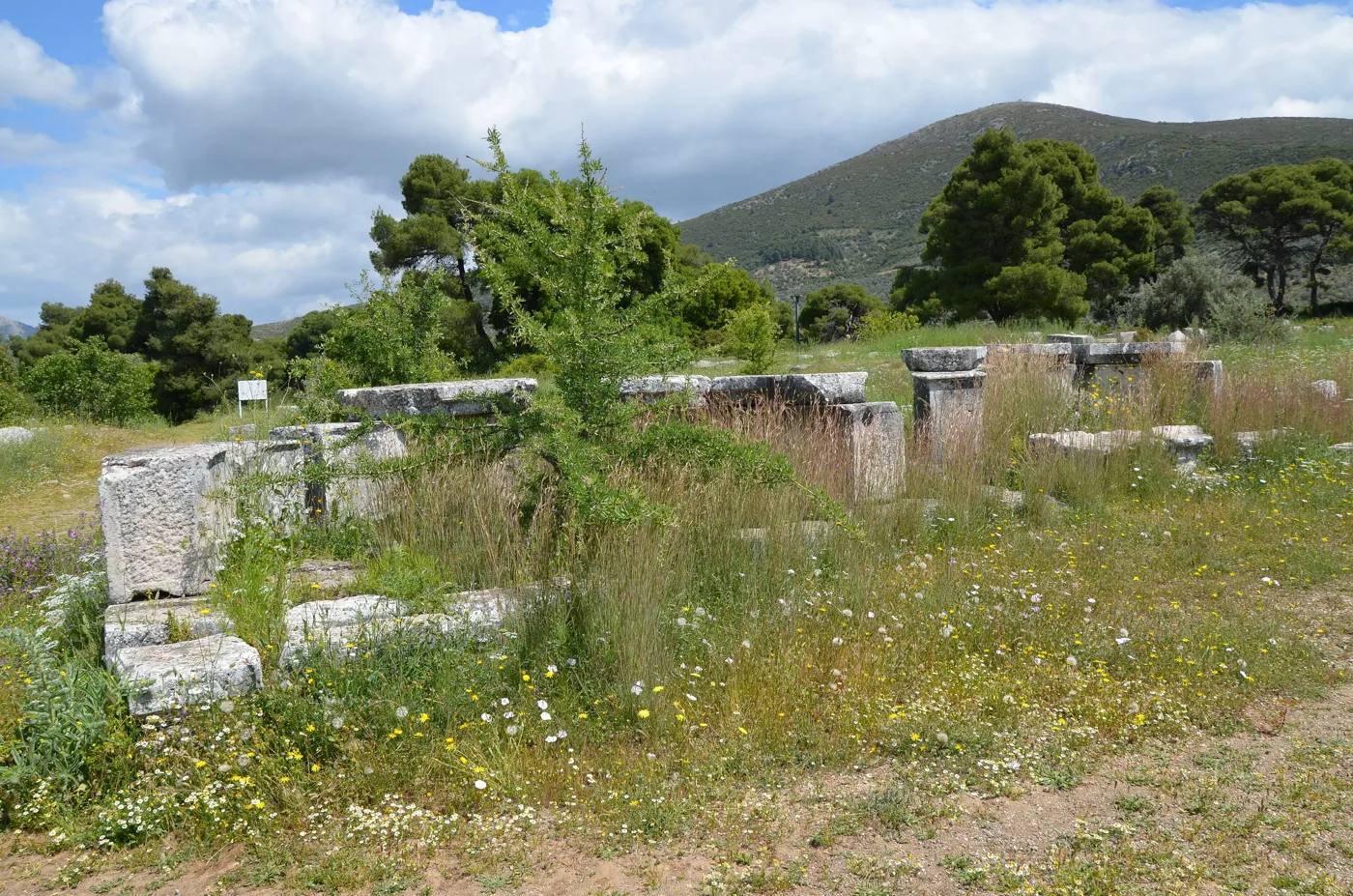
Water was part of the cure.
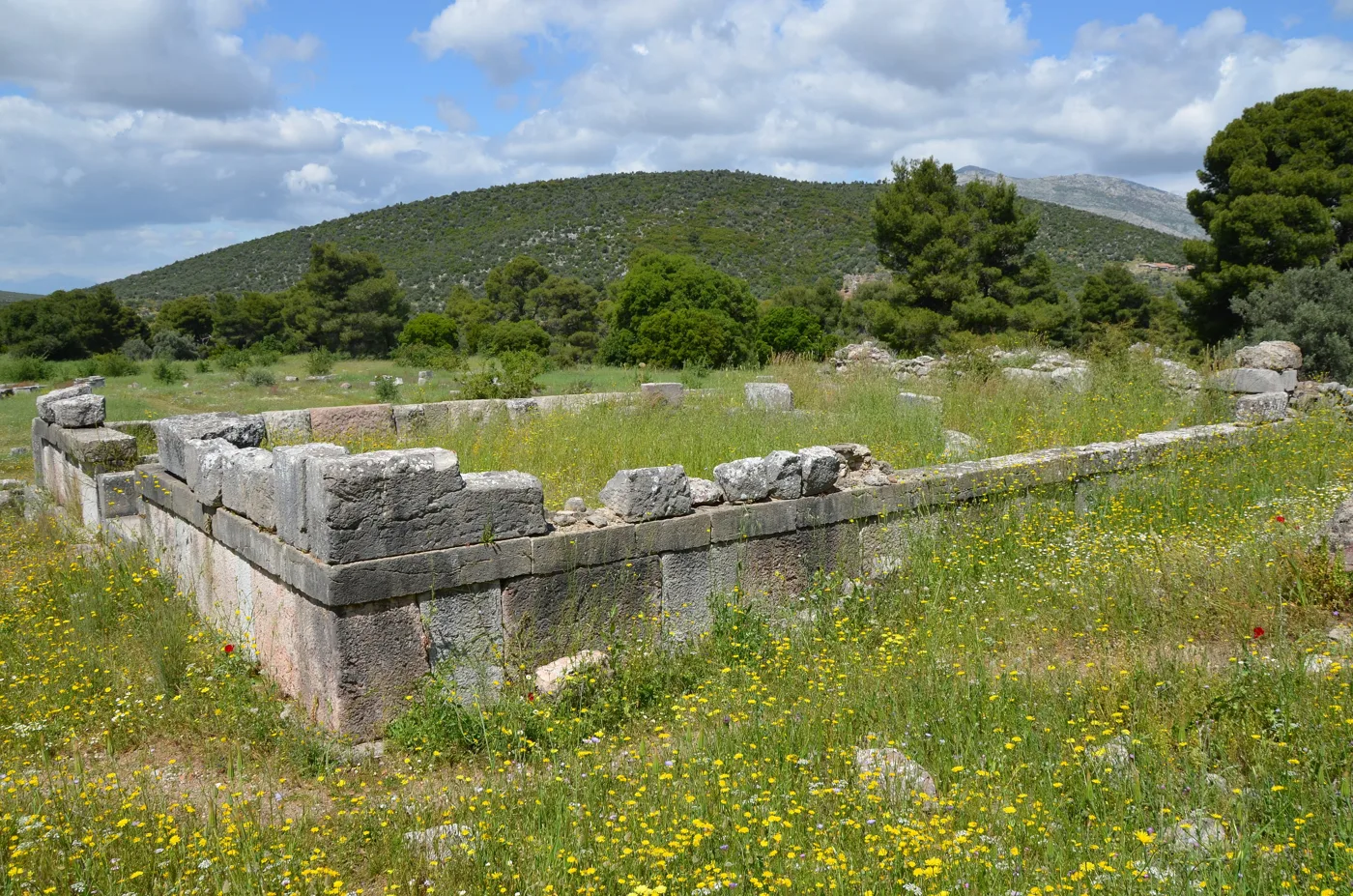
From Hellenistic times.
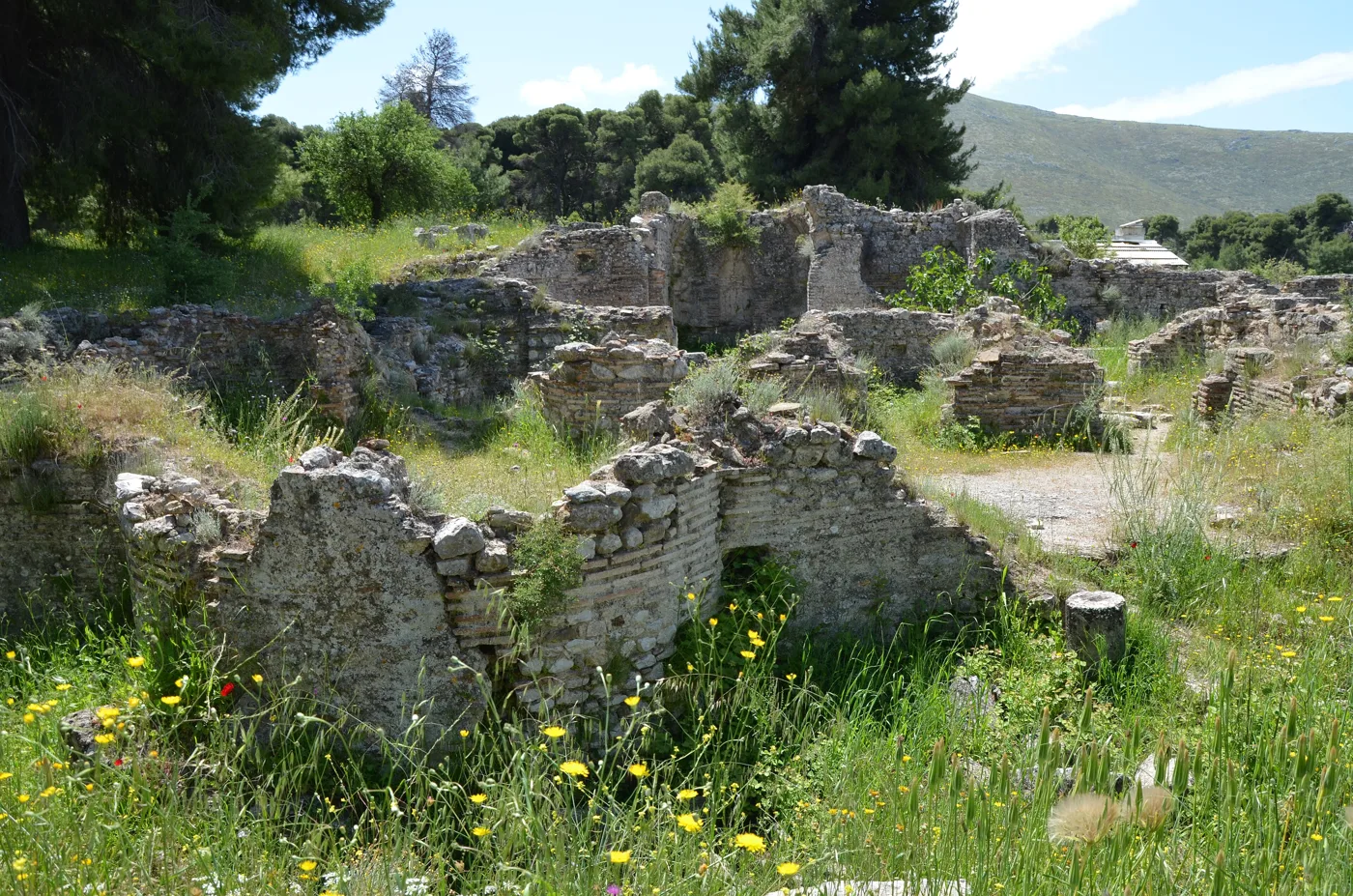
The Romans added thermae.
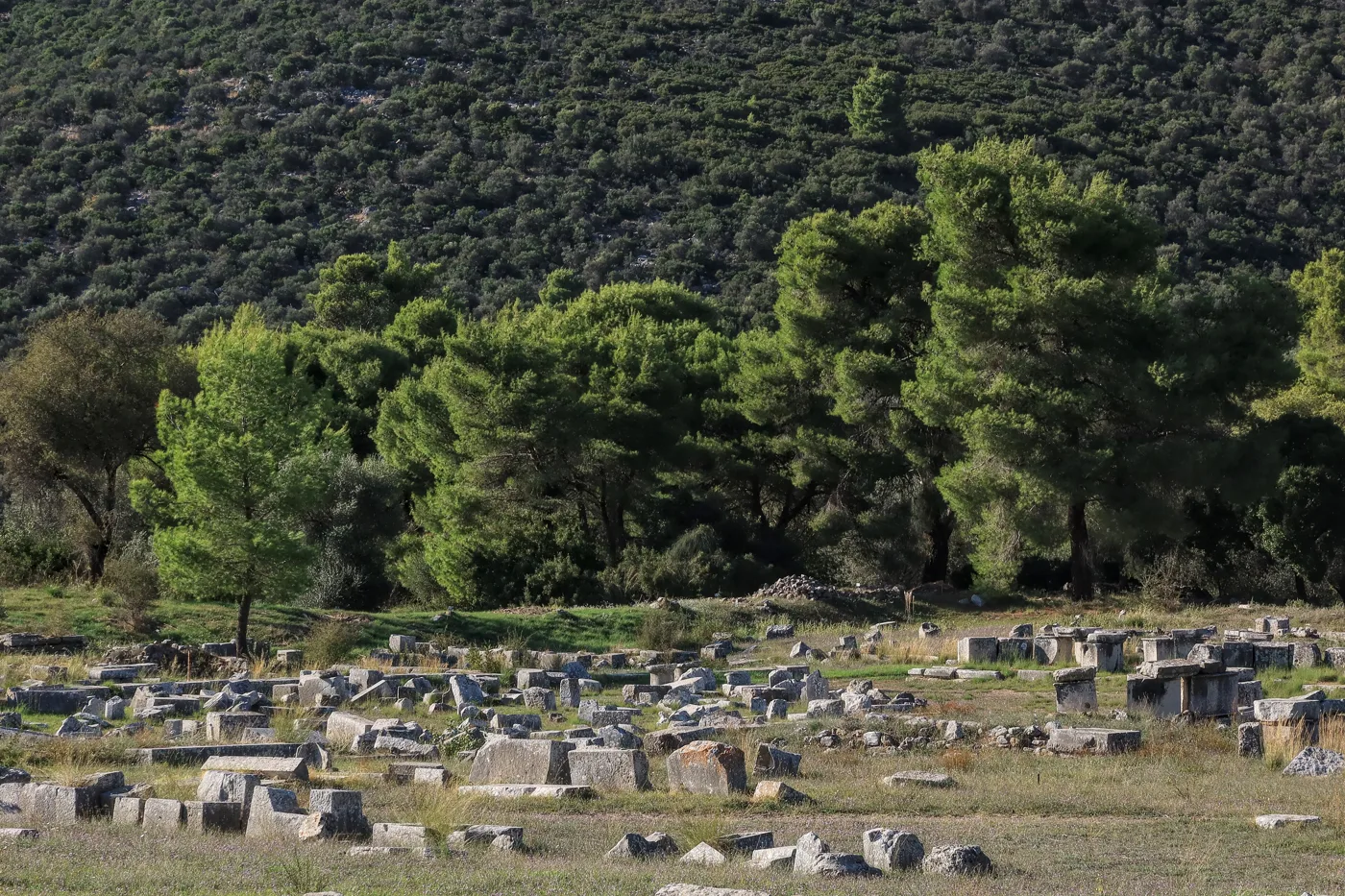
The sanctuary needs a map and imagination.
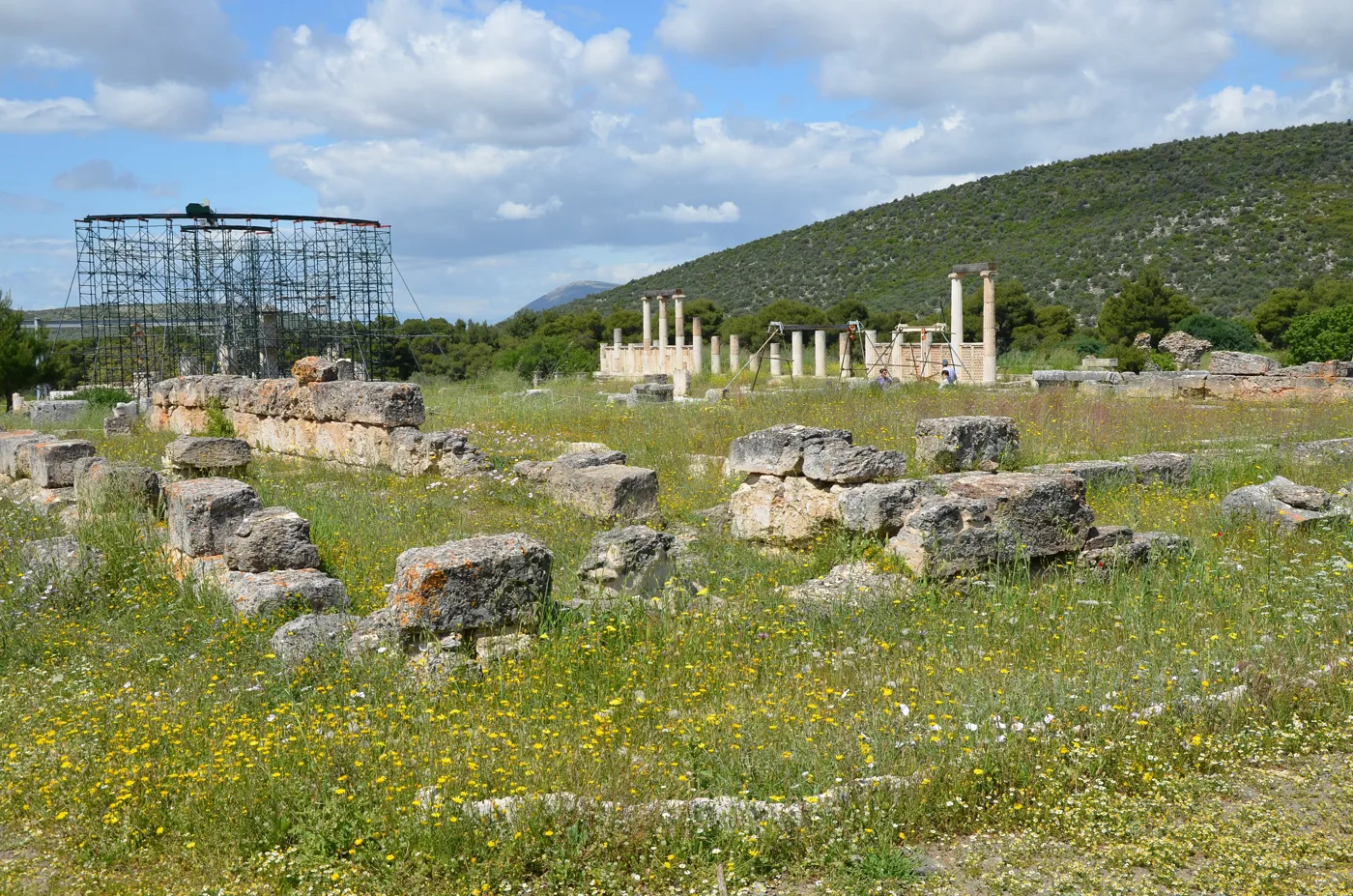
The centre of the sanctuary.
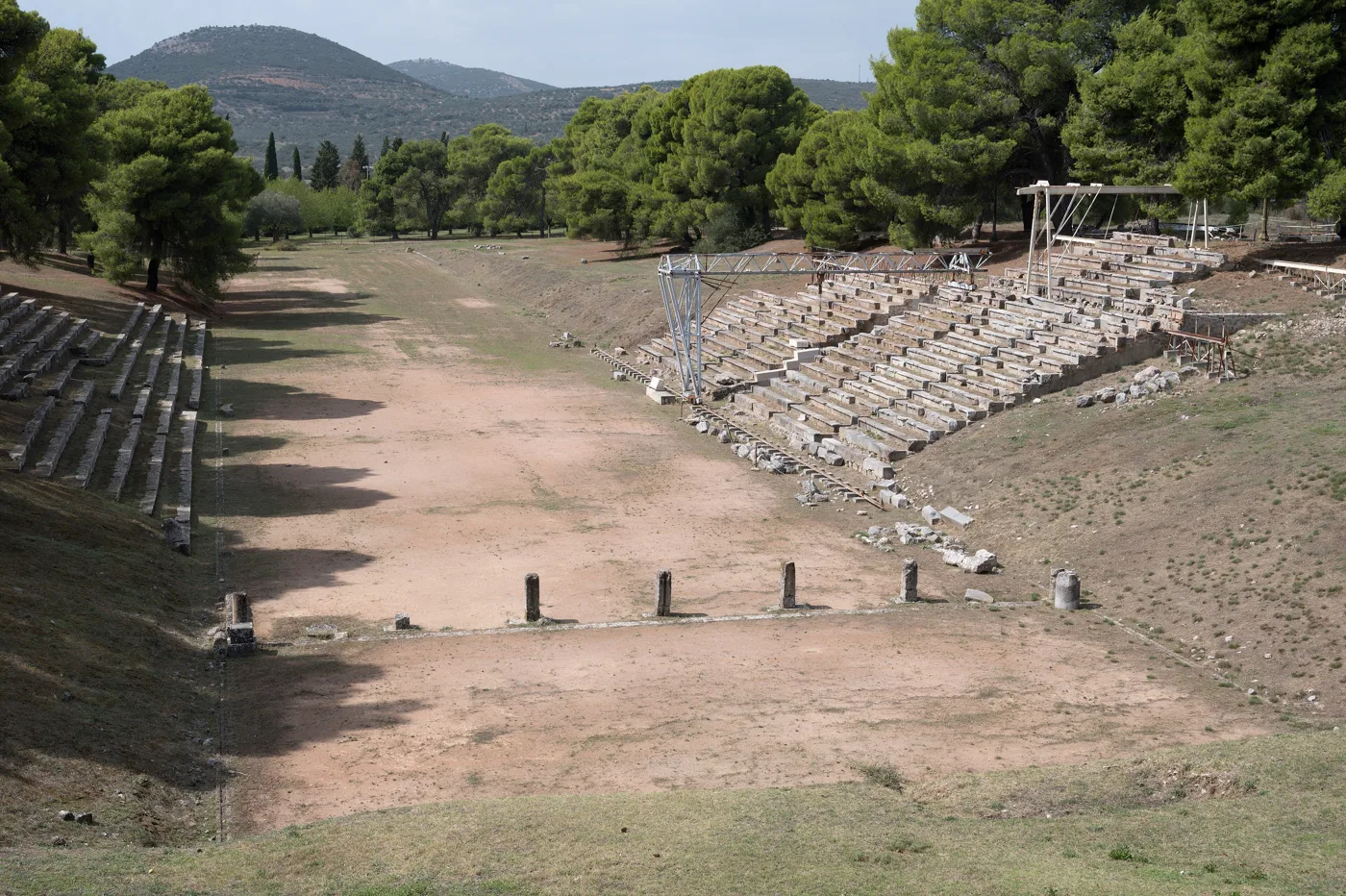
The games of the Asklepieia, every four years.
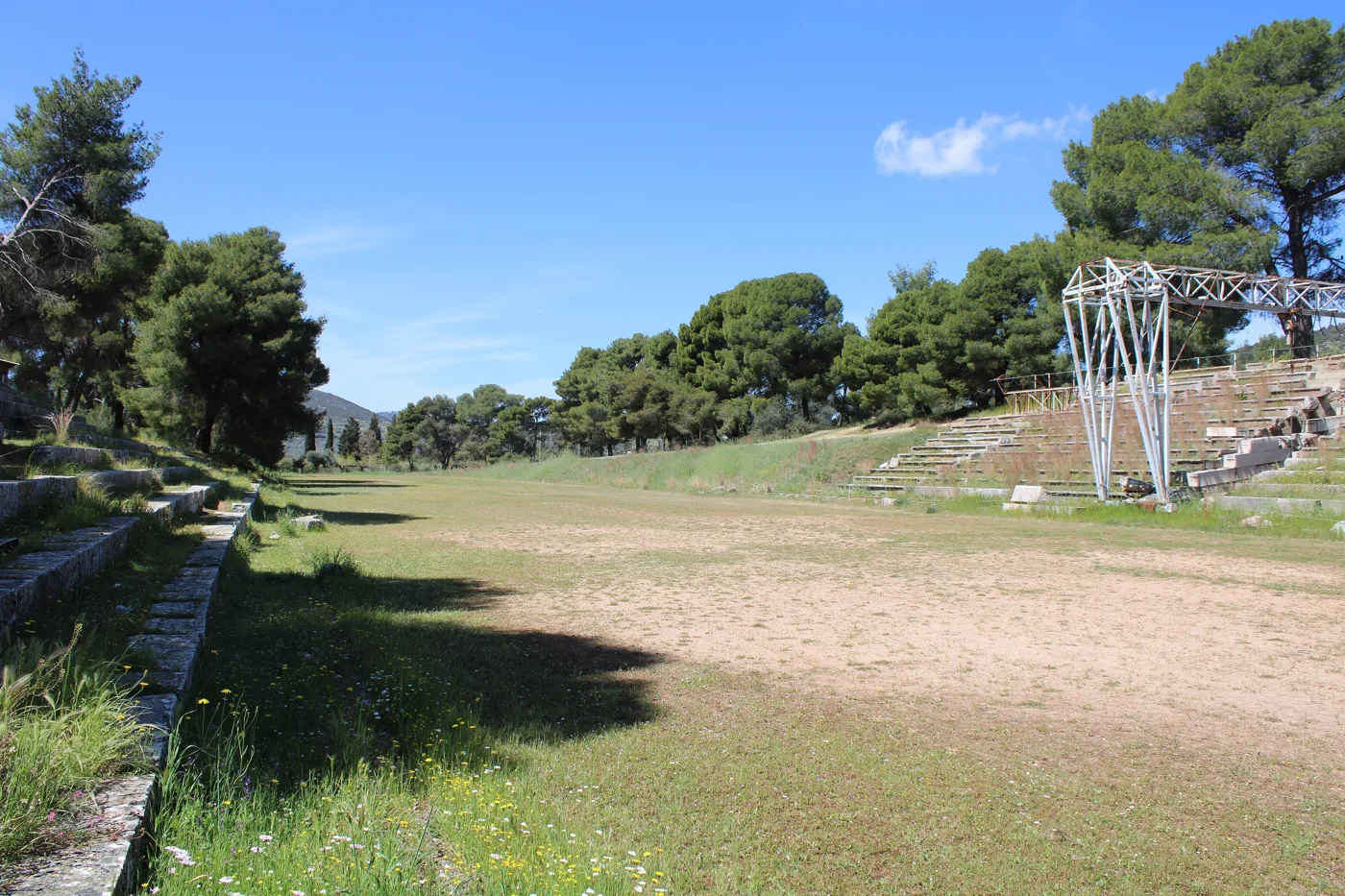
181 metres, the length of an ancient stadion.
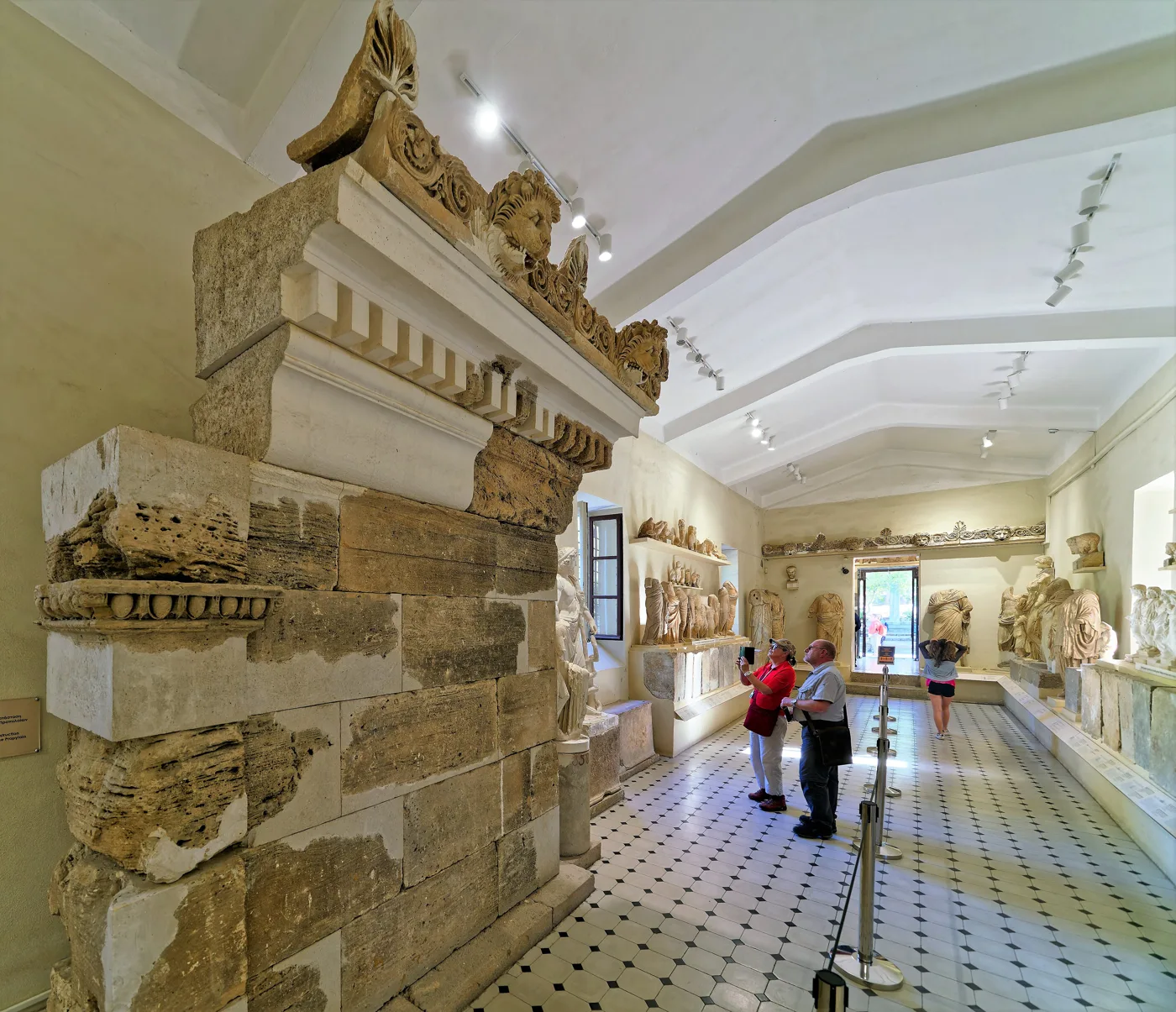
Since 1909, beside the theatre.
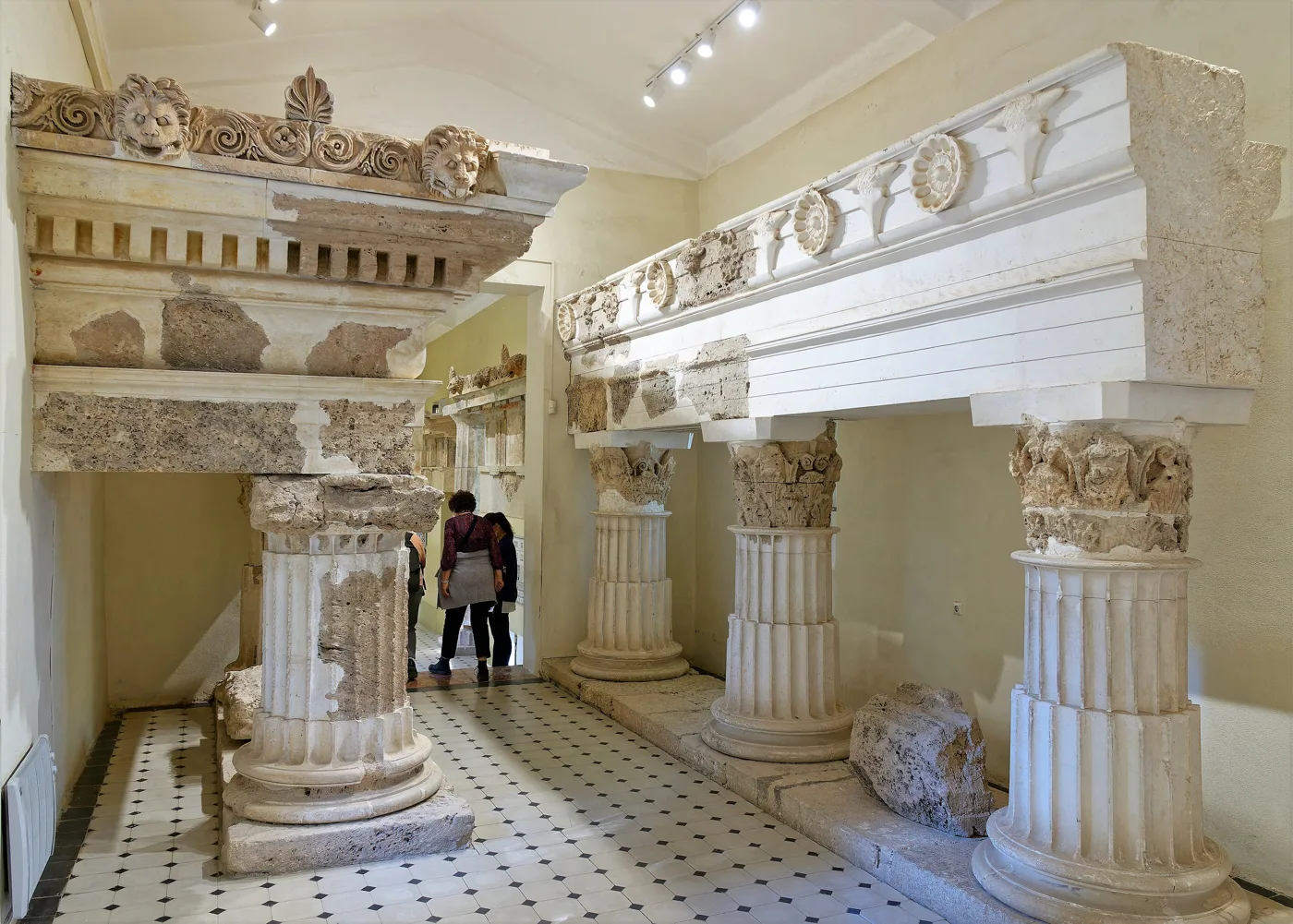
The originals, inside the museum.
Photos: HerrAdams (CC BY-SA 4.0), Fotografidis (CC BY-SA 4.0), George E. Koronaios (CC0), Jean Housen (CC BY-SA 4.0), Carole Raddato (CC BY-SA 2.0), Peulle (CC BY-SA 4.0), Julien Seguinot (CC BY-SA 2.0), Zde (CC BY-SA 4.0), Zunkir (CC BY-SA 4.0), Holger Uwe Schmitt (CC BY-SA 4.0) · Wikimedia Commons
⛵ Nafplio: the first capital
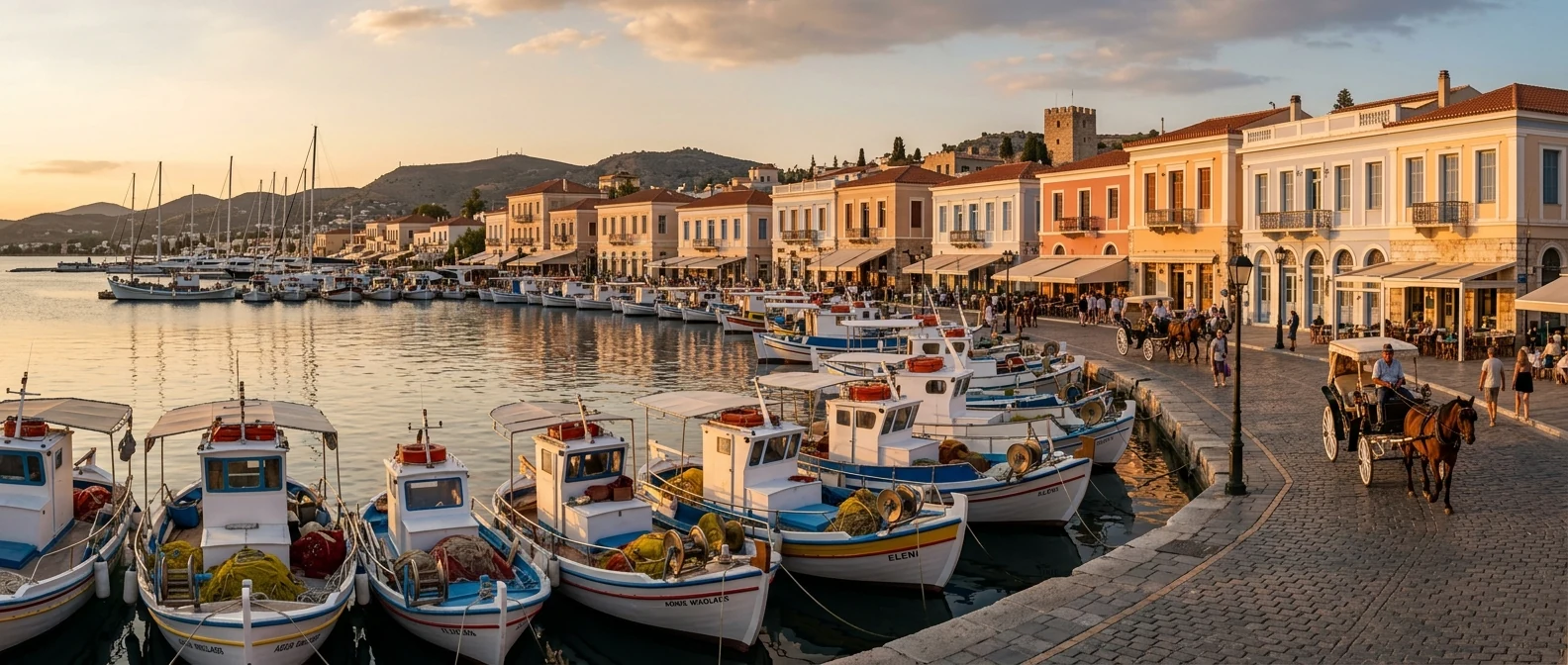
Nafplio is the reward of the day. The old town spreads out below the rock of Akronafplia, between the harbour and Palamidi: paved lanes without cars, neoclassical houses with balconies and bougainvillea, Venetian lions on the walls and a mosque that became the first Parliament of Greece. Syntagma Square is its heart: marble-paved, car-free, with cafés, children on bicycles, and the Venetian arsenal of 1713 that houses the Archaeological Museum, with the Dendra armour, the oldest complete suit of armour in Europe, from the 15th century BC. On Staikopoulou Street the tavernas, on Farmakopoulon the shops, on the seafront the walk under the palm trees to the harbour.
From the waterfront, the little boats take you in five minutes to Bourtzi, the small Venetian fortress of 1473 on the islet at the entrance of the harbour, which was a prison, the executioner's house and a hotel; around €5 return, and half an hour inside. From the square, ten minutes uphill take you to Akronafplia, the oldest castle of the town, free, with a view over the roofs and Bourtzi, and from there the Arvanitia walk, the promenade around the rock above the sea, descends to the small beach of Arvanitia, where the people of Nafplio swim. Three kilometres further on is the long sandy beach of Karathona.
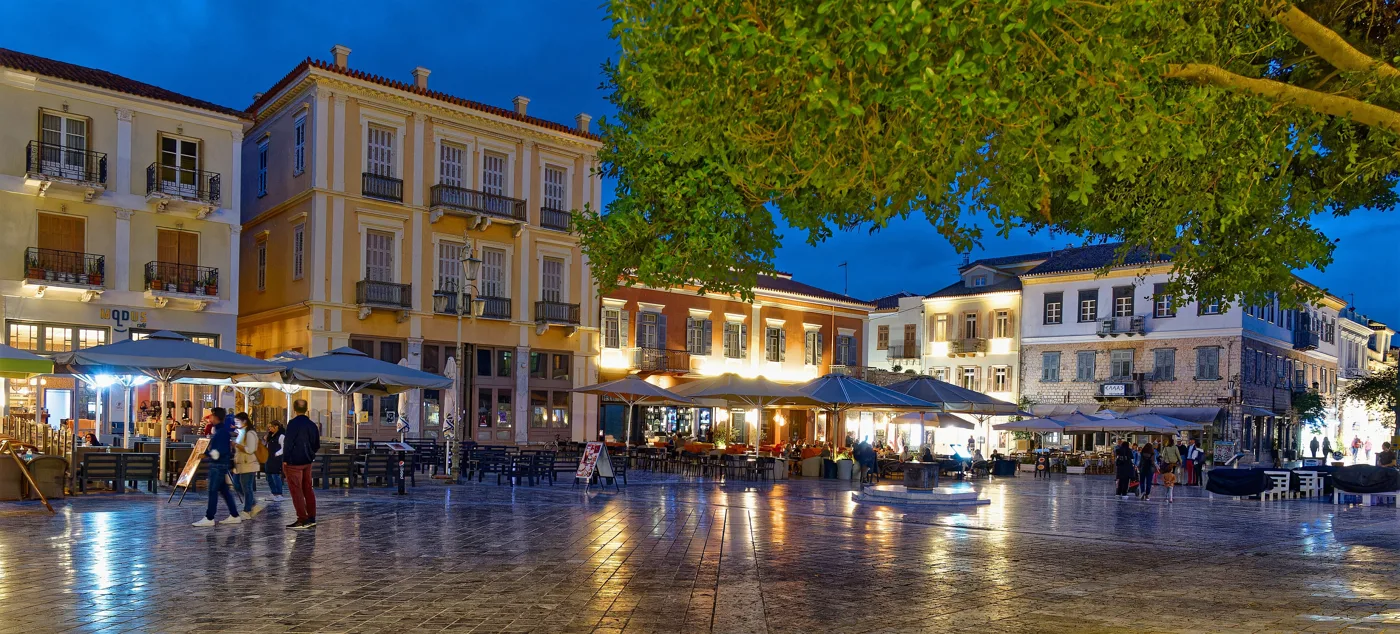
The heart of the old town.
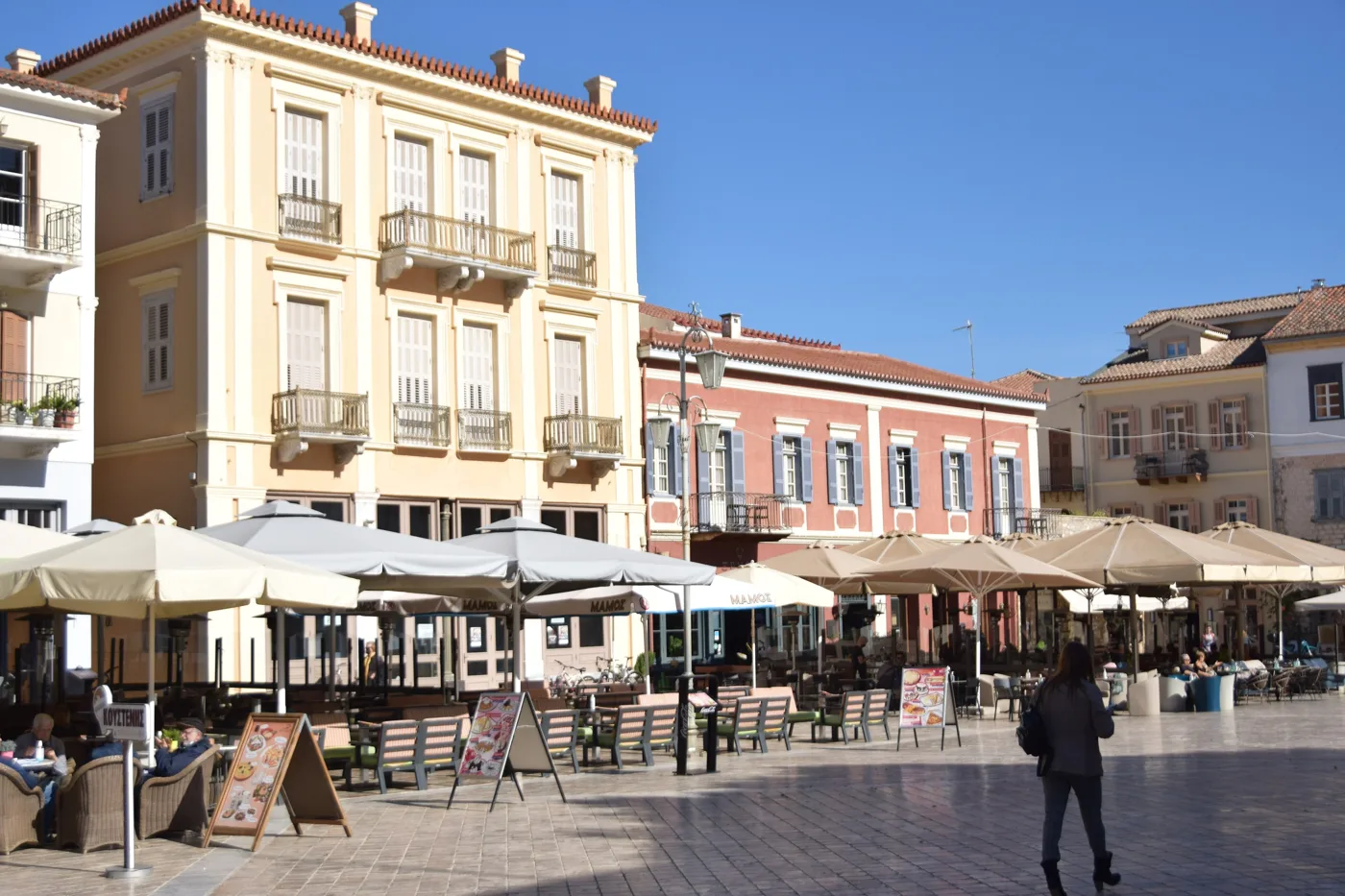
Neoclassical buildings, cafés and children on bicycles.
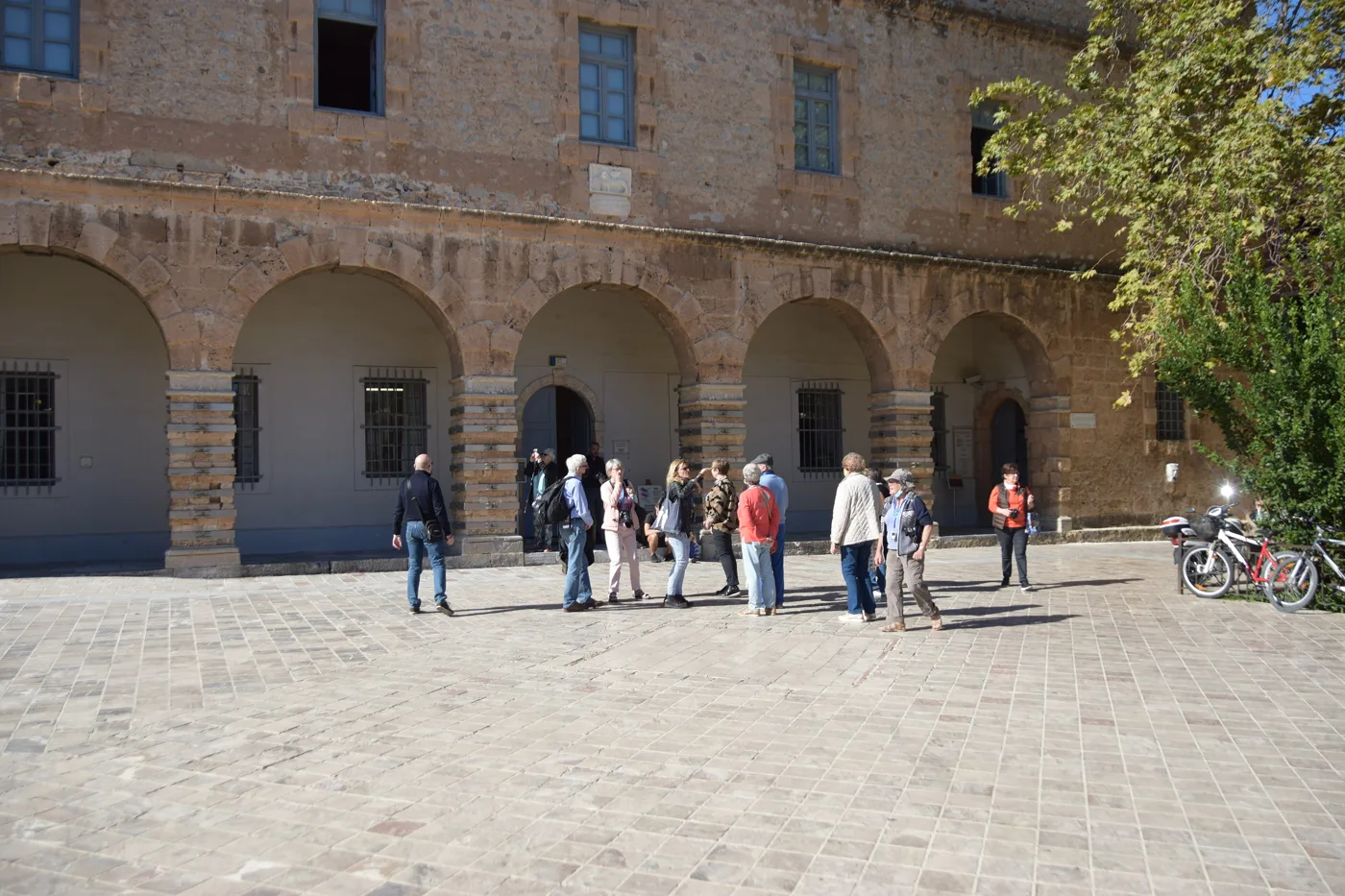
The Venetian arsenal of 1713.
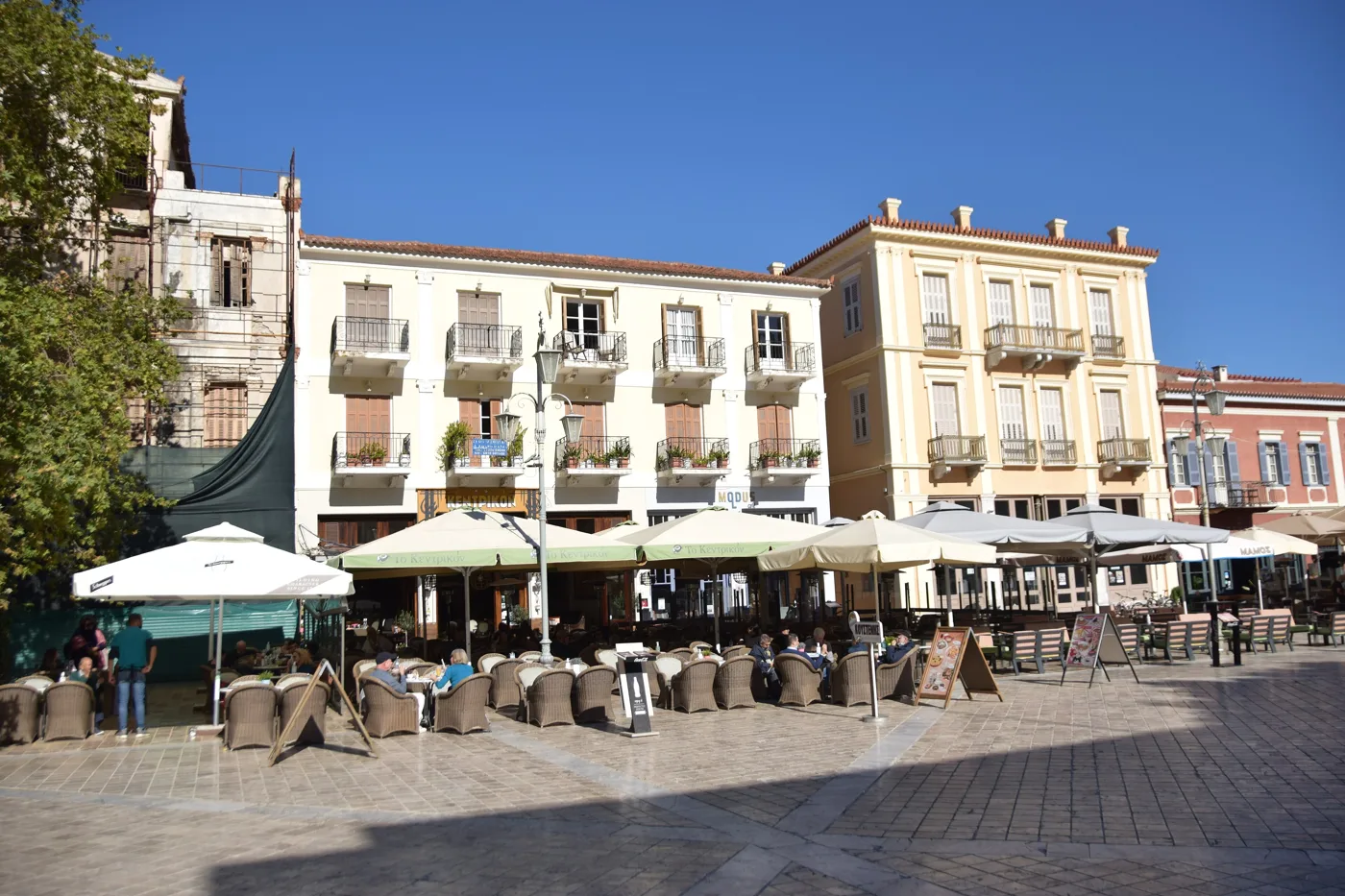
Nafplio lives in its squares.
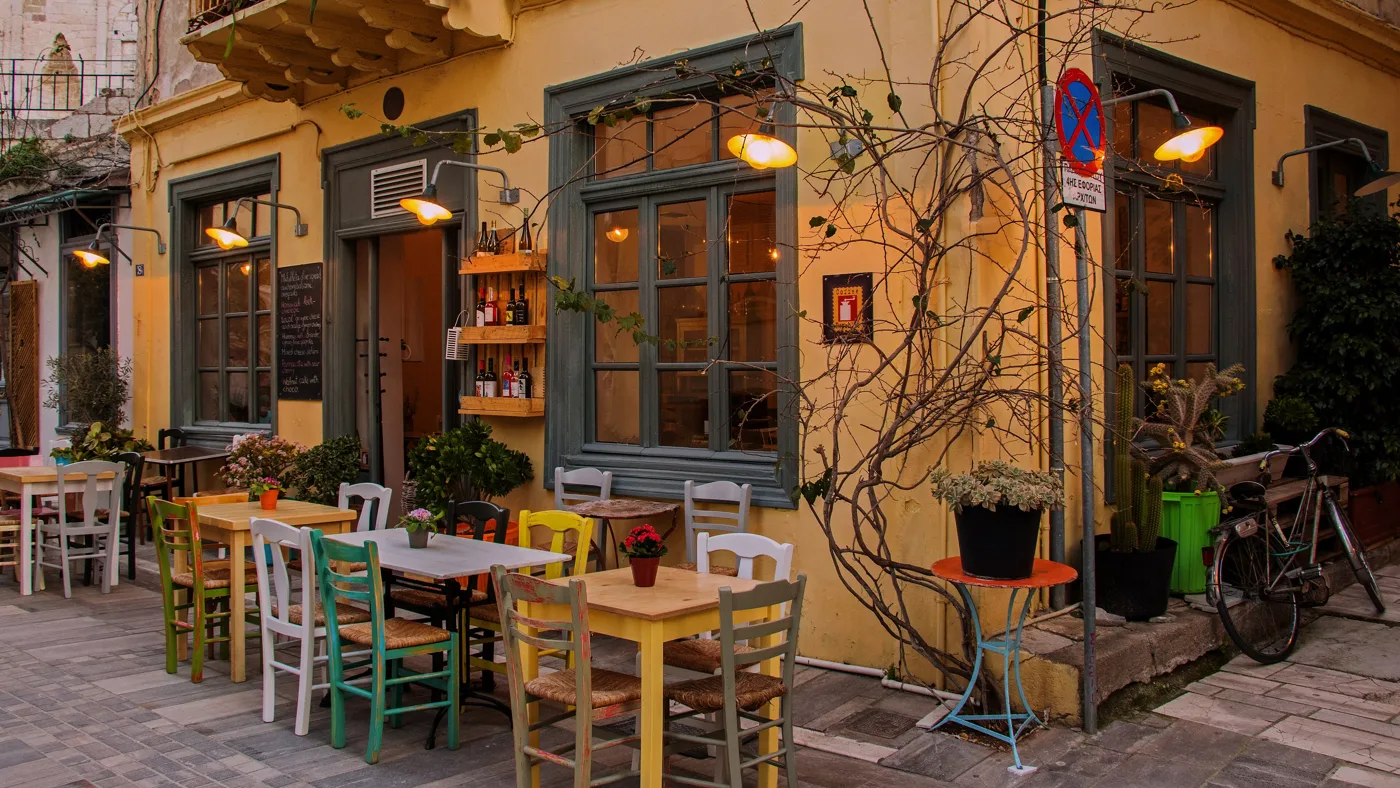
Every corner is a photograph.
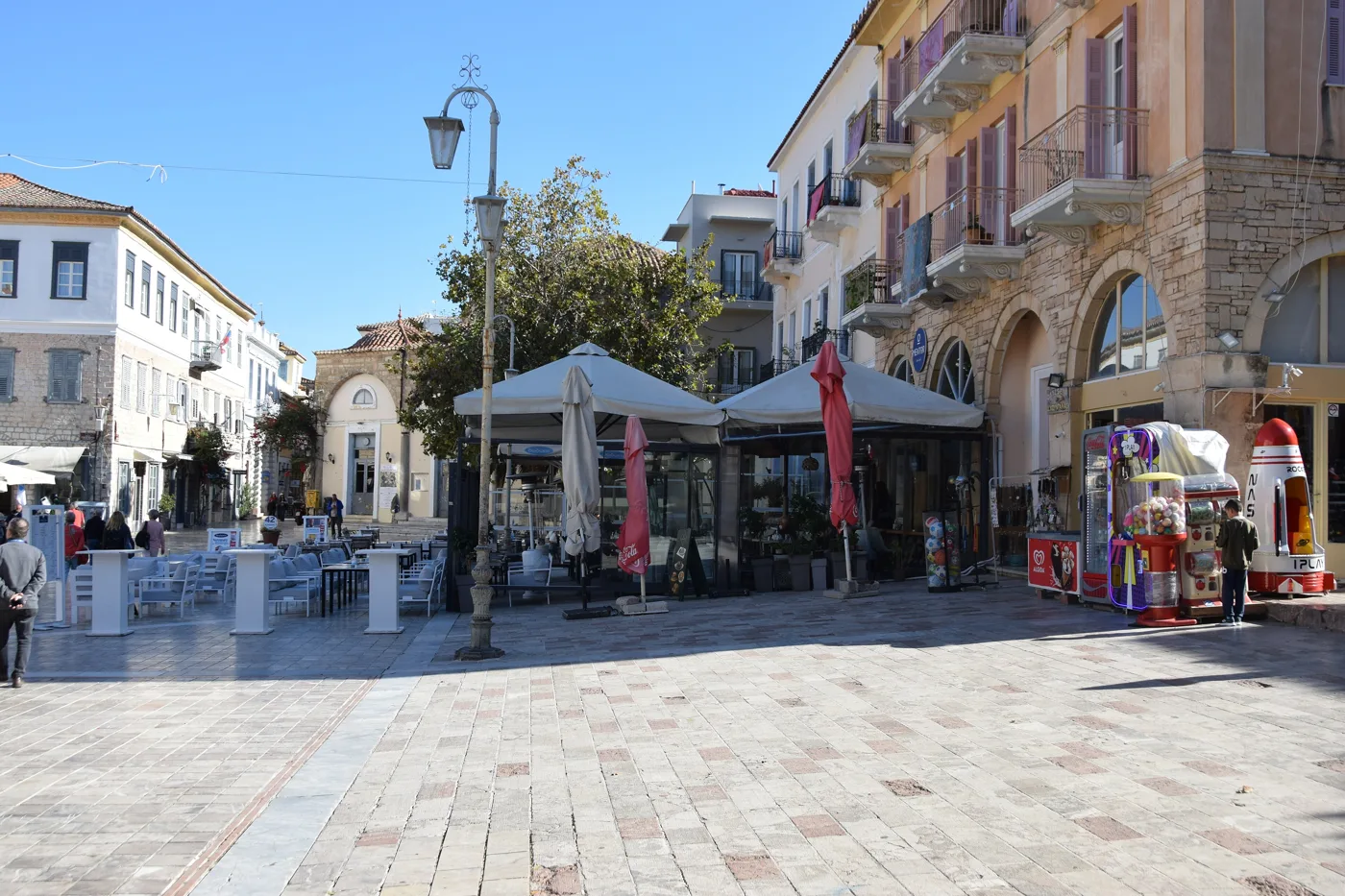
Venetian, Ottoman and neoclassical together.
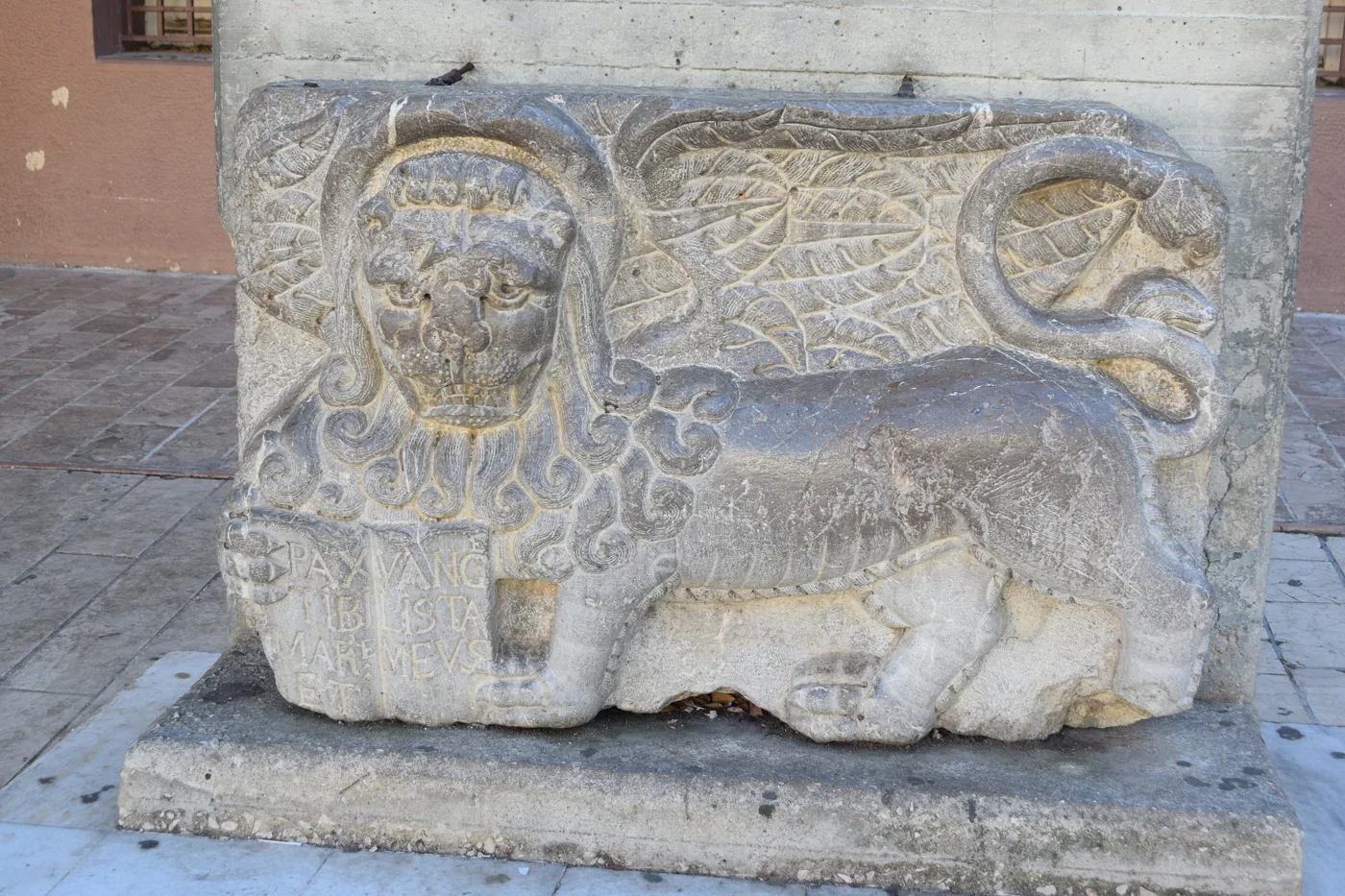
The Venetians left their lions everywhere.
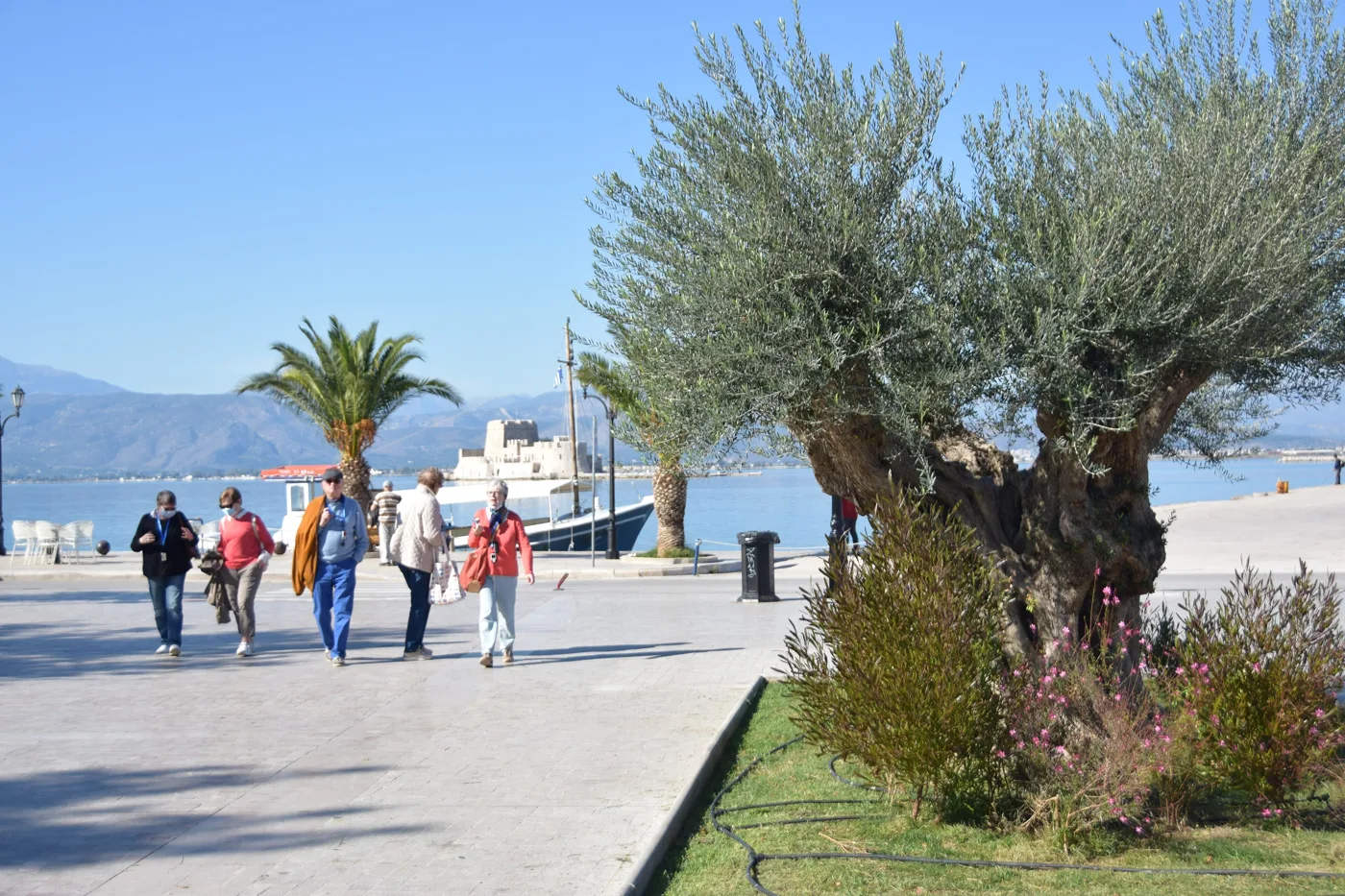
The walk along the harbour.
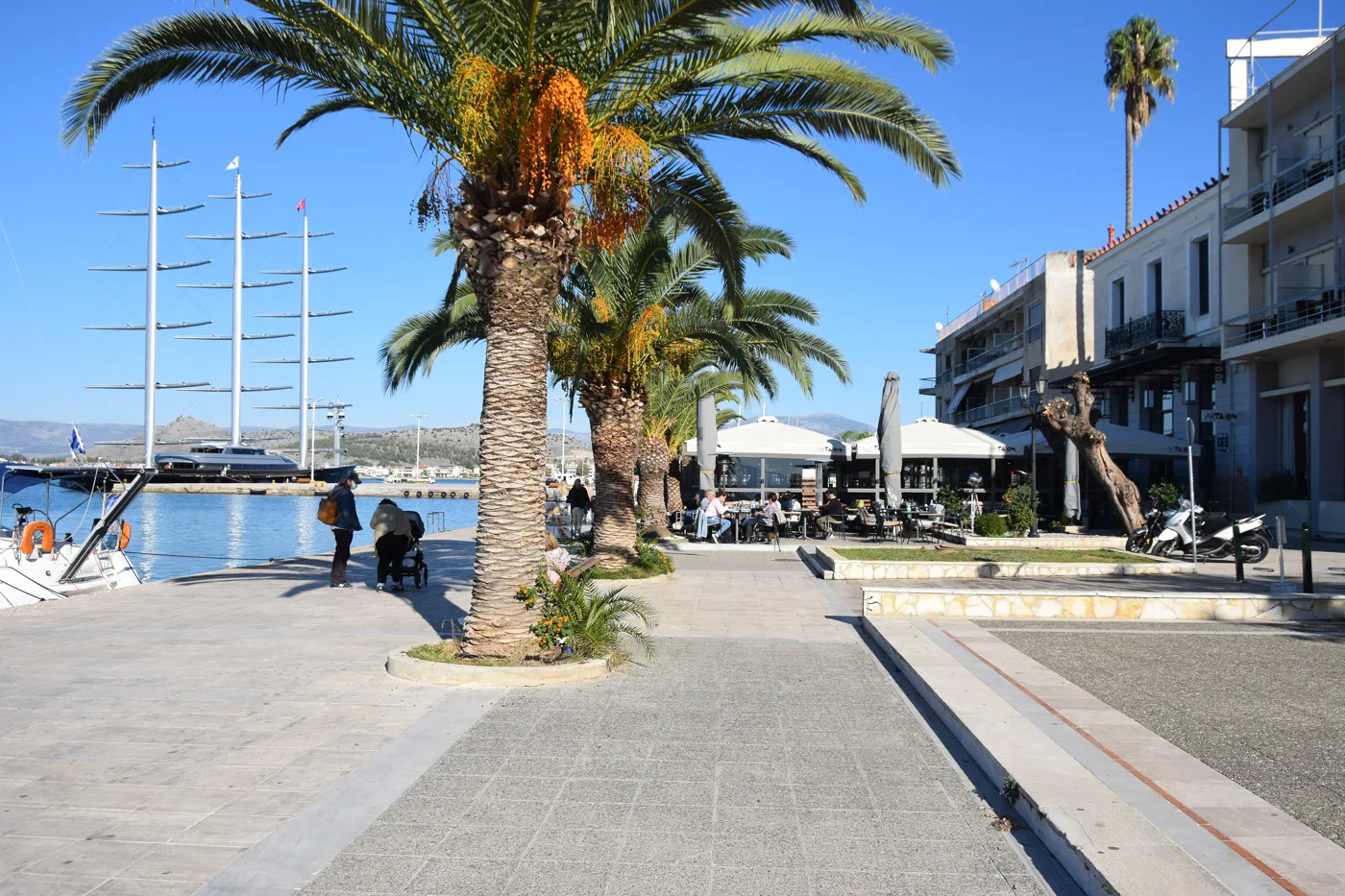
Sailing boats and caiques.
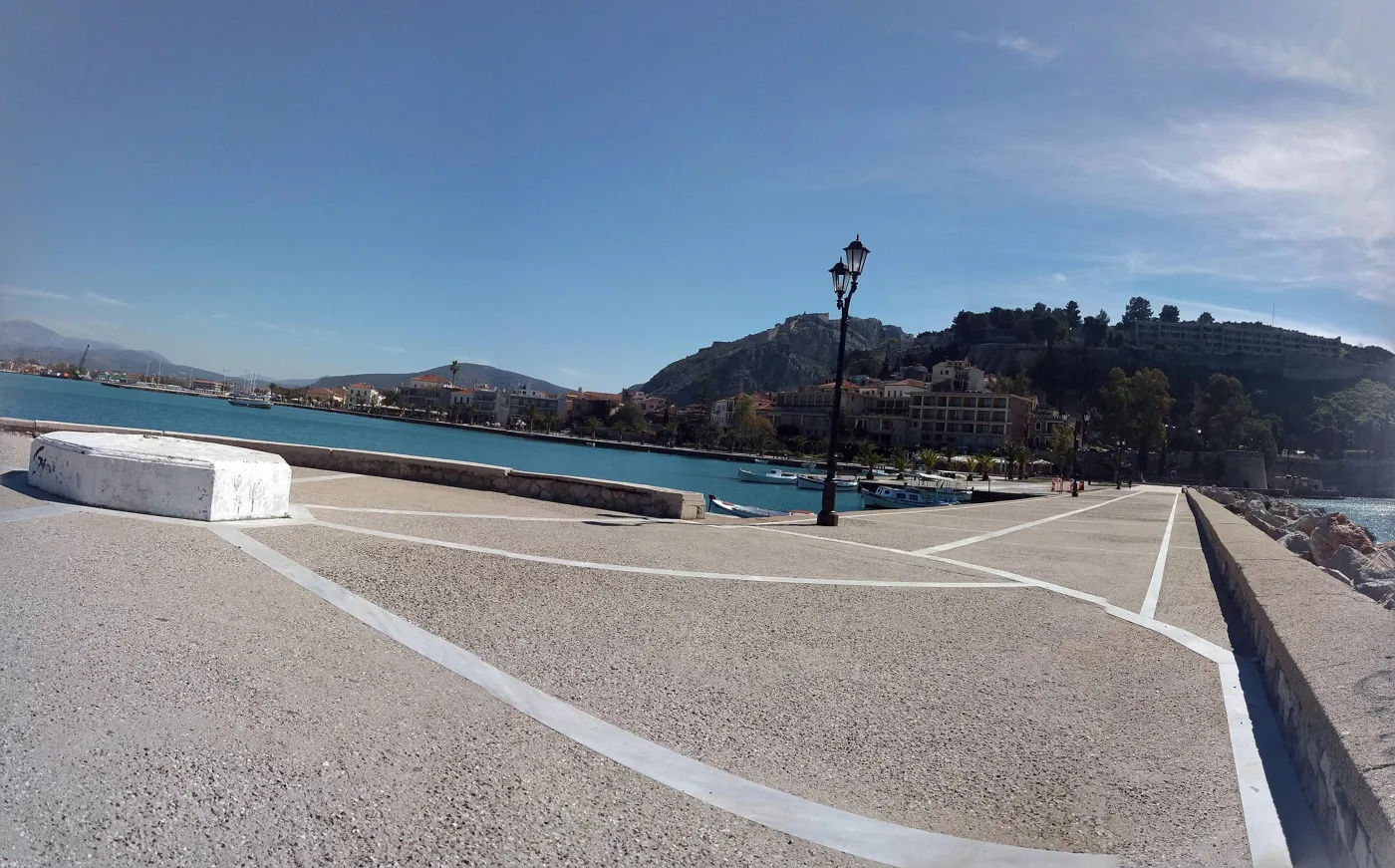
Below Palamidi.
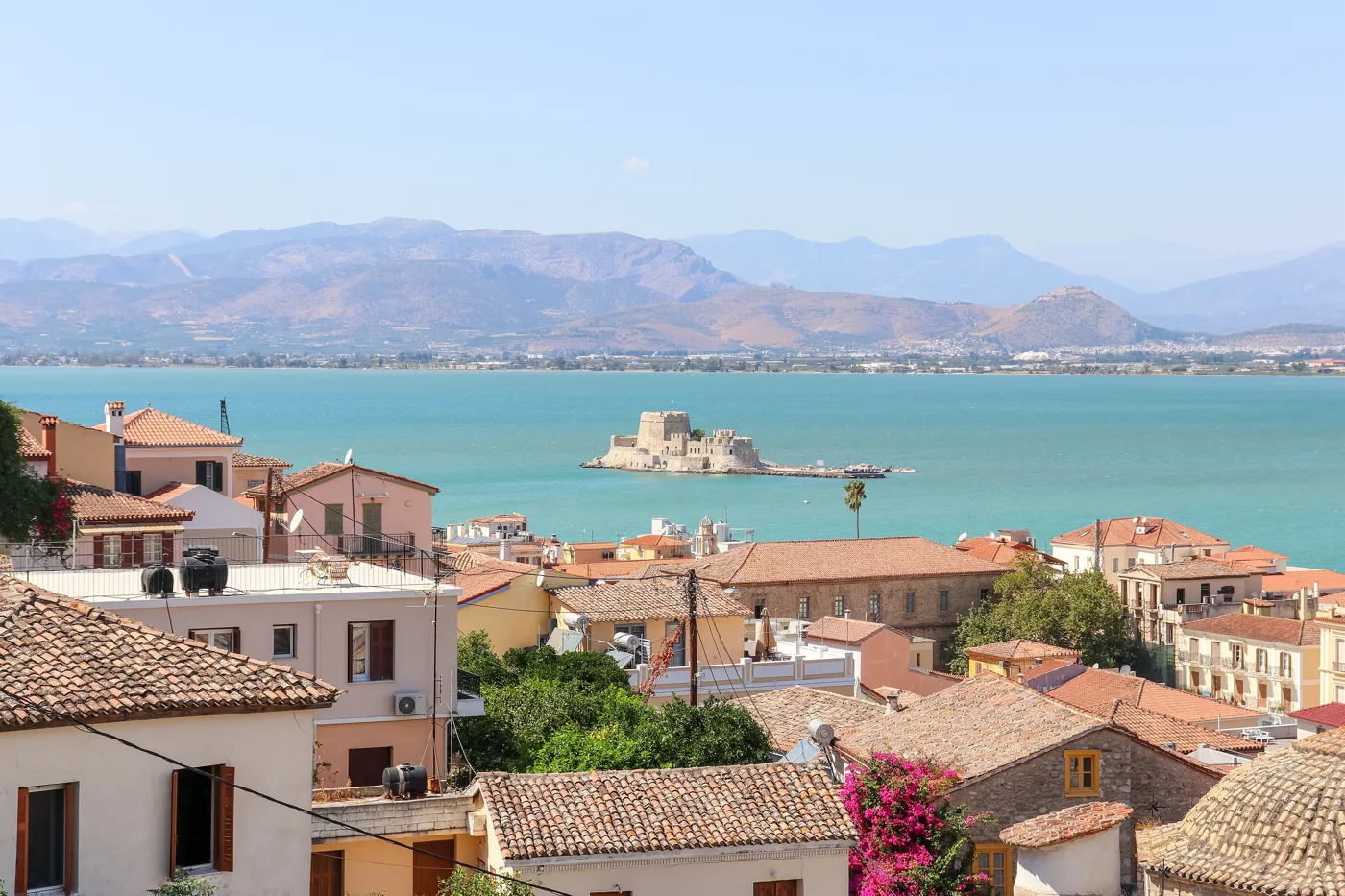
From Akronafplia.
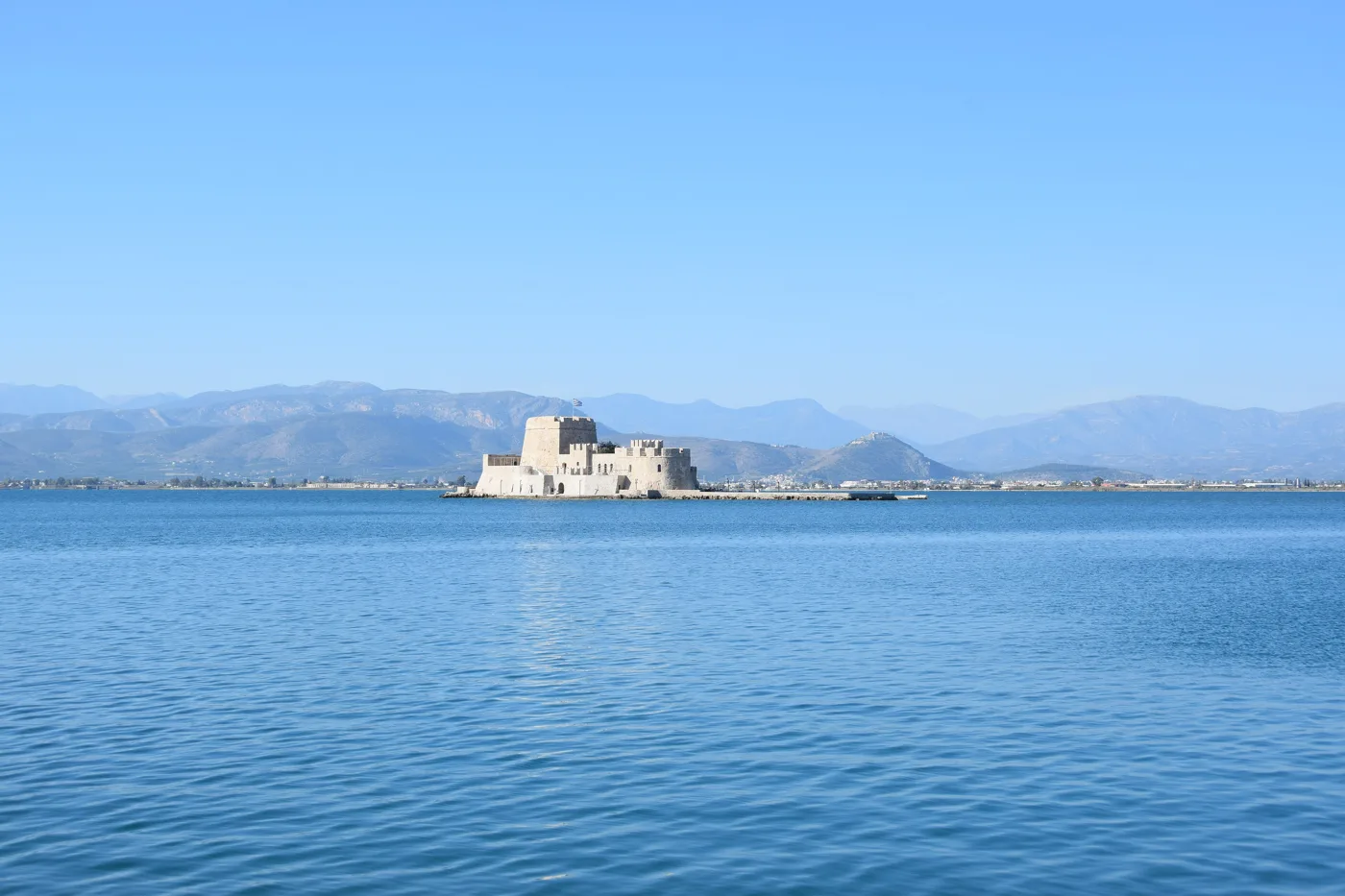
The Venetian fortress of 1473 on the islet.
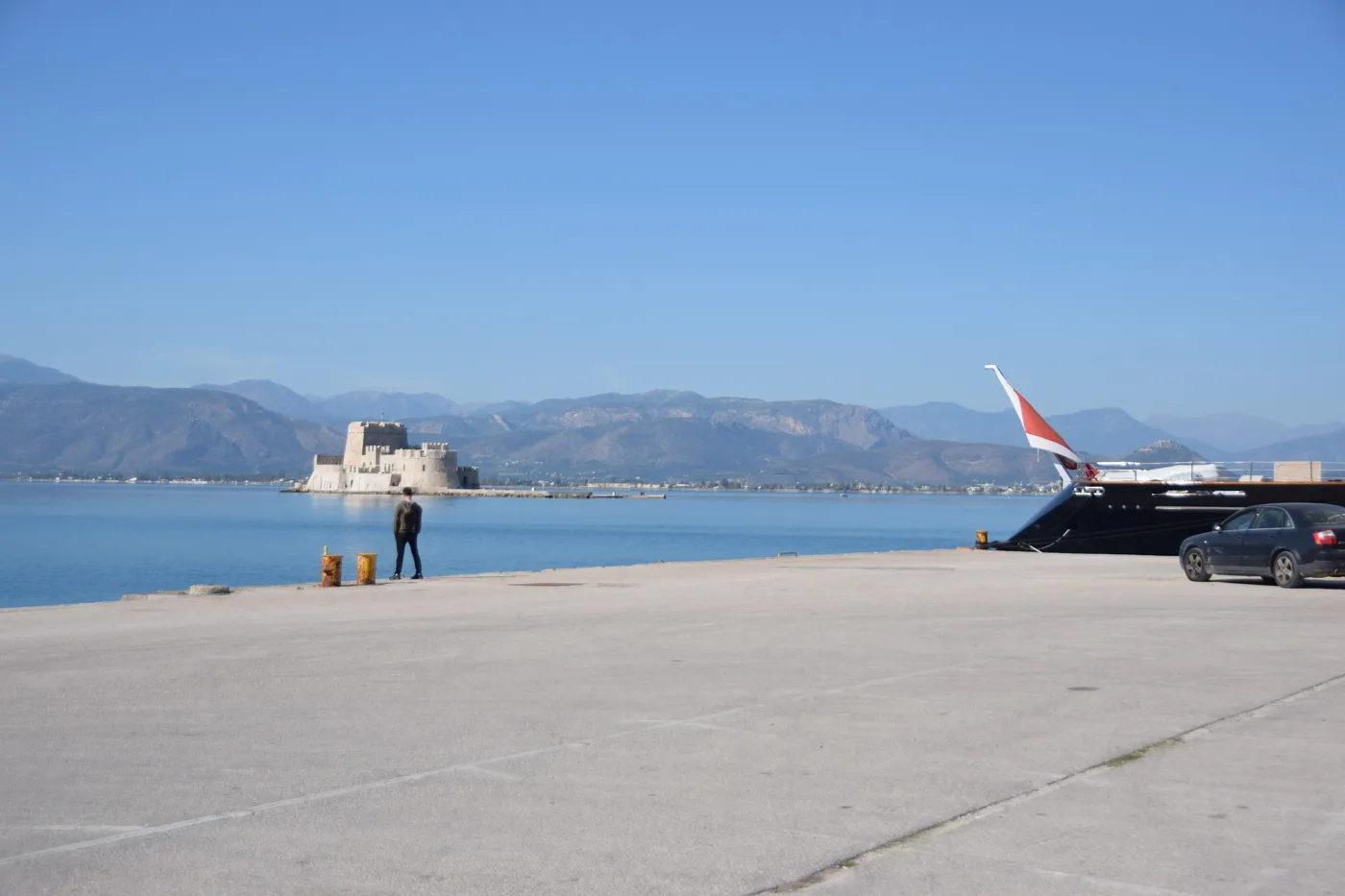
Five minutes by boat.
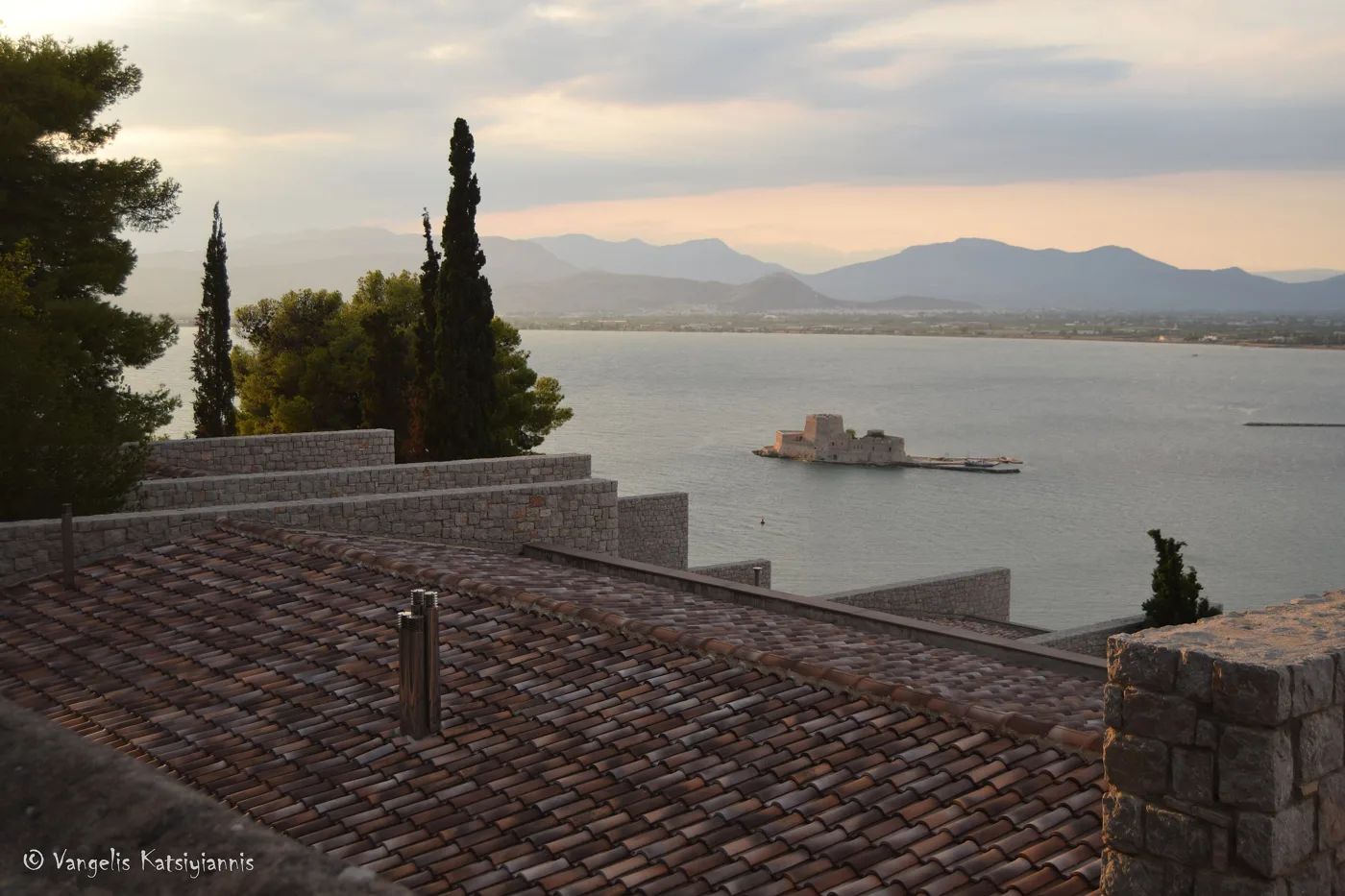
The photograph of Nafplio.
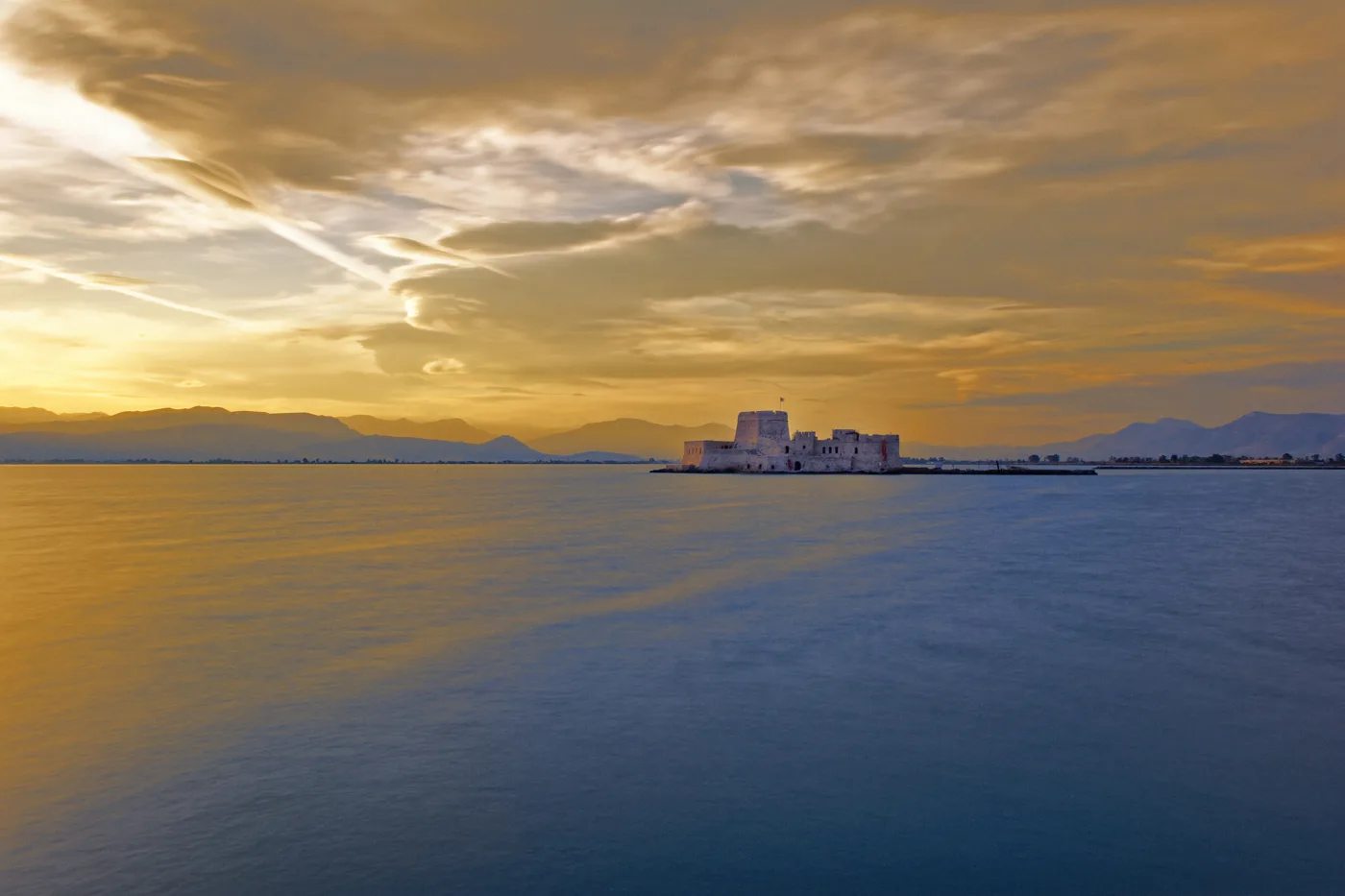
The last light of the day.
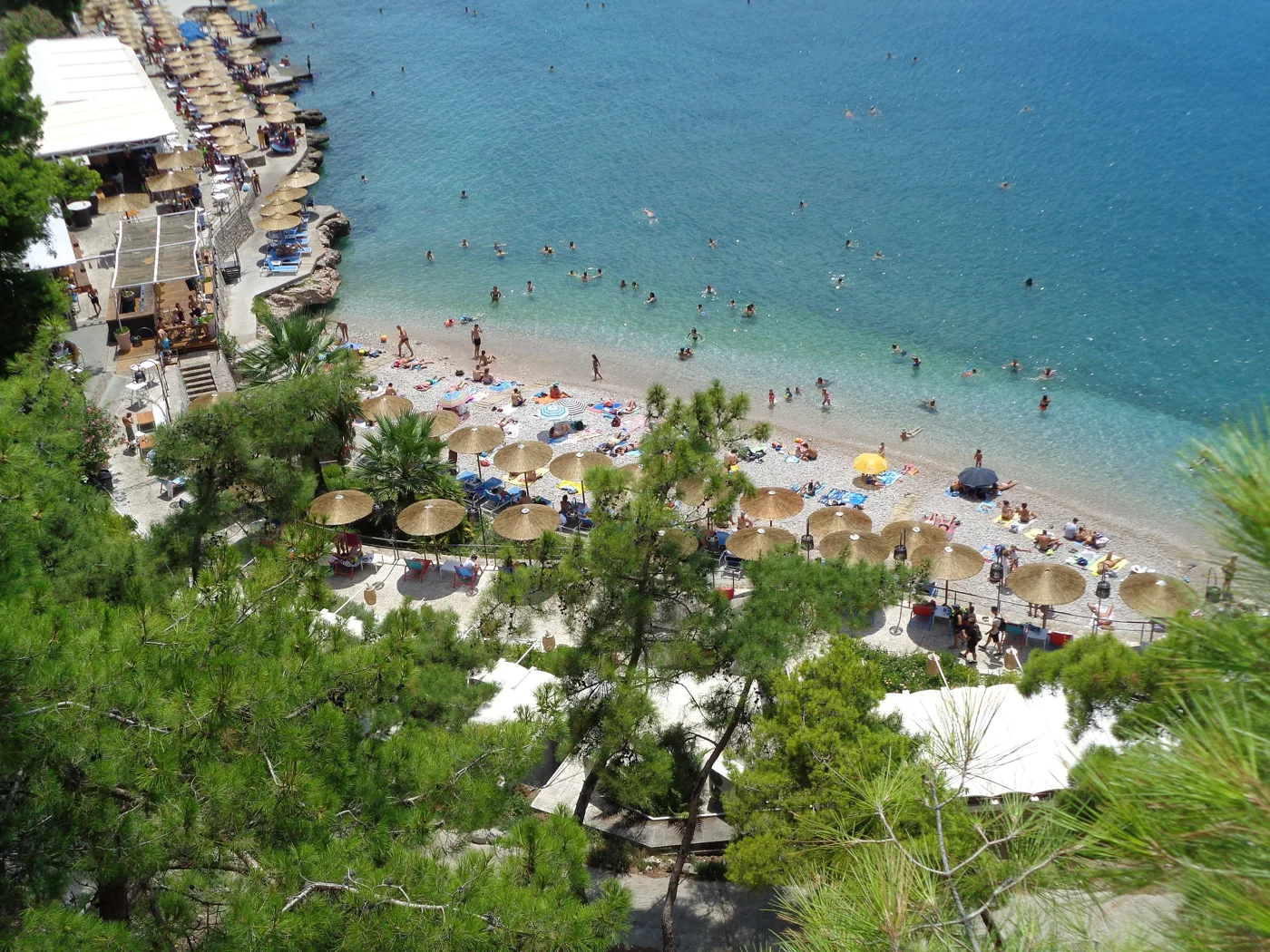
The town beach, five minutes from the square.
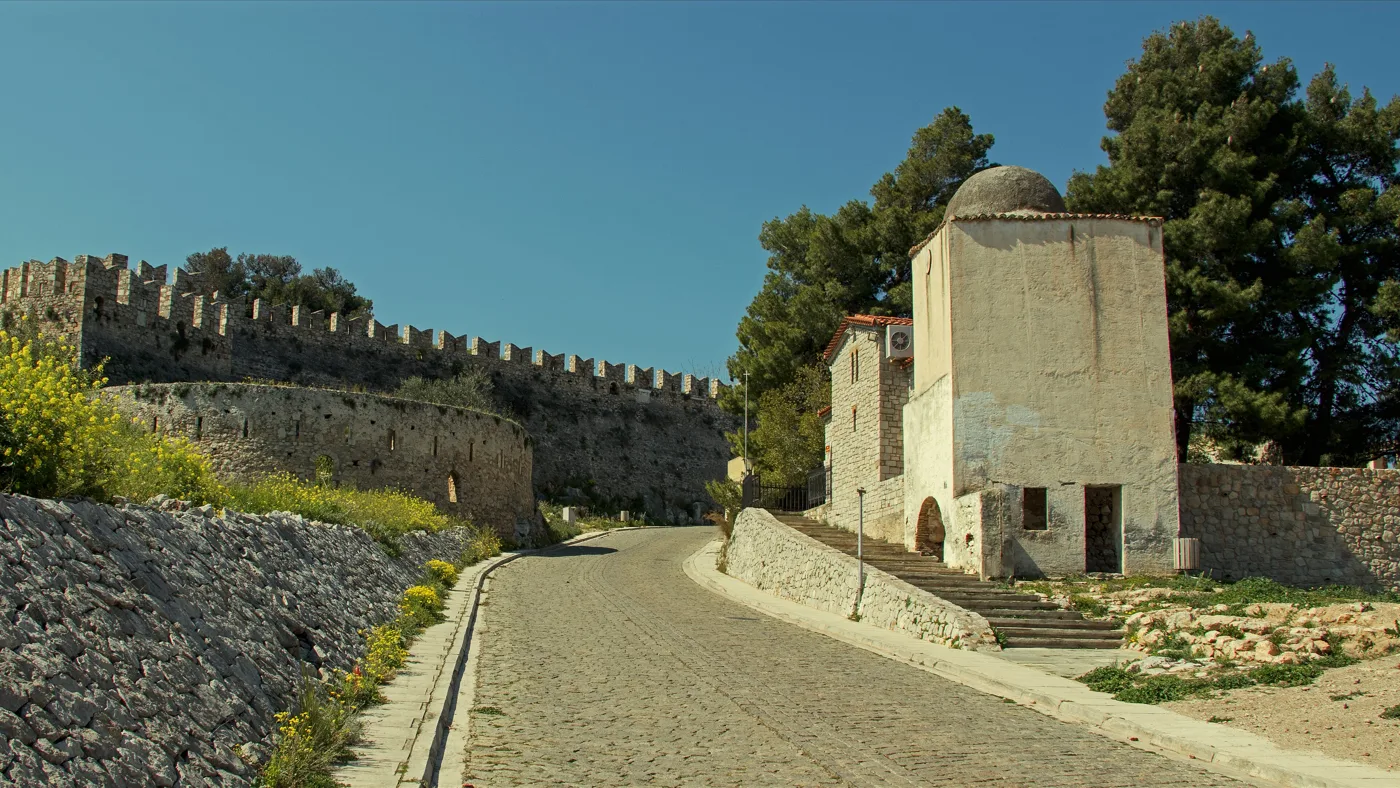
The oldest castle of the town, free.
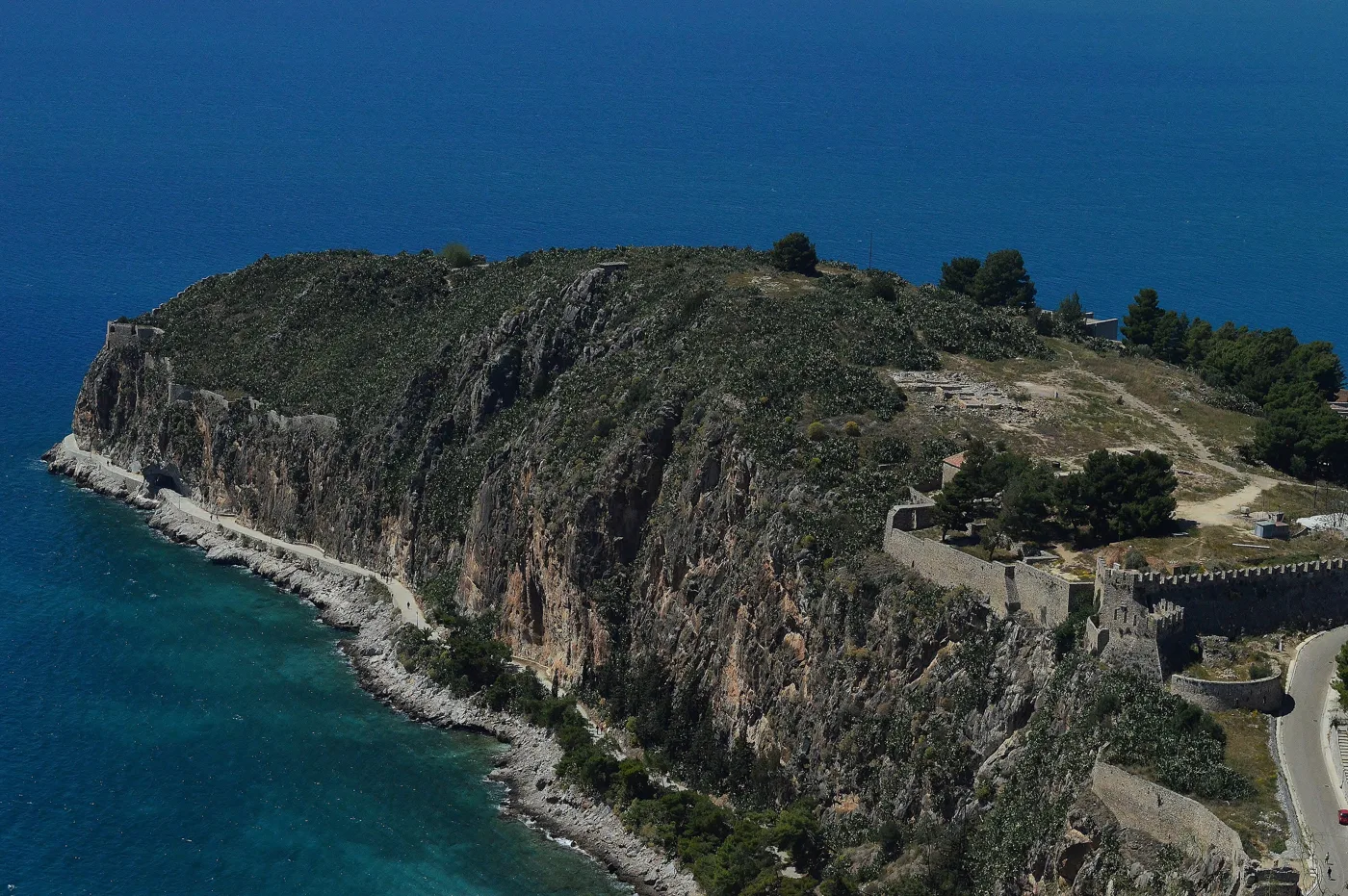
The old town hangs from the rock.
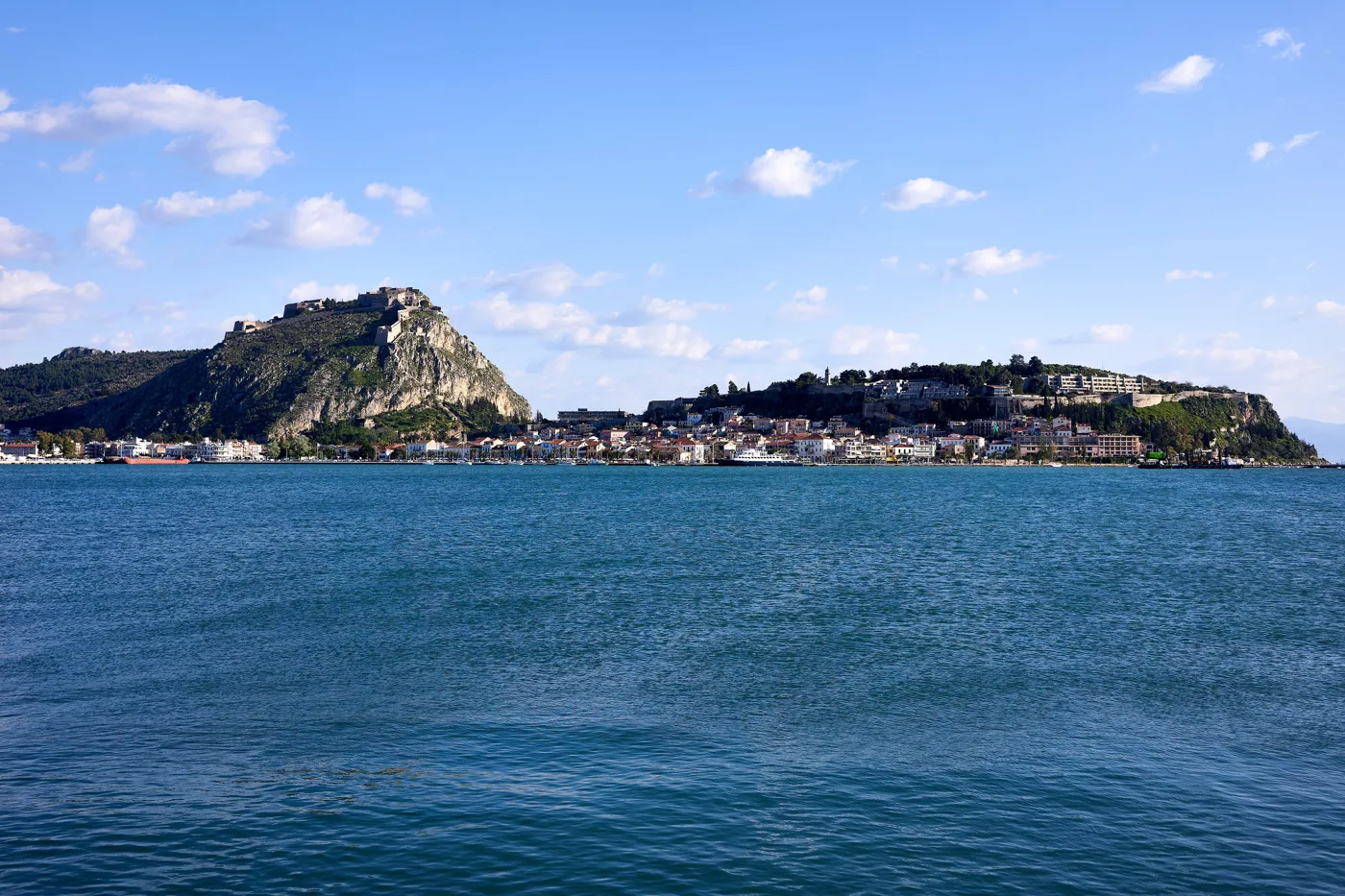
Two castles, one above the other.
Photos: Holger Uwe Schmitt (CC BY-SA 4.0), Jean Housen (CC BY-SA 4.0), DimitrisP67 (CC BY-SA 4.0), NikosLikomitros (CC0), Stolbovsky (CC BY-SA 3.0), Vangelis Katsiyiannis (CC BY-SA 4.0), Anastasius Moumtzoglou (CC BY-SA 4.0), S-miroslav (CC BY-SA 4.0), Anastkyriakos (CC BY-SA 4.0), George E. Koronaios (CC0) · Wikimedia Commons
🏰 Palamidi
Above the town, at 216 metres, Palamidi is the best-preserved Venetian castle in Greece: eight bastions, each an independent fortress with its own cistern and gate, built in just three years, from 1711 to 1714, only to be surrendered to the Ottomans in 1715 after a siege of eight days. In the Miltiades bastion is the prison of Kolokotronis, the damp cell where the hero of the War of Independence was held in 1833 and 1834, sentenced to death by the kingdom he had helped to create. From the walls you see all of Nafplio, Akronafplia, Bourtzi, the Argolic Gulf as far as the mountains of Arcadia, and the plain as far as Argos and Tiryns.
You go up in two ways: by car, along the road that leaves from behind the town, to the car park at the gate, or on foot up the 999 steps, which start at the edge of the old town, next to Arvanitia. Legend says there were 1,000 and Kolokotronis' horse broke the last one; in reality there are 857, and they take twenty to thirty minutes with stops, with the view opening up at every turn. In summer climb early in the morning or before sunset. The castle closes at 20:00 in summer and at 15:30 in winter, and the ticket is €20.
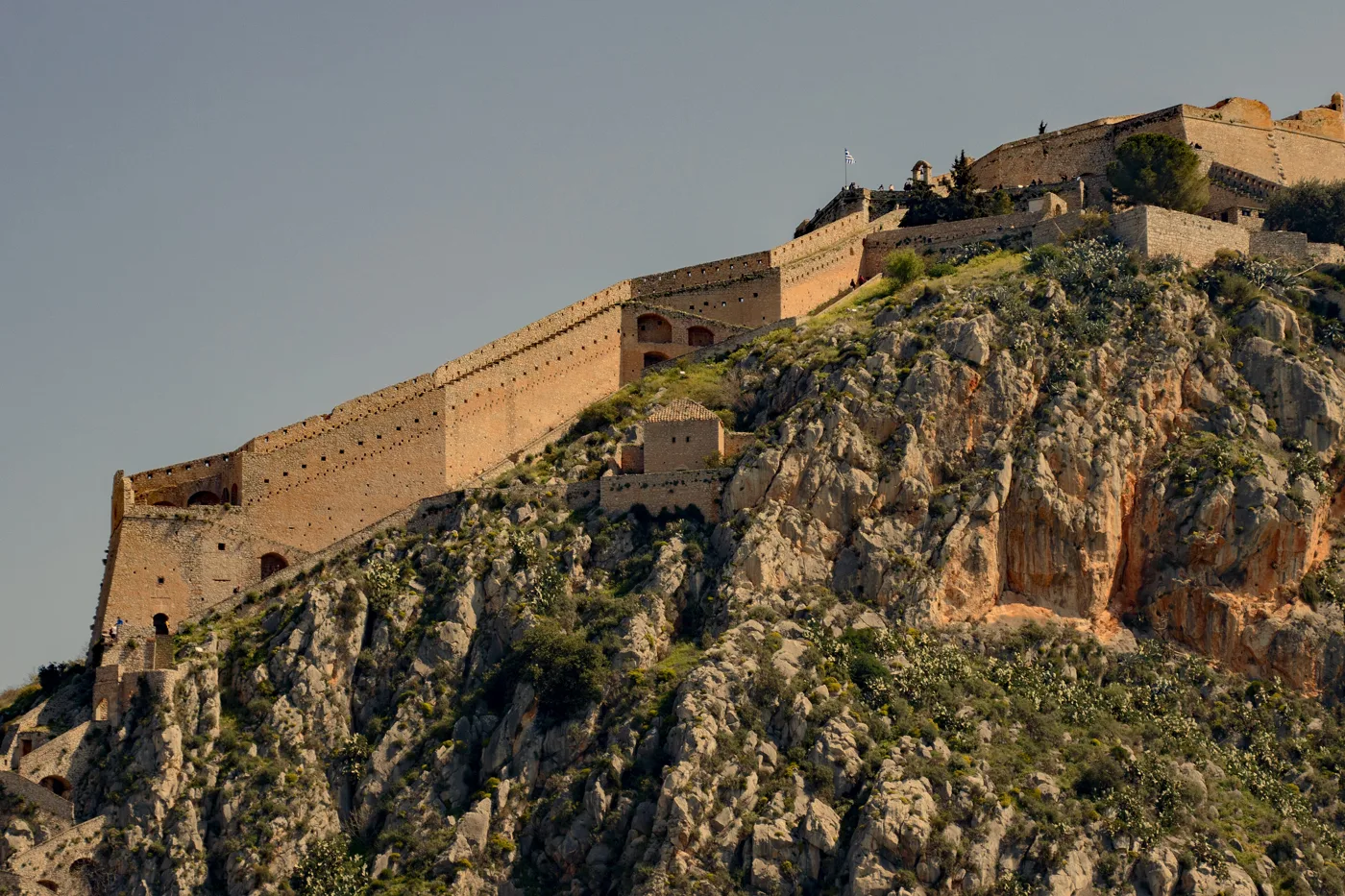
Venetian, 1711 to 1714, at 216 metres.
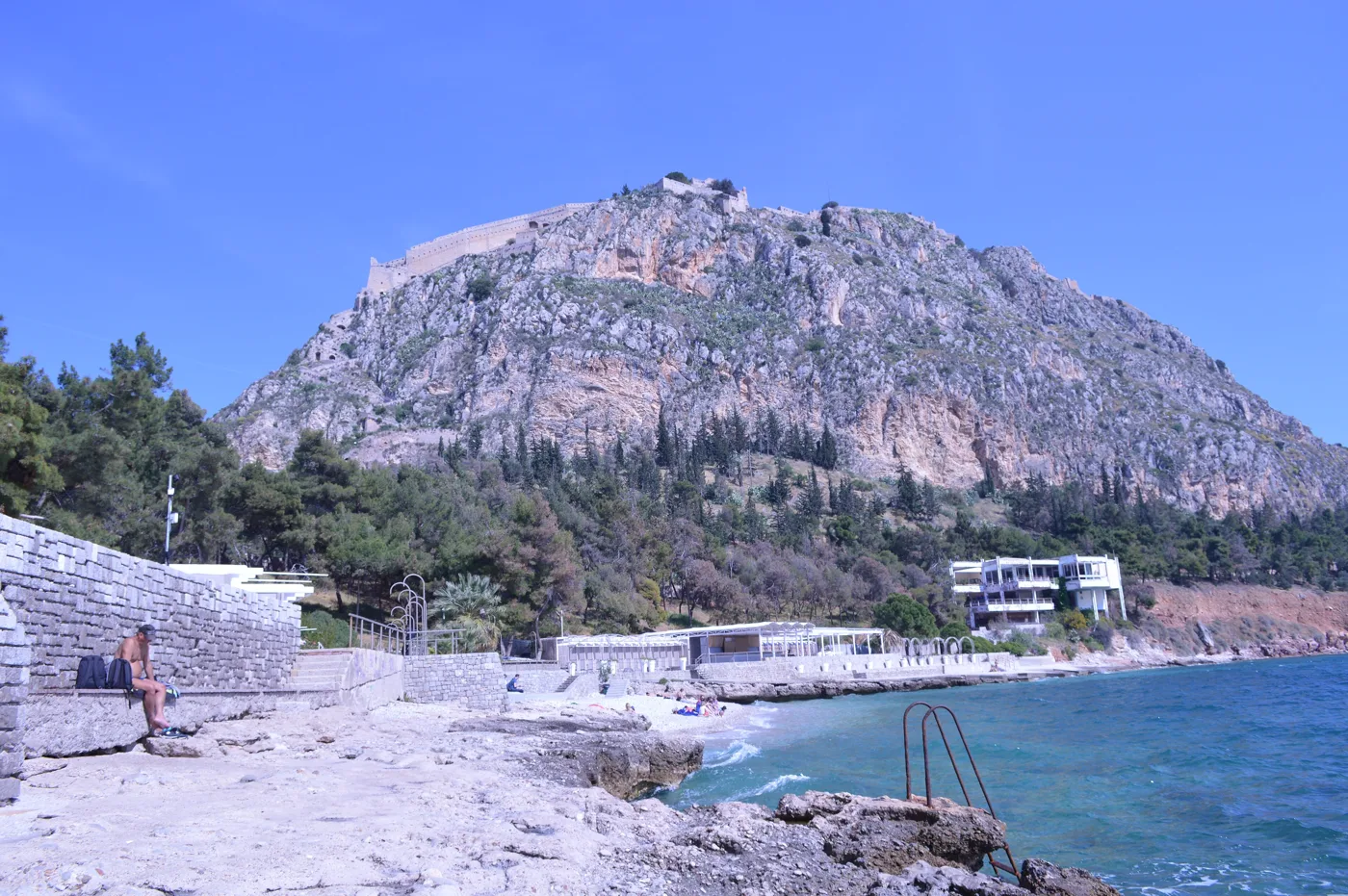
The castle above the beach.
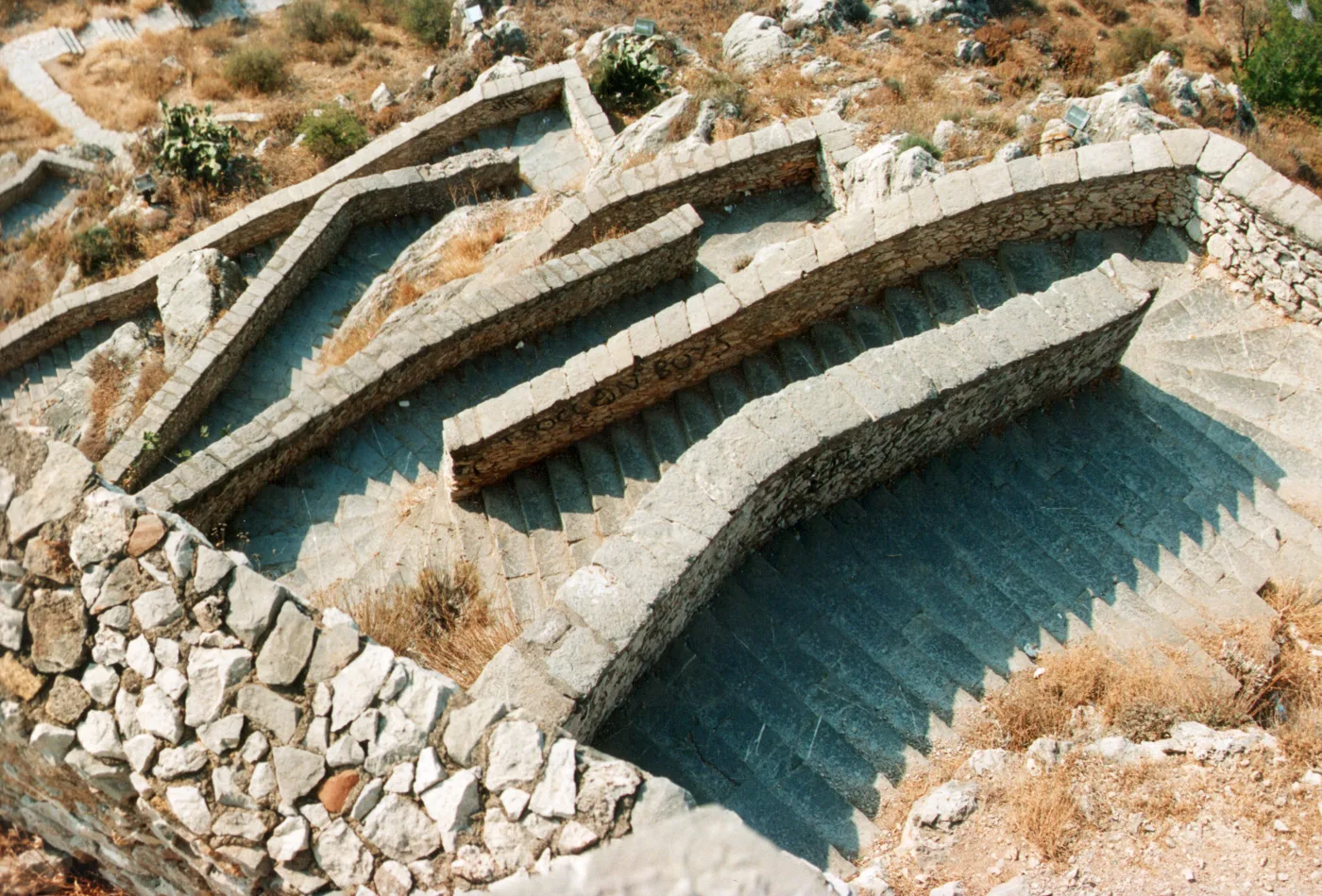
In reality 857, but nobody counts them.
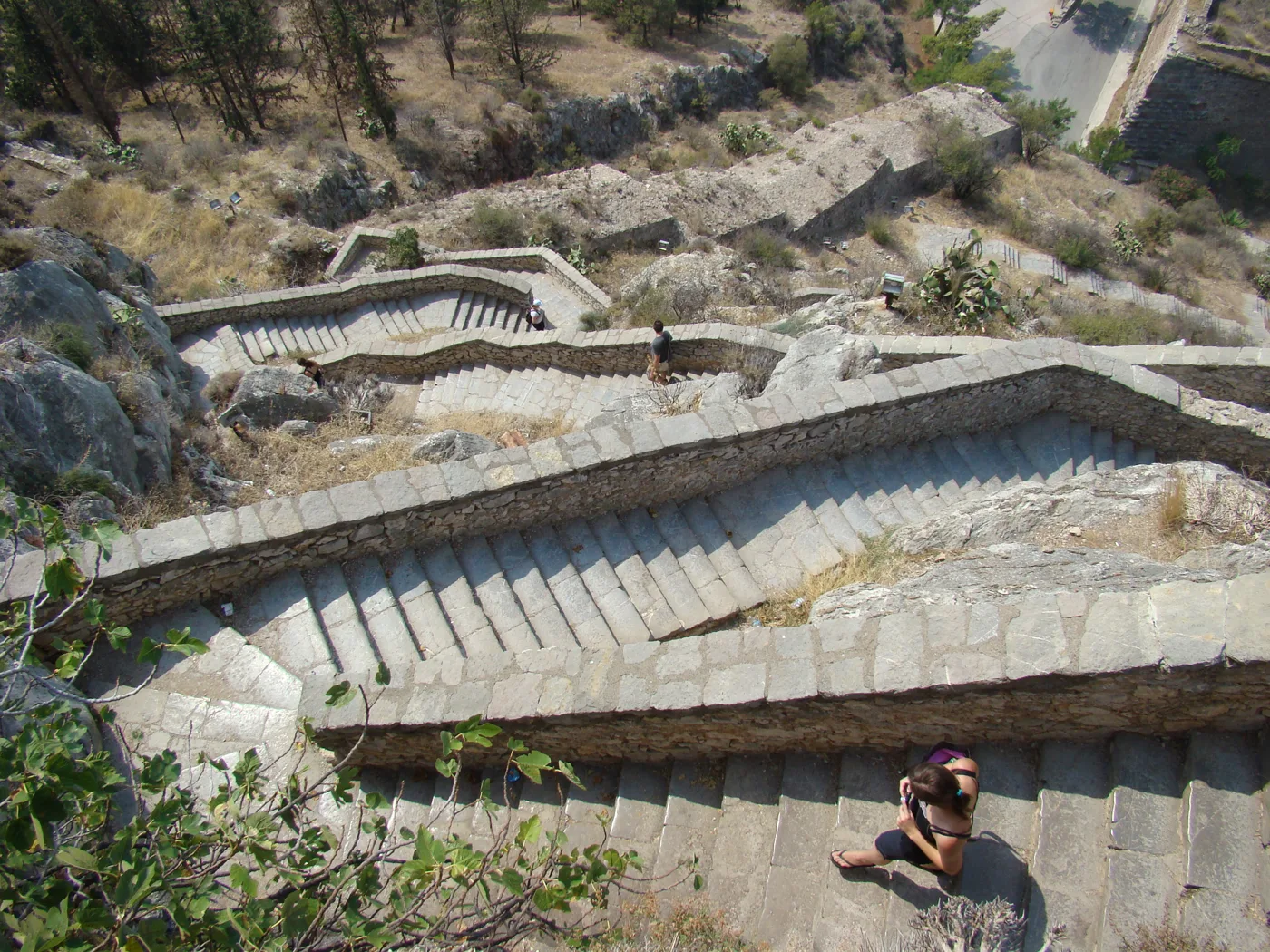
Twenty to thirty minutes, with stops.
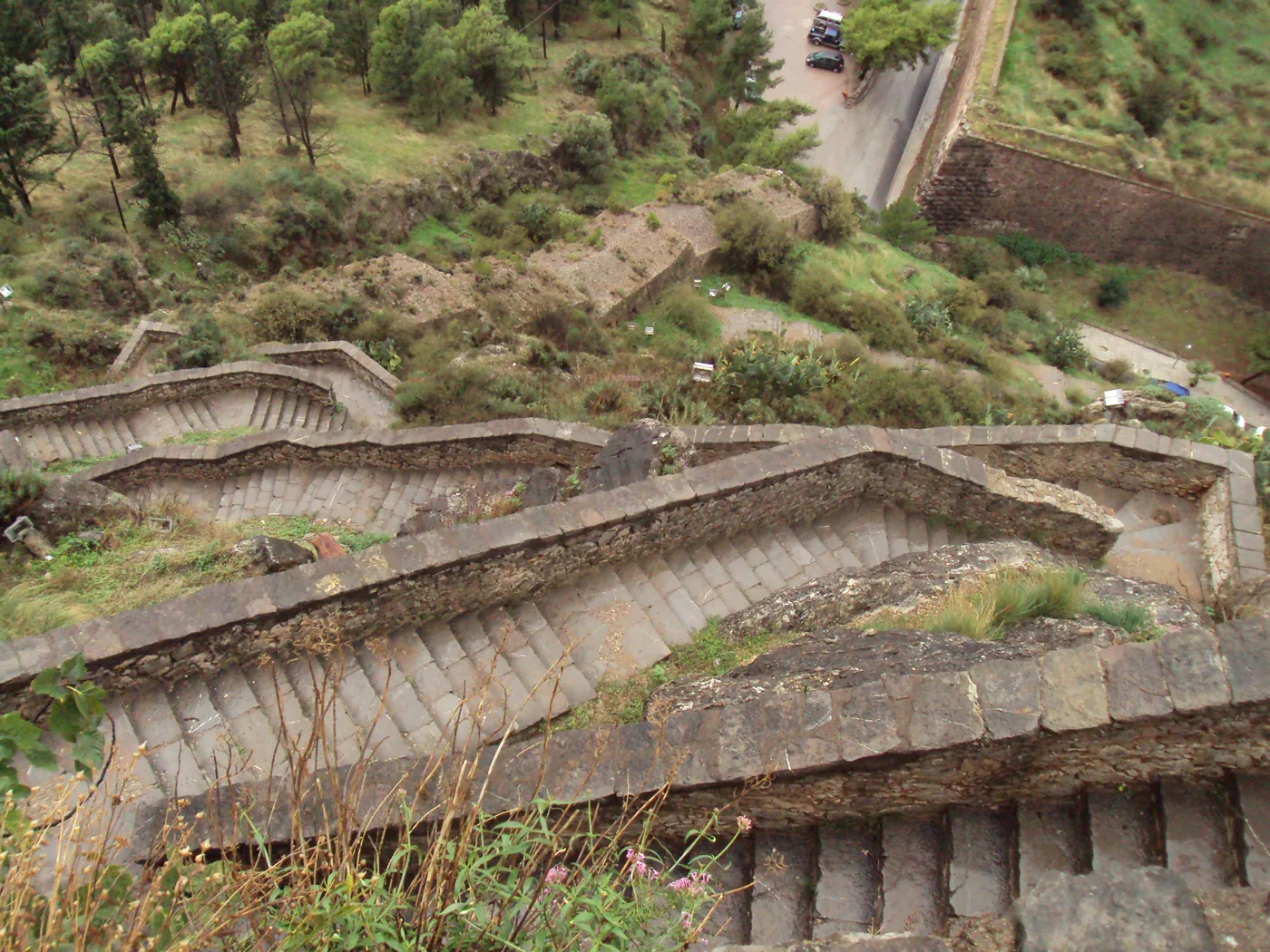
The view opens up at every turn.
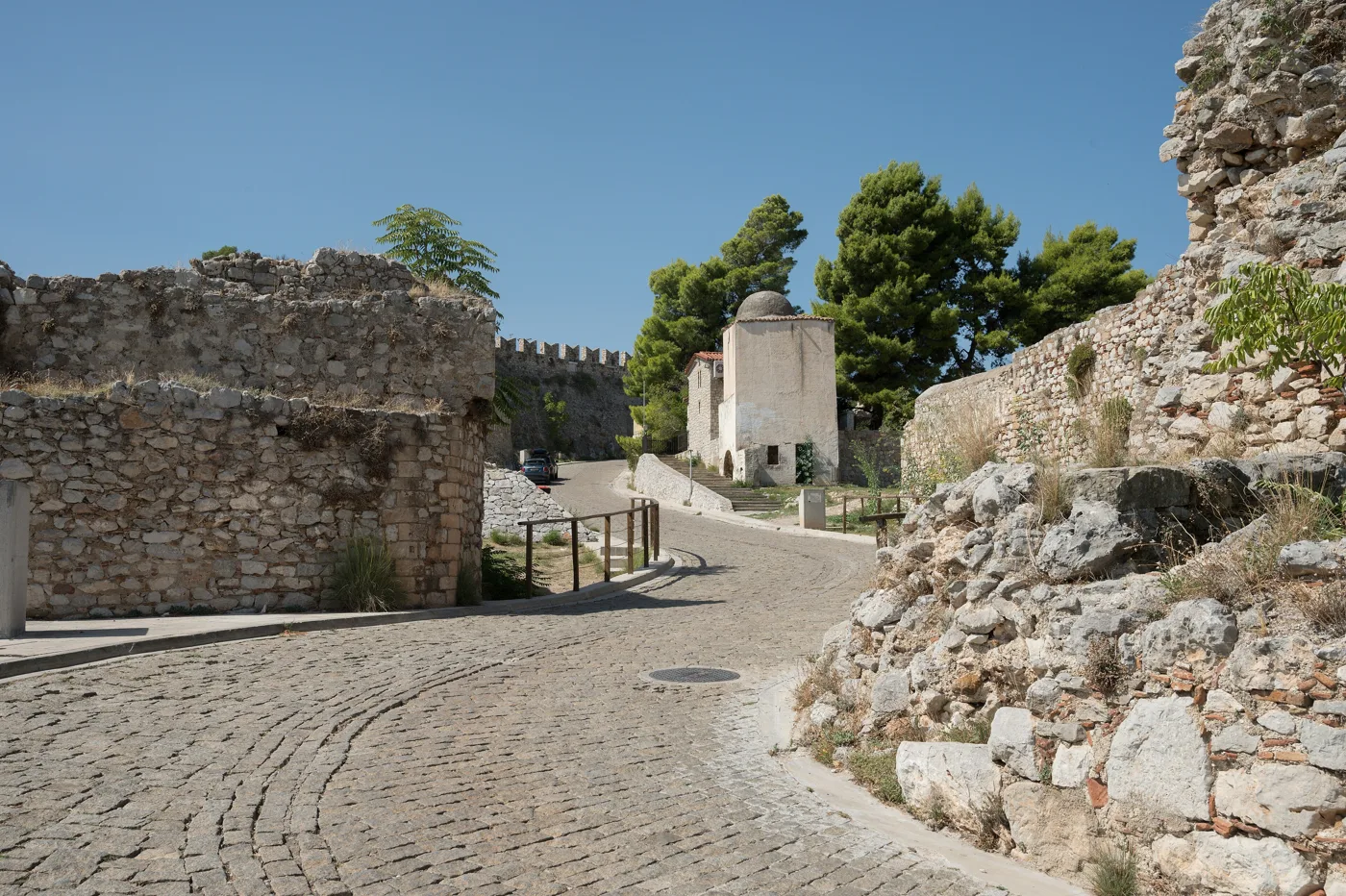
Eight bastions, each independent of the others.
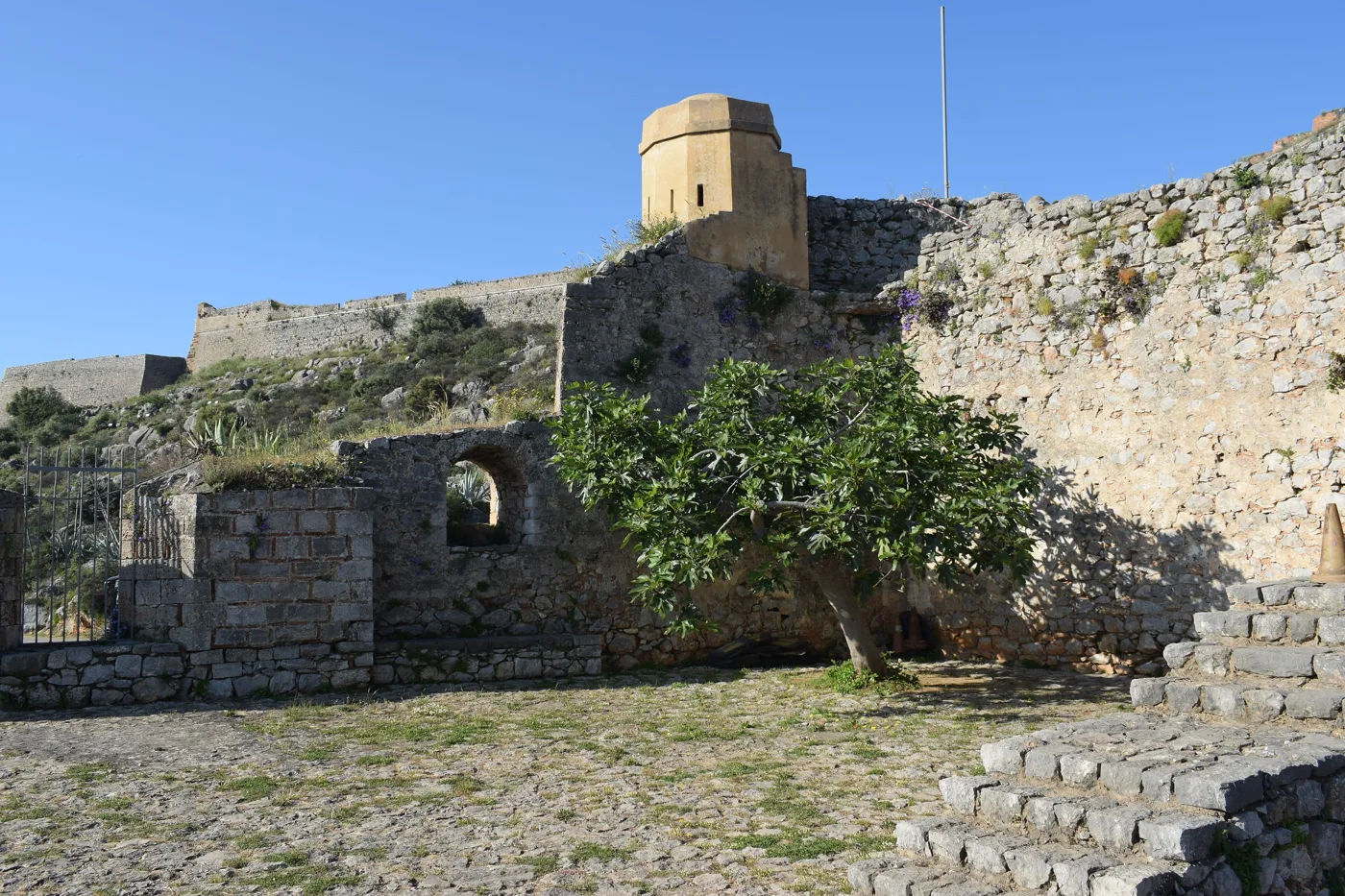
Each bastion could defend itself alone.
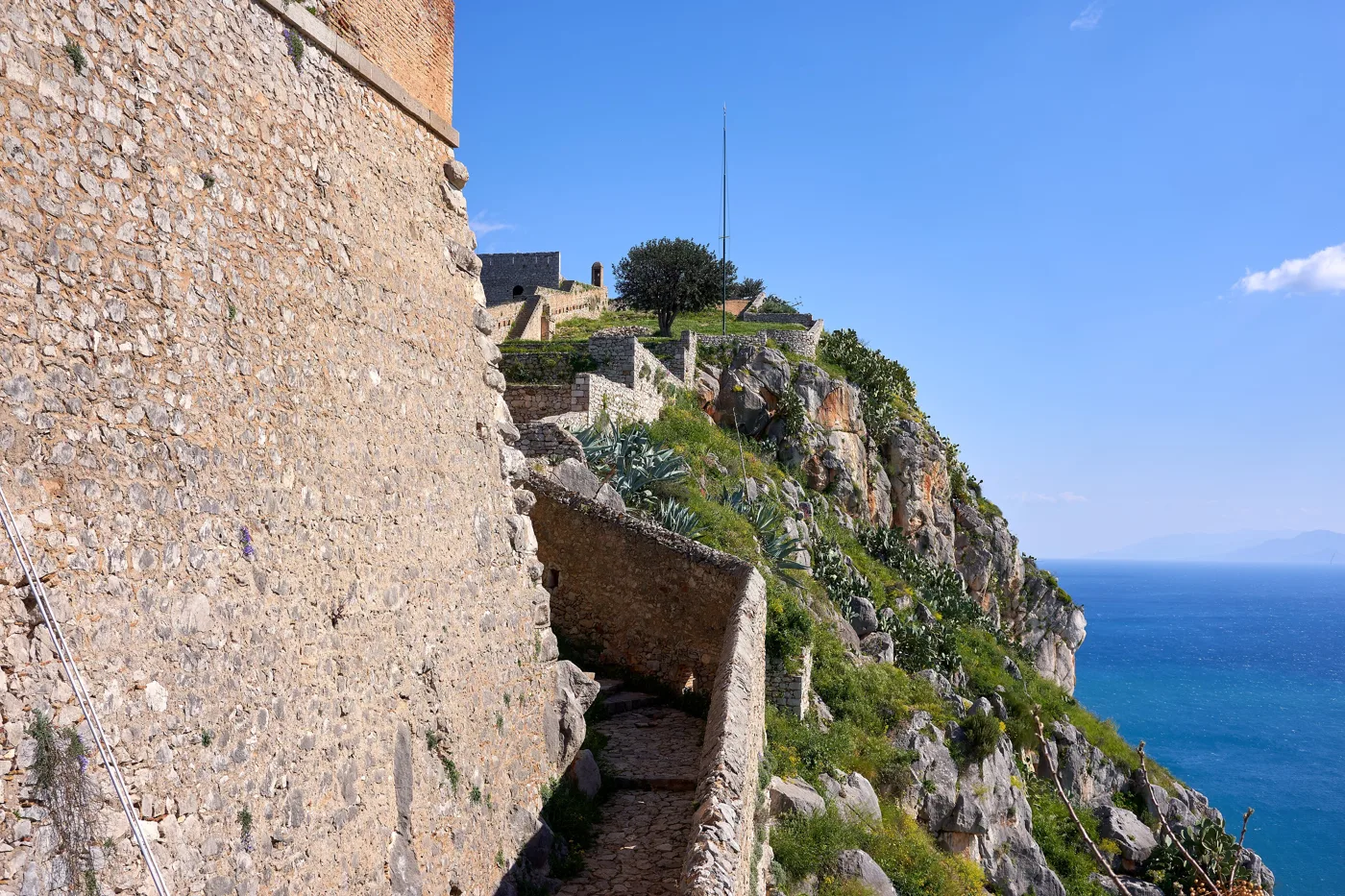
The best-preserved Venetian castle in Greece.
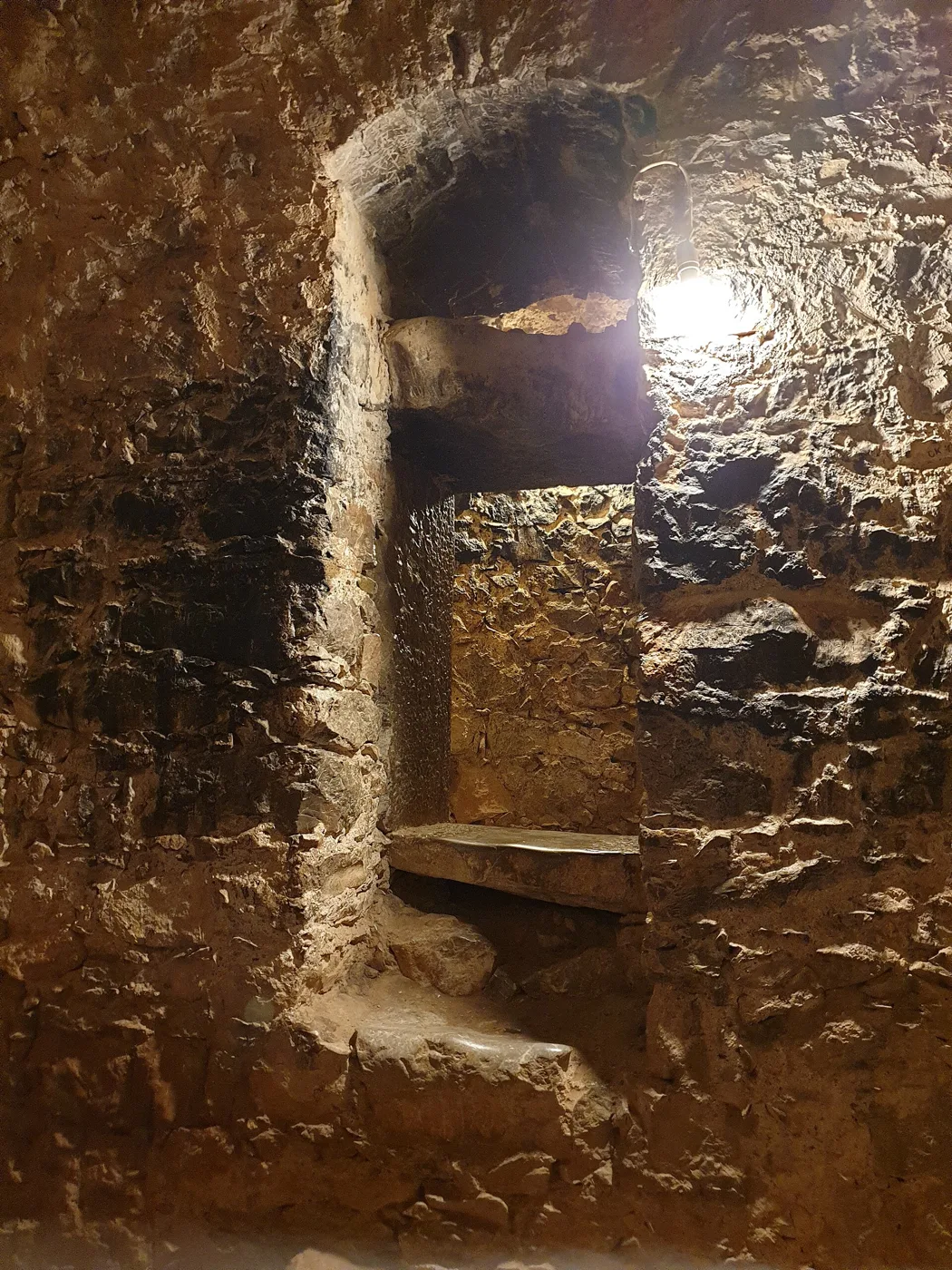
Here Kolokotronis was held in 1833.
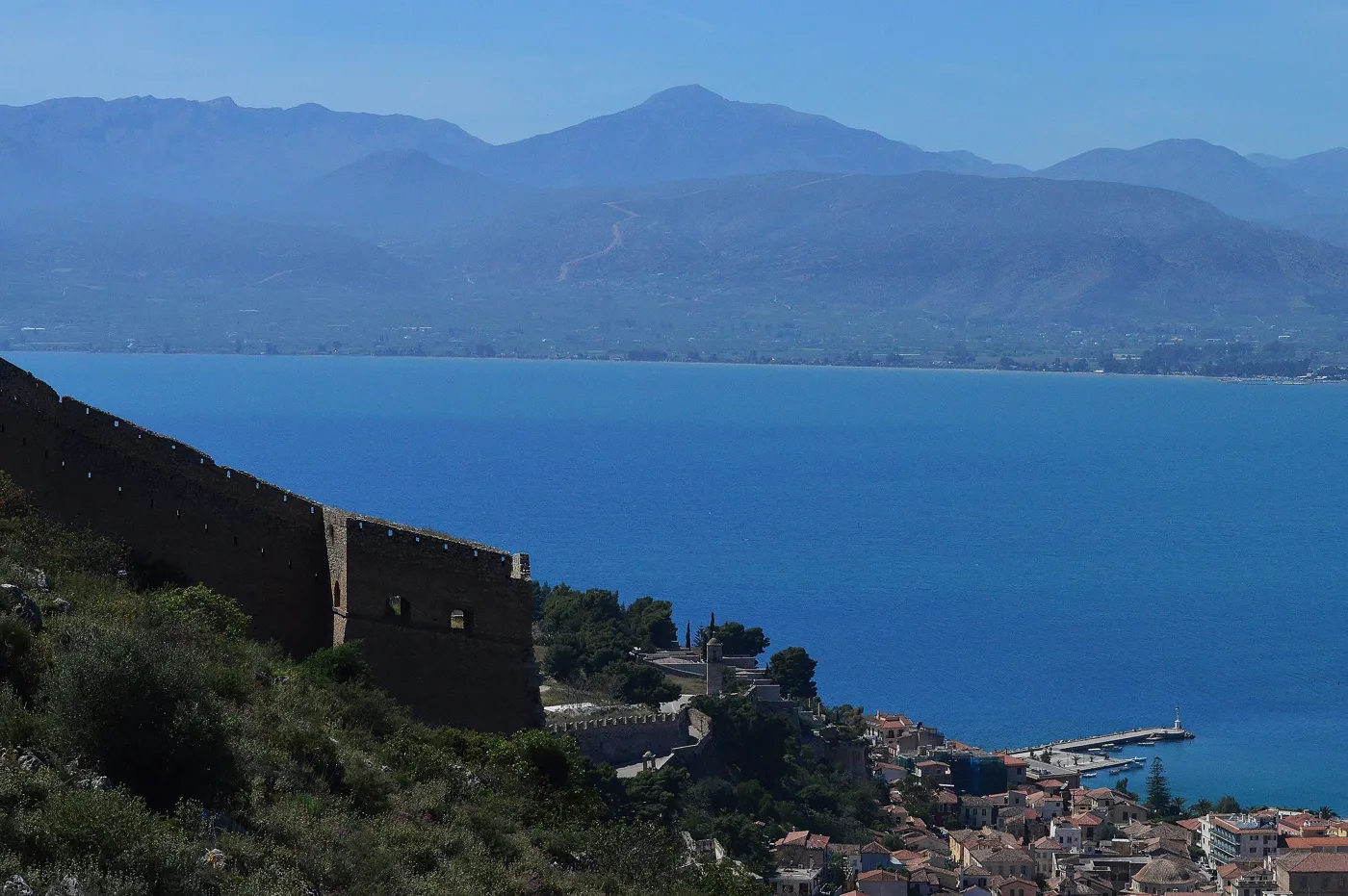
The Argolic Gulf from above.
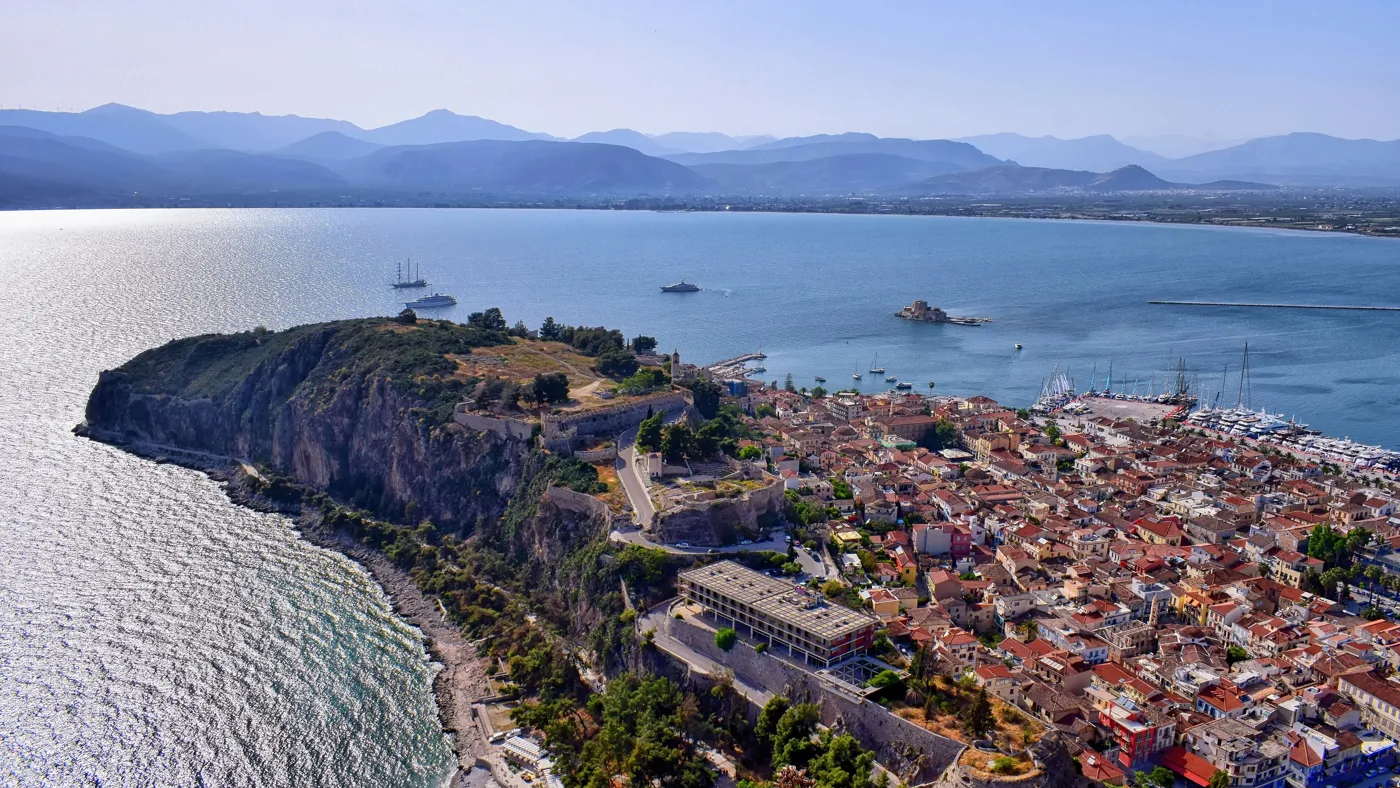
All of Nafplio in one glance.
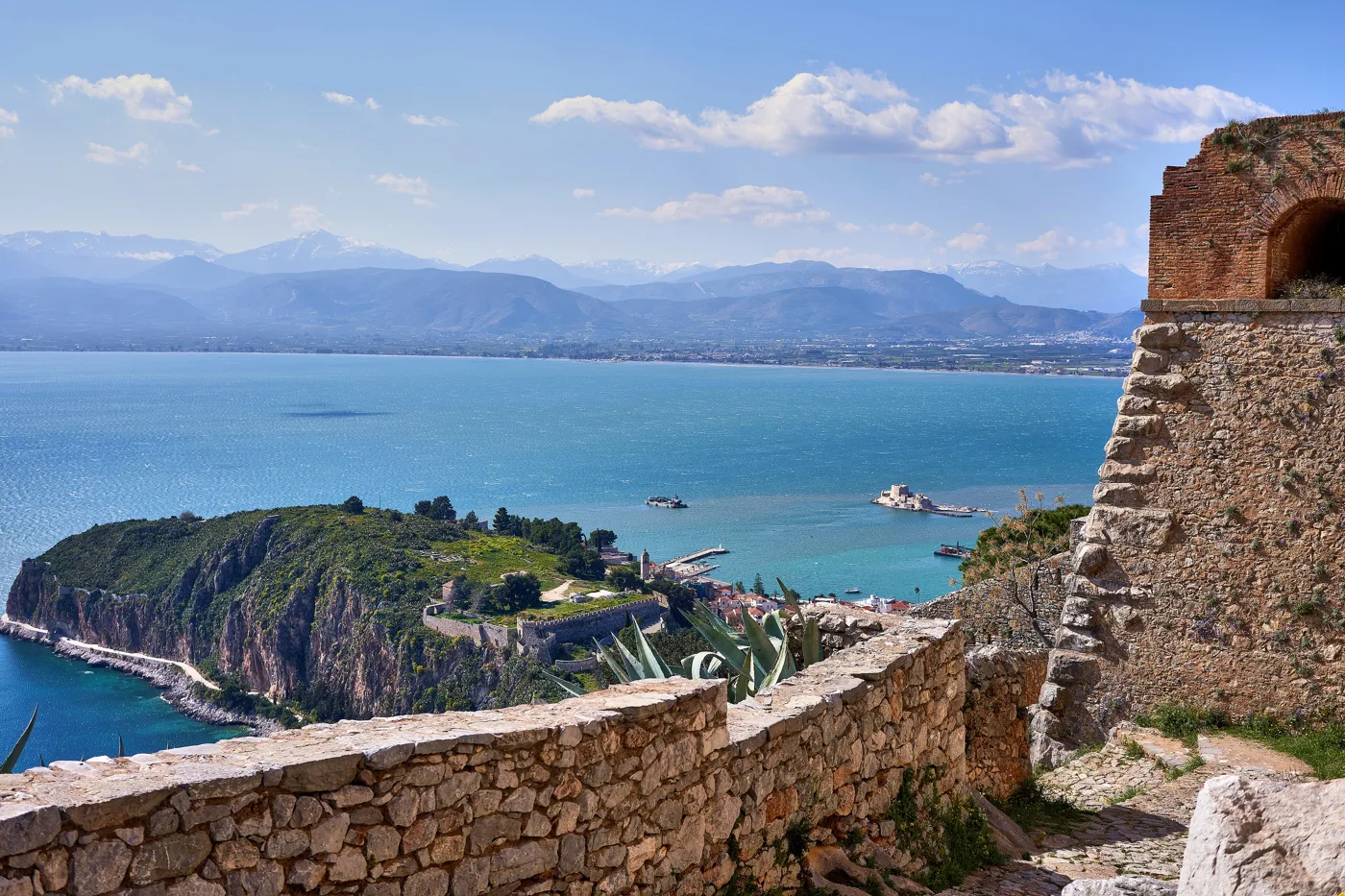
From the bastion of St Andrew.
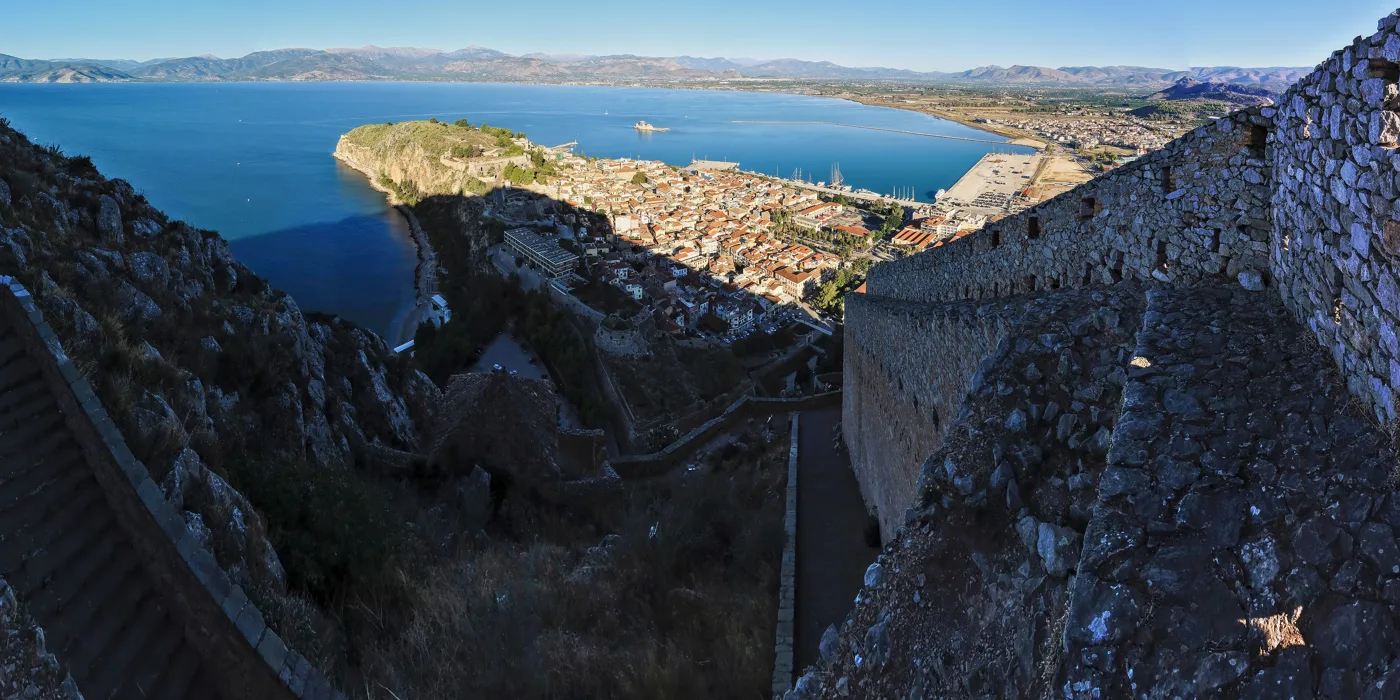
The town, the gulf, the mountains of Arcadia.
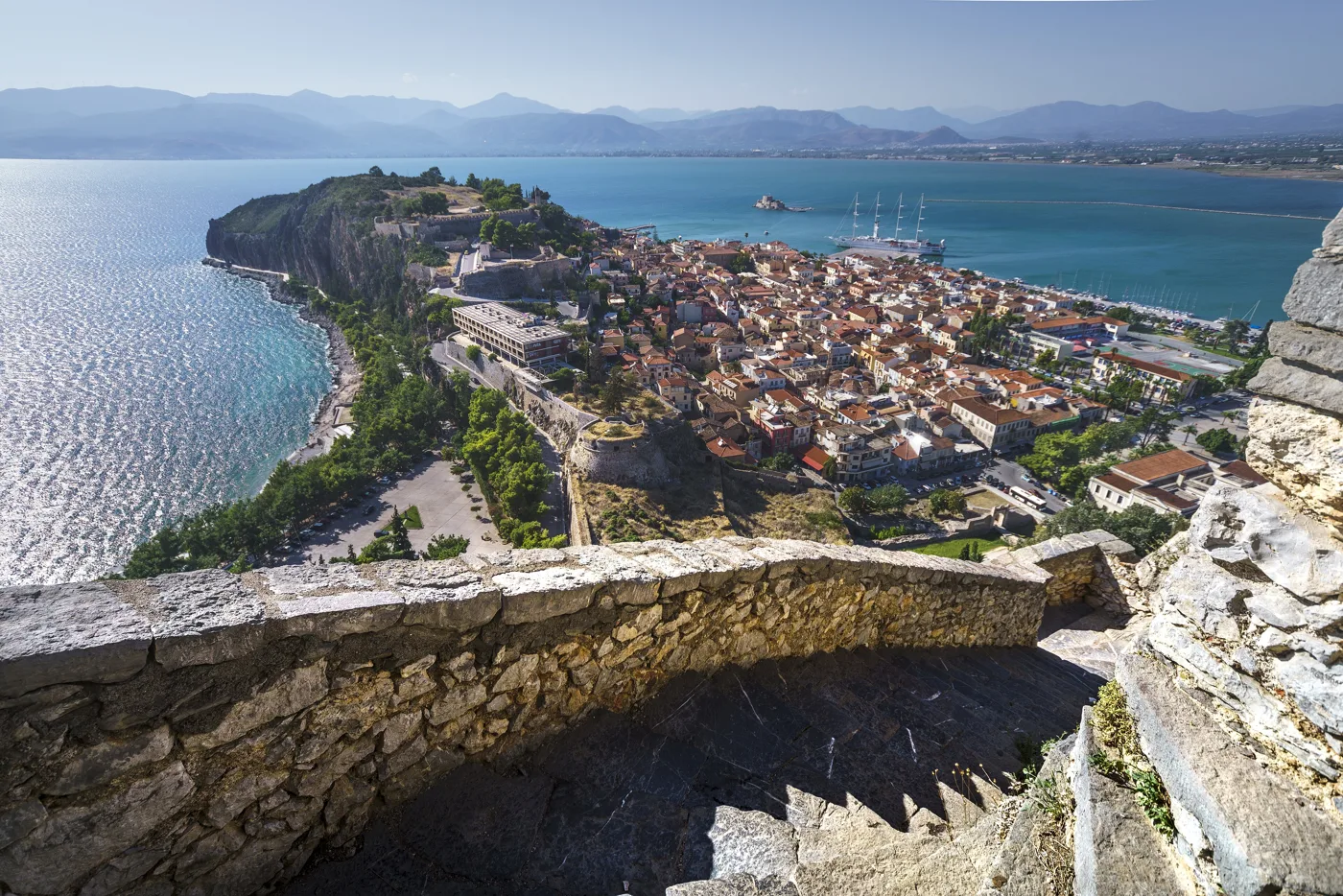
The roofs of the old town.
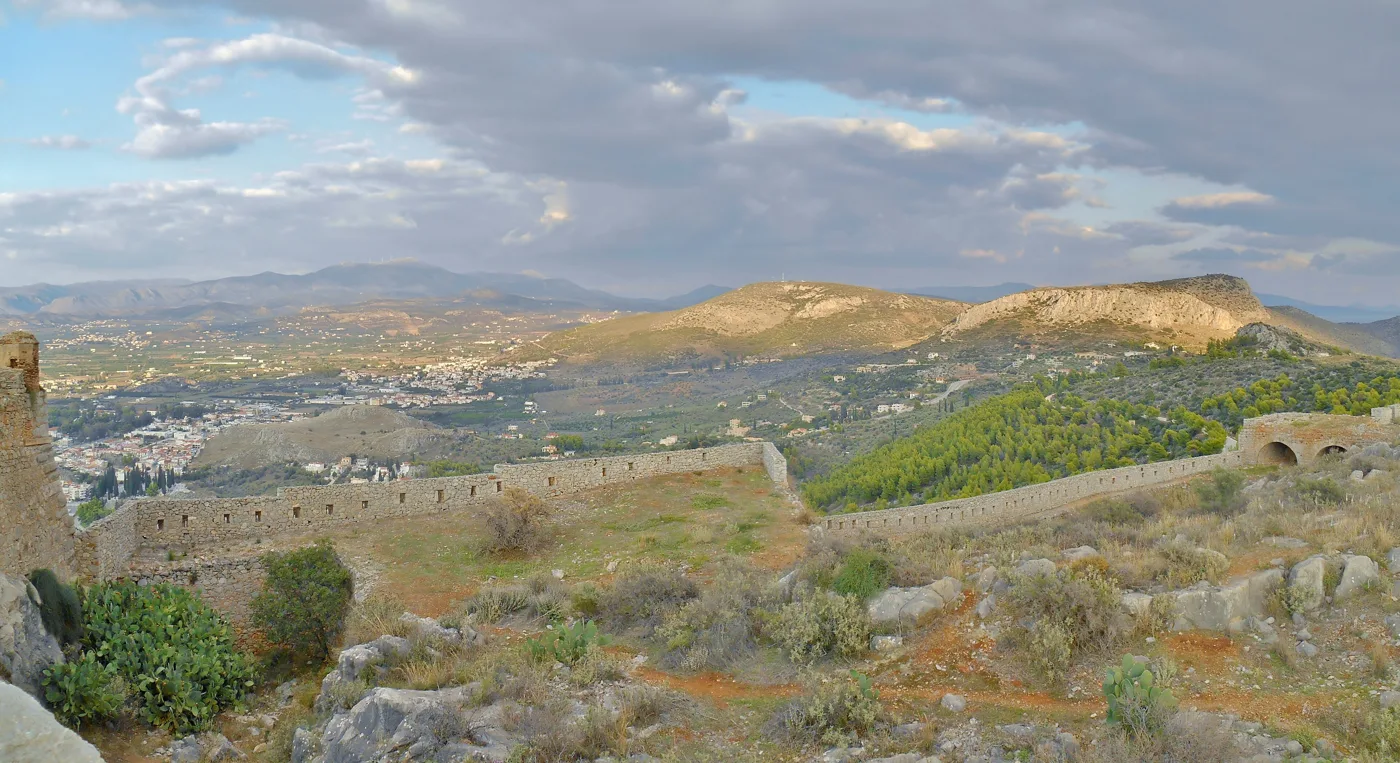
As far as Argos and Tiryns.
Photos: DimitrisP67 (CC BY-SA 4.0), Ioanna Koutsogeorgopoulou (CC BY-SA 4.0), Mätes II. (CC BY-SA 3.0), Kurnosem (CC BY-SA 3.0), Vislupus (CC BY-SA 4.0), Zde (CC BY-SA 4.0), Jean Housen (CC BY-SA 4.0), George E. Koronaios (CC0), Rc1959 (CC BY-SA 4.0), Anastkyriakos (CC BY-SA 4.0), Petroskaz (CC BY-SA 4.0), George E. Koronaios (CC BY-SA 4.0), Julien Seguinot (CC BY-SA 2.0), Stathis floros (CC BY-SA 4.0), Enrique Íñiguez Rodríguez (Qoan) (CC BY-SA 3.0) · Wikimedia Commons
In Nafplio ice cream is an institution: the Antica Gelateria di Roma, on Farmakopoulon Street, has made Italian gelato since 1998 and has a queue every afternoon. The komboloi, the worry beads, has its own museum on Staikopoulou Street, and the shops with komboloi, soaps and wooden toys are the best souvenirs in the Peloponnese.
🧱 Tiryns, Argos and Nemea
Five minutes outside Nafplio, on the road to Argos, Tiryns is the other Mycenaean citadel of the Argolid, a UNESCO site together with Mycenae: a low rock in the plain, girded by the most massive Cyclopean walls in Greece, up to 8 metres thick, with the famous galleries, the vaulted corridors inside the wall, which Pausanias compared to the pyramids. Ticket €10, 08:30 to 15:30 all year round, half an hour, and almost never crowded. Argos, the oldest continuously inhabited town in Europe, has an ancient theatre larger than that of Epidaurus, cut into the rock, with the castle of Larissa above it. And Nemea, 25 minutes to the north, is the temple of Zeus with its columns and the wineries of Agiorgitiko, on the way back.
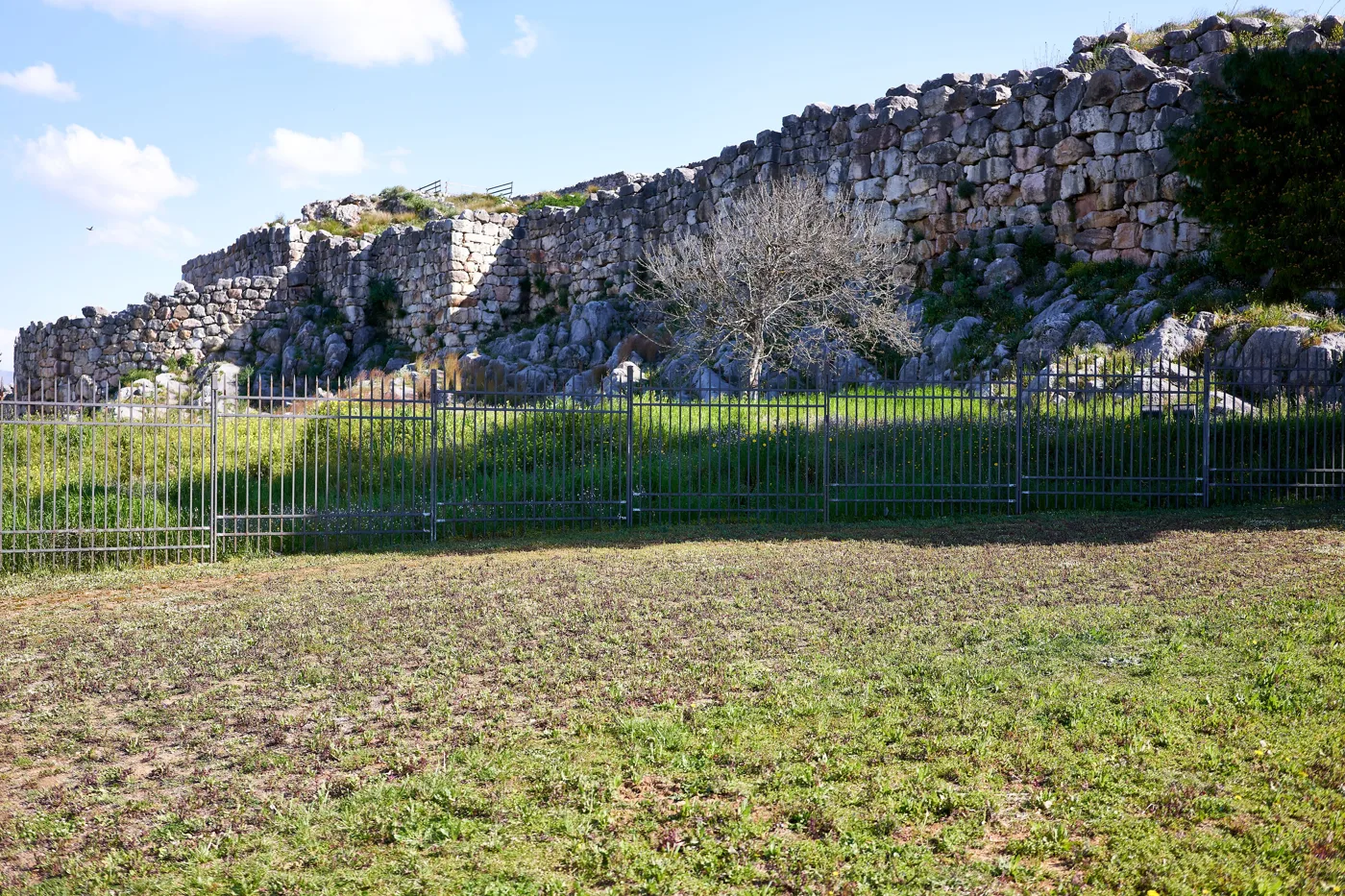
Walls of the 13th century BC, up to 8 metres thick.
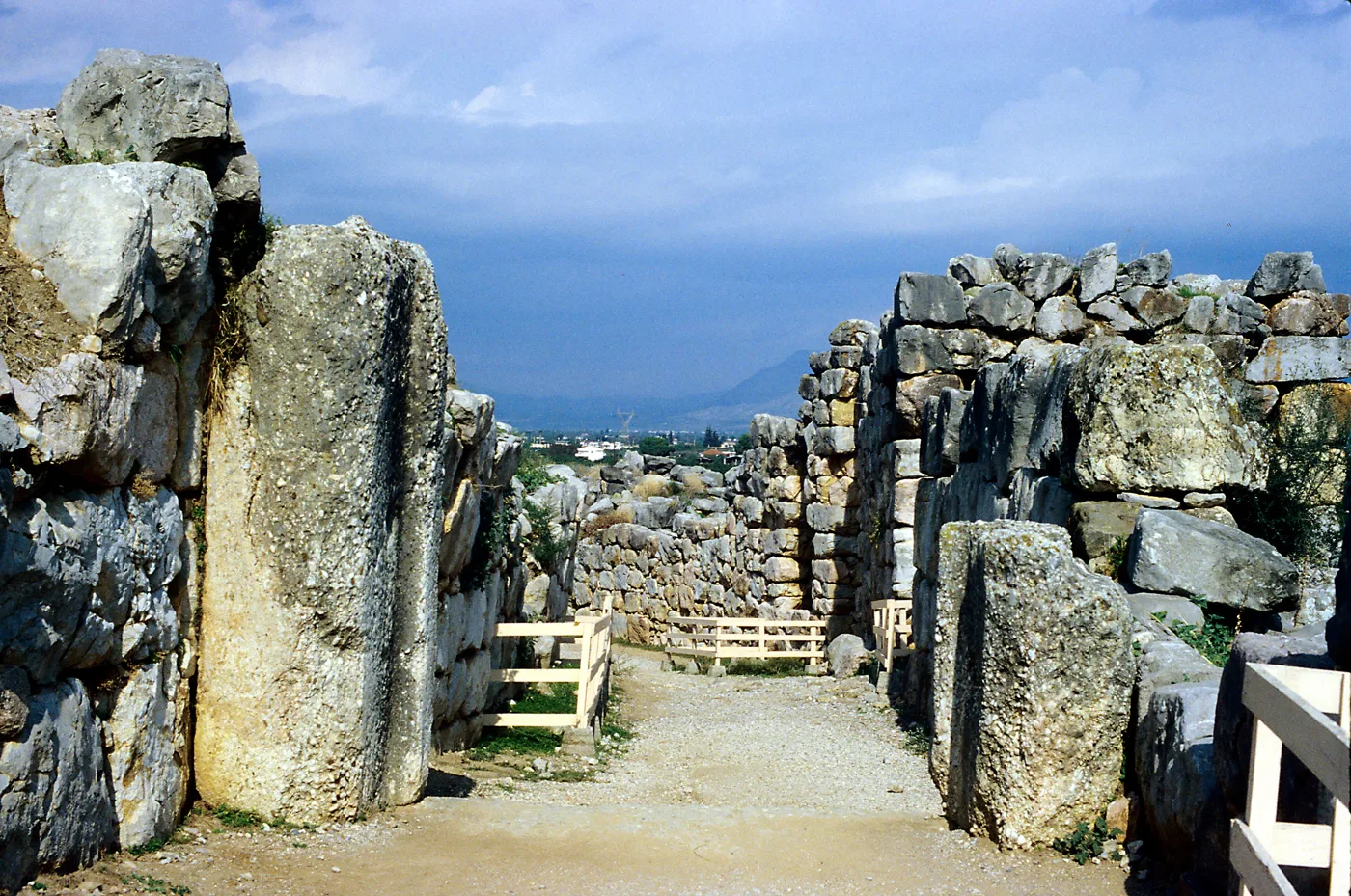
The same size as the Lion Gate.
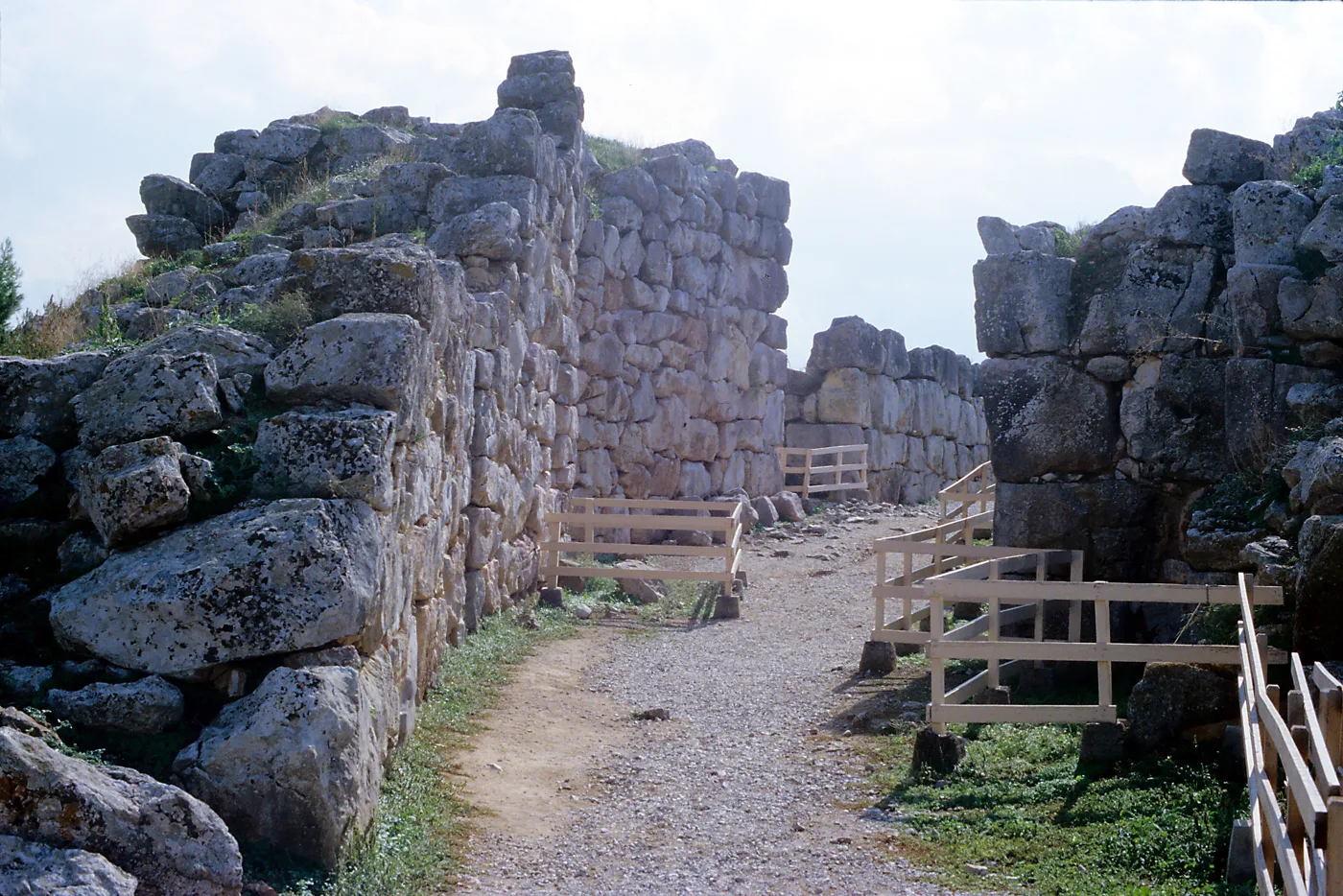
Exposed to arrows from the walls.
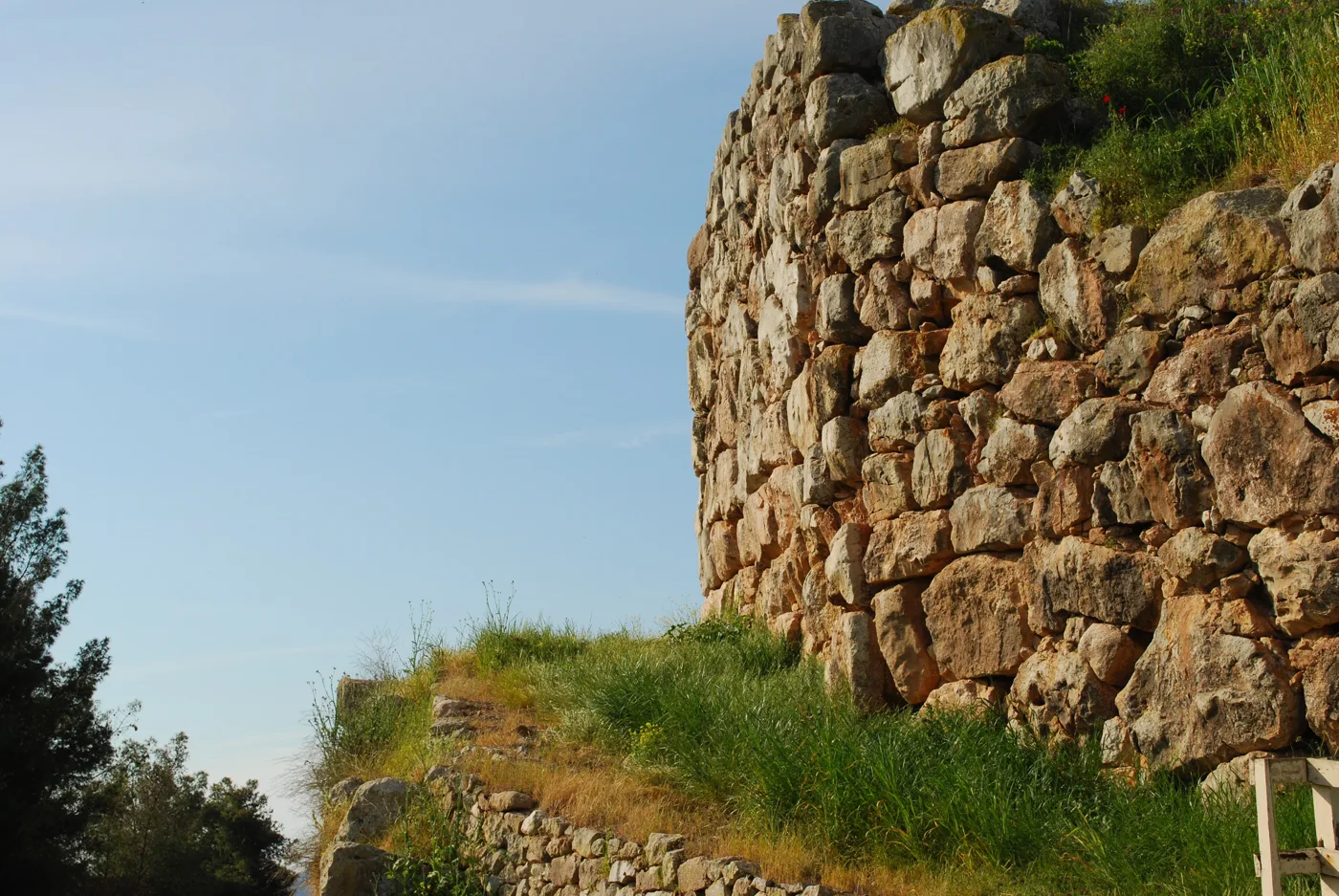
Pausanias compared them to the pyramids.
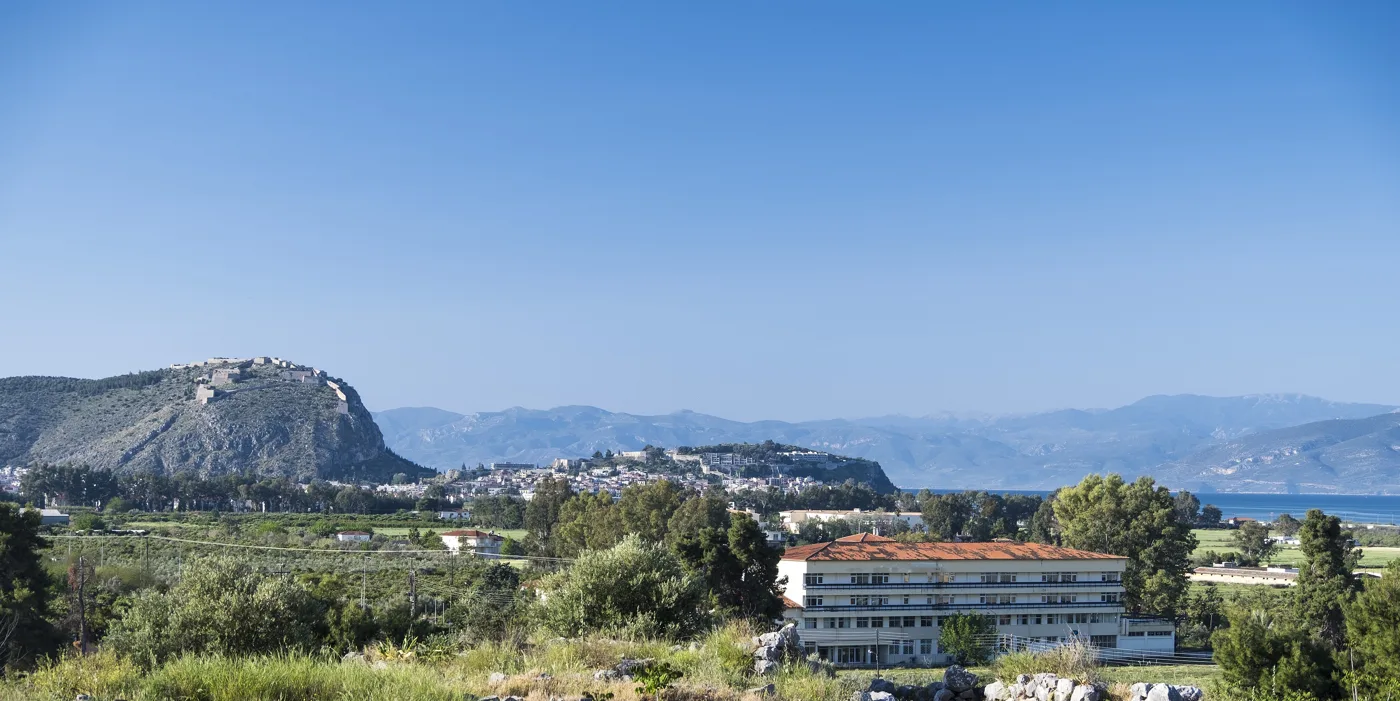
Palamidi can be seen from the walls.
Photos: George E. Koronaios (CC BY-SA 4.0), Falk2 (CC BY-SA 4.0), Jean Housen (CC BY 3.0), Davide Mauro (CC BY-SA 4.0) · Wikimedia Commons
🎫 Opening hours and tickets
Three sites, three €20 tickets: Mycenae (citadel, Treasury of Atreus and museum on one ticket), Epidaurus (theatre, Asklepieion and museum) and Palamidi. The prices are those of the Ministry of Culture for 2026, reduced €10 for EU citizens over 65 and students from outside the EU, free for children and young people up to 25 from the EU. The hours are almost the same everywhere: long in summer, until 20:00, short in winter, until 15:30. Check on hh.gr before you set off.
🎫 Opening hours and tickets
🚍 How to get there
The three places in one day are possible only by car or with an organised tour. With the KTEL Argolida bus you reach Nafplio easily and from there local buses or taxis take you to Mycenae and Epidaurus, but it takes two days. Tap each tab.
🚍 How to get there
By car, the only way to do all three in one day
- Athens, Athens–Corinth motorway, Isthmus bridge, motorway towards Tripoli, Mycenae exit: 129 km, 1 h 45.
- Mycenae to Epidaurus via Argos and Nafplio or via Dervenakia and Lygourio: 46 km, 1 hour. Epidaurus to Nafplio 27 km, 40 minutes.
- Return from Nafplio 148 km, 2 hours. Total 350 kilometres, tolls around €20, fuel €25 to €30.
- Free parking at Mycenae, at the Treasury of Atreus and at Epidaurus. In Nafplio park at the harbour, in the big car park beside the sea, €2 to €3, and at Palamidi you drive up to the gate.
- Car hire for a day €35 to €60. On summer Sundays start the return before 18:00: the motorway from Corinth fills up.
By KTEL Argolida bus, based in Nafplio
- Departure from the Kifissos KTEL bus station. Buses to Nafplio on weekdays at 06:00, 08:00, 09:30, 11:00, 12:30, 14:00, 15:30, 16:30, 17:30, 18:30, 20:00 and 21:30, Saturday and Sunday from 07:30 every 1 to 2 hours. Ticket €15.70, €29 return, journey 2 hours and a quarter.
- The buses pass through Fichti, at the junction for Mycenae: get off there and you are 3.5 kilometres from the site, by taxi from the village or on foot, 45 minutes.
- From Nafplio, local buses to Mycenae (€3.50) and to the theatre of Epidaurus (€3.50, weekdays: departure 10:30, return 12:30), to Tiryns €2.20 and to Argos.
- For Epidaurus directly from Athens: bus to Lygourio on weekdays at 09:30 and 16:30, return 11:50 and 18:20. Lygourio is 4 kilometres from the theatre.
- Return from Nafplio on weekdays from 05:00 to 20:30, every 1 to 2 hours. Buy on ktelargolida.gr, the Sunday afternoon buses fill up.
With the KTEL bus the three places do not fit into one day: do Mycenae and Nafplio one day, Epidaurus the next, or choose. The times change with the season, check on ktelargolida.gr.
With an organised tour, the classic day
- The most popular day trip from Athens: Corinth Canal, Mycenae, Nafplio, Epidaurus, by coach with a guide. 11 to 12 hours, €90 to €130.
- The site tickets, €40 for Mycenae and Epidaurus, are often not included. Lunch almost never. Ask before you book.
- In Nafplio the stop is usually only an hour, for lunch. Palamidi is left out.
- Small groups in a van with an archaeologist guide: €150 to €220, with more time at Mycenae.
- Pick-up from the centre around 07:30, return 19:00 to 20:00.
With a night in Nafplio, the best version
- Nafplio is one of the most beautiful towns in Greece for a night: a double room in a guesthouse in the old town €70 to €150, more on spring weekends.
- First day: Mycenae in the morning, Nafplio in the afternoon, sunset at Palamidi or Arvanitia, dinner in the square.
- Second day: Epidaurus early, before the coaches, a swim at Karathona or Arvanitia, return in the afternoon via Tiryns and Nemea.
- It works without a car too: KTEL bus to Nafplio and from there the local buses or taxis.
- In summer, on a Friday or Saturday, book a ticket for a performance at Epidaurus: the best evening in Greece.
🕗 The day's schedule
🕗 The day's schedule
The programme of a day by car, from April to October. In winter the sites close between 15:30 and 17:00: start at 07:00 and leave Palamidi for next time.
Departure from Ioulianou 50
Early, to be at Mycenae before the coaches. Coffee, water, hat. An hour to the Isthmus.
Mycenae
First the Treasury of Atreus, then the citadel: Lion Gate, Grave Circle, palace, cistern. The museum at the end, in the cool. Two hours.
Towards Epidaurus
Via Argos and Nafplio, or via Lygourio. One hour.
Epidaurus
The theatre first, while there is strength for the steps, then the Asklepieion and the museum. An hour and a half.
Nafplio: lunch
Forty minutes' drive. A taverna on Syntagma Square or on Staikopoulou Street, and ice cream afterwards.
Old town and Bourtzi
A stroll through the lanes, the little boat to Bourtzi, the waterfront as far as Arvanitia.
Palamidi
By car up to the gate, an hour on the bastions, sunset from the walls.
Return
Two hours to Athens, home around 21:00. In winter Palamidi closes at 15:30: change the order.
By KTEL bus in two days: the 08:00 bus from Kifissos, get off at Fichti at 09:45 and taxi or 45 minutes on foot to Mycenae, three hours at the site, the local bus or a taxi to Nafplio, afternoon in the town, Bourtzi and Palamidi, night in Nafplio. The next day, the 10:30 bus to the theatre of Epidaurus, return at 12:30, a swim at Arvanitia, and the KTEL bus to Athens in the afternoon.
🍽️ What to eat
The meal of the day is in Nafplio. On Staikopoulou Street and around Syntagma Square the tavernas serve home-cooked dishes, kid goat, handmade pasta and fish, €18 to €30 per person, and in the streets parallel to the seafront the meze places, €15 to €25. Ask for lemon kid goat, gogges, the handmade pasta of the Argolid, and oranges, which here are the best in Greece. At Mycenae, the village below the site has tavernas for the groups, €15 to €25, and the hotel La Belle Hélène, the house where Schliemann stayed, with his guest book. At Epidaurus there is only coffee and snacks at the site, and tavernas in Lygourio. Take water for the sites: at Mycenae and Epidaurus it is not sold inside.
📅 When to go
From March to June the Argolid is green, wildflowers grow between the boulders and the orange trees blossom around Argos. From September to November the light is clear and the sea at Arvanitia still warm. In July and August Mycenae at midday is an oven, without a trace of shade: go at 08:00, and it is also the season of the Epidaurus Festival, which is worth a night. In winter the sites are empty and beautiful, but they close between 15:30 and 17:00 and Nafplio fills up with Athenians at weekends.
💡 Tips before you set off
Mycenae is a stony hill with no shade and slippery slabs, Epidaurus has 55 rows of steps, Palamidi 857. Closed shoes, a hat, sunscreen and a litre of water per person. Water is not sold at the sites: fill up in Nafplio or at the petrol station.
In summer, Mycenae first, at 08:00 to 09:00, before the heat and the coaches that arrive at 10:30. Epidaurus at midday has shade in the pines. Nafplio in the afternoon, when the town wakes up. In winter, when everything closes early, reverse it: Epidaurus and Mycenae in the morning, Nafplio after 15:30, when the castles have closed.
The Lion Gate is lit in the morning. The theatre of Epidaurus wants the top of the cavea, with a wide-angle lens. Bourtzi at sunset from the waterfront, and the whole of Nafplio from the bastion of St Andrew at Palamidi, as the lights come on. Drones are forbidden at archaeological sites.
🚶 How to get there from Ioulianou 50
For the KTEL Argolida bus, the Kifissos bus station is 15 minutes by taxi from Ioulianou 50, €10 to €12, or by metro to Omonia and bus 051 from Zinonos Street, which takes 15 minutes. By car, from Ioulianou you come out onto Acharnon, from there onto Kifissou Avenue, and in ten minutes you are on the motorway towards Corinth. The organised tours pick you up from the centre or from your hotel around 07:30.
🚇 From Ioulianou 50 to the Kifissos KTEL station
Metro from Victoria to Omonia (one stop on line 1) and from there bus 051 from Zinonos Street to the KTEL bus station at Kifissos, 15 minutes. Or a taxi from the house, 15 minutes and €10 to €12. By car, from Ioulianou you come out onto Acharnon and Kifissou Avenue.
Frequently asked questions
Can all three be done in one day?
Yes, by car or with an organised tour: Mycenae 2 hours, Epidaurus 1.5, Nafplio 2 to 3, and 5 hours on the road. It is 12 hours door to door and worth every minute. If you have two days, a night in Nafplio makes the trip perfect.
How much does the day cost?
By car: €60 in tickets per person, €20 tolls, €30 fuel, €25 food, €5 for the boat. By KTEL bus: €29 for the return ticket, €7 for the local buses, and the taxis to the sites. With an organised tour: €90 to €130 plus tickets and food.
Is Palamidi worth €20?
If you have the time, yes: it is the most imposing Venetian castle in Greece and the view is the best in the Argolid. If you have to cut something, cut Palamidi and climb Akronafplia, which is free and has the same view over the town from lower down.
Can it be done by KTEL bus without an overnight stay?
Only two of the three: KTEL bus to Fichti for Mycenae, then Nafplio, and return in the evening. Or KTEL bus to Nafplio, the 10:30 local bus to Epidaurus and return at 12:30, afternoon in Nafplio. For all three, a night in Nafplio.
Is it suitable for children?
From 7 or 8 years old and up, very much so: the Lion Gate, the underground cistern with the torch, the whisper in the theatre, the little boat and the castle make a day that children remember. With younger ones, cut Epidaurus and add a swim at Karathona.
Mycenae, Epidaurus and Nafplio or Delphi?
If you want the most powerful monument, Delphi. If you want variety, sea, food and a town for a stroll, this trip. Most visitors who have two days for excursions do both.
— Kathy