Two monuments, one ticket
The site you'll see on your ticket is officially "Roman Agora," and it has two distinct things to look at:
- The Roman Agora itself — a commercial center shaped in the 1st century BC, in the time of Julius Caesar and Augustus, when the older Agora had already taken on a more monumental and less purely commercial role.
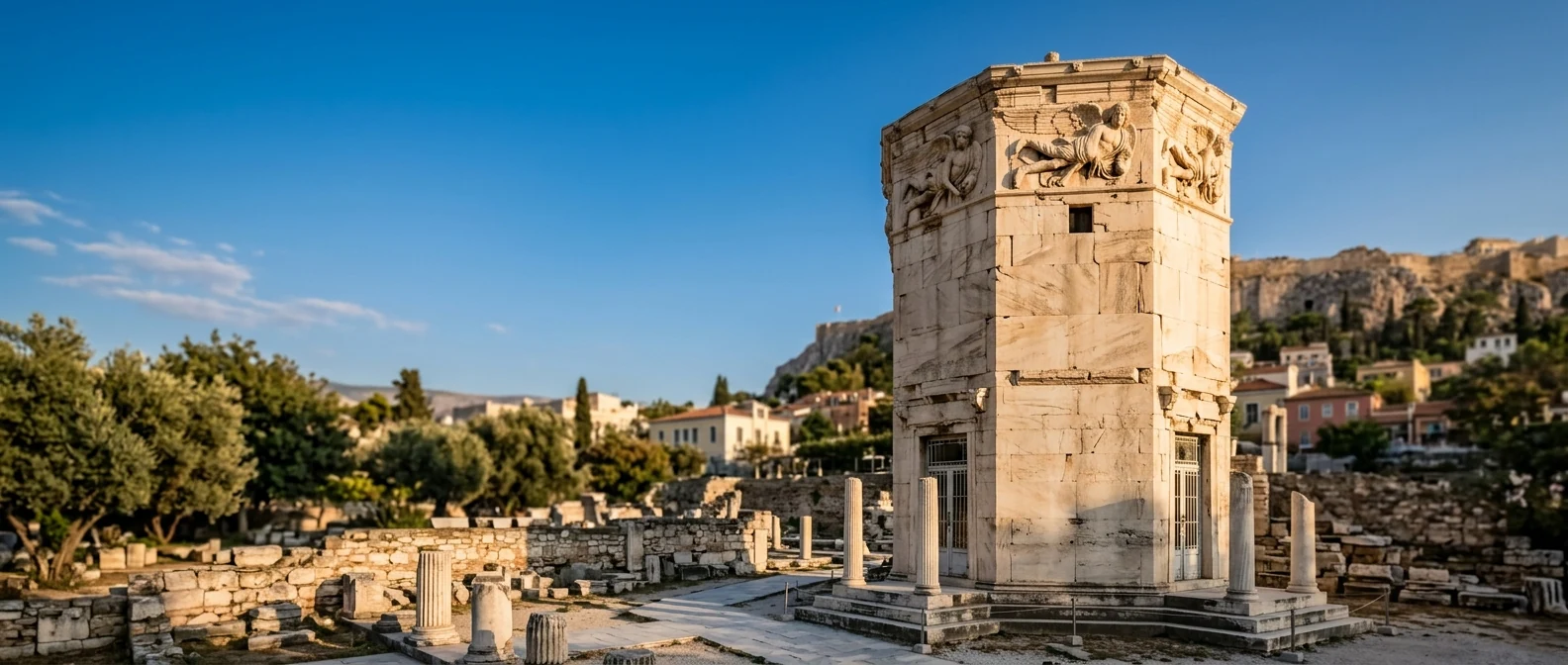
- The Aerides, or Tower of the Winds — also known as the Horologion of Andronicus of Cyrrhus — an octagonal marble building in the northeastern corner of the site, perhaps a generation older than the Agora itself.
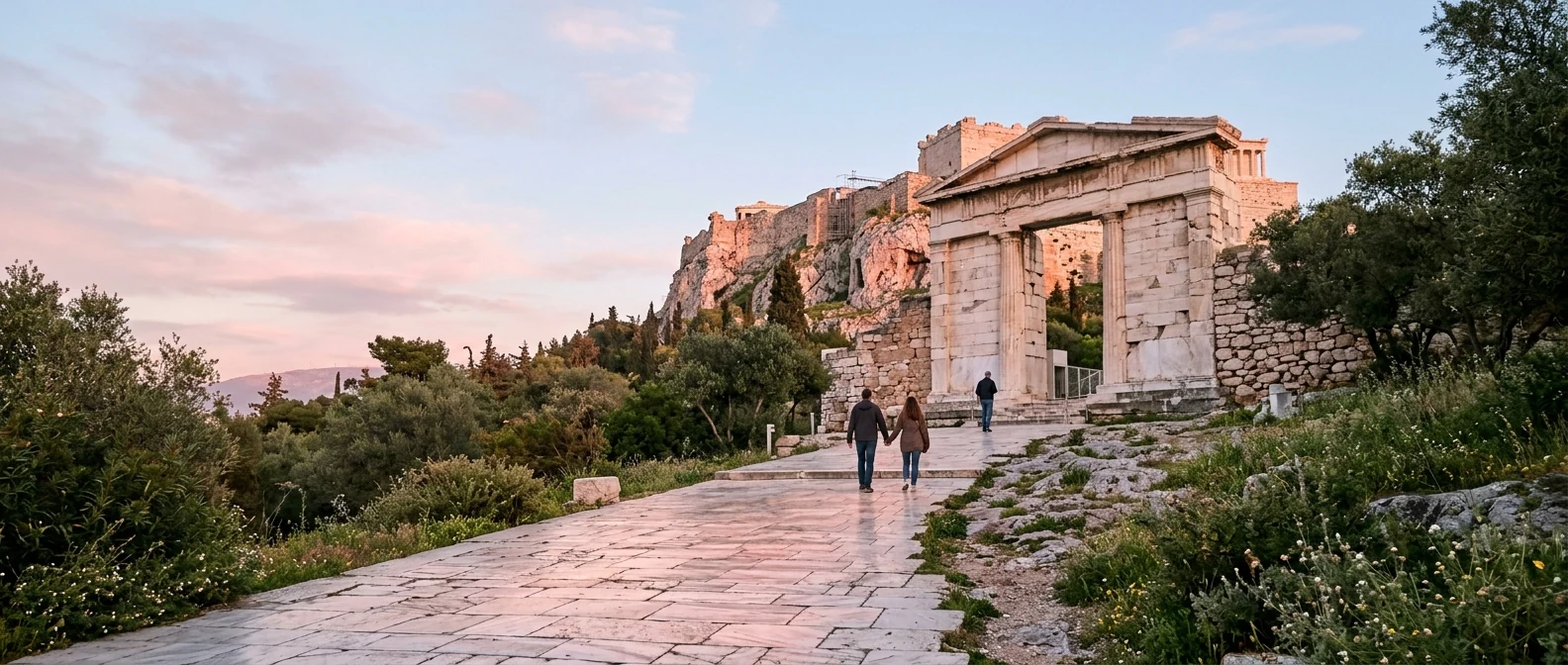
You enter through the Gate of Athena Archegetis on the west, a propylon with four Doric columns, and step into a broad rectangular courtyard. On one side you can trace the foundations of the shop colonnades. Ahead and to the left stands the Tower of the Winds. Further back, toward the Acropolis side, is the Fethiye Mosque from the Ottoman period.
The Tower of the Winds — what to look for
The building is small, but almost every surface had a function. It is usually attributed to the astronomer Andronicus of Cyrrhus and dated to the 1st century BC. As you walk around it, look for four main things:
The eight wind reliefs
Below the cornice, each of the eight sides carries a relief figure of a wind, facing the relevant direction. You will see Boreas, Kaikias, Eurus, Apeliotes, Notus, Lips, Zephyrus, and Skiron, each with attributes that help identify them.
The sundial scratches
Below each wind, look for the thin lines cut into the marble: traces of the eight sundials. The bronze pointer that once cast the shadow is gone, but the grid remains.
The wind vane (lost)
A bronze Triton once stood on the conical roof and worked as a weather vane. Ancient literary references help make the identification of the monument especially interesting. The Triton itself does not survive.
The water clock (also lost)
Inside there was a hydraulic clock, a form of clepsydra. You no longer see the mechanism, but it helps you understand that the building was never only decorative.
📍 From Angels Athens to Roman Agora · Tower of the Winds
See at a glance how to get from the apartment at Iouliánou 50. Drag the map and zoom in for details.
The later lives of the Tower
The Tower changed use many times, which helps explain why it stayed so present in the life of the city:
- 1st c. BC – 4th c. AD: Public weather and time station for the Roman commercial centre.
- Early Christian period: Adapted as the bell tower of a small church.
- Ottoman era: Used as a tekke, a meeting house for whirling dervishes of the Mevlevi order. The interior plaster from this period was removed in the 19th-century excavations, revealing the marble underneath.
- Modern period: Excavation, cleaning, and conservation brought the ancient building back into view. In recent years the site has become more accessible to visitors.
Its shape also left a mark on later architecture. The Tower of the Winds inspired buildings such as the Radcliffe Observatory in Oxford and other neoclassical monuments that borrowed its octagonal form.
The Roman Agora itself
The Roman Agora is easier to read than the Tower itself. Three elements stand out:
- The Gate of Athena Archegetis (west entrance) — the most photographed feature, with its inscribed dedication to Augustus and the goddess. The four standing Doric columns are intact.
- The market courtyard — the open area that helps you imagine the Agora as an organized commercial center.
- The Fethiye Mosque (corner of the site) — an Ottoman mosque preserved inside the archaeological area and sometimes used for exhibitions or special purposes.
Practical information
- Address: entrance on Polygnotou or Pelopida Street, Plaka. Two minutes' walk from Monastiraki metro (Blue + Green lines). From Angel Athens at 50 Ioulianou, walk a few minutes to Victoria and take Line 1 direct to Monastiraki; from there it is a short walk east through the lanes below Plaka to the Roman Agora.
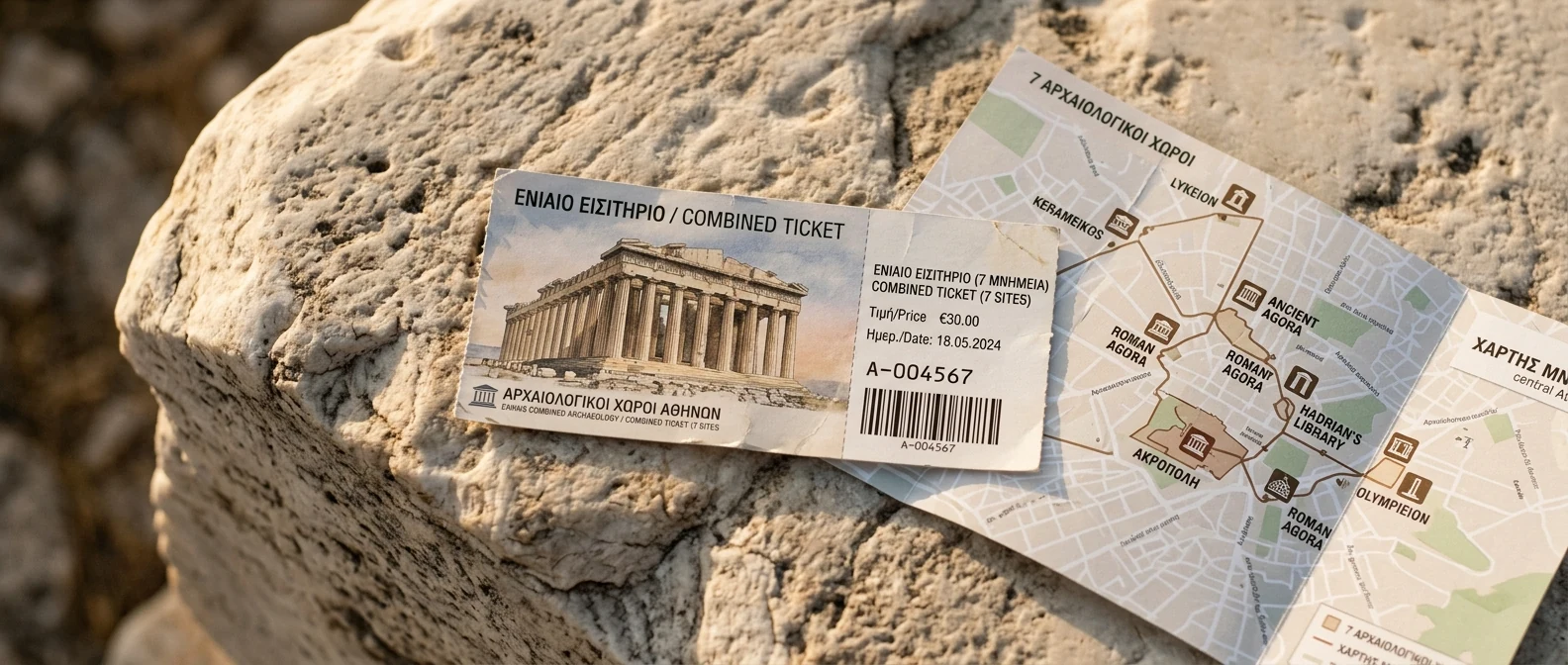
- Tickets: standalone tickets are available, and the site is often included in the combined archaeological ticket. Check current prices on hhticket.gr.
- Hours: these change by season. Confirm opening times and holidays before you go.
- Booking: usually not needed for a normal visit unless you are working with a very tight schedule.
How much time to allow
30–45 minutes
Realistic average. The site is small and most visitors do a single perimeter loop.
1 hour
If you go inside, when it is open, and spend time looking at the wind reliefs one by one.
15 minutes
If you have a combined ticket and a very tight schedule. Go straight to the Tower, look at the reliefs, and continue.
Photography
The eight-sided form of the Tower photographs best from the southeastern corner of the Agora, especially when the light falls low across the reliefs. Outside the site, Aiolou Street gives a clean view of the Tower without much visual clutter.
What to combine it with
The Roman Agora combines easily with nearby archaeological sites and a walk through Plaka:
- Hadrian's Library — a short walk to the north.
- Roman Agora & Tower of the Winds — this site.
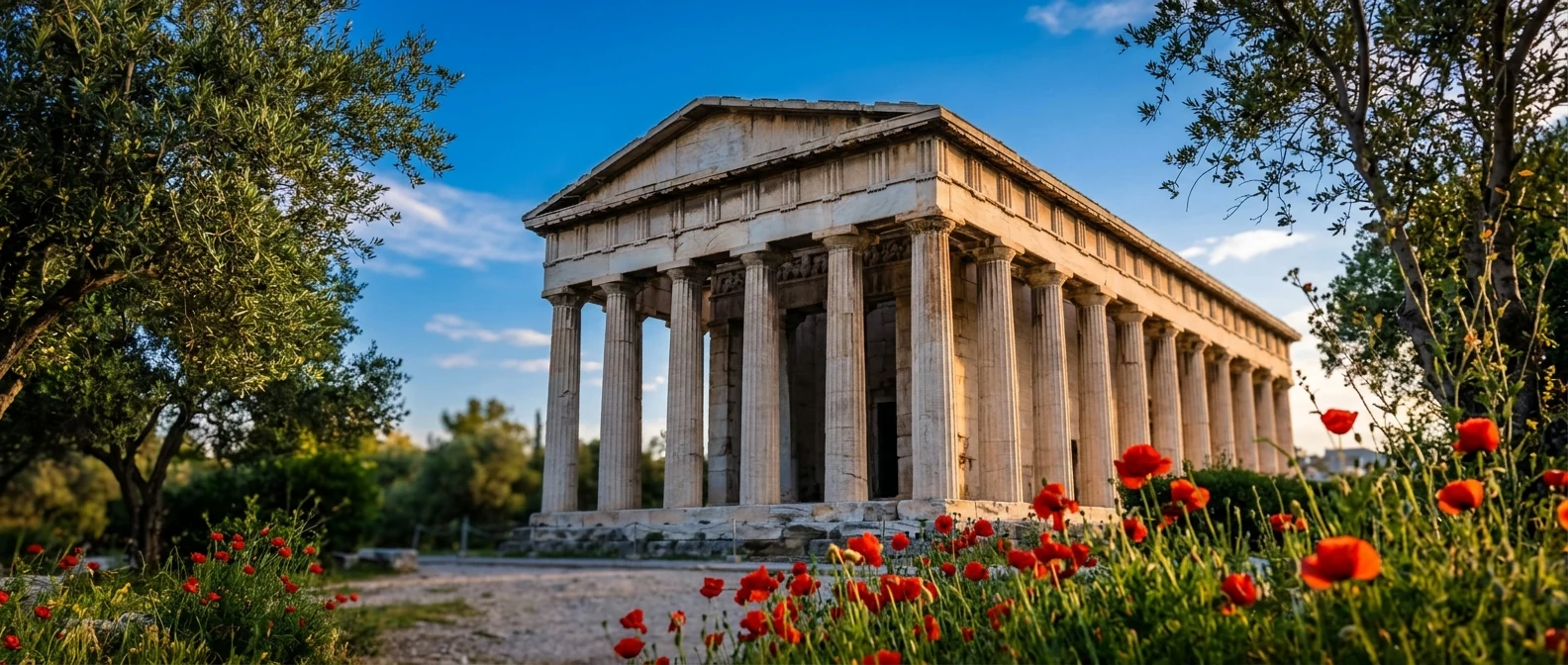
- Ancient Agora & Temple of Hephaestus — to the west, if you want to see the larger agora of classical and Hellenistic Athens.
- Plaka and Anafiotika — to the south, for a short walk before or after the visit.
Frequently asked questions
Can you go inside the Tower?
Usually yes, but there may be restrictions for conservation or operational reasons. Ask at the gate before building your whole visit around interior access.
Is it accessible?
The Agora courtyard is mostly level, with paving and gravel. The Tower interior has a small step at the entrance. It is manageable for most visitors, but not fully wheelchair-accessible.
How does this compare to the Greek (Ancient) Agora?
The Roman Agora is smaller, more focused, and easier to read in a short visit. The Ancient Agora is much larger, with the Temple of Hephaestus, the Stoa of Attalos museum, and many more scattered remains. If you have a combined ticket and time, they work well together.
— Kathy