The five coffees you should know
Ελληνικός · Ellinikós (Greek coffee)
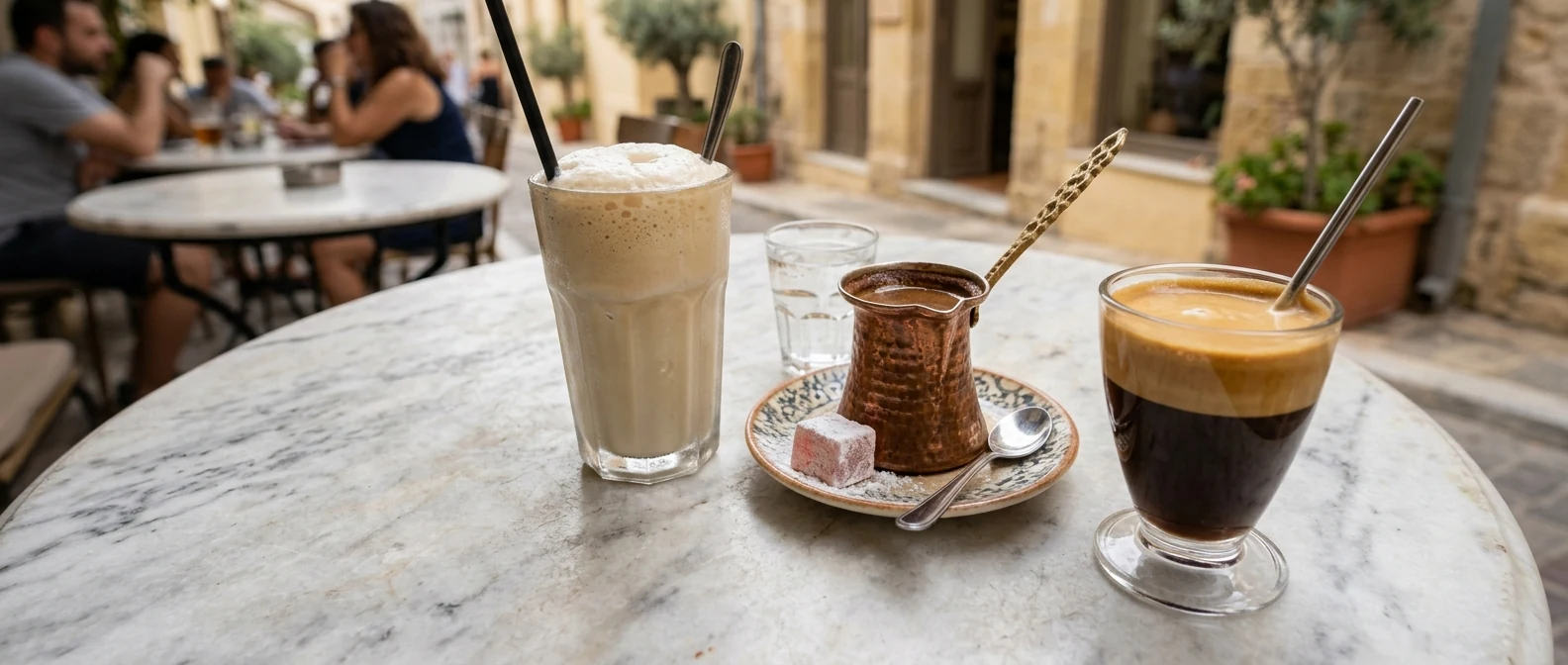
Finely ground coffee boiled in a small pot called a briki. Served in a small cup, with grounds at the bottom. Similar brewing methods exist across the eastern Mediterranean and the Balkans under different names.
Φραπέ · Frappé
A very familiar summer coffee in Greece. Instant coffee whipped with cold water and ice into a tall foam-topped drink. According to the best-known story, it appeared in 1957 at the Thessaloniki International Fair when a Nestlé employee had no hot water.
Φρέντο εσπρέσσο · Freddo Espresso
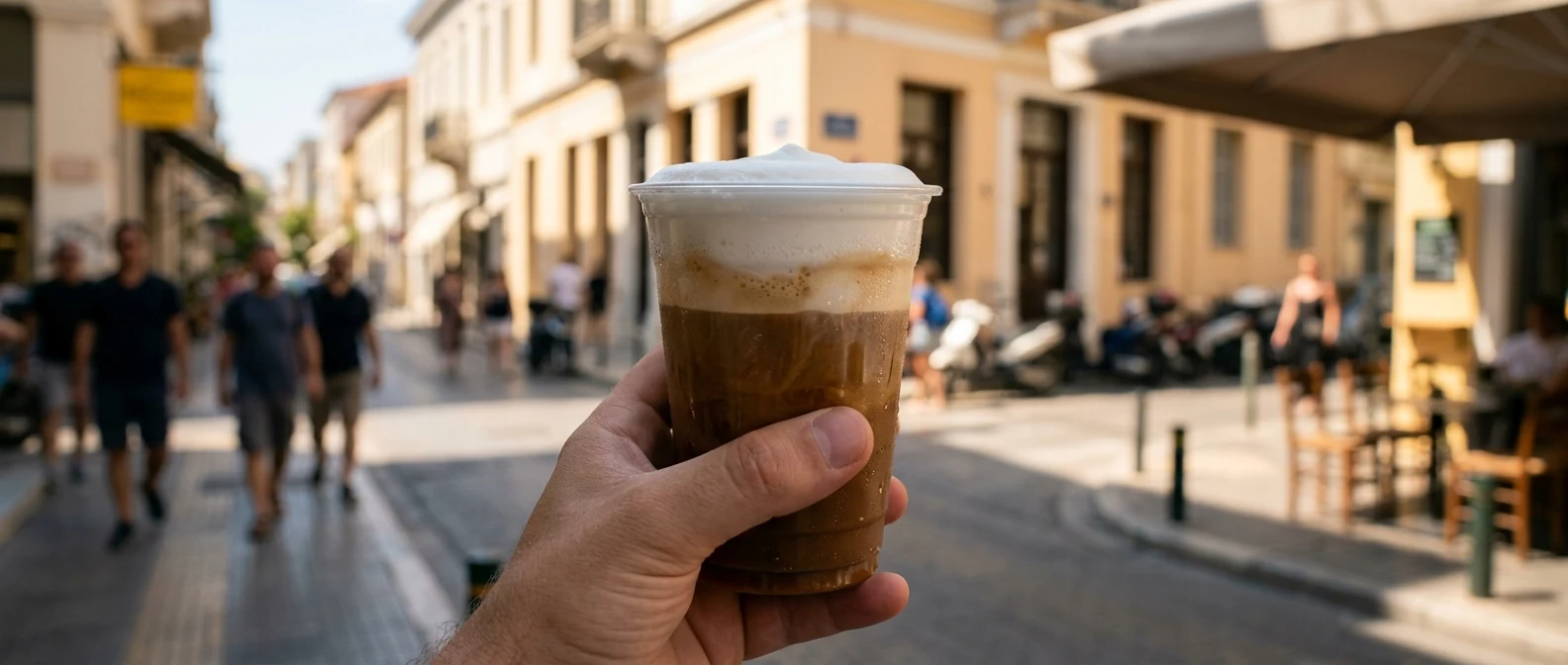
Double espresso shaken with ice and served cold. Since the early 2000s it has become one of the most common cold coffee choices in many Athens cafes, because it keeps the intensity of espresso without being hot.
Φρέντο καπουτσίνο · Freddo Cappuccino
Like freddo espresso, but topped with a thick layer of cold-foamed milk (afrogala). It is a very common choice for people who want a cold coffee with milk.
Καφές φίλτρου · Filter coffee
The usual filter coffee, in a simple or specialty version. You find it easily in modern cafes and roasteries, but less often in old kafeneia. It often comes with a small glass of water alongside.
Sugar in the order
In Greece, sugar is often added while the coffee is being made, not afterwards. That is why the order usually needs a second word. The basic levels are these:
σκέτος · skétos
No sugar.
μέτριος · métrios
About one spoonful of sugar. The most common middle option.
γλυκύς · glykýs
Two spoonfuls. Sweet.
γλυκύς βραστός · glykýs vrastós
Very sweet, traditional Greek coffee with extra-long boil. Old-school.
So the order becomes clear: "frappé métrios", "ellinikós skétos", "freddo cappuccino métrio". If you do not say anything, the barista will ask or guess.
Milk and plant-based options
For coffees that take milk:
- με γάλα · me gála — with milk
- χωρίς γάλα · chorís gála — without milk
- γάλα βρώμης · gála vrómis — oat milk, now available in most specialty cafes and quite a few chains
- γάλα αμυγδάλου · gála amygdálou — almond milk, less common but not hard to find in modern cafes
Greek coffee: how to drink it
The grounds rule
The bottom of the cup is sediment. Do not stir it before drinking. Sip slowly from the top and leave the thick grounds at the bottom. Fortune telling (kafemanteia) is traditionally based on the shapes those grounds leave when the cup is turned over.
Greek coffee is almost always served with a glass of cold water alongside. You will often see the same with frappé or freddo too. Have a little water first and then the coffee, especially if it is sketos.
Frappé: the slow coffee of summer
Frappé is strongly associated with the Greek summer. It comes in a tall glass with ice, a straw and foam on top, and it usually stays on the table for quite a while as the ice melts slowly.
That says quite a lot about coffee culture in Athens:
- Coffee does not end quickly. You can sit for a long time with one glass and some water, and nobody will rush you.
- The drink lasts as long as the conversation. Cold coffee with ice stays on the table as long as the group does.
- The price also buys time. In many cafes, you are paying not only for the drink but also for the table for quite a while.
Freddo cappuccino: the safe order
If you want a cold coffee with milk and do not know what to choose, freddo cappuccino is a safe option. The reasons are simple:
- You can find it almost everywhere, from chains to small cafes.
- Even in a simple shop, it is often a decent choice.
- People drink it at many different times of day.
- It gives you a very typical Athens cold-coffee experience with milk.
Where to drink each kind of coffee
Specialty filter coffee
Specialty roasteries in Exarchia and Pangrati, with single-origin coffee and more careful brewing. For a nearby option from Victoria, see our Exarchia coffee guide. Usually €3.50–€4.50.
Greek coffee
A traditional kafeneio or old cafe is usually the best setting for it. Plaka has a few, while Anafiotika, Mets, and older neighbourhoods keep quieter options too. See also our guide to kafeneia. Usually €1.80–€2.50.
Freddo
Almost anywhere — chains like Mikel, Coffee Island and Gregory's usually have lower prices than specialty cafes. €2.50–€4.00.
What they cost
€1.80–€2.50
Greek coffee in a traditional kafeneío.
€2.50–€4.00
Freddo or frappé in a chain café.
€3.50–€5.50
Freddo cappuccino at a specialty café.
€6.00+
In very tourist-heavy parts of Plaka or around major sights. A few streets away, prices often drop noticeably.
How to get there from Angel Athens (Ioulianou 50)
From Ioulianou 50, you will find frappé, freddo espresso, and freddo cappuccino at almost every nearby bakery or takeaway coffee place. For specialty coffee, walk 12-15 minutes toward Exarchia. For a more traditional Greek coffee in a kafeneio, try Exarchia or take Line 1 from Victoria to Monastiraki and continue a few minutes on foot toward Plaka.
FAQ
Is "Greek coffee" really the same as Turkish?
The brewing method is very similar: finely ground coffee, water, a briki, and grounds left in the cup. The name changes from country to country and depends on local history. In Greece, the name ellinikos became especially common from the 1970s onward.
Is decaf available?
"Ντεκαφεϊνέ" (decaffeinated) is available in most chains and specialty cafés but rare in traditional kafeneía. Ask: "Έχετε ντεκαφεϊνέ;"
What about espresso?
Hot espresso drinks such as espresso, doppio, cappuccino and latte are available almost everywhere. In summer, cold coffee is simply more common, while from November to March hot orders become more frequent again.
Why is the cup of water always there?
In Greece, coffee often comes with water as a small gesture of hospitality. Tap water in Athens is safe and of good quality. You can drink it before, during, or after the coffee.
— Kathy