The teacher-student chain
Socrates (~469-399 BCE) taught Plato (~428-348 BCE). Plato taught Aristotle (384-322 BCE). Aristotle taught Alexander III of Macedon. These three philosophers do not belong to distant ages. Socrates was about 40 when Plato was born. Plato was about 60 when Aristotle was born.
All three lived and worked in Athens, although Aristotle was born in Stageira in Chalkidiki. Their thought extends across ethics, politics, logic, metaphysics, knowledge, biology, rhetoric, and poetry. Many questions still discussed in universities begin in this period.
Socrates: the man of questions
- ~469-399 BCE. An Athenian. His father was a stonemason, his mother a midwife.
- He wrote no works. We know him from Plato, Xenophon, and Aristophanes' satirical comedy The Clouds.
- He taught in public spaces. The Agora, gymnasia, symposia. He had no school and charged no fees.
- His method was examination. He kept asking questions until contradictions in his companion's views became clear.
- His best-known phrase: "I know that I know nothing." Wisdom begins with recognising one's ignorance.
- In 399 BCE he was tried for impiety and corrupting the young. He was condemned by a vote of 281-220 and drank hemlock.
Plato: the Academy and the dialogues
Plato's Academy
Plato was a young aristocrat when Athens executed Socrates. He left the city for years, travelled in Egypt, southern Italy, and Sicily, and returned to Athens in 387 BCE. Then he founded the Academy. The school operated for about 916 years, until 529 CE, when Justinian closed it. Around 30 Platonic dialogues survive almost complete, including the Republic, the Symposium, the Phaedo, the Apology, the Timaeus, the Phaedrus, and the Laws.
The Theory of Forms
- The visible world changes. Things come into being, wear away, and disappear.
- True knowledge concerns the Forms. Beauty, Justice, and the Good exist as stable models.
- The allegory of the cave appears in Book VII of the Republic. People are like prisoners looking at shadows on a wall. The philosopher comes out into the light and returns to teach.
- Learning is recollection. For Plato, the soul recalls what it knew before birth.
Plato's Republic
- The Republic is Plato's best-known political dialogue.
- Its subject is justice. Plato first looks for the just city and then for the just person.
- The city is divided into three groups: philosopher-rulers, guardians, and producers.
- The soul has three parts: reason, spirit, and appetite. The structure of the soul mirrors the structure of the city.
- Education lasts for decades. Music, gymnastics, mathematics, and dialectic.
- Democracy receives sharp criticism. Plato fears demagogy and the road to tyranny.
Aristotle: the philosopher of classification
- 384-322 BCE. He was born in Stageira. His father was a physician at the Macedonian court.
- He studied at the Academy from the age of 17 and remained there for about 20 years.
- In 343-340 BCE he taught Alexander at the Macedonian court.
- In 335 BCE he founded the Lyceum in Athens. The school was also called "Peripatetic," because teaching often happened while walking.
- He wrote on almost every field of knowledge: logic, biology, physics, metaphysics, ethics, politics, rhetoric, poetics, meteorology, dreams, and theatre.
- Of about 200 works, around 31 survive. Most read more like teaching notes than literary books.
- In 322 BCE he left Athens after Alexander's death. Anti-Macedonian feeling had intensified. He died the same year on Euboea.
Aristotle's main contributions
Logic
Aristotle formulated the theory of the syllogism. His formal logic dominated until the 19th century.
Biology
He recorded around 500 animal species. He made anatomical observations and early classifications.
Ethics
In the Nicomachean Ethics, he defines virtue as a settled disposition. The goal is eudaimonia, a flourishing life.
Politics
In the Politics, he compares constitutions. The phrase "man is by nature a political animal" became classical.
Metaphysics
Substance, form, matter, the four causes, and the unmoved mover. Terms that stayed in philosophy for centuries.
Poetics
An analysis of tragedy, mimesis, and catharsis. Its influence reaches into theatre theory.
At a glance
3 generations
Socrates → Plato → Aristotle. ~150 years.
~30 dialogues
Plato's complete corpus, all surviving.
~31 works
Aristotle's surviving texts (of ~200 written).
916 years
Plato's Academy ran continuously, 387 BCE-529 CE.
Plato and Aristotle: the main difference
- Reality: Plato looks for the Forms beyond things; Aristotle finds form within things themselves.
- Method: Plato starts from first principles; Aristotle looks at observation, classification, and induction.
- Politics: Plato writes about the ideal city; Aristotle compares actual constitutions.
- Ethics: Plato connects knowledge of the Good with virtue; Aristotle emphasises habit and action.
- Style: Plato writes dialogues; Aristotle writes treatises and teaching notes.
- Raphael's School of Athens: Plato points upward, Aristotle toward the ground. The gesture sums up their difference.
Three deaths
- Socrates, 399 BCE. He was tried, condemned, and drank hemlock. Plato describes his final hours in the Phaedo.
- Plato, 348 BCE. He died at the Academy, at about 80 years old.
- Aristotle, 322 BCE. He died on Euboea, shortly after leaving Athens.
Influence after antiquity
- Christian theology: Plato influenced Augustine; Aristotle influenced Thomas Aquinas.
- Islamic philosophy: Ibn Sina and Ibn Rushd commented extensively on Greek texts.
- Modern science: the Aristotelian framework dominated until Galileo and Newton.
- Modern universities: the Academy and the Lyceum provided models of school, discussion, and systematic study.
Where their story appears in Athens
Ancient Agora
Socrates moved through the Ancient Agora, spoke in public spaces, and was tried in Athens in 399 BCE. From 50 Ioulianou the route is about 20 minutes: Line 1 from Victoria to Monastiraki and 3 minutes on foot.
Aristotle's Lyceum
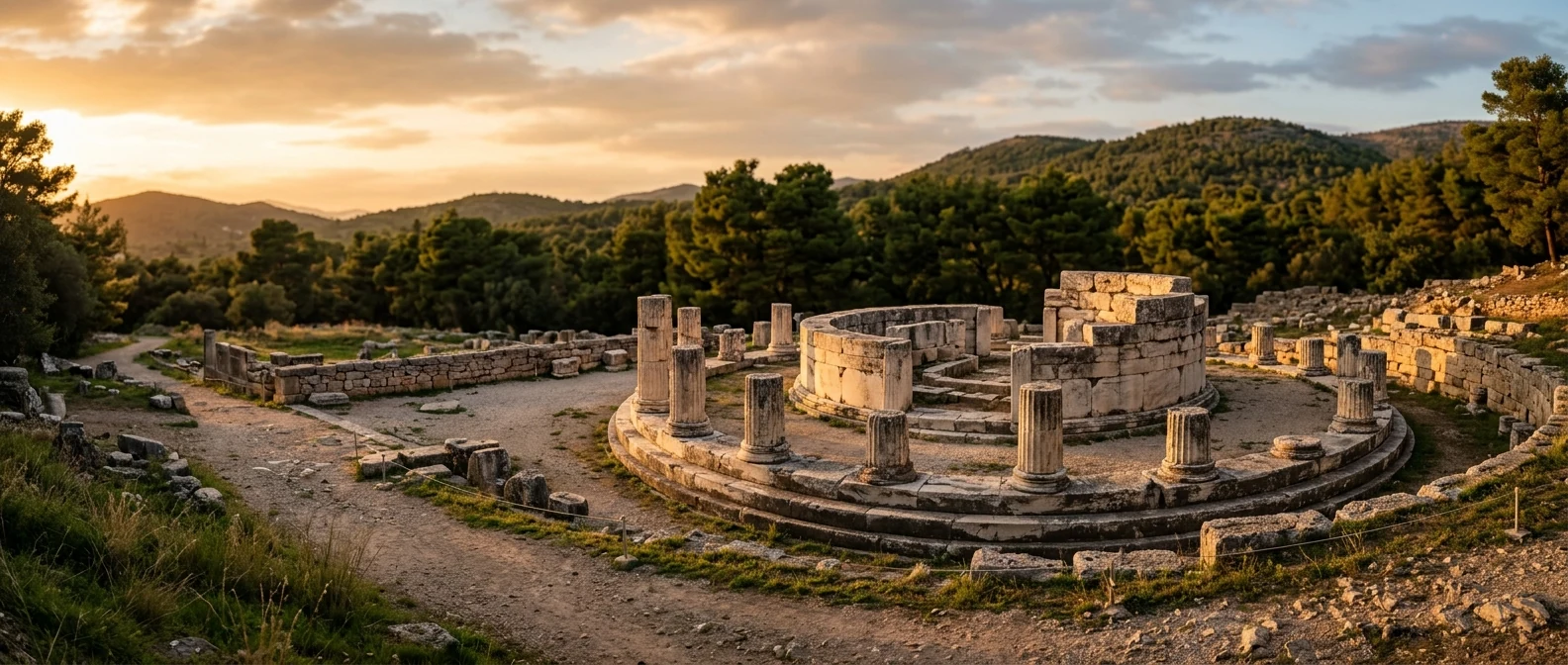
The archaeological site lies near Rigillis Street and Kolonaki. The ruins are modest, but they show the grounds of the school Aristotle founded in 335 BCE.
Plato's Academy
The area lies northwest of the centre, about 3 km from Syntagma. Today it is a park with archaeological remains and free access.
Statues and public memory
Statues of Socrates and Plato stand in front of the Academy of Athens on Panepistimiou Street. A statue of Aristotle stands at the Aristotle University of Thessaloniki.
Where to start reading
- Plato for a start: Apology. Short, clear, and focused on the trial of Socrates.
- Plato for depth: Republic. A large work, but central to political philosophy.
- Plato in a more narrative mood: Symposium. Love, speeches, a dinner table, and philosophy.
- Aristotle for a start: Nicomachean Ethics. A practical text about virtue, habit, and eudaimonia.
- Aristotle in a more demanding key: Metaphysics and Politics.
Frequently asked questions
Did Socrates write anything?
No. What we know comes through pupils and opponents: Plato, Xenophon, and Aristophanes. That is why the "historical Socrates" is difficult to pin down.
Who is easier to read, Plato or Aristotle?
Usually Plato. His dialogues have characters, scenes, and dramatic tension. Aristotle is more technical because many of his texts read like lecture notes.
Why was Socrates executed?
The formal charge was impiety and corrupting the young. The political background was heavy: after the Peloponnesian War, Athens viewed figures linked to anti-democratic circles with suspicion.
Did Aristotle agree with Plato?
Not in everything. He worked on Platonic questions, but rejected a separate world of Forms. Their difference is also one of temperament: Plato is more mathematical and metaphysical, Aristotle more observational.
Why do they remain important?
Ethics, political theory, logic, and philosophy of science still use their questions. Not as ready-made answers, but as starting points for thought.
Which Athenian site gives the clearest sense of their world?
The Ancient Agora. The Stoa of Attalos, the paths among the ruins, and the view toward the Acropolis make the setting in which Socrates spoke much clearer.
Sources:
— Kathy