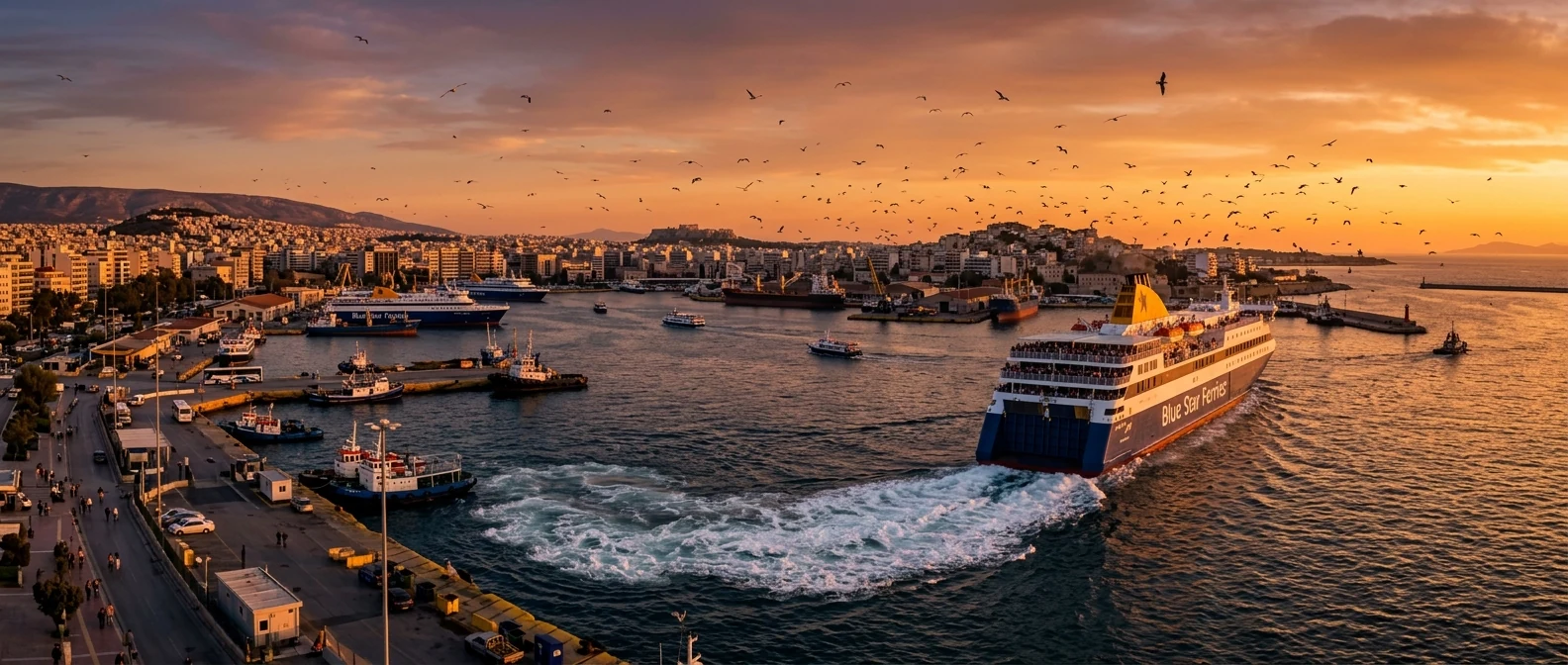
Piraeus first
Piraeus is Athens's main port for the Cyclades, the Dodecanese, Crete, the Northeast Aegean and the Saronic. From here ferries leave for Santorini, Mykonos, Naxos, Paros, Milos, Rhodes, Kos, Patmos, Lesbos, Chios, Samos, Heraklion, Chania, Aegina, Hydra and Spetses. The port is not one small quay where you step off the metro and instantly see the ship. The gates stretch over a long distance. For a July or August morning departure, 45 to 60 minutes is a sensible margin for passengers without a car. With a car or a distant gate, allow more time.
From Ioulianou 50 to Piraeus
- From Ioulianou 50: walk a few minutes to Victoria Station.
- Metro Line 1: from Victoria, take the green line directly to Piraeus. The ride is about 30 minutes.
- From Piraeus station to your gate: for some gates it is only a few minutes, but for the farther ones allow another 20 to 30 minutes, especially with luggage and heat.
- Do not plan the arrival only around the metro ride: the port itself still takes time.
- A taxi makes more sense if you have many bags, a very early departure or children.
- With a car, parking near the port needs either booking or extra time.
The gates without panic
What to check on your ticket
The ticket shows the gate. That is the first thing to check. The gates are not next to each other, and some are quite far from the station. Certain gates are more often linked to routes such as Crete, the Cyclades, the Saronic or the Dodecanese, but changes happen. The final point of reference is always the ticket, the ferry company and the current port information.
Booking and tickets
- Online booking is easy now, either through the ferry companies themselves or through comparison platforms.
- Check carefully the departure time, port, gate, ship type and whether there is any special boarding step.
- In July and August, the popular routes for Santorini, Mykonos, Naxos and Paros fill up.
- If you are travelling with a car, booking earlier matters even more.
- Simple deck tickets on the larger conventional ferries are often easier to find, but last minute is not a serious plan on a peak day.
- Most companies send a QR code: keep a screenshot and, if possible, save it offline.
Slow or fast ferry
Conventional ferries
Bigger, steadier at sea and often cheaper. They take cars, have outdoor decks and, on longer routes, cabins.
Fast ferries
Mostly catamarans that save time, but cost more, give you less outdoor space and move more in strong wind.
Times that help with planning
30 minutes
Victoria to Piraeus on Line 1.
45-60 minutes
A safe arrival margin without a car.
3 km
Roughly the spread of the main gates.
4.5-8 hours
A useful range for Piraeus to Santorini, depending on ship and stops.
What to have with you
- Water and a small snack help, especially on morning departures.
- A power bank is useful.
- A light layer also helps, because the indoor spaces often have strong air-conditioning.
- If you are prone to sea-sickness, take something before you need it.
- Big ferries are steadier, but strong August wind can still make a familiar route uncomfortable.
- ID or passport should stay accessible, not buried in luggage.
Seat, deck or cabin
- Deck is the cheapest choice and is enough for short or medium trips.
- An airline-style seat gives you a more stable base for a long daytime route.
- Distinguished class means more space and more quiet, though it is not always necessary.
- A shared cabin often makes the most sense on overnight routes to Crete or the Dodecanese.
- A private cabin costs more, but it changes the trip if you need proper rest.
- If you travel with a car, remember that you cannot stay in the garage during the journey.
When most ferries leave
- Many island departures leave in the morning, so the day starts early.
- For Crete and Rhodes, overnight routes are common.
- For Aegina, Hydra, Poros and Spetses, departures are more frequent through the day.
- In winter, schedules thin out and some lines run only a few times a week.
- Strong wind can bring delays or cancellations, and fast ferries are usually affected more often.
A few on-board notes
- There is food and coffee on board, but it is better not to rely on it as the main plan.
- Outdoor decks are the best part of a conventional ferry when the weather is good.
- Indoor spaces can feel much colder than expected because of the air-conditioning.
- Wi-Fi exists on some ferries, but it is not something to plan around.
- Toilets are usually fine, though there can be queues close to arrival.
The usual mistakes
- Arriving at the last minute: Piraeus does not forgive lateness easily.
- Going to the wrong gate: that mistake is common and expensive in stress.
- Dragging a heavy suitcase across the port in a heatwave.
- Buying separate tickets without checking the connection: if the first ferry is delayed, the second one is not always protected.
- Underestimating the weather: if meltemi is expected, check updates before leaving for the port.
- Assuming waiting at the gate solves a cancellation: it usually does not.
Indicative prices
- Prices change with the company, the season and availability.
- A conventional ferry is often cheaper than a fast one.
- For Crete or the Dodecanese, a basic deck ticket costs less, while a cabin raises the total more noticeably.
- For Aegina and the nearby Saronic, prices are usually lower than for the Cyclades or Crete.
- For Rhodes and the farther Dodecanese, time and cabin comfort can matter more than a small price difference.
- Before booking, look at the total cost: ticket, seat, transport to the port and any possible overnight stay.
Could Rafina work better?
- For Andros, Tinos and Mykonos, Rafina is often more practical than Piraeus.
- It is a smaller port, less chaotic and closer to the airport.
- If you land and go straight to an island, Rafina is worth checking first.
- From Ioulianou 50, however, Piraeus is usually simpler because of the direct Line 1 connection.
Frequently asked questions
How early should I arrive?
Without a car, 45 to 60 minutes is a good summer margin. With a car, allow more, especially on busy days.
Can I bring food on board?
Yes. It is often a better plan than relying only on the ferry cafe, especially on longer or morning routes.
What if I miss the ferry?
The ticket is not usually refunded easily. Some companies allow changes for a fee or a move to a later sailing, depending on the fare.
Which company is better?
That depends on the route, the weather, the departure time and whether you care more about speed or comfort. Compare the ship type, duration, arrival time and change policy before you book.
Will I get seasick?
Large ferries are steadier. Fast ferries move more in wind. If you have a history of sea-sickness, take something preventively before departure.
How do I continue to more islands?
For island hopping, leave gaps between sailings and keep an eye on the weather. The guide to Greek island hopping helps with the planning.
Sources:
— Kathy