The geology behind the view
Santorini is what remains of a volcanic system that changed violently around 3,600 years ago. The Minoan eruption, around 1600 BCE, is counted among the strongest volcanic eruptions of the historical era.
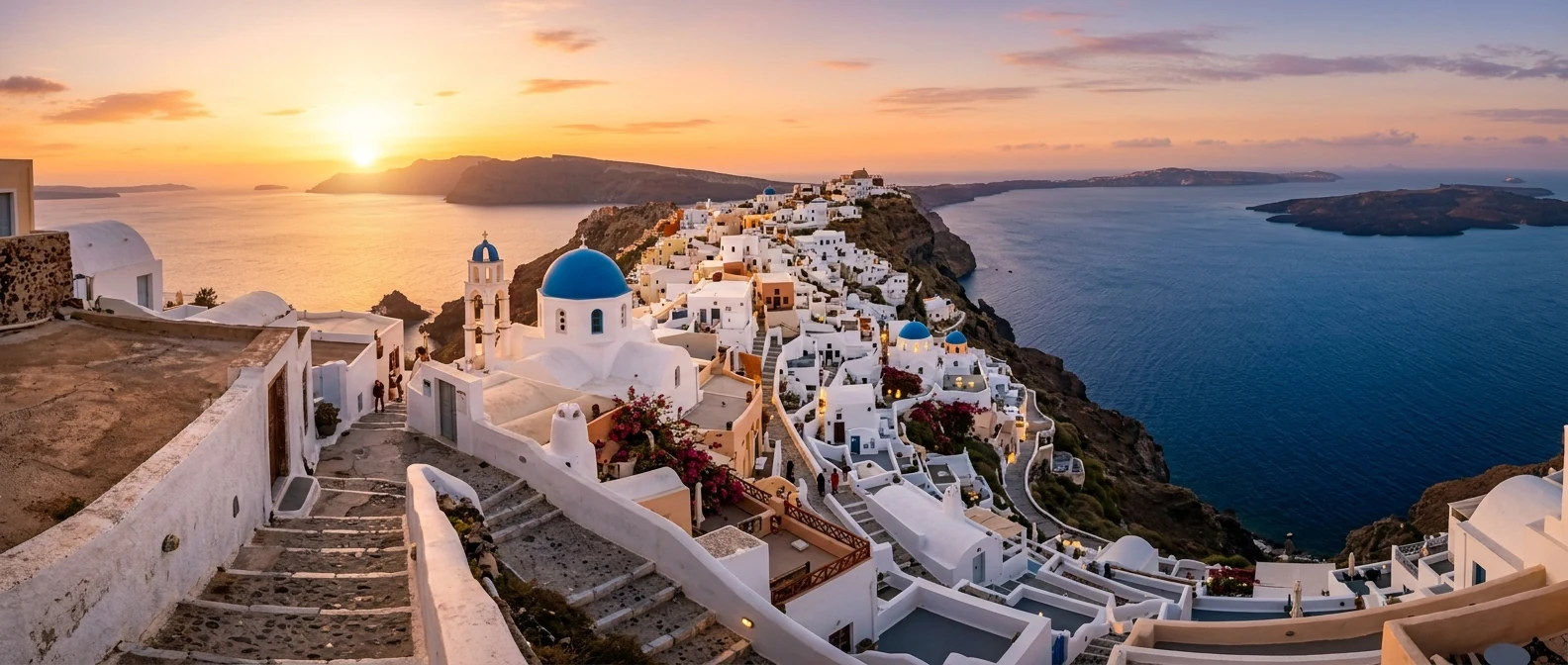
The older island collapsed and left today's caldera. Thera, Thirassia, Aspronisi, Nea Kameni and Palea Kameni are all pieces of that geological story. The view is not stage scenery. It is the result of collapse.
The same eruption covered Akrotiri in metres of pumice, which is why it survived so well. The link with the Atlantis myth remains a theory, not a certainty.
Akrotiri: a Bronze Age town
A settlement buried by the eruption
Excavations at Akrotiri began in 1967 under Spyridon Marinatos. The settlement had two- and three-storey buildings, paved streets, drainage and wall paintings that belong to the wider Minoan world. One of the most striking facts is the absence of skeletons and many valuables, which suggests that the inhabitants probably left after earthquakes that came before the eruption. The site is covered and visited from walkways above the ruins. For tickets, combined passes and opening days, check the current Ministry of Culture information. Most visitors need around an hour and a half there, longer if they stop to read the signs.
Fira, Oia, Imerovigli and Pyrgos
- Fira: the capital and main hub of the island. From the old port you go up by cable car or by roughly 580 steps. Restaurants, shops, hotels and buses gather here, so it is practical but crowded.
- Oia: the northern edge of the caldera and the most photographed part of Santorini. At sunset the lanes fill long before the sun drops, so if you do not want to stand shoulder to shoulder, it is often better to see the light from Imerovigli, Fira or from a boat.
- Imerovigli: the highest point on the caldera, with the path toward Skaros rock.
- Firostefani: attached to Fira, but with less pressure.
- Pyrgos: inland, with more village scale, a castle and views to several sides of the island.
Beaches with volcanic colour
Red Beach
Red cliffs near Akrotiri. Access is often restricted because of rockfalls, so the view from above is usually the safer choice.
White Beach
White pumice cliffs, usually reached by boat from Akrotiri.
Perissa, Perivolos and Kamari
Black volcanic sand, organised sections and beach bars. At midday the sand becomes very hot.
Vlychada
On the south coast, with cliffs carved into strange shapes by the wind. Usually under less pressure.
Volcanic boat trip
- Nea Kameni: the active volcanic islet inside the caldera. The walk to the crater is not difficult, but it happens on black, hot and dusty ground. The last small eruption happened in 1950.
- Palea Kameni: hot springs with sulphurous water. The water is brownish and smells of sulphur, not like a spa pool.
- Thirassia: included in many excursions as a food stop.
- Afternoon boats: a good answer to sunset without the Oia crowd.
Assyrtiko and basket-trained vines
- Assyrtiko: a dry white wine with acidity, minerality and a saline edge.
- The vines: growers weave them low into basket shapes to protect them from the wind and help them keep moisture.
- Vinsanto: a sweet wine from sun-dried grapes, mainly Assyrtiko and Aidani.
- Wineries: the island has several, from cooperative facilities to smaller estates. In the high season, book ahead for visits and tastings.
Useful facts
Small island
Beauty and pressure sit very close together on Santorini.
Akrotiri
A Bronze Age town preserved under pumice.
580 steps
The old port to Fira on foot is short in distance, but not light work.
Assyrtiko
Wine is one of the strongest reasons to look past the caldera views alone.
🍽️ Local food
- Cherry tomatoes: PDO, small and concentrated because they grow in volcanic soil with very little water.
- Fava: PDO and usually served as a smooth puree with onion, capers and olive oil.
- White aubergine: sweeter than the purple variety.
- Tomatokeftedes: found almost everywhere, often with mint or other herbs.
- Chloro: a fresh local cheese made from sheep and goat's milk, less famous than it should be.
The donkeys: no
- Donkey rides: still offered on the 580 steps at Fira.
- Welfare concerns: documented by Greek authorities and international organisations, including overwork, sores, poor equipment and heat stress.
- Cable car: fast, though it can involve queues in peak hours.
- Walking: free, but the steps need care. The animals should not be used as tourist transport.
Getting around the island
- Buses (KTEL): start mainly from Fira and connect Oia, Kamari, Perissa, Akrotiri and Pyrgos. In summer they fill quickly, so leave margin if you have a ferry, flight or reservation to catch.
- ATV and scooter rentals: available everywhere, but the roads are narrow, steep and full of visitors who often do not know the route.
- By car: useful for beaches and villages, although parking in Fira and Oia is difficult.
- Taxis: few, with long waits.
Getting there from Athens
- To the airport: from 50 Ioulianou, take Line 1 from Victoria to Monastiraki and then Line 3 to the airport. Count about an hour, depending on the connection.
- By plane: Athens to Santorini is a short flight, and in summer the island also has many direct European routes.
- By ferry: Line 1 from Victoria goes directly to Piraeus, but ferry times and prices vary a lot by company and vessel type.
- Cruise pressure: on days with many cruise ships, the old port and Fira feel especially strained around the arrival and departure of the groups.
📅 When to go
- April, May and October: the most sensible months for Santorini, with milder weather, usually lower prices and a caldera that can breathe again.
- Spring sea: can still be cool, but walking and archaeological sites are much more comfortable.
- June and September: bring warmer sea and more movement, but still remain manageable.
- July and August: mean extreme demand, expensive rooms, heat and crowding in the lanes. For those months, book months ahead.
Four days in Santorini
- Day 1: Fira, the cable car, a caldera walk and sunset in Imerovigli.
- Day 2: Akrotiri, Red Beach from above, Vlychada and Pyrgos.
- Day 3: Nea Kameni, the hot springs and Thirassia by boat.
- Day 4: a winery and the black beaches at Perissa or Kamari.
Things to avoid
- Oia at sunset: not essential. In the morning it is clearer, quieter and more useful for actually walking around.
- Donkey rides: still the wrong choice.
- Caldera restaurants in Oia: often charge mainly for the view rather than the food.
- Midday in Fira during cruise season: one of the easiest ways to exhaust yourself.
Frequently asked questions
Is Santorini still worth it?
Yes, if you go with realistic timing and expectations. The caldera, Akrotiri and the wine are not invented; the pressure is not invented either.
How long should you stay?
Four days work well for a first visit. More time helps if you want a slower pace.
Where is the easier base?
Caldera villages give you the view and the pressure. Pyrgos, Kamari and Perissa are often easier and usually cheaper.
Is it family-friendly?
The beach areas are easier for families. The caldera villages are full of stairs and are harder for strollers or limited mobility.
Cruise stop or overnight stay?
Overnight is much better. A cruise stop gives you the island at its most crowded and for the shortest time.
Is the Atlantis story accepted?
No. It is a theory linked to the eruption and Akrotiri, not something settled as fact.
Sources:
— Kathy