🪪 The island at a glance
📍 Where it is
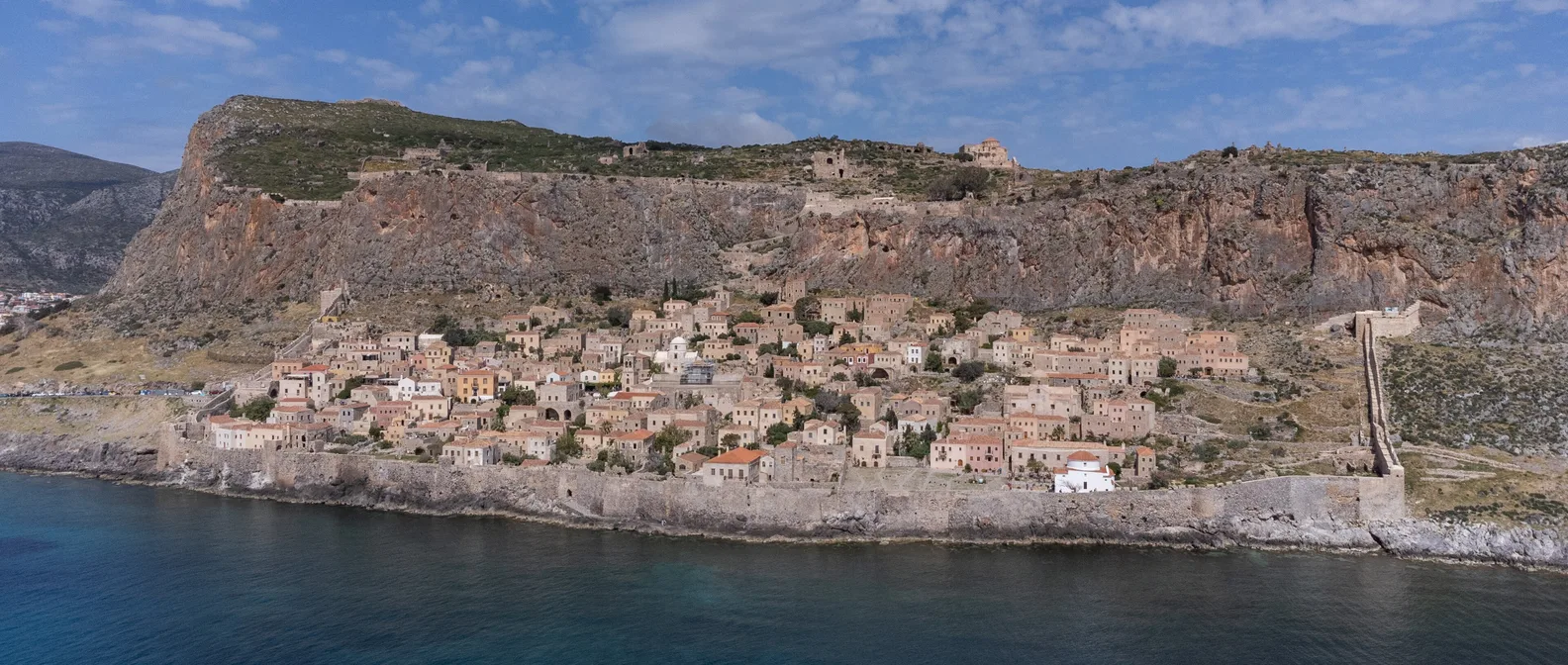
Monemvasia lies on the east coast of Laconia, in the southeastern Peloponnese. The rock is joined to the mainland by a bridge from the village of Gefyra, where there are hotels, tavernas and a small beach. From Athens the easiest way is by car, about four hours via Tripoli and Sparta. There are also KTEL Laconia buses, with a change in Sparta or Molaoi.
📍 Where Monemvasia is
Monemvasia lies on the east coast of Laconia, in the southeastern Peloponnese, about four hours by car from Athens. The rock is shown in red, and in green Athens, the airport and Sparta, on the way.
🗺️ The map
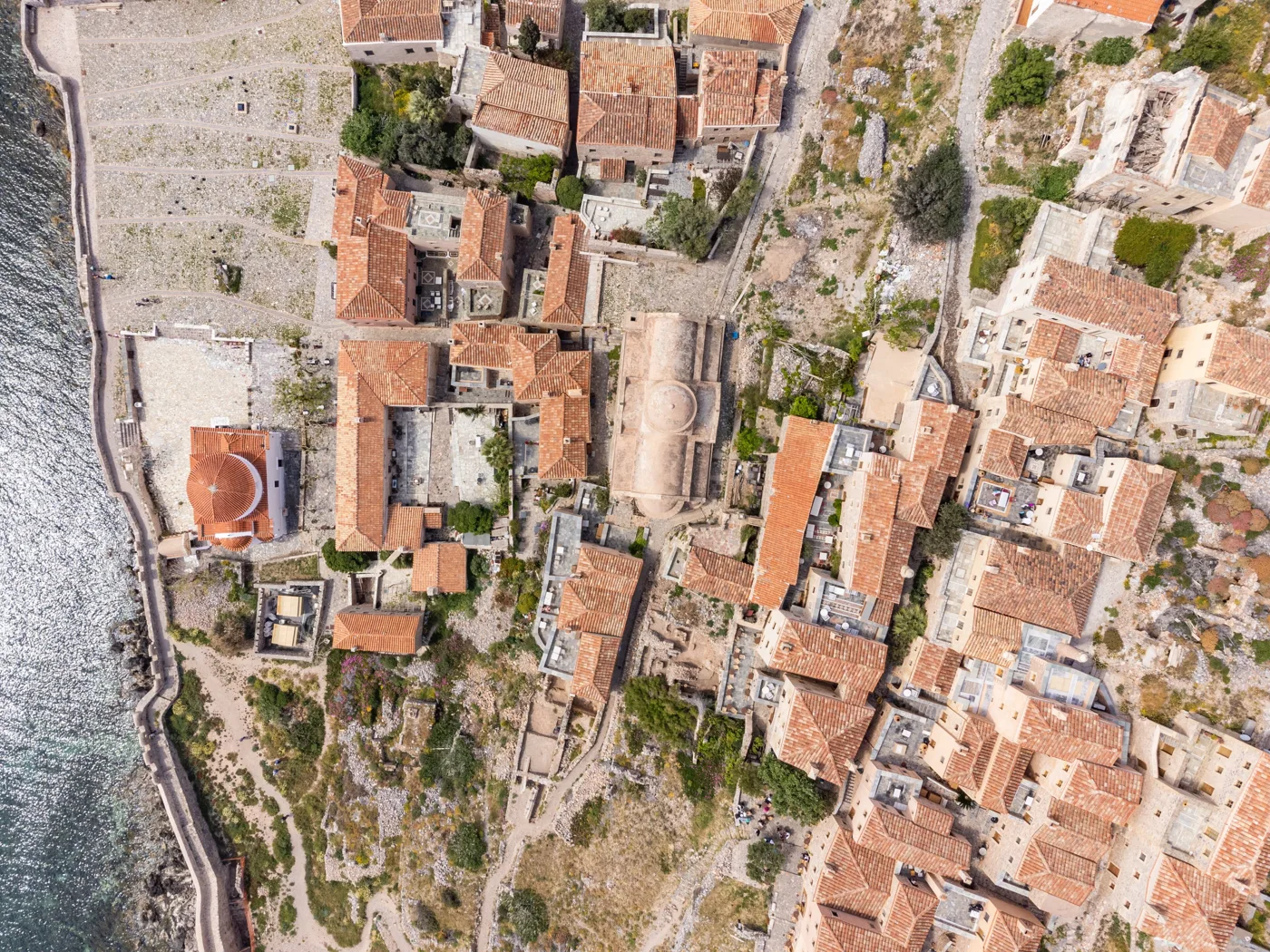
The rock is about one and a half kilometres long and a few hundred metres wide, with sheer sides all round. From the bridge, a road circles it to the main gate, where you leave the car. Inside the walls, on the south side, the Lower Town spreads from the sea to the foot of the cliff. A zigzag path climbs to the flat top, to the Upper Town, with Agia Sofia.
🗺️ The map of Monemvasia
The rock of Monemvasia is joined to the mainland by a bridge from the village of Gefyra. A road circles it to the main gate. Inside the walls, on the south side, is the Lower Town, and on the flat top the Upper Town with Agia Sofia. Tap each number to see what it is.
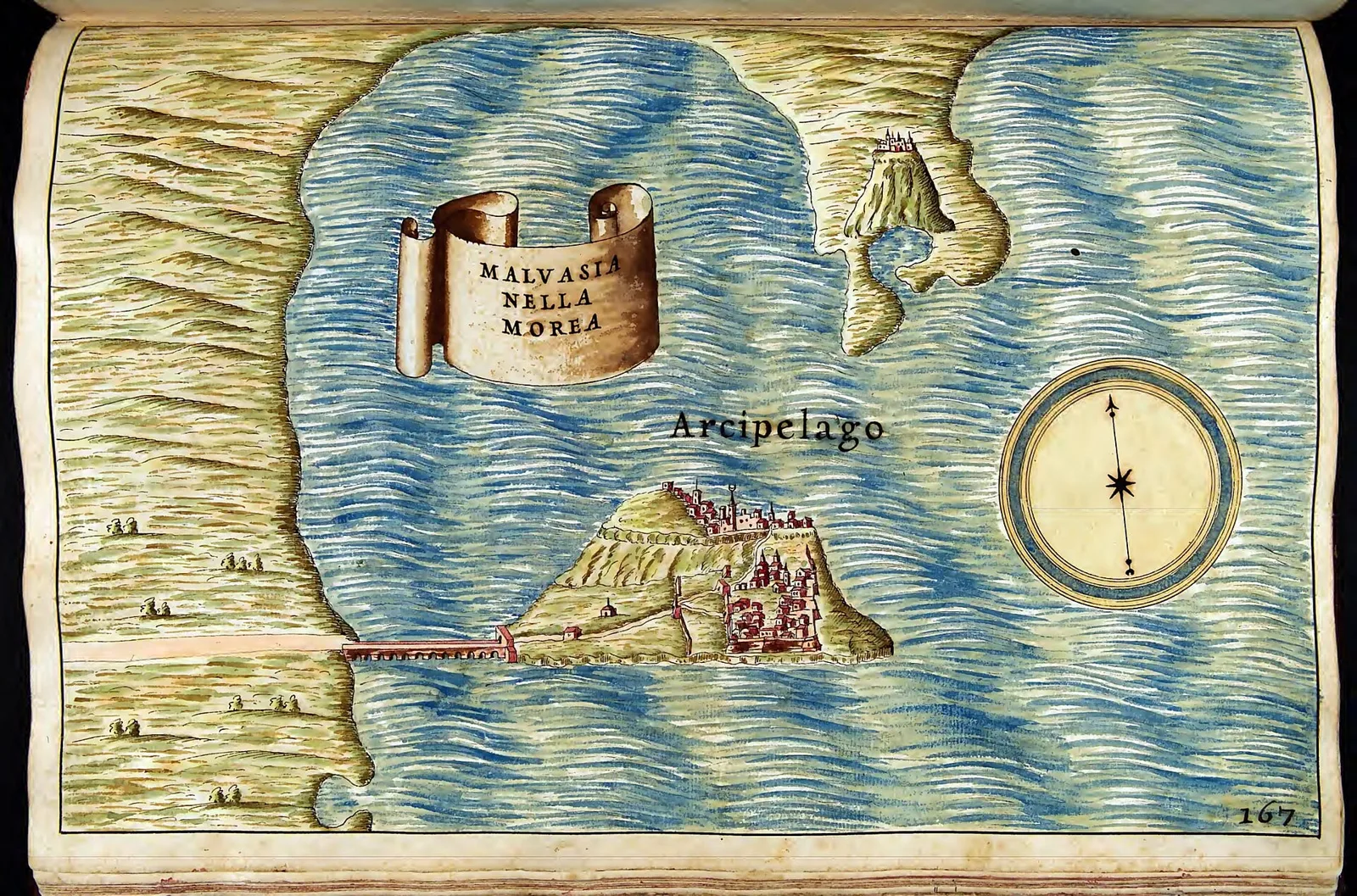
Map: Matteo Neroni, 16th century (Public domain) · Wikimedia Commons
⚖️ Is it worth it? The pros and cons
Monemvasia is one of the most atmospheric places in Greece, and deserves at least one night inside the walls. But it is not a place for long sandy beaches, and it fills up at weekends. Here is an honest picture.
📊 At a glance, from 1 to 5
👍 The pros
- A whole medieval town without cars, still inhabited.
- Agia Sofia on the edge of the cliff and the view from the Upper Town.
- You stay in stone mansions inside the walls.
- Swimming off the rocks, below the walls.
- Combines well with Elafonisos and Laconia.
👎 The cons
- Crowded at weekends and holidays.
- The path to the Upper Town is steep and has no shade.
- Guesthouses inside the walls are expensive.
- You leave the car outside and carry your luggage.
🏰 The history of the castle town
The rock was separated from the mainland by an earthquake in 375 AD. In the 6th century, people from Laconia took refuge here from the raids, and built a town that could be reached from only one point: “moni emvasia”, a single entrance, which gave it its name. In Byzantine times it became one of the richest ports of the Morea, with thousands of inhabitants, and gave its name to malvasia, the sweet wine the Venetians sold all over Europe.
It passed from the Byzantines to the Venetians and the Ottomans, and in 1821 it was one of the first castles the revolutionaries took. In the 20th century it was almost deserted, until it was slowly restored, house by house. The poet Yannis Ritsos was born here in 1909, and he is buried here.
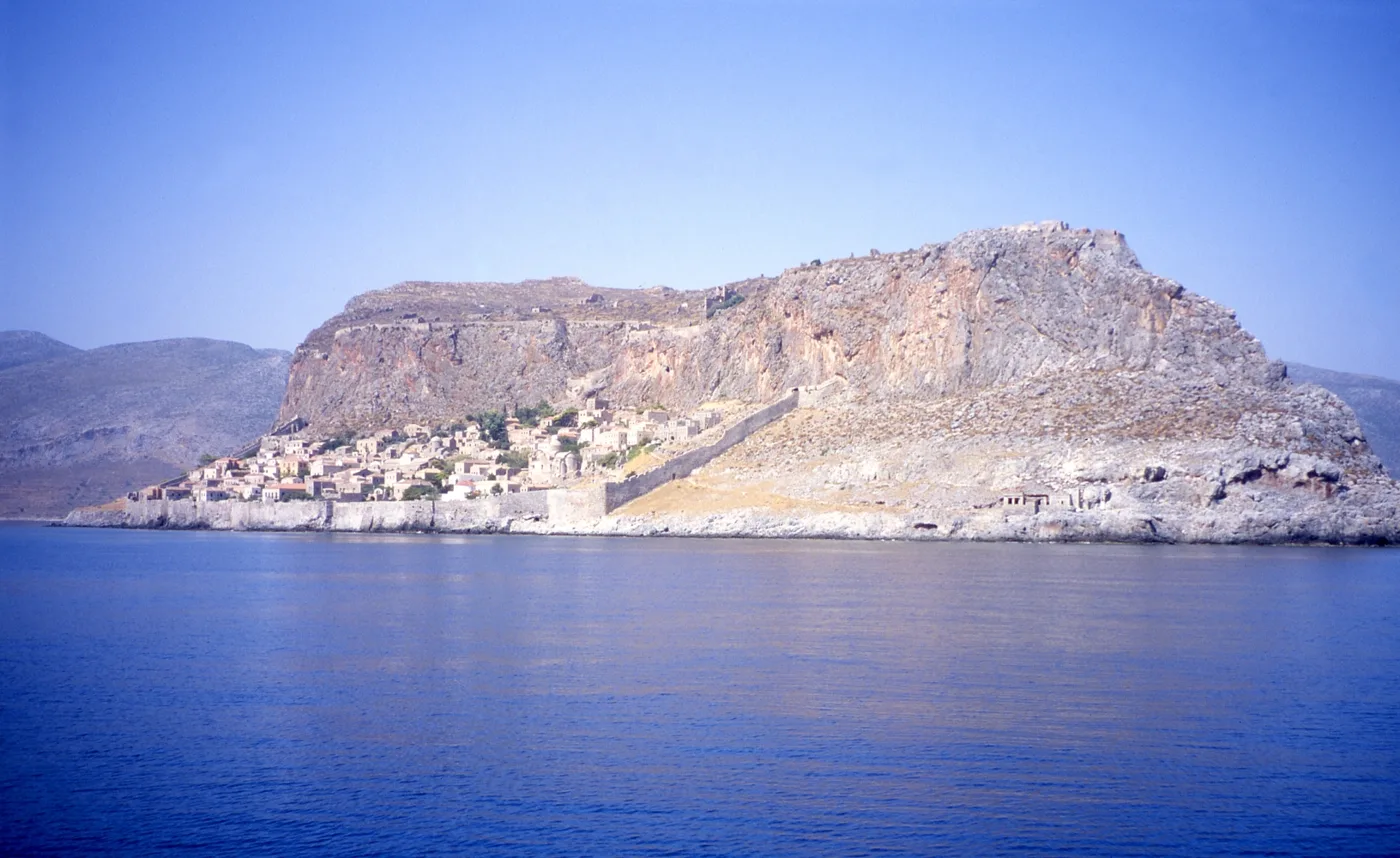
This is how you see it from afar.
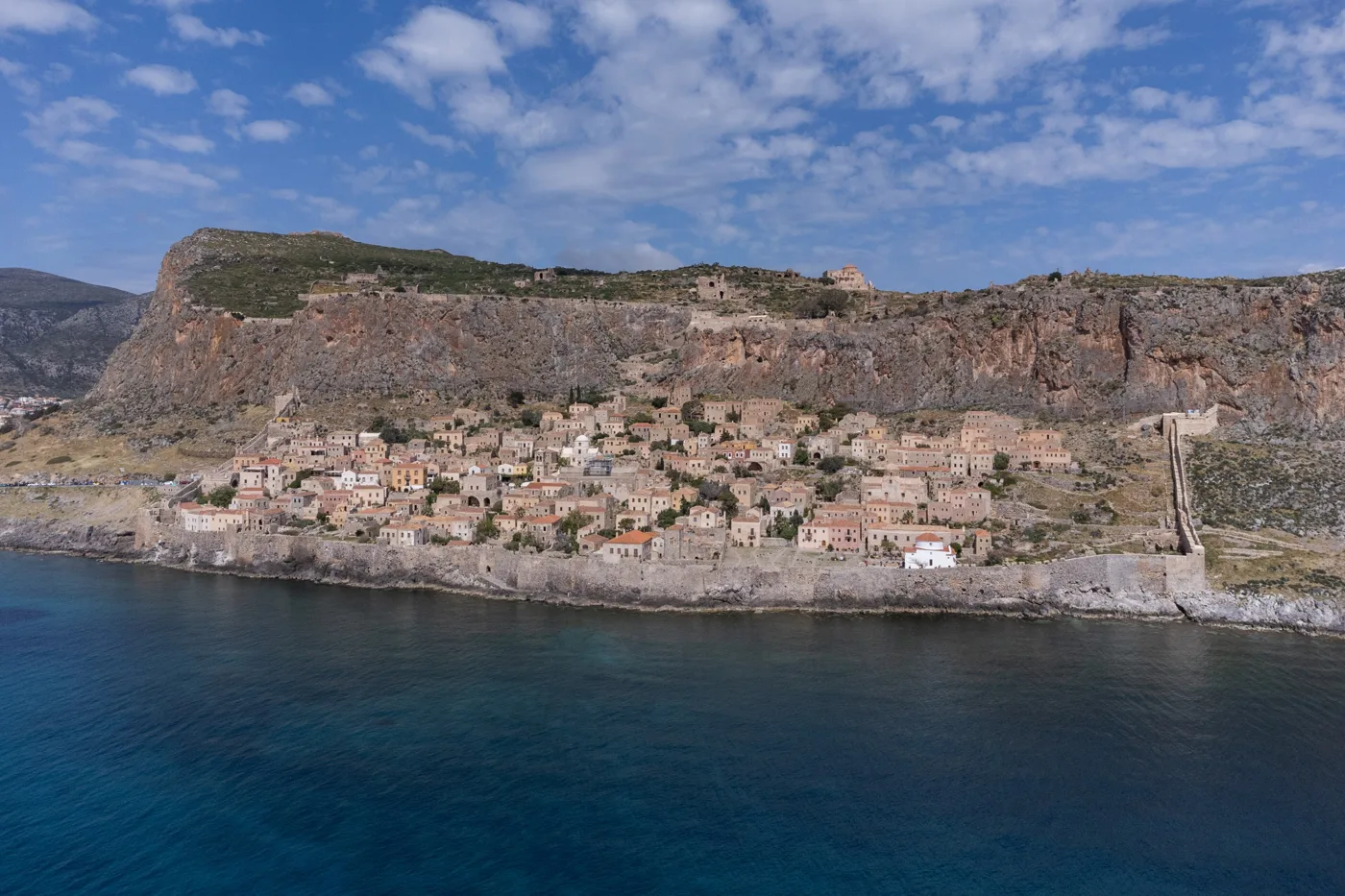
The town hidden on the south side.
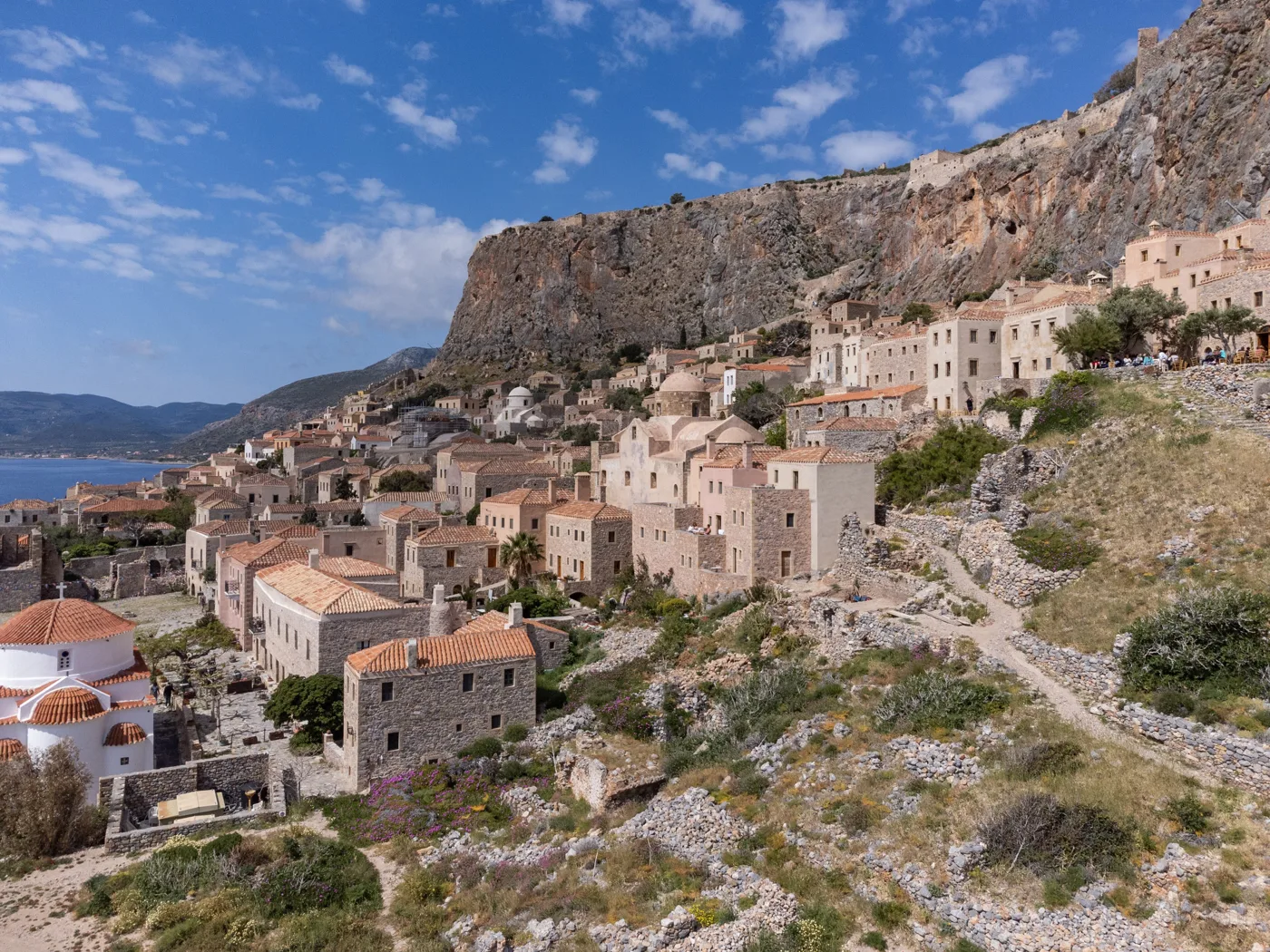
Houses clinging to the rock.
The walls down to the waves.
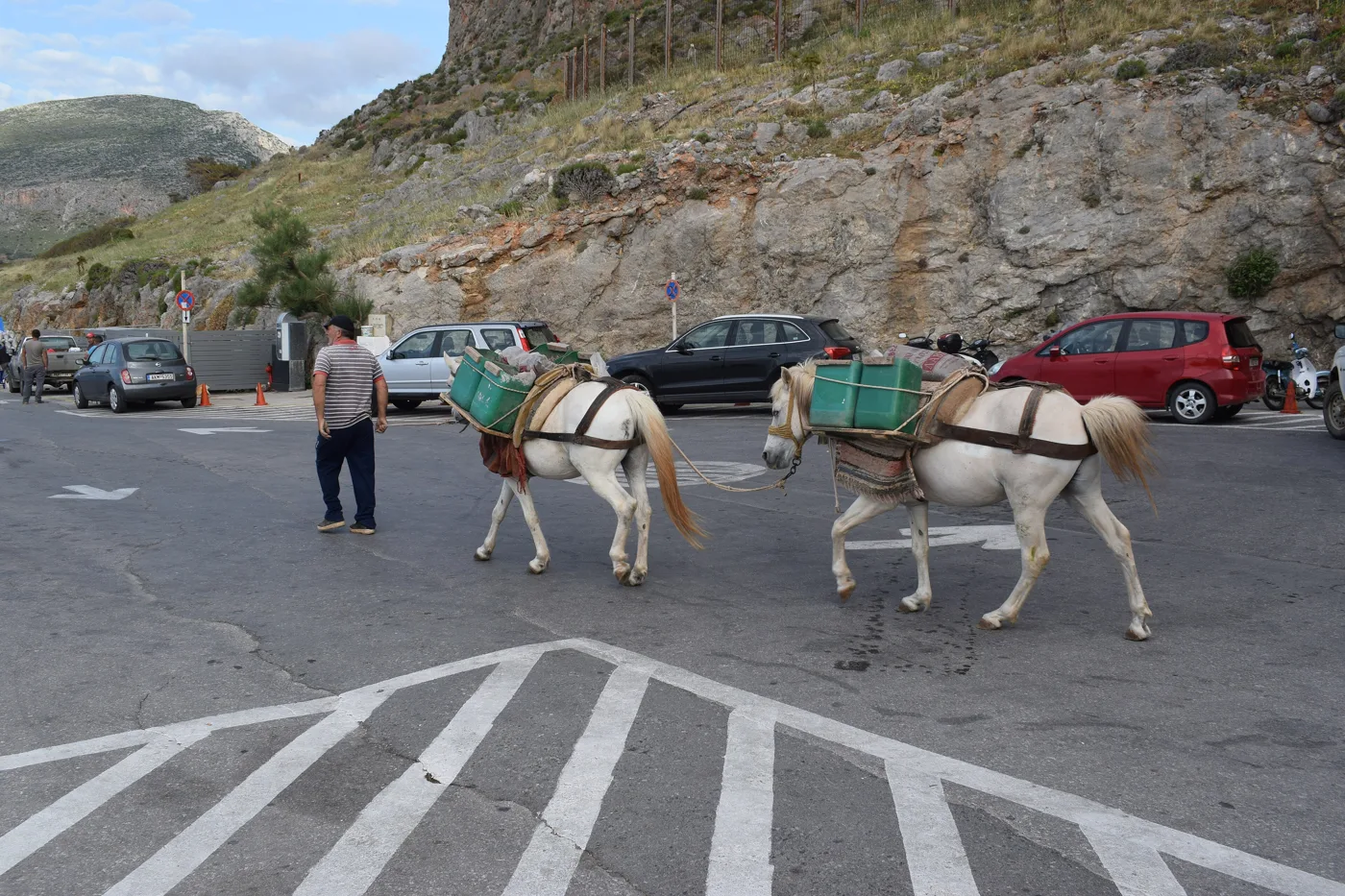
No cars go inside the walls.
Photos: Ingo Mehling (CC BY-SA 3.0), C messier (CC BY-SA 4.0), Jean Housen (CC BY-SA 4.0) · Wikimedia Commons
No cars go inside the walls. Park on the road outside the gate, which fills up early at weekends, or leave the car in Gefyra and walk across, in twenty minutes. In summer there is often a small bus from Gefyra.
⛪ The Lower Town
You pass through the main gate, an arch in the wall, and find yourself on the main street, a narrow cobbled lane with little shops, cafés and tavernas. Follow it to the square with the cannons, where you find Elkomenos Christos, the town’s cathedral, and opposite it the old mosque, which today houses the archaeological collection. A little further down, above the sea, is Panagia Chrysafitissa with its courtyard.
Then leave the main street and lose yourself in the lanes, among stone mansions, arches, steps and small churches. Next to the gate you will see the house of Yannis Ritsos, with his bust. On the south side, along the sea wall, a street takes you to the eastern tip, with a view of the open sea.
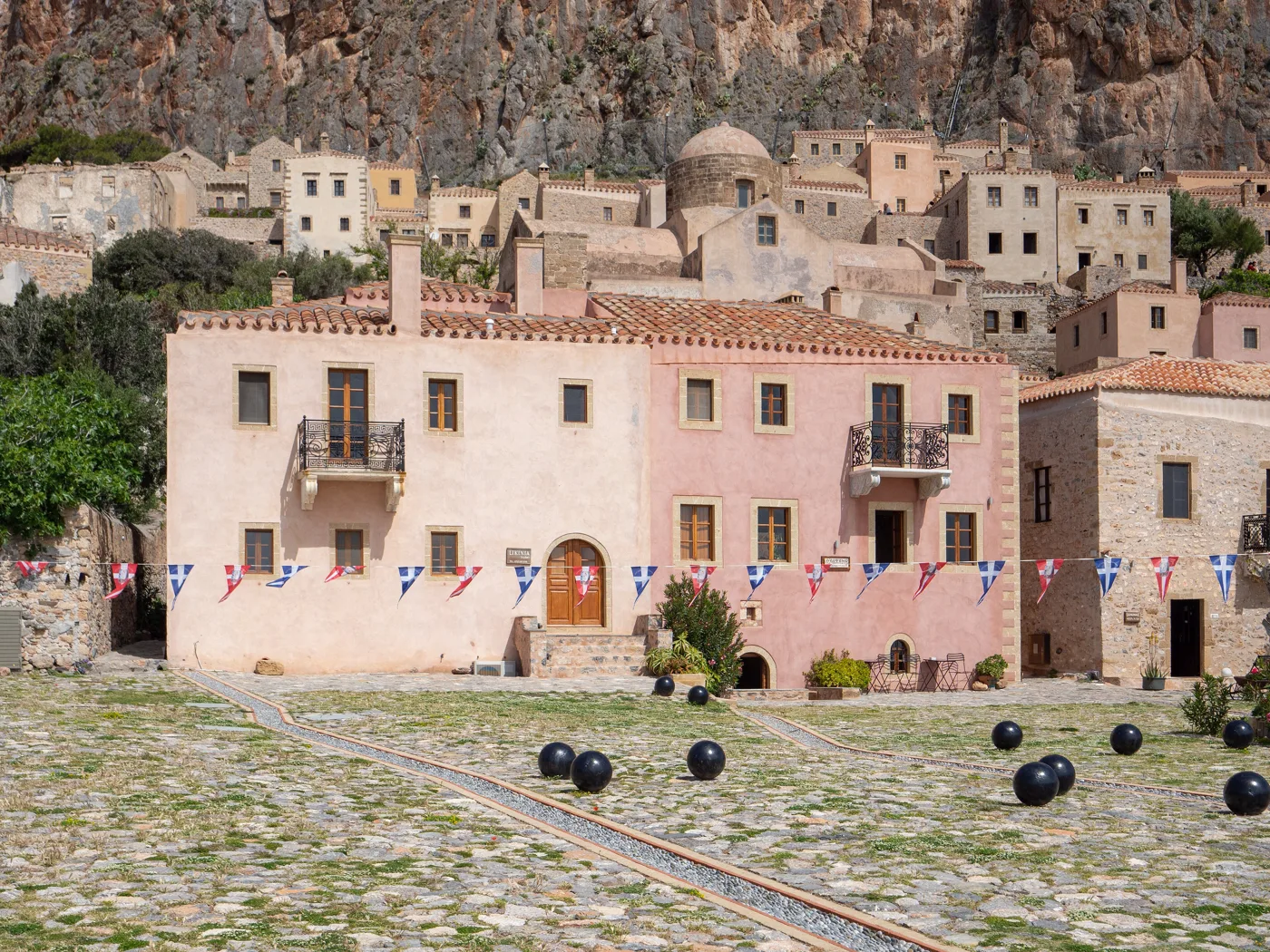
The square of Elkomenos Christos.
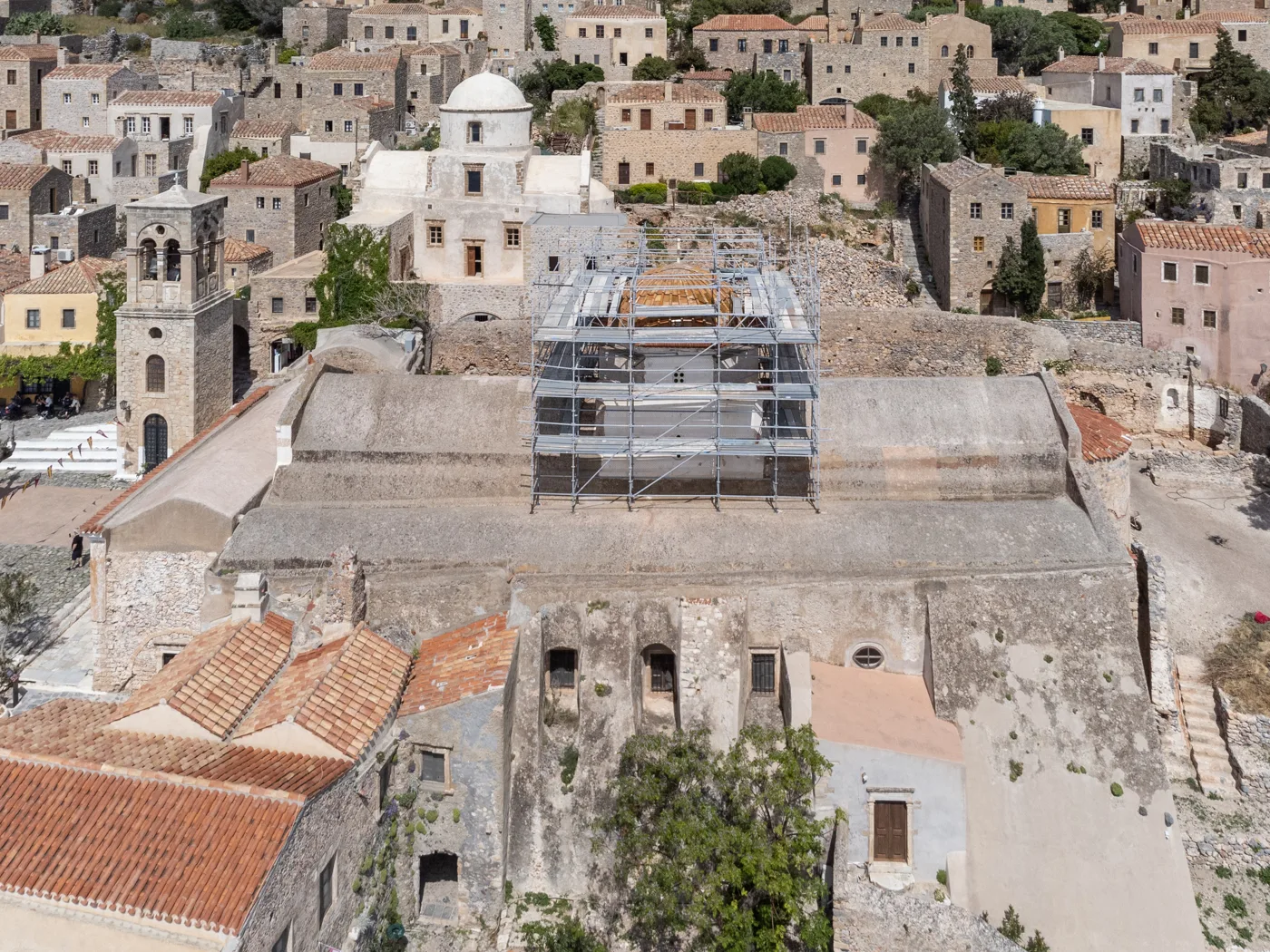
The cathedral of the Lower Town.
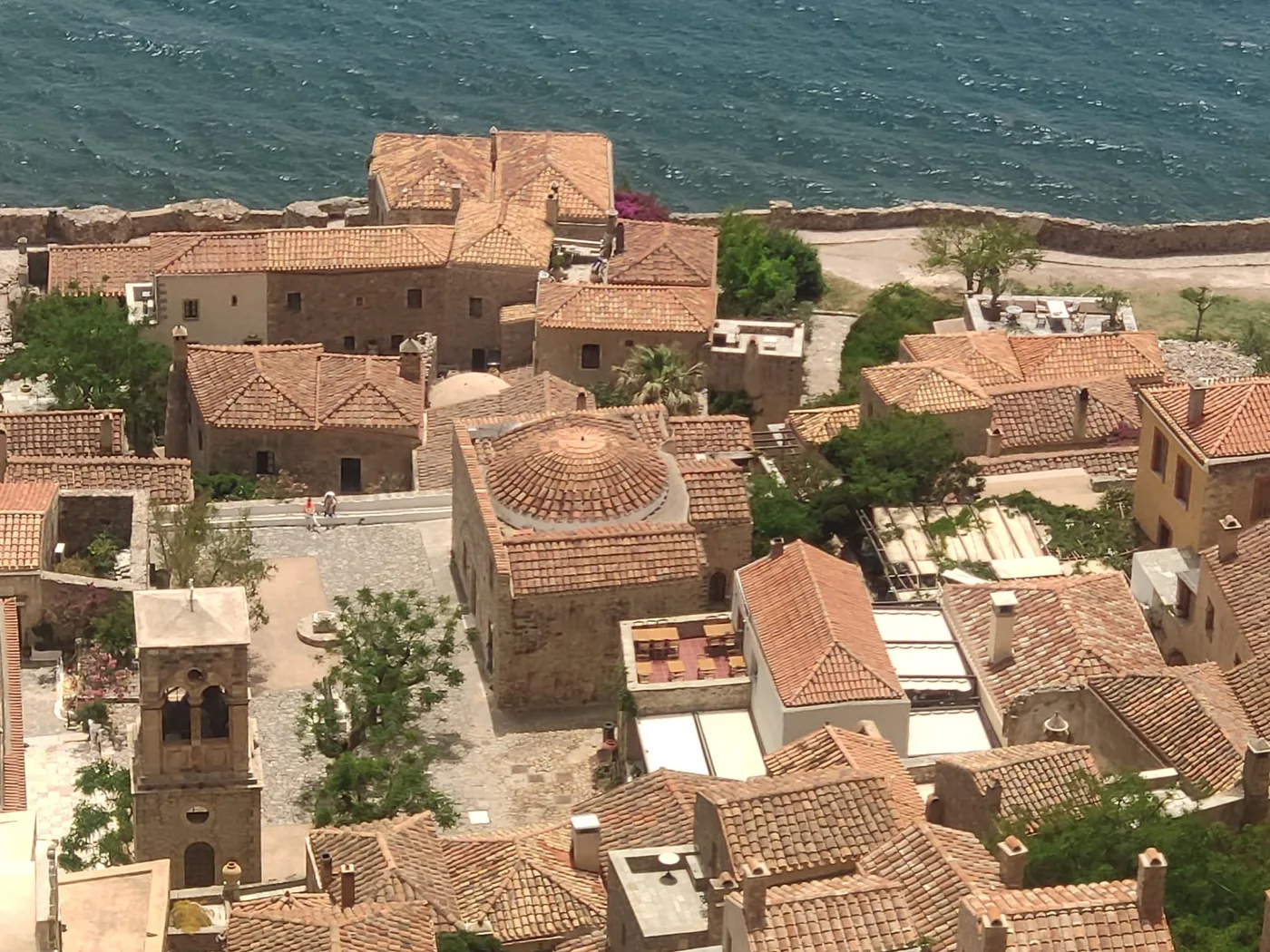
Today an archaeological collection.
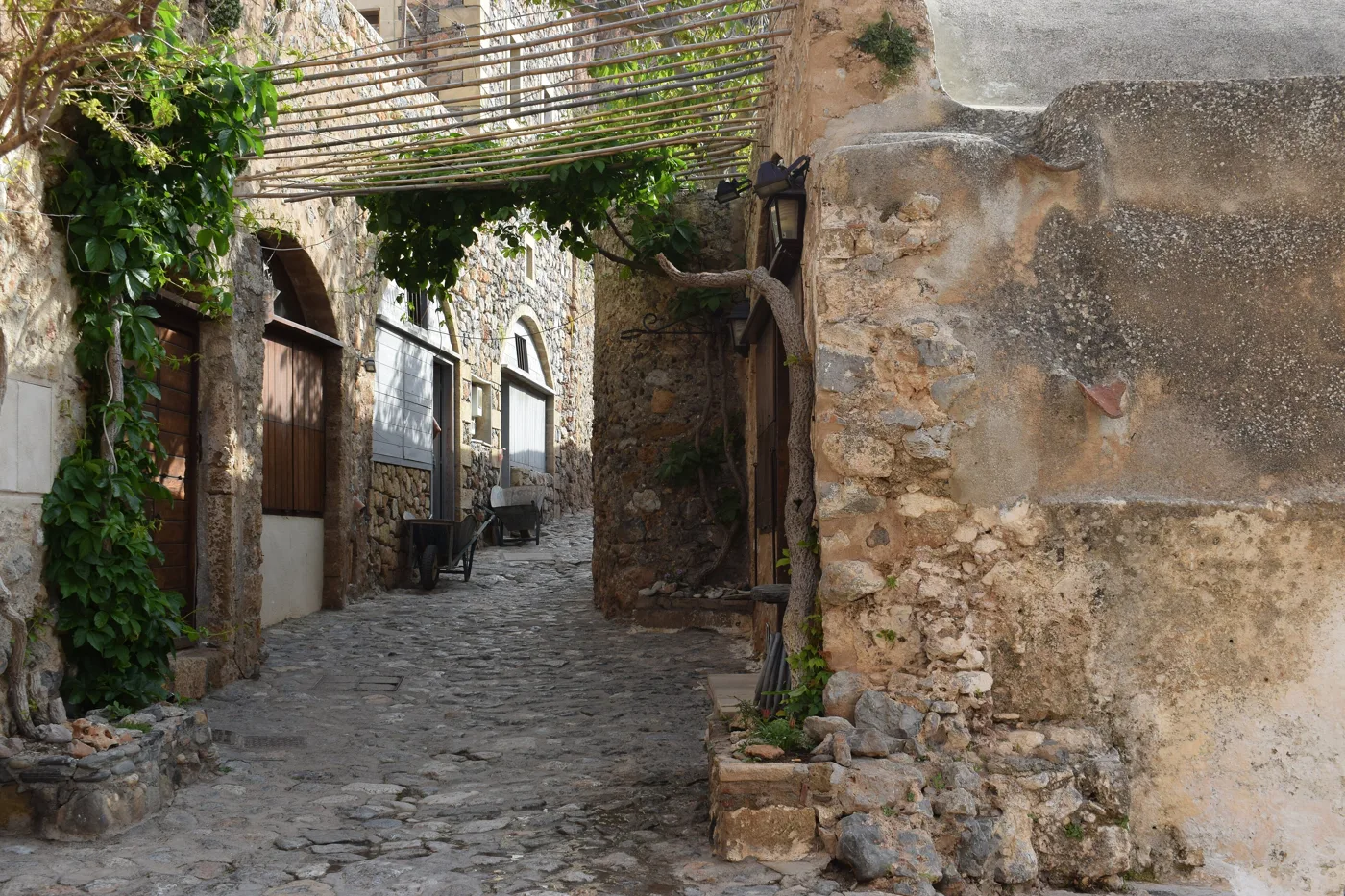
No cars, only stone.
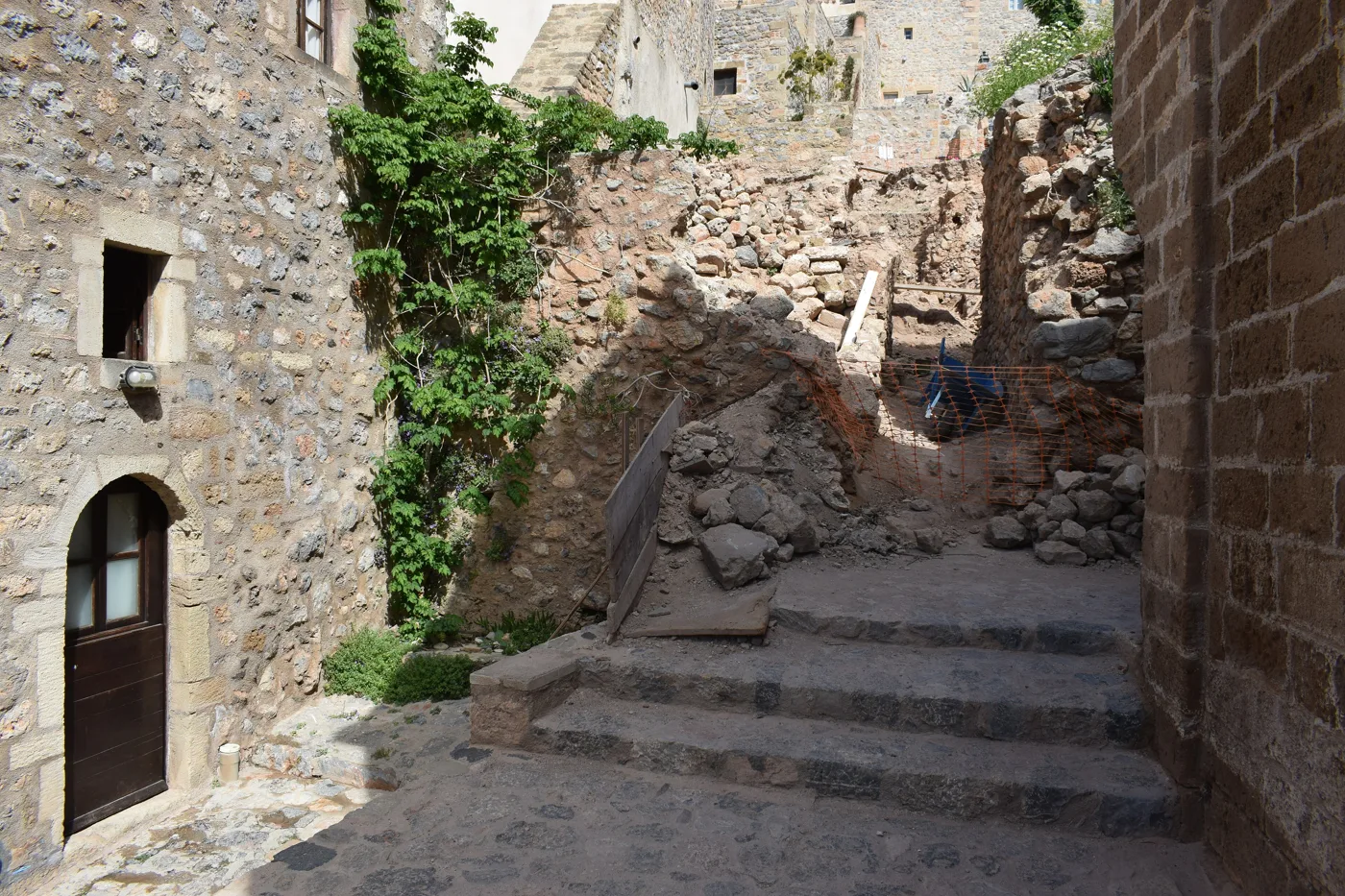
The town climbs up the rock.
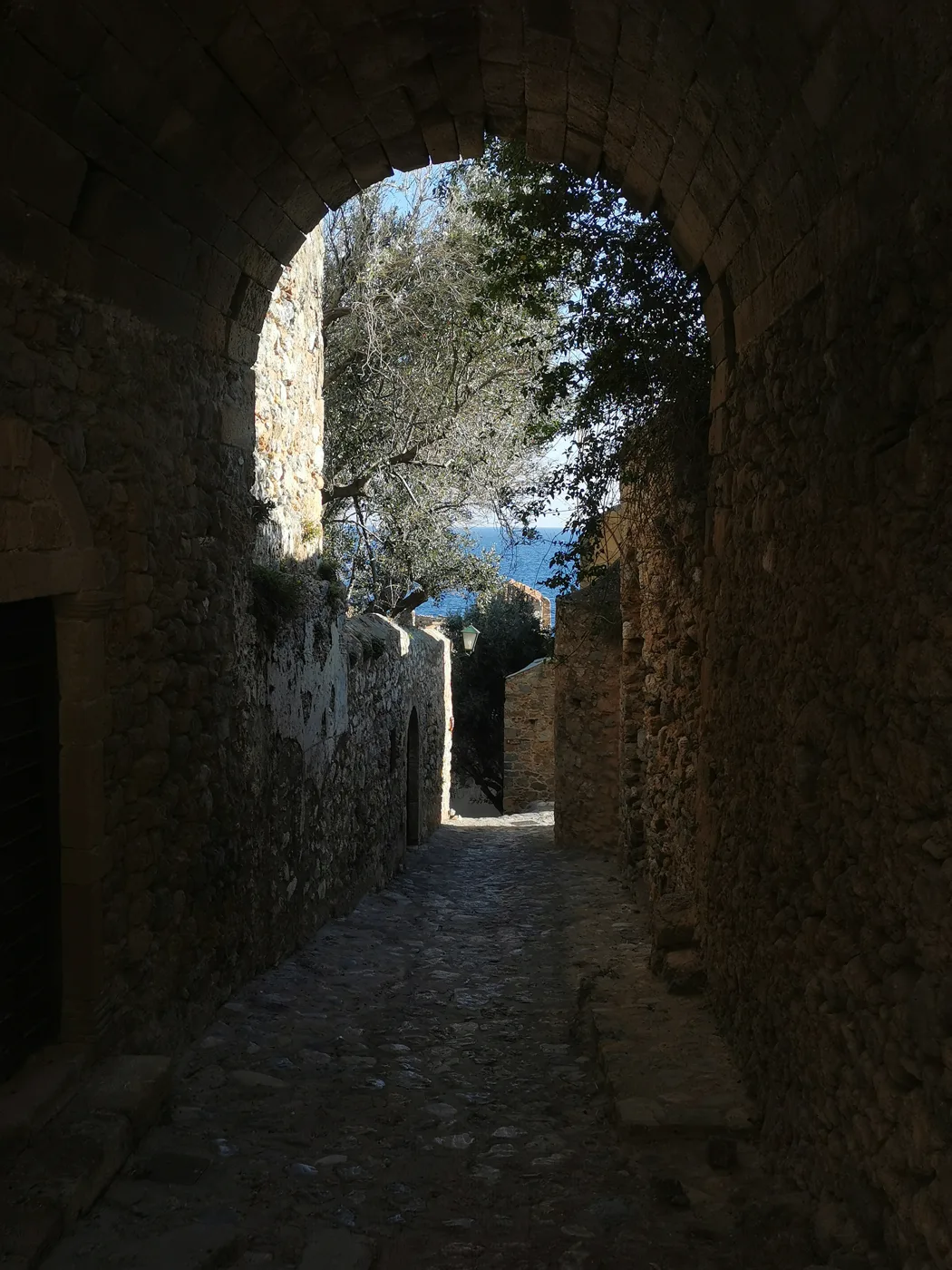
One entrance, just as the name says.
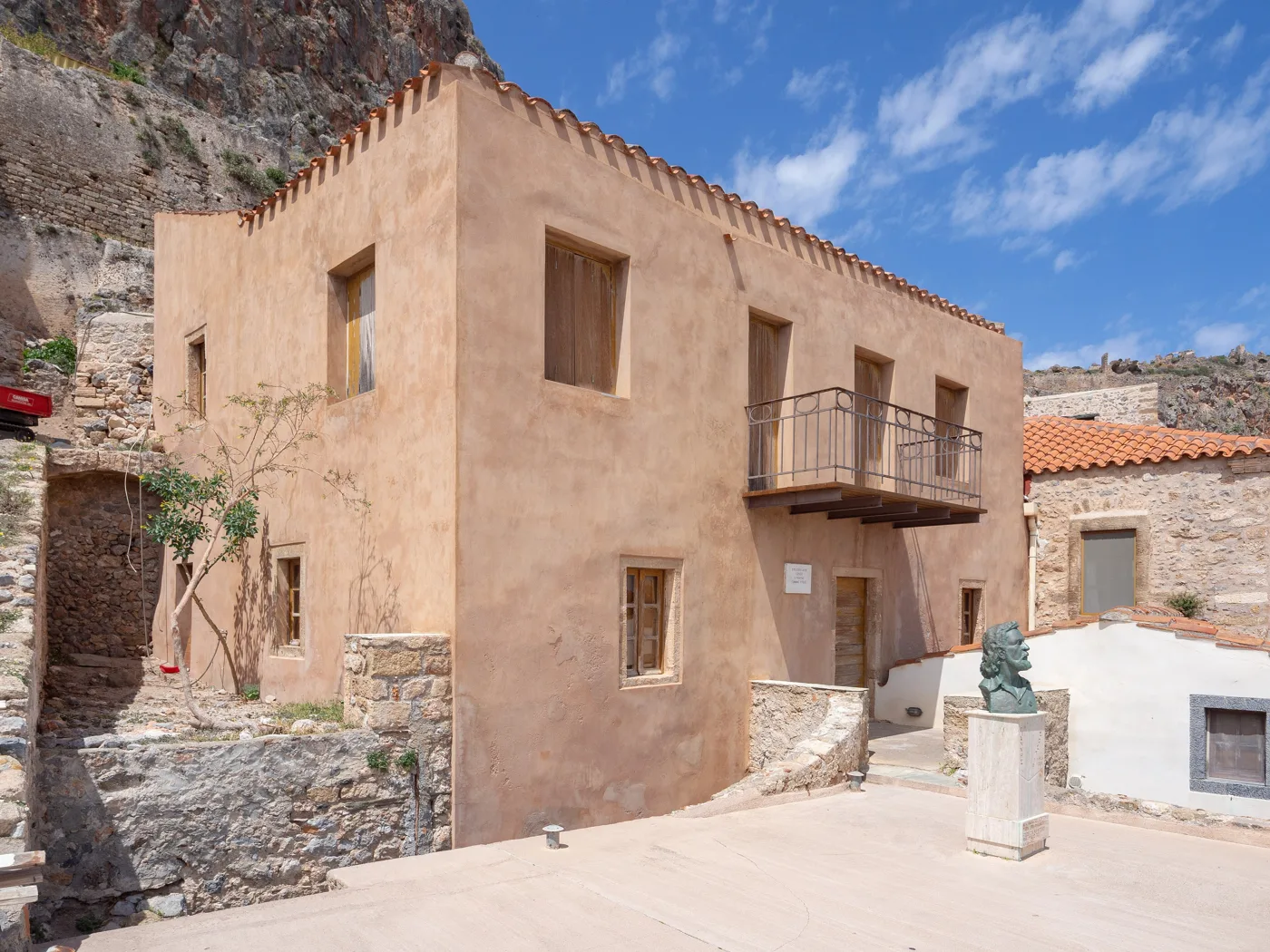
Next to the main gate.
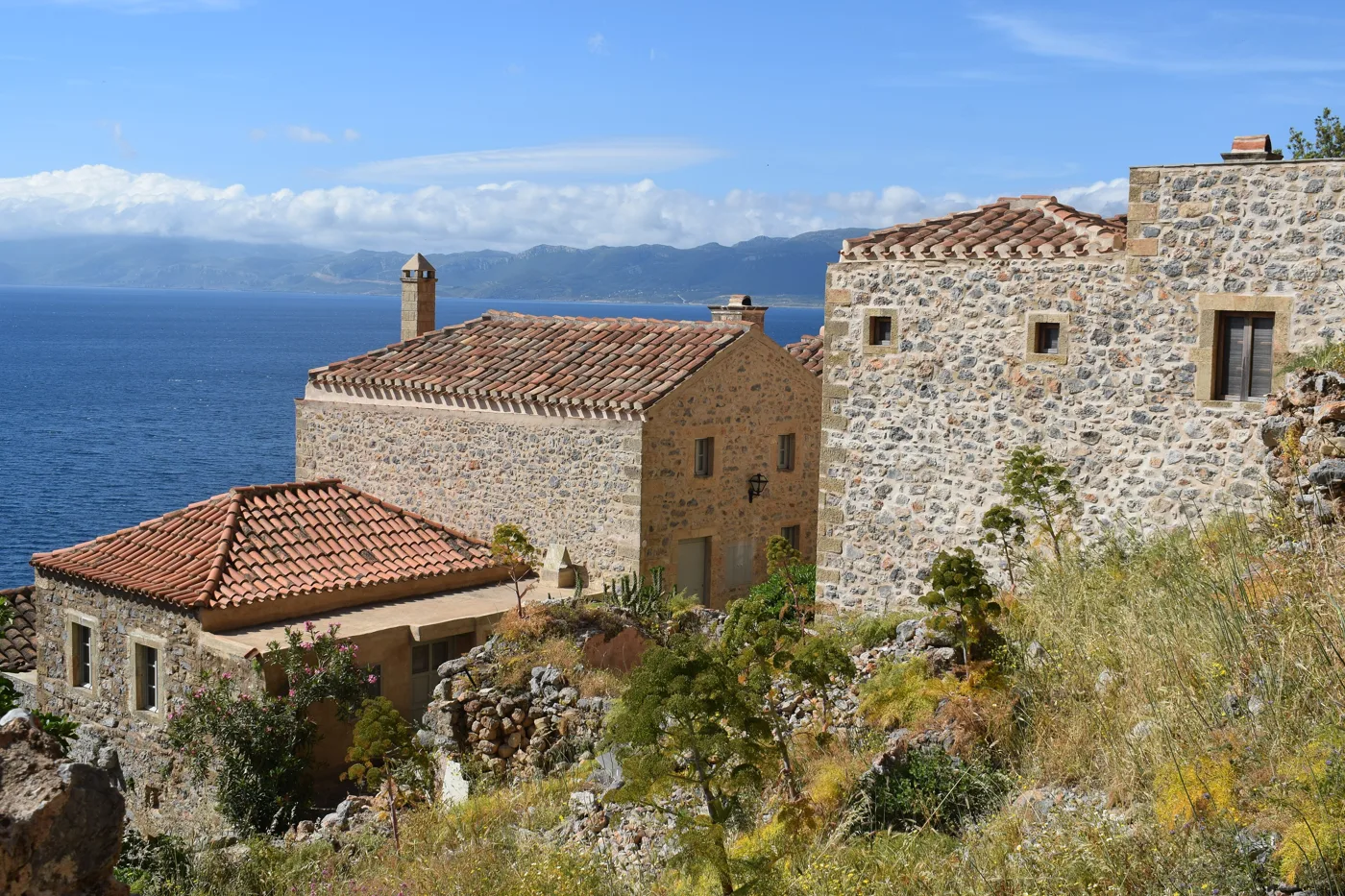
Many are guesthouses today.
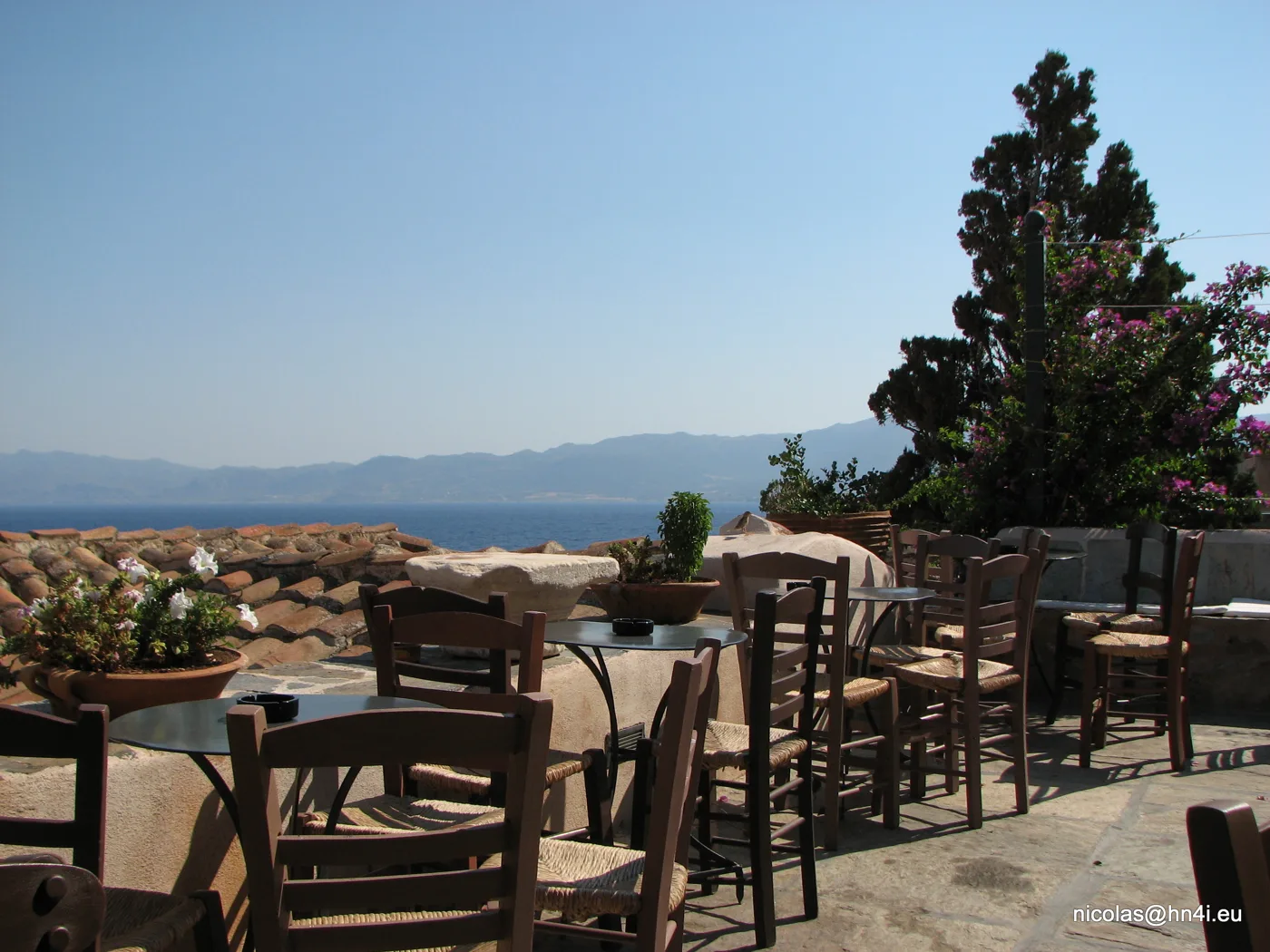
Coffee with a sea view.
Photos: C messier (CC BY-SA 4.0), Iolchos07 (CC BY-SA 4.0), Jean Housen (CC BY-SA 4.0), Dongping Du (CC BY-SA 4.0), Nicolas Hadjidimitriou (CC BY-SA 4.0) · Wikimedia Commons
⛰️ The Upper Town and Agia Sofia
From the Lower Town, a stone path with steps zigzags up the cliff to a gate at the top. There, on the flat top of the rock, was the Upper Town, where the nobles lived: today ruins of houses, cisterns and walls among the bushes. On the edge of the north cliff, above the sea, stands Agia Sofia, a 12th-century Byzantine church with a large dome, the only one that survives intact up here. The climb takes about twenty minutes, and the view from the walls is one of the best in the Peloponnese.
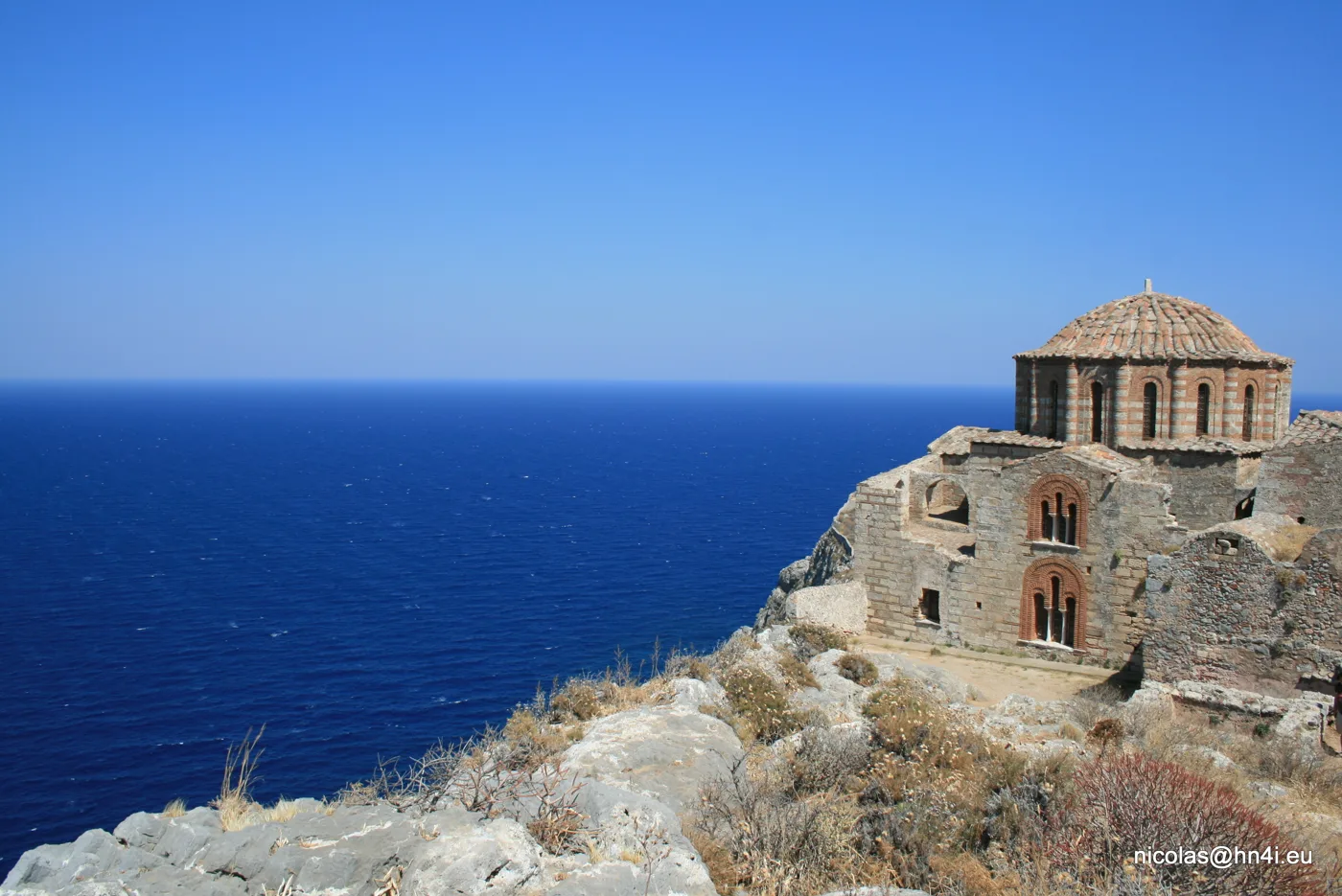
On the edge of the cliff.
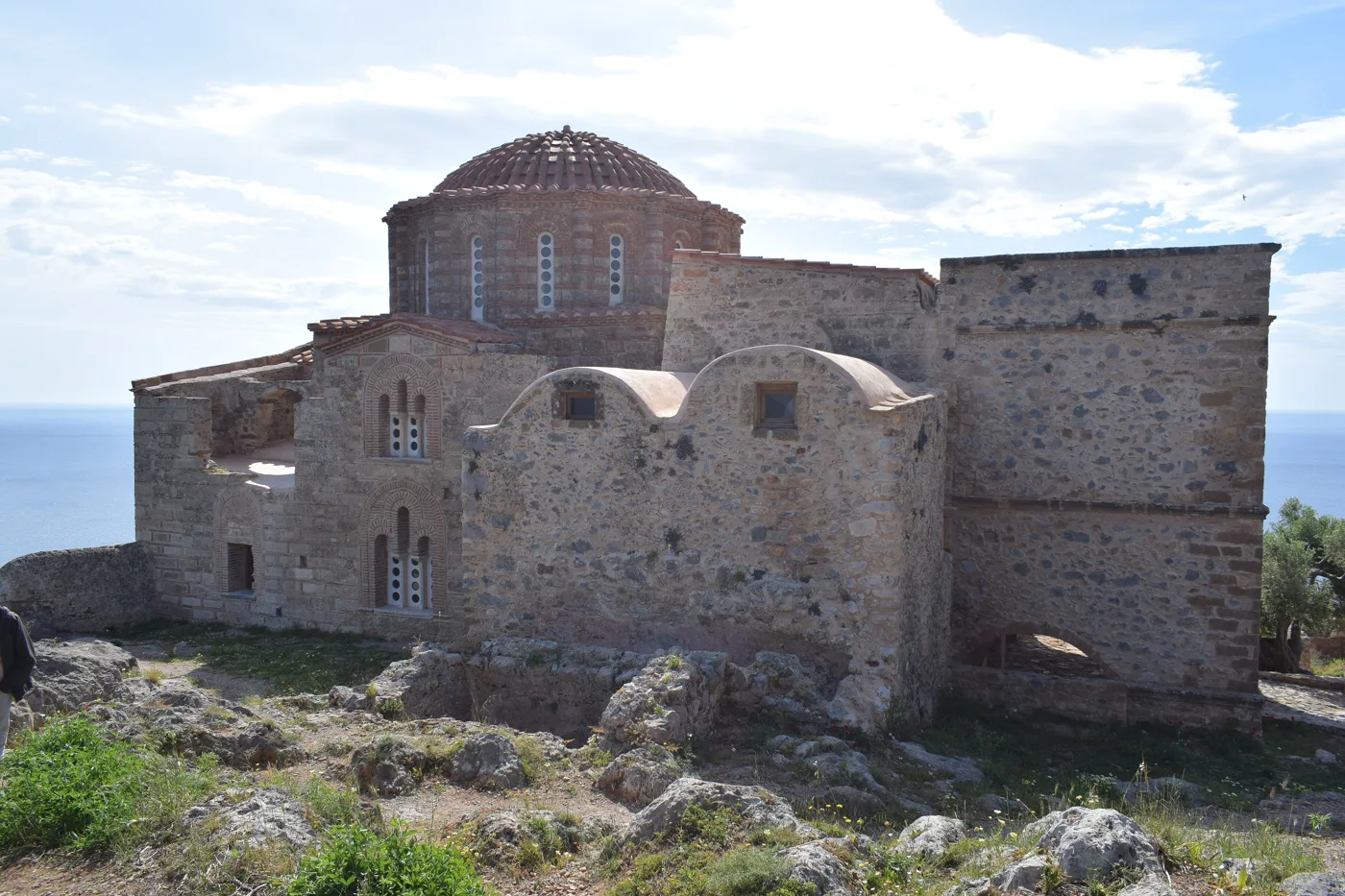
From the 12th century.
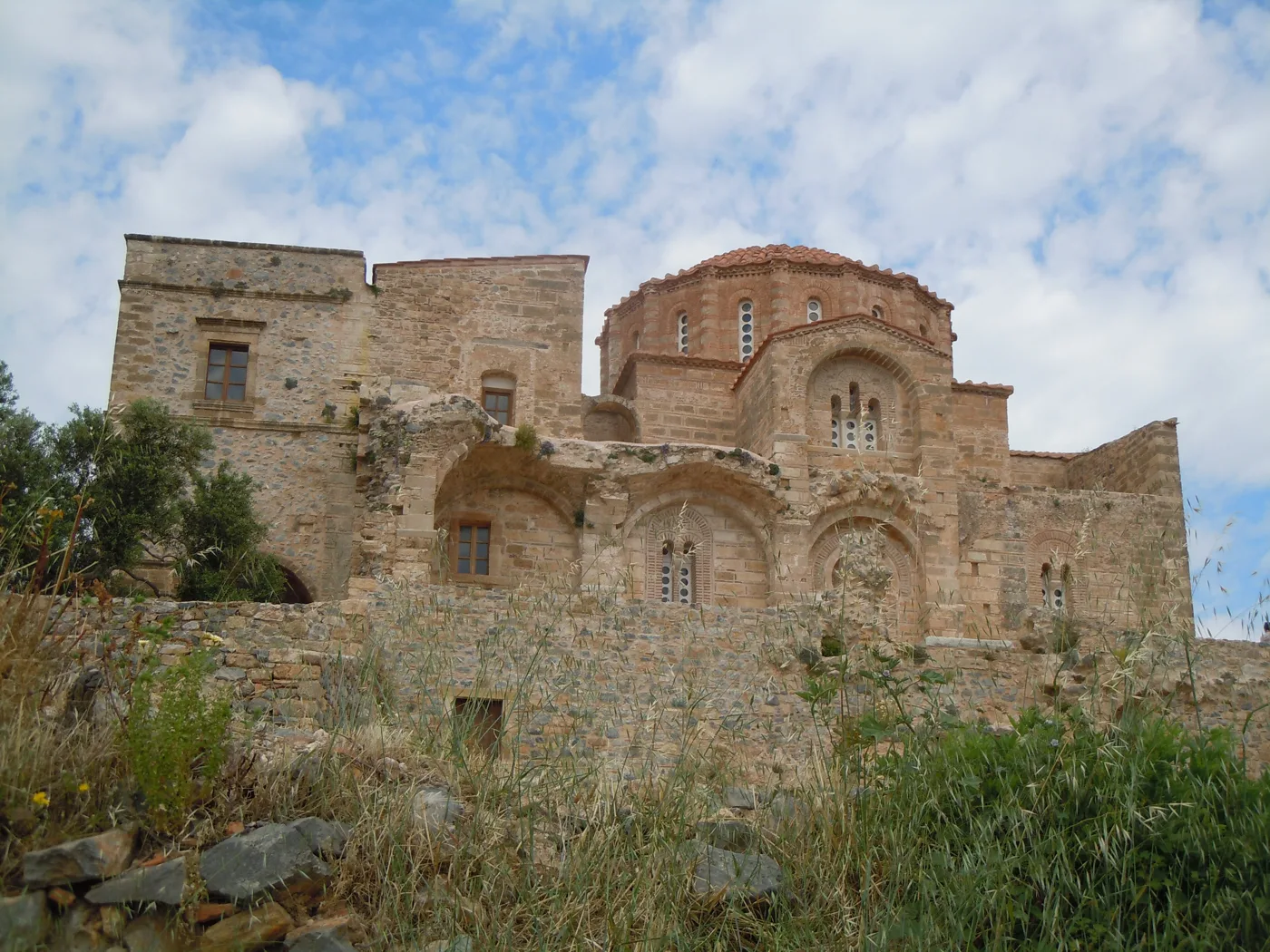
The arcade with its arches.
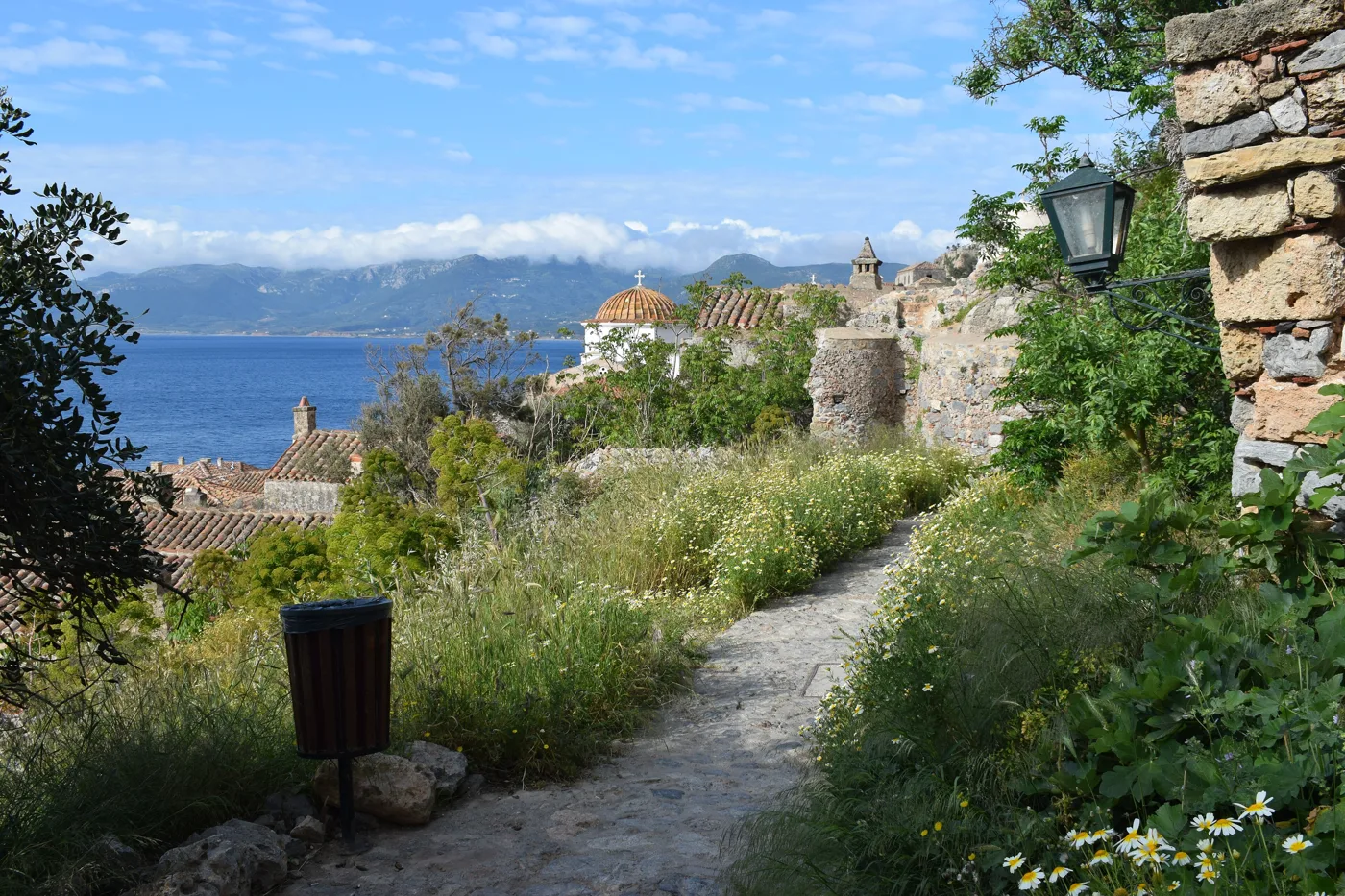
The climb to the Upper Town.
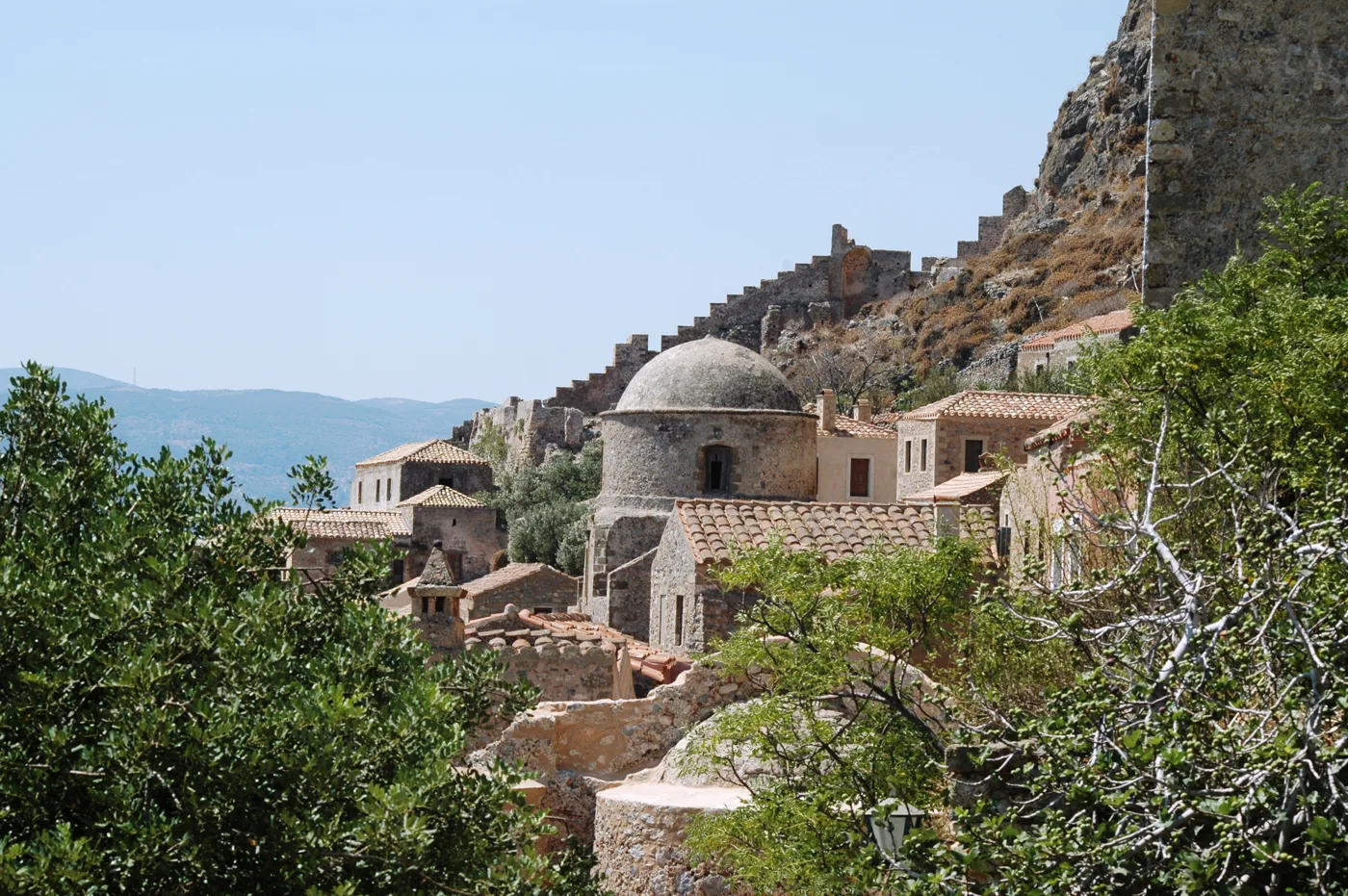
Ruins of a whole town.
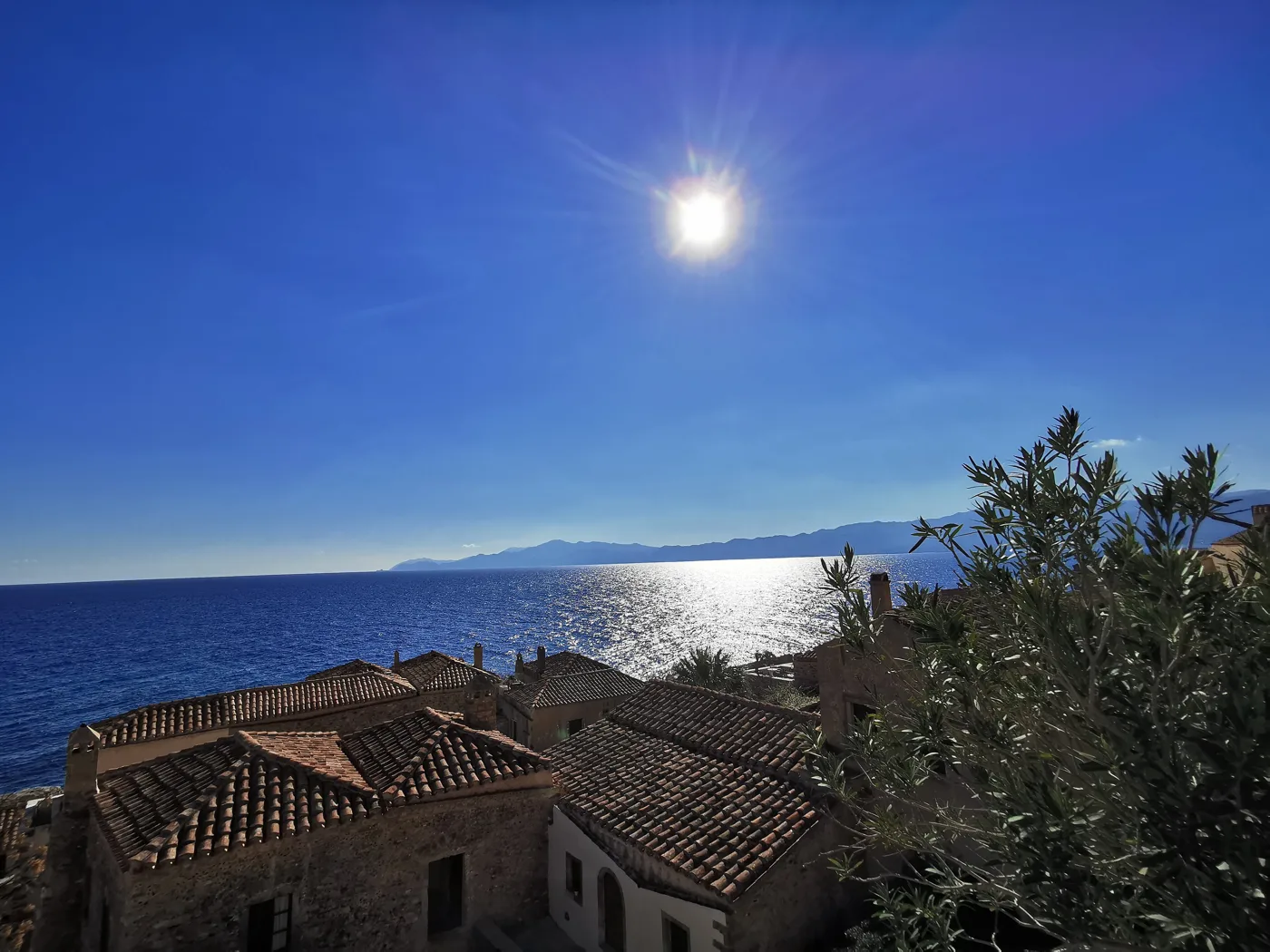
From the walls of the Upper Town.
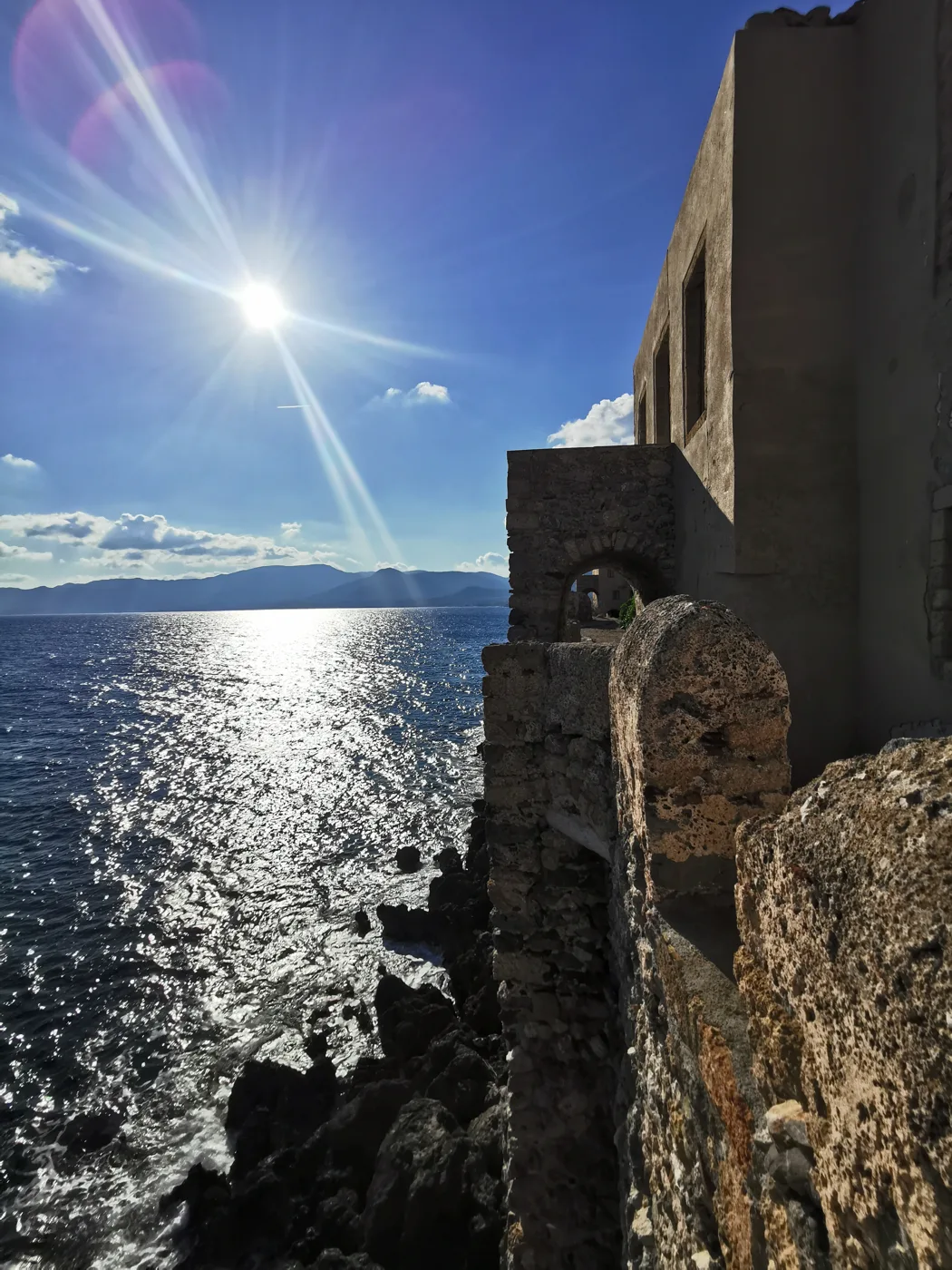
The sea deep below.
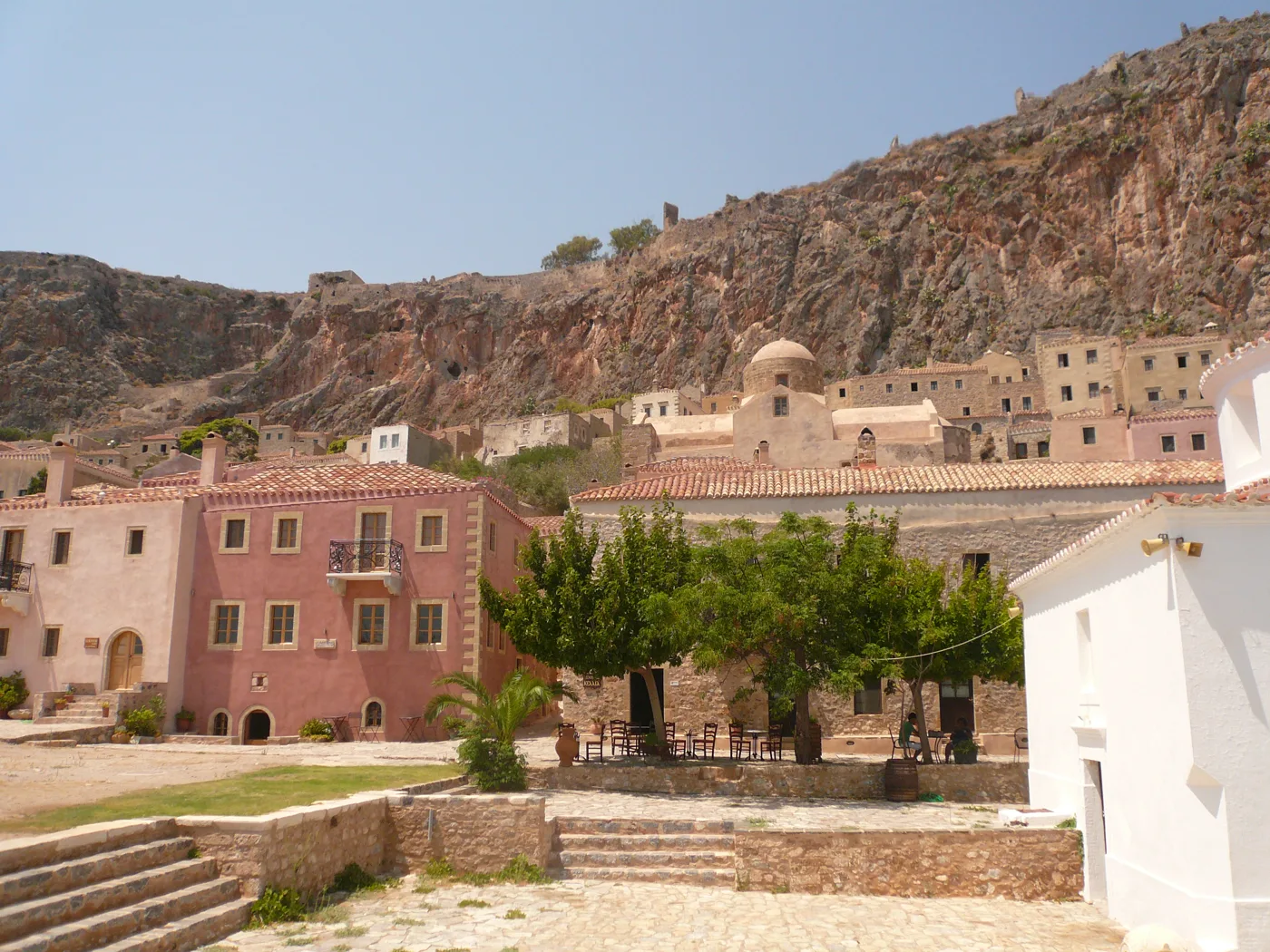
The tip of the Lower Town.
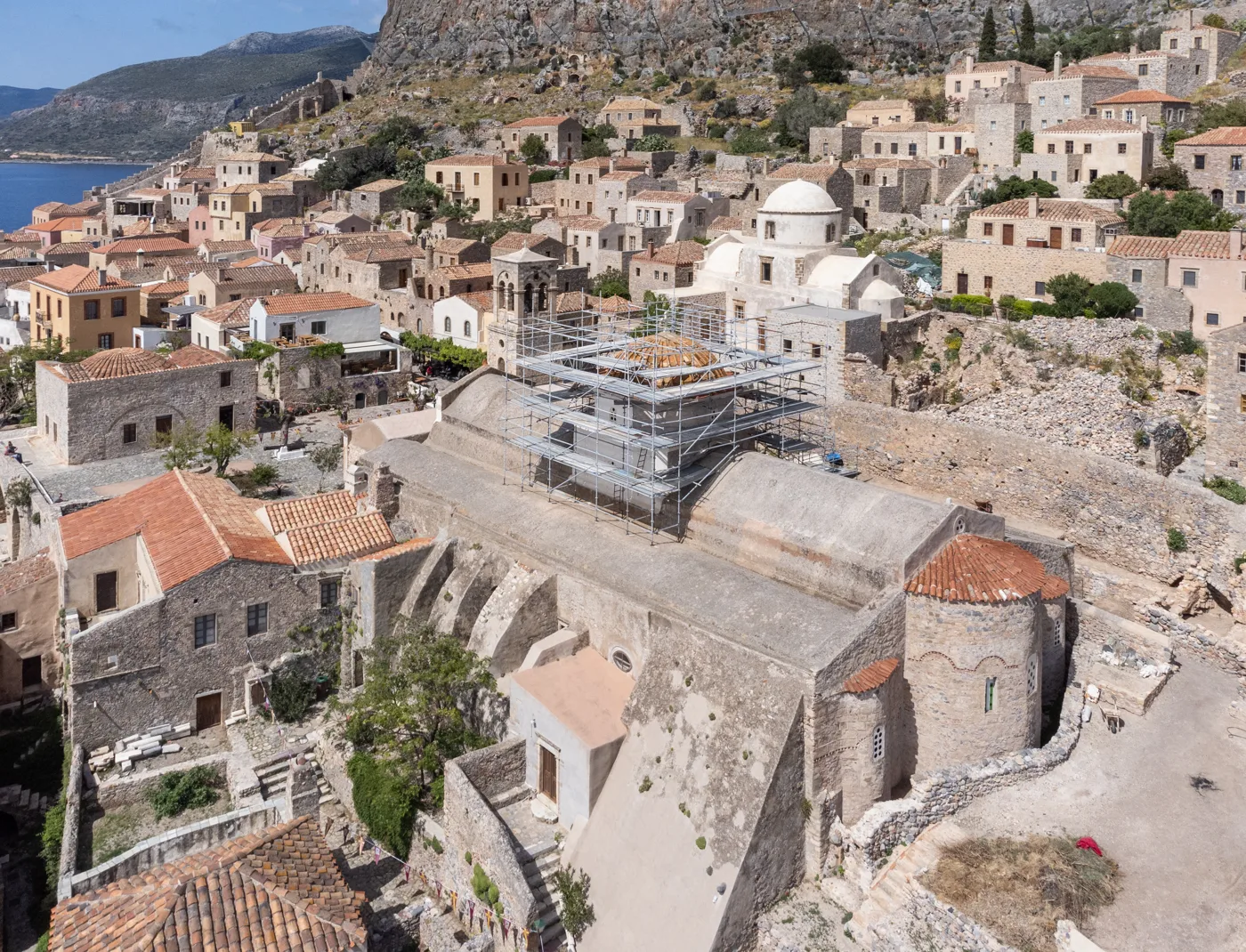
The Lower Town from the air.
Photos: Nicolas Hadjidimitriou (CC BY-SA 4.0), Jean Housen (CC BY-SA 4.0), Patrice78500 (CC BY-SA 4.0), Chris Kar (CC BY-SA 4.0), Dongping Du (CC BY-SA 4.0), Lunar sea n (CC BY-SA 4.0), C messier (CC BY-SA 4.0) · Wikimedia Commons
The path is stone, steep and slippery, with no shade. Wear good shoes, take water, and go up early in the morning or late in the afternoon. The Upper Town is an archaeological site, with opening hours that change with the season.
🌊 Swimming in Monemvasia
Monemvasia has no sandy beach, but it has something special: swimming off the rocks below the walls. On the south side of the Lower Town, steps and metal ladders go down into deep, clear water, with the medieval walls above you. For sand, there is the small beach at Gefyra, and a little further away in Laconia, Pori and Xifias. For long sandy beaches, Elafonisos is an hour to the south.
🍽️ What to eat
The tavernas of the Lower Town and Gefyra cook Laconian food: siglino, the smoked pork of Mani, lalangia, wild greens, fresh fish, and almond sweets such as the amygdalota of Monemvasia. Try a glass of malvasia too, the wine that the local wineries are making again. In the evening, eat on a terrace inside the walls, with the castle lit up.
📅 When to go
Monemvasia is worth it all year round. From April to June and in September and October, the weather is ideal for walking and swimming. In July and August it is hot and fills up at weekends. In winter it is quiet, with few people, and at Christmas and Easter it has a festive atmosphere, with many people.
🚗 How to get there from Athens
| How | Duration | From | Notes |
|---|---|---|---|
| Car | About 4 hours | Athens → Tripoli → Sparta → Monemvasia | The easiest way, motorway as far as Tripoli. |
| Bus | About 5 hours | KTEL Kifissos → Sparta or Molaoi → Monemvasia | With a change, few departures a day. |
| Combination | One hour to Elafonisos | Monemvasia → Neapoli → Elafonisos | An ideal one-week trip. |
From Ioulianou 50, the Kifissos intercity bus station is a few minutes by taxi, or by bus from Omonia. For your nearby destination, see our guide to Elafonisos.
🗓️ A day in Monemvasia
The Upper Town
Go in through the main gate early and climb straight up the path to the Upper Town, before the heat sets in. See Agia Sofia on the edge of the cliff and the view from the walls.
The Lower Town
On the way down, lose yourself in the lanes, as far as the square with Elkomenos Christos, Panagia Chrysafitissa and Ritsos’ house. Lunch at a taverna with a view, and a swim from the ladders on the rocks.
The lights of the castle
In the afternoon, walk along the sea wall. In the evening, when the day visitors leave, the town is lit by lanterns: a drink on a terrace and dinner inside the walls or in Gefyra.
Frequently asked questions
Is Monemvasia an island?
Yes, a small rocky island that an earthquake separated from the mainland in 375 AD. Today a short bridge joins it to Gefyra, and you can drive as far as the gate.
Is it worth staying inside the castle?
Yes, if you can. In the evening, when the visitors leave, the Lower Town grows quiet and is lit by lanterns. The guesthouses are in stone mansions, more expensive than in Gefyra, and need booking early.
How long is the climb to the Upper Town?
About twenty minutes from the Lower Town, on a stone path with steps. Allow one to two hours in total for the Upper Town and Agia Sofia.
Can I swim?
Yes, off the rocks below the walls, where ladders go down into deep water, or at the small beach in Gefyra. For sandy beaches, go to Elafonisos.
— Kathy