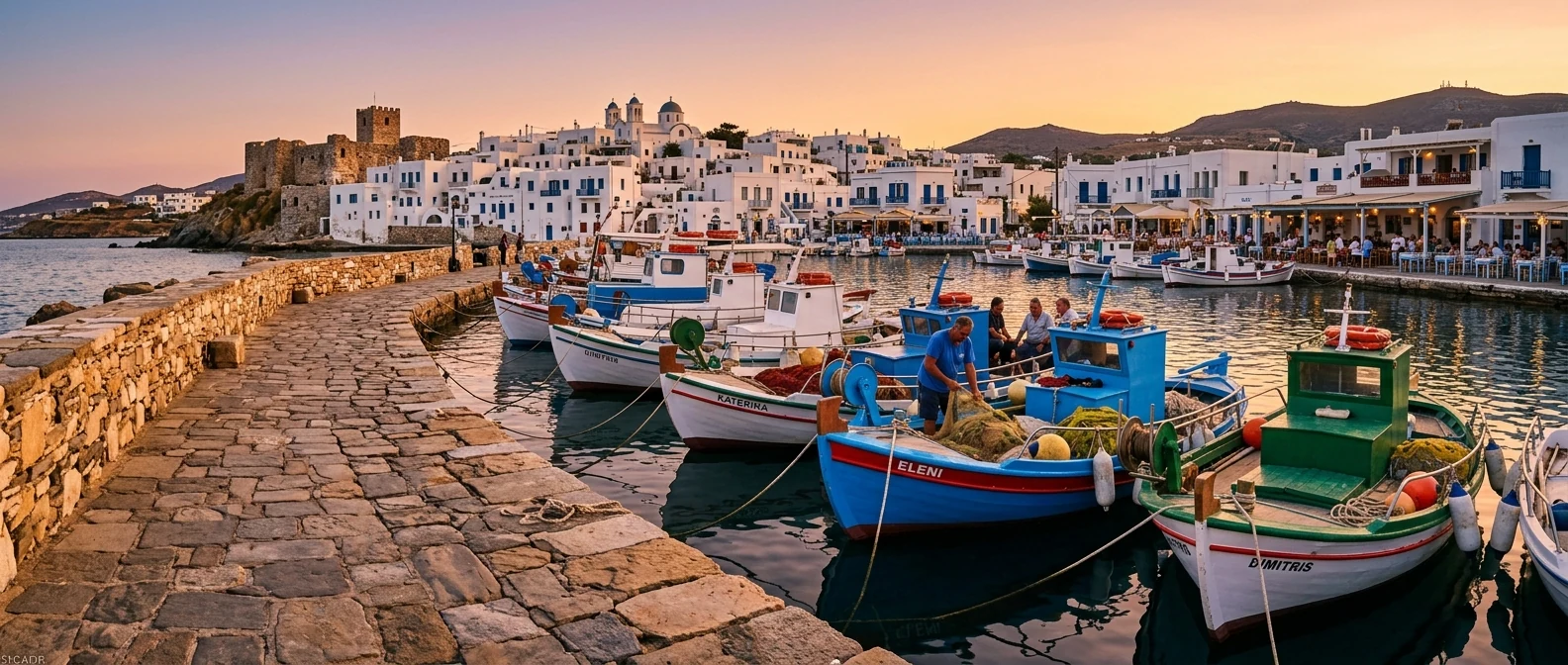
The two Mykonos
There are really two islands with the same name. The south coast — Paradise, Super Paradise, Psarou, Paranga — works to a large degree as beach clubs with an island background. Prices can rise very high there, especially for loungers, drinks and bookings at the better-known places.
The rest of the island does not feel like that at all. Chora with its 16th- and 17th-century lanes, Delos 2 kilometres to the southwest, Ano Mera inland, and the northern beaches without rows of loungers make up the other Mykonos.
Chora: how the maze was built
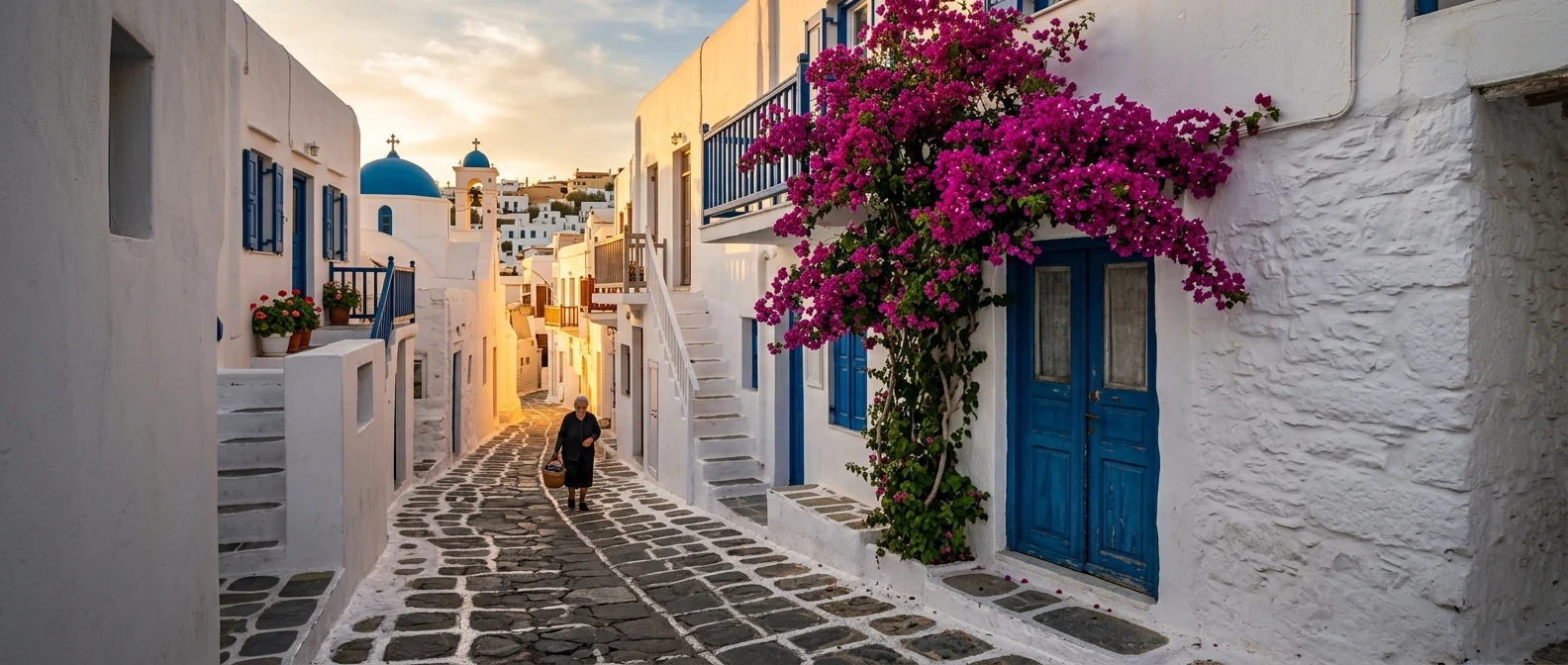
- The lanes of Chora are not random in the way they feel. Their turns, narrow passages and lack of straight lines create a maze that protects from wind and, in local telling, made life harder for pirates too.
- Little Venice, officially Alefkandra, is a line of medieval houses built directly over the water. Today they are mostly bars, but the architecture is worth seeing even in daylight.
- The windmills stand a few minutes away and recall the time when wind was a working tool, not only a problem for the beach.
- Panagia Paraportiani is a compound church, with five chapels built between the 14th and the 17th centuries. From outside it reads like one sculpted white form.
- The castle area and museum stops help if you want a little more context beyond the postcard view.
Delos: the island where nobody stays
Birthplace of Apollo and Artemis
Delos lies 2 kilometres southwest of Mykonos. In mythology it is the birthplace of Apollo and Artemis. In practical terms, it is a UNESCO archaeological site, without any permanent residents and with no overnight stays allowed on the island. Boats leave mainly in the morning from Mykonos Old Port. The timetable, prices and opening days of the archaeological site change by season, so it is best to check official information before you plan the day. Water and a hat are necessary, because the shade is minimal.
Beaches: which one for whom
South: for clubs
Paradise, Super Paradise, Psarou and Paranga mean loungers, music and high prices, especially at the peak of the season.
South: for families
Platis Gialos and Ornos are organised but calmer, and connect more easily with Chora by bus.
North: wilder
Fokos, Mersini and Agios Sostis have fewer facilities, more wind exposure and usually need your own vehicle.
East coast
Elia, Kalo Livadi and Kalafatis are larger beaches and often easier to manage than the more famous southern ones.
Ano Mera: the quieter interior
- Ano Mera lies east of Chora and is the main village inland.
- It does not have the theatre of Chora or the noise of the south coast, which is exactly why it is worth a stop.
- Tourliani Monastery was built in the 16th century and stands on the central square.
- The square itself is one of the few places on Mykonos where food does not feel priced mainly as scenery.
📊 At a glance
~86 km²
Area. ~10,700 permanent residents.
Two sides
The club-heavy south coast and the more everyday island beyond it.
UNESCO 1990
Delos as a World Heritage site.
5 chapels
The combined structure of Panagia Paraportiani.
Local flavours to try
- Kopanisti is the PDO cheese of Mykonos: spicy, salty and strong.
- Louza is cured pork cut into thin slices, one of the island's characteristic meats.
- You will find both in small places in Chora and Ano Mera at much lower cost than in beach restaurants.
- The best rule here is to eat away from the beach-club strip whenever you can.
Cost and timing
- July and August are the most expensive and pressured period.
- Rooms, transport, loungers and restaurants all rise sharply then.
- The meltemi also blows hard, especially on the northern beaches.
- June and September are the more sensible choice.
- You still get a lively island, but with a better chance of more manageable prices.
- The roads and beaches also feel less pressured then.
🚗 Getting around
- Buses serve the central beaches and Ano Mera.
- In August they fill easily, so do not build every move around the last departure.
- Taxis are limited in relation to demand and often need booking.
- A rented car or scooter gives more freedom, but prices rise a lot at the peak.
- For the northern beaches, your own vehicle helps.
✈️ Getting to Mykonos
- Mykonos airport has flights from Athens and, in the tourist season, many direct links from European cities.
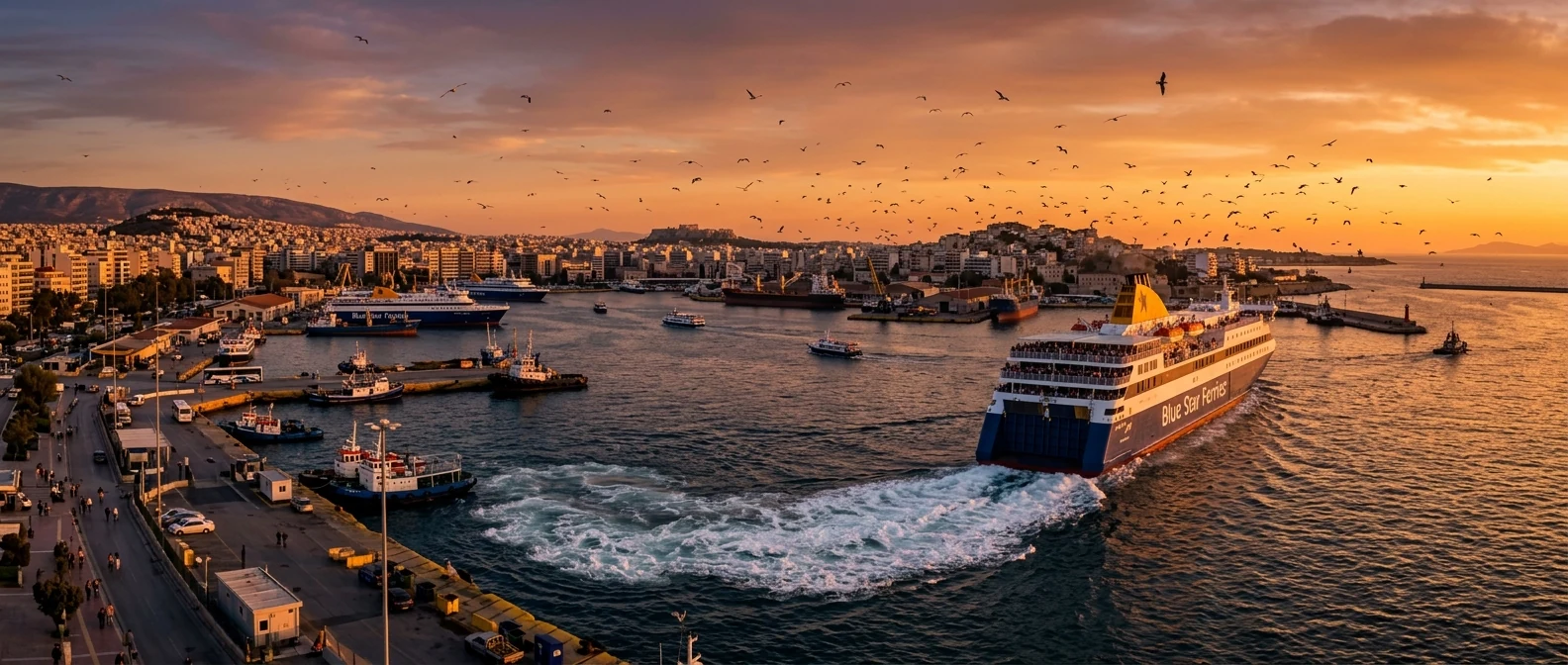
- With ferries, check both Piraeus and Rafina.
- Rafina often suits Mykonos well, especially if you are combining the trip with an airport arrival or departure.
- From Ioulianou 50, Piraeus is the simpler option thanks to Line 1 from Victoria.
📅 When to go
- July and August are peak season, with more crowd, higher prices and strong meltemi.
- June and September are the more balanced choice.
- May and October are quieter, but with fewer options in some services.
- Off-season means many tourist businesses are closed.
A practical way to see the island
- Day 1: Chora, Little Venice, the windmills and Panagia Paraportiani.
- Day 2: Delos in the morning, with the rest of the day free for a beach.
- Day 3: Ano Mera and a quieter meal inland.
- Day 4: one of the northern beaches if the wind allows it.
- Day 5: a slower final day or a boat outing if the budget and the weather fit.
Things that often go wrong
- Seeing only the south coast is the most common mistake.
- Not booking early enough in the busy season creates problems fast.
- Underestimating the meltemi changes ferries and makes some beaches much harder.
- Relying on last-minute transport also goes wrong easily in August.
- Delos works best in the morning, not as an afterthought later in the day.
🎯 FAQ
Is Mykonos worth it for non-partiers?
Yes. Chora, Delos, Ano Mera and the northern beaches make a much richer trip than the club image suggests.
How long?
Three nights is the minimum for Chora and Delos. Five is more comfortable.
Best for first-time Greek-island visitors?
It can work well if the budget allows it. The logistics are easy and the choices are many, but August is the hardest moment to see the island well.
Can you do Mykonos on a budget?
It is tighter than on many other islands, but it is still more possible if you stay around Ano Mera, use buses and travel in June or September.
Day trip from Athens?
Technically yes by fast ferry, but it is tight. An overnight stay is the more sensible version.
How safe is Mykonos for solo travellers?
Generally very safe. The main pressure is more practical than criminal: crowd, transport demand and late-night movement in peak season.
Sources:
— Kathy