The historical layers of Rhodes
Rhodes carries several periods at once. There is the ancient Greek layer, with Lindos, Kameiros and the memory of the Colossus. Then the era of the Knights of St John, from 1309 to 1522. After that come the Ottoman city, the Italian administration of the 20th century and, after the Second World War, the union of the Dodecanese with Greece.
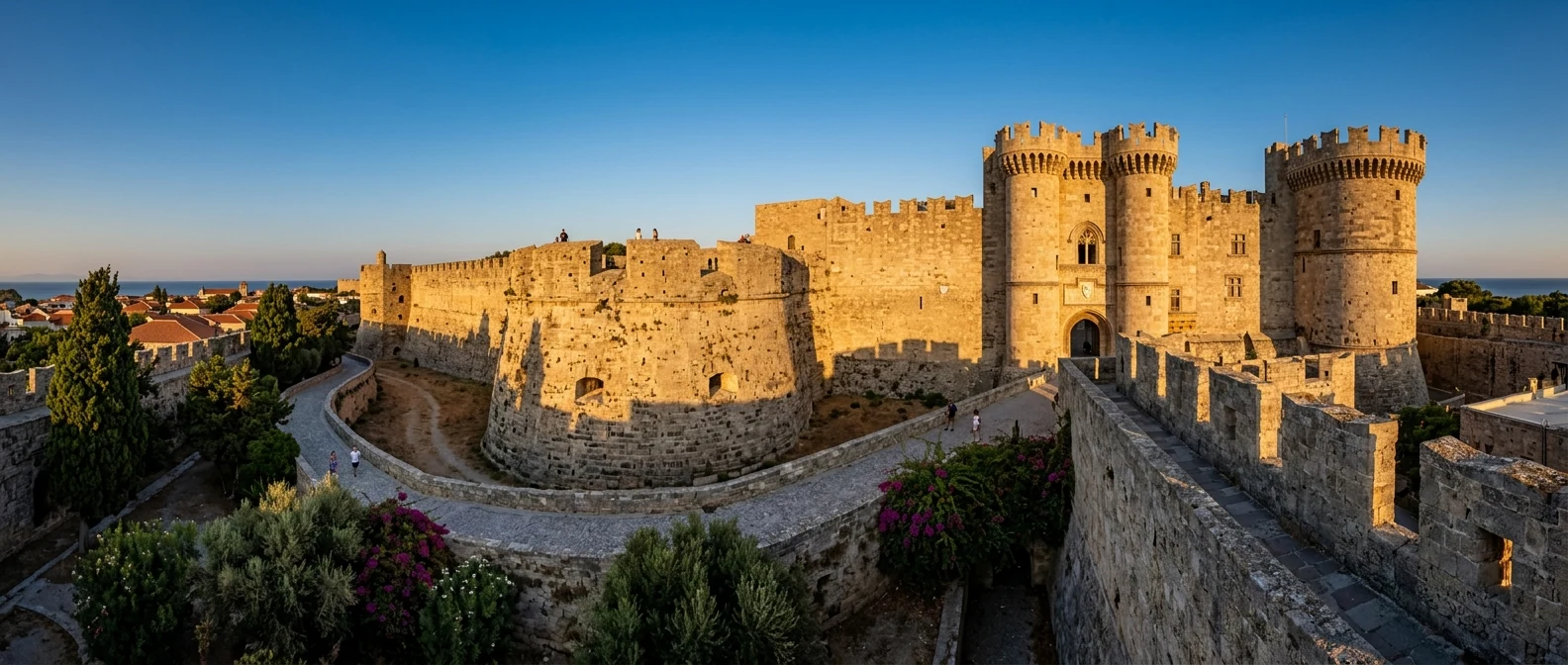
The result is not uniform. The walls and the Palace of the Grand Master belong to the world of the Knights. Minarets and hammams recall the Ottoman town. The broad avenues of the New Town, lined with palms and administrative buildings, belong to the Italian period.
Old Town: UNESCO since 1988
- Scale: Rhodes Old Town is one of the largest inhabited medieval cities in Europe.
- Life inside the walls: around 6,000 people still live there.
- The fortifications: they run for about 4 kilometres and, for the most part, remain standing.
- Palace of the Grand Master: not exactly as the Knights left it, because the Italians rebuilt it extensively in the 1930s. It now houses a museum, so check the current ticket and opening hours before you go.
- Street of the Knights: the clearest medieval frontage in the city, lined with the buildings of the different "tongues" of the Order.
- Archaeological Museum: housed in the former Hospital of the Knights and genuinely worth time.
The Knights of St John
1309 to 1522
The Order of St John took Rhodes in 1309 and held it as a sovereign knightly state for 213 years. It built walls, a palace, a hospital, churches and storage buildings. The island stood on the frontier between the Latin West and the Ottoman Empire. The first major Ottoman siege in 1480 failed. The second, in 1522 under Suleiman the Magnificent, lasted for months. The Knights surrendered and left Rhodes, and a few years later settled in Malta. The walls of Rhodes remain one of the fullest surviving traces of that knightly architecture.
Lindos: the acropolis above the village
- Location: Lindos sits about 50 kilometres south of Rhodes Town, with the white village spread below a 116-metre rock.
- Acropolis: at the top you find the Temple of Athena Lindia, a Hellenistic stoa and later knightly fortifications.
- Summer timing: the climb at midday is heavy even if the site is open, so check the current ticket and opening hours before you set off.
- St Paul's Bay: the cove below is linked by local tradition with a stop by the apostle.
- The village: 17th-century captain's houses survive there, and although donkey rides are still offered, walking the steps is the better option for both the visitor and the animal.
Kameiros, Filerimos and the Colossus
- Kameiros: on the west side of the island, and one of the three ancient cities of Rhodes. A stoa, agora, temples and parts of houses still survive.
- Filerimos: above Ialyssos, combining ancient remains, a monastery and an Italian-era cross with a wide view.
- The Colossus: completed around 280 BCE, about 33 metres high, and later destroyed by an earthquake around 226 BCE. Nothing visible survives today, and the popular image of it straddling the harbour is a later myth.
Butterflies
- The valley: inland Rhodes fills in summer with Jersey tiger moths.
- The setting: wooden bridges, water, shade and small waterfalls make it a pleasant stop even beyond the butterfly watching itself.
- Quiet matters: the butterflies become exhausted when they are forced to fly, so avoid noise and do not try to lift them for photos.
- Before you go: check the opening period and ticket information.
The beaches of Rhodes
Lindos and Pefkos
Sandy bays below and near the acropolis, with shallow water and a lot of summer traffic.
Tsambika
Large sandy beach on the east side, with sunbeds and tavernas.
Anthony Quinn Bay
Small rocky cove, best known from the filming of The Guns of Navarone.
Prasonisi
At the southern tip, with sea on both sides and a strong windsurfing and kitesurfing scene.
Faliraki
Large organised beach with a strong tourist rhythm. It is not the place for quiet.
Stegna
Lower-key on the east coast, with sand, tavernas and a more local pace.
Useful facts
Largest island
Rhodes is the biggest island in the Dodecanese and needs time beyond the Old Town.
1309-1522
The Knights held Rhodes for 213 years.
UNESCO 1988
The Old Town was inscribed as a World Heritage Site in 1988.
Lindos
The acropolis rises above a village that is still very much alive.
Local food
- Pitaroudia: chickpea fritters with herbs.
- Meliopita: a mix of honey and cheese.
- Souma: a local grape-pomace spirit, close in style to raki.
- Wine: Rhodes works mainly with Athiri and Mandilaria, and CAIR is one of the better-known names on the island.
- Fish and tavernas: Symi shrimp and fish from the east coast appear often, but restaurants in the busiest lanes of the Old Town need a bit more price caution.
Getting around the island
- Buses: they cover many main routes from Rhodes Town to Lindos, Kameiros, Faliraki and the beaches, but longer journeys need timetable checks in advance.
- By car: it helps for Butterflies, Prasonisi and villages, especially if you do not want to move with the clock in your hand.
- Old Town: pedestrian only, so the car stays outside the walls and your shoes need to handle cobbles.
Getting there from Athens
- To the airport: from 50 Ioulianou, take Line 1 from Victoria to Monastiraki and then Line 3 to the airport. Count about an hour, depending on the connection.
- By plane: the Athens to Rhodes flight is short, and in summer Rhodes also has many direct European flights.
- By ferry: Line 1 from Victoria goes directly to Piraeus, but the sea trip to Rhodes is long and often overnight, so a cabin can make the experience much easier.
- Island links: Rhodes also connects by ferry with Symi, Kos and Karpathos, depending on the season.
When to go
- May, June, September and October: the most comfortable months, with swimmable sea, easier heat and fewer groups in the Old Town.
- July and August: bring more heat, higher prices and heavier traffic.
- Winter: the Old Town has atmosphere and quiet, but many tourist services close.
How many days do you need
- 3 days: enough for the Old Town, Lindos and one beach.
- 5 days: add Kameiros, Butterflies and a day trip to Symi.
- 1 week: opens up the south of the island, Prasonisi, villages, quieter coasts and a return to the Old Town early in the morning before the cruise traffic arrives.
Practical tips
- Old Town timing: it is best early or later in the day if you want it less crowded.
- Lindos timing: the climb is harsher at midday in summer than it may look on the map.
- Sun protection: hat, water and sunscreen matter on Rhodes.
- Shoes: useful for both cobbles and archaeological sites.
- Before longer detours: check current opening hours and tickets for the main sites.
Frequently asked questions
Is Rhodes only about the Old Town?
No. The Old Town is central to the island's identity, but Rhodes also needs time for beaches, villages and longer archaeological detours.
Is Lindos better as a day trip or an overnight stop?
A day trip works for most people. Staying overnight is calmer if you want the village outside the busiest hours.
Do you need a car?
Not always. Buses cover many main routes, but a car helps once you start heading south, inland or toward less direct stops.
Is Symi worth adding?
Often yes, if the ferry schedule suits your trip and you have at least five days on Rhodes.
Can you still see the Colossus?
No visible remains survive, and even its exact position is still debated.
How many days are enough for Rhodes?
Three days cover the basics. Five days feel more balanced, and a week lets the island open up properly.
Sources:
— Kathy