🪪 The island at a glance
📍 Where it is
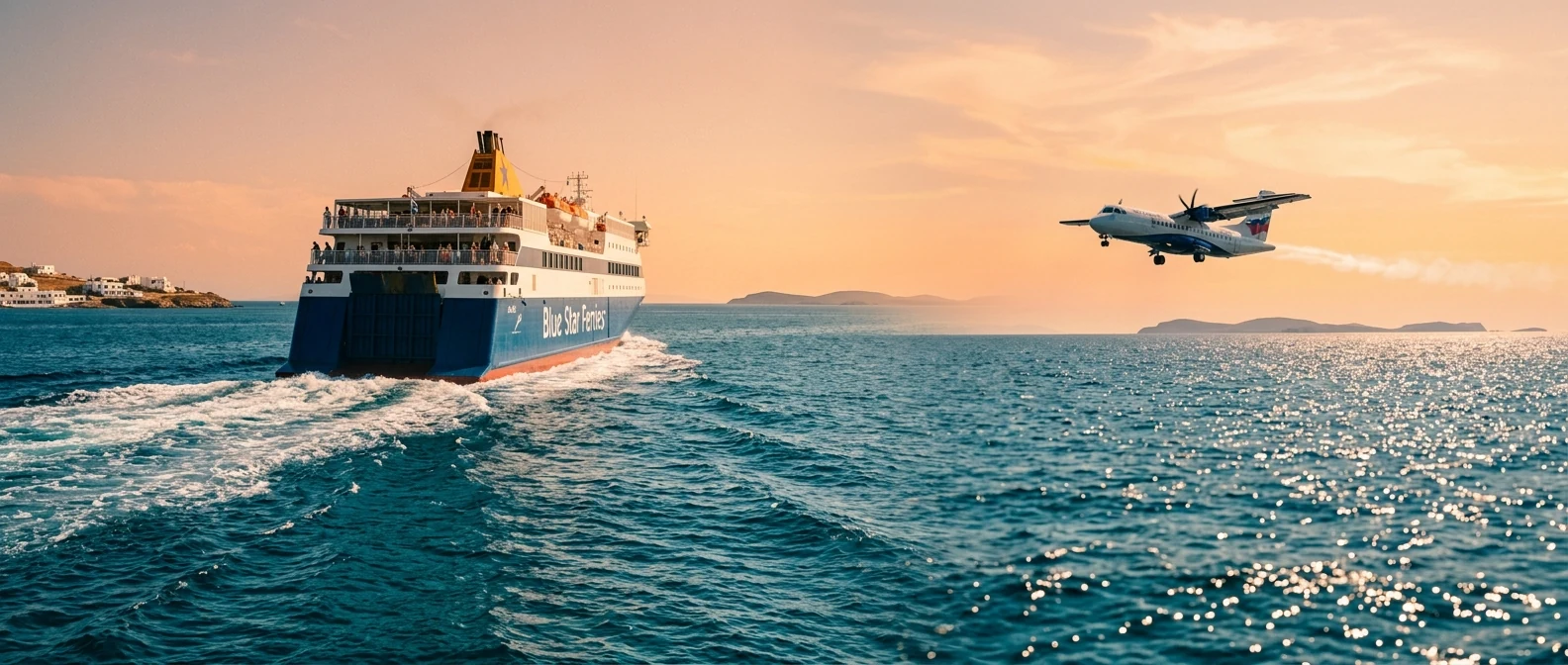
Leros is in the Dodecanese, between Patmos and Kalymnos, a few miles off the coast of Turkey. It has a small airport at Partheni, with one-hour flights from Athens, and that is the best way to get there. Ferries from Piraeus take nine to eleven hours, often overnight, and arrive at Lakki. There are also small boats from Kos and Kalymnos.
📍 Where Leros is
Leros is in the Dodecanese, between Patmos and Kalymnos, close to the coast of Turkey. The island is shown in red, and in green the Athens airport, Piraeus and Kos, from where you arrive.
🗺️ The map of the island
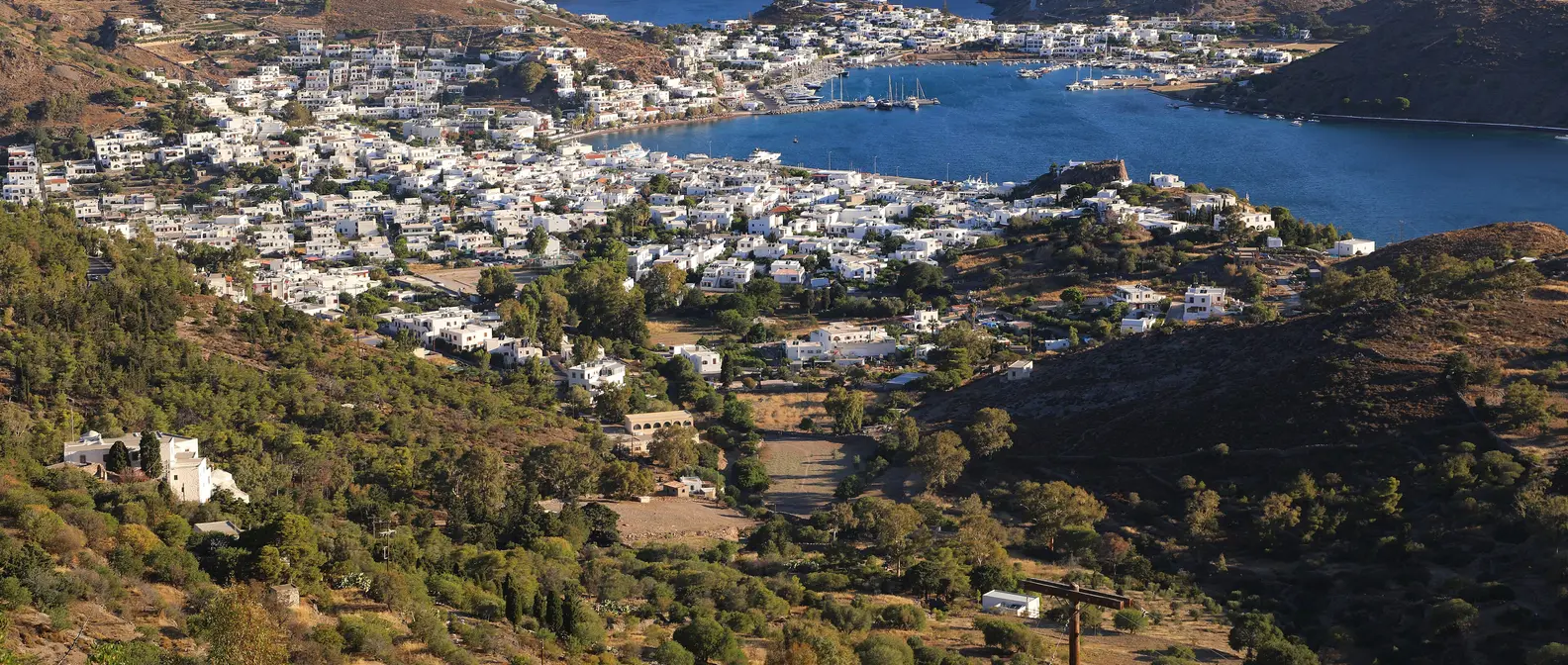
Leros is an island full of bays, as if cut out with scissors. In the middle of the east coast is Agia Marina, the harbour, Platanos, the capital, on the ridge above, and Panteli, the fishing village, on the other side: three villages that merge into one below the Castle. A little further north is Alinda, the big beach. In the south, the huge bay of Lakki, and at the southern tip Xirokampos. In the north, Partheni with the airport.
🗺️ Map of Leros
Agia Marina, Platanos and the Castle are in the middle of the east coast, with Panteli below and Alinda a little further north. Lakki is on the big bay in the south, with the War Museum next to it at Merikia. Xirokampos is at the southern tip, and Partheni with the airport in the north. Tap each number to see what it is.
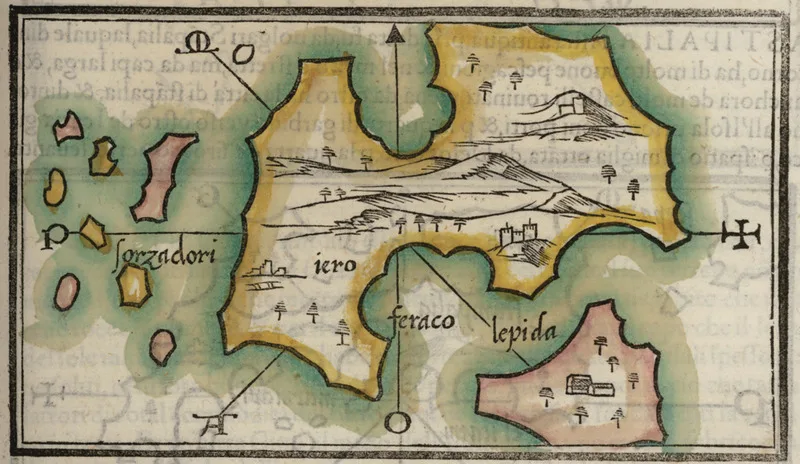
Map: Benedetto Bordone, 1547 (Public domain) · Wikimedia Commons
⚖️ Is it worth it? The pros and cons
Leros is an island for those who want history, quiet and authenticity, not for those looking for big sandy beaches and parties. Here is an honest picture.
📊 At a glance, from 1 to 5
👍 The pros
- An airport, with a one-hour flight from Athens.
- Lakki, an Italian town of the 1930s that exists nowhere else.
- A Castle with a view over the whole island and the islands around it.
- Fishing villages, tavernas and Dodecanese prices.
- An authentic island, without mass tourism.
👎 The cons
- The beaches are small, with pebbles, without big sandy stretches.
- Few ferries and a long trip from Piraeus.
- Little nightlife.
- Lakki, with its empty buildings, strikes some people as odd.
🏰 Agia Marina, Platanos and the Castle
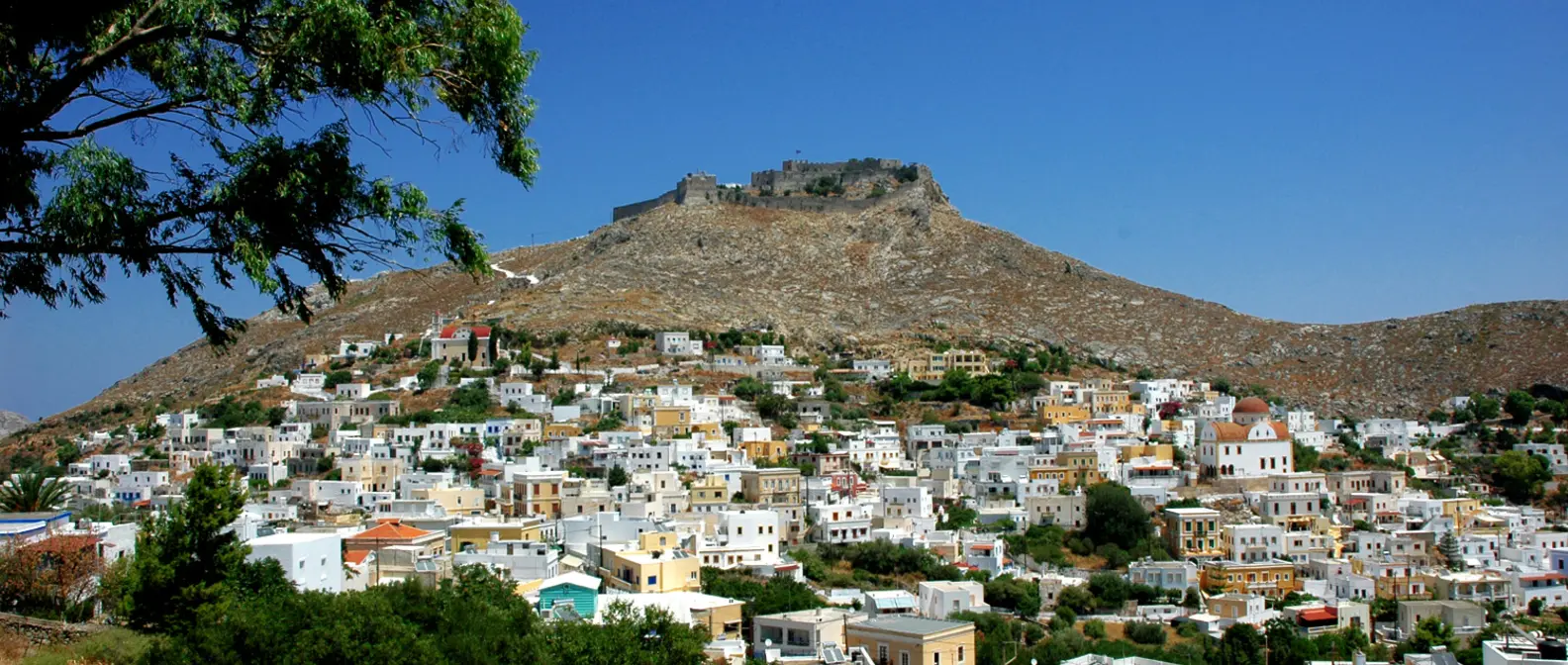
Agia Marina is the harbour of the east coast: fishing boats, neoclassical houses, cafés on the quay and an Italian market building. Above it, on the ridge, Platanos is the capital, with the square, the town hall and lanes climbing towards the Castle. And on the other side, Panteli is a fishing village with a small sandy beach and tavernas that put their tables on the sand. The three villages are joined together, and you walk through all of them in an hour.
Above everything, on top of the hill, the Castle of Leros, or Castle of Panteli, was built by the Byzantines and rebuilt by the Knights of St John in the 15th century, with three rings of walls. Inside is the church of Panagia tou Kastrou, with an icon that, according to tradition, was found inside the gunpowder store, and a small ecclesiastical museum. You go up by car or by the steps from Platanos, passing the windmills that stand on the ridge. From the top you see all of Leros, its bays and the islands around it.
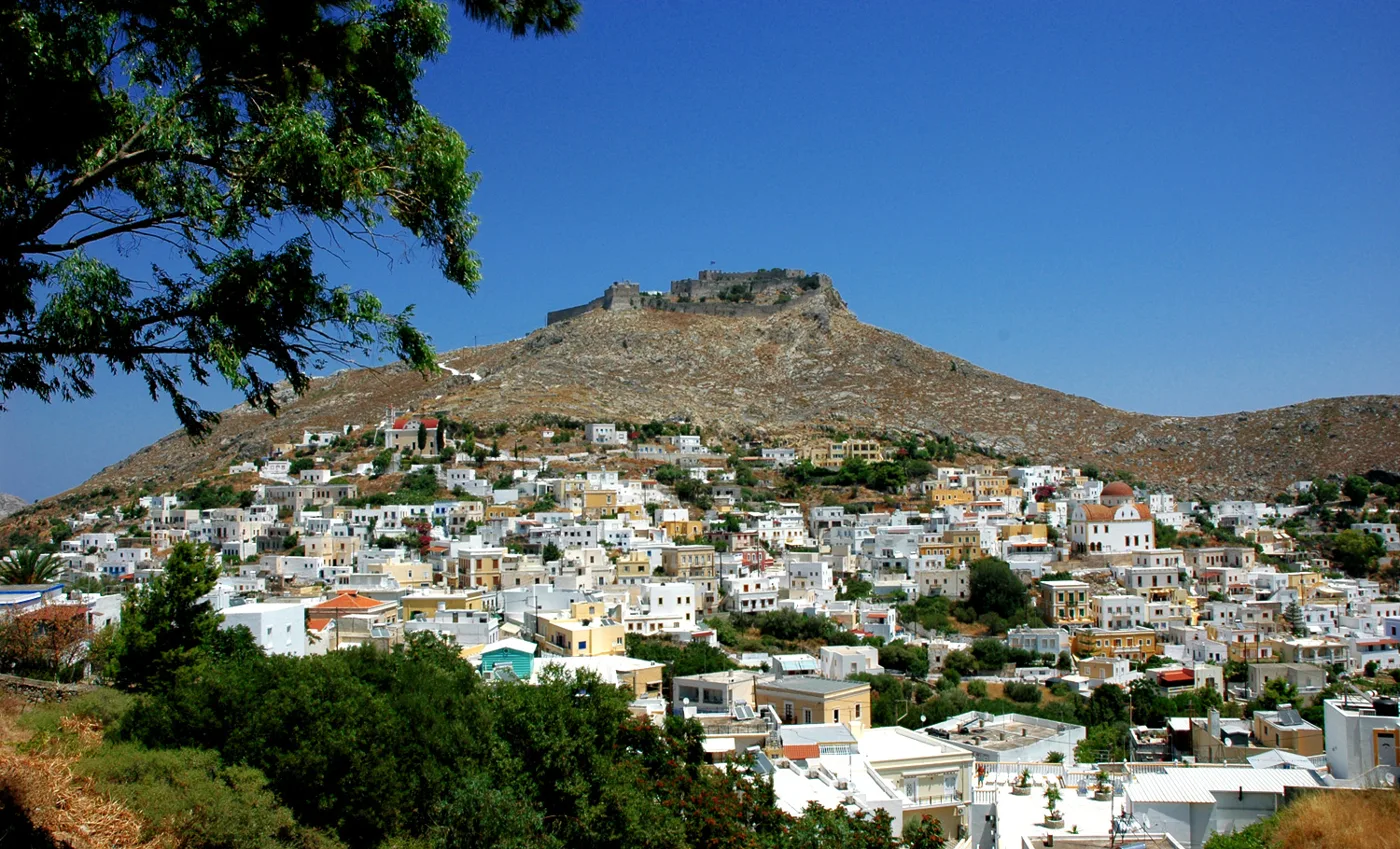
Two villages that merge into one, below the Castle.
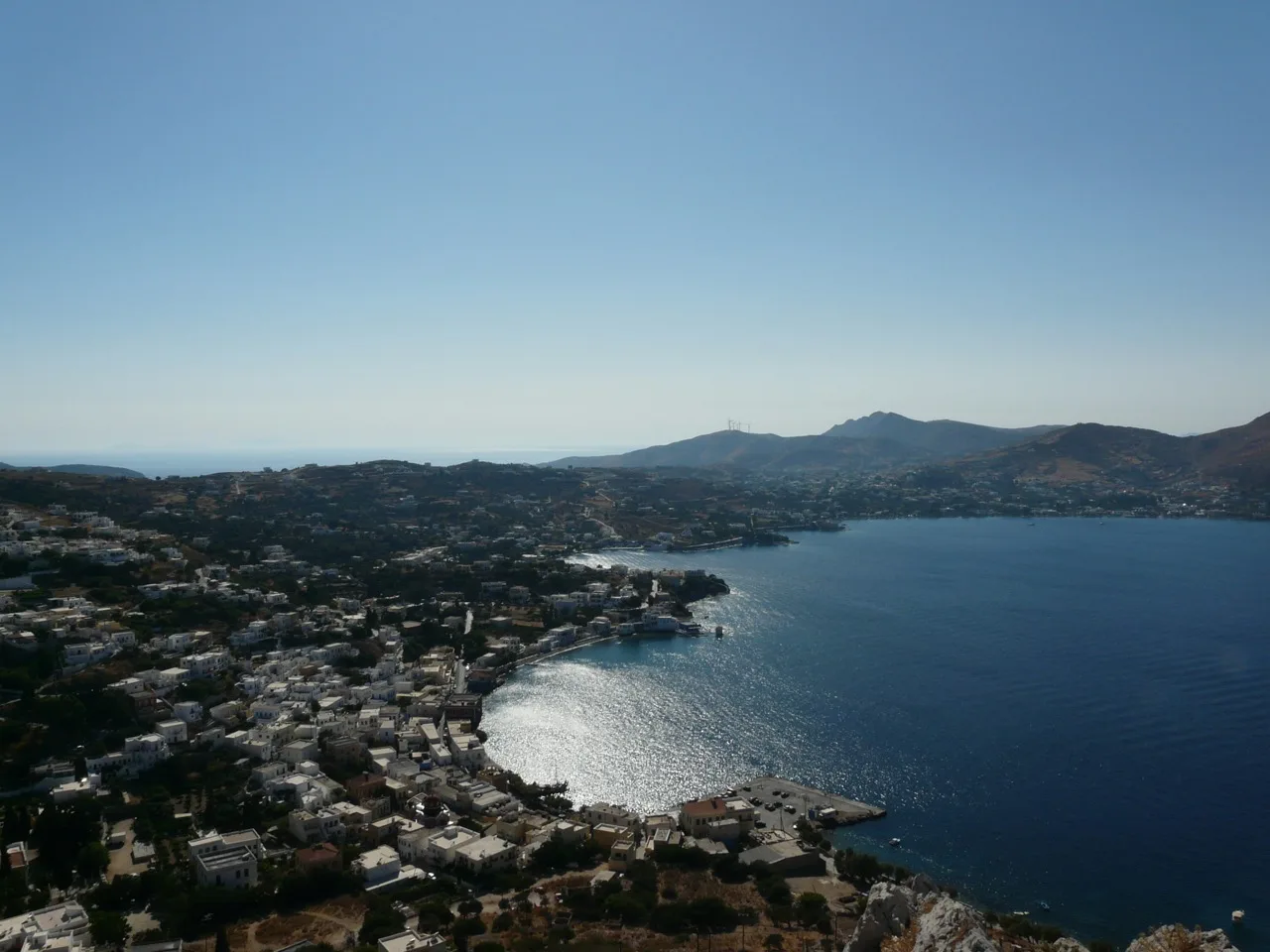
From the Castle, with the sun on the water.
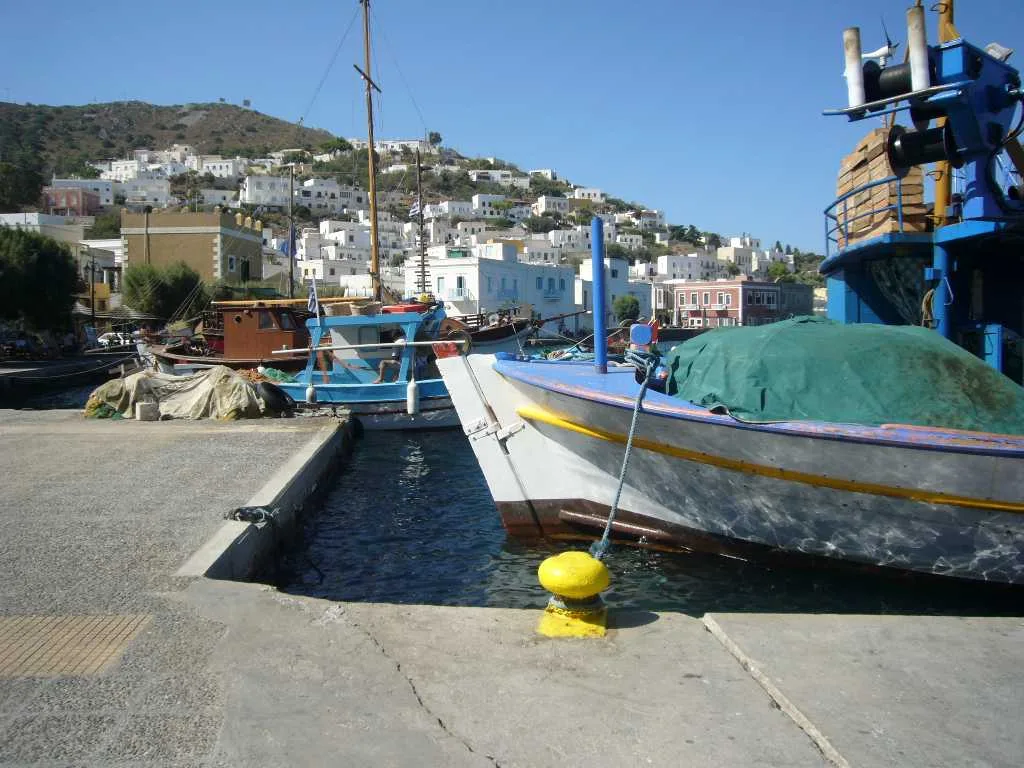
Fishing boats and neoclassical houses.
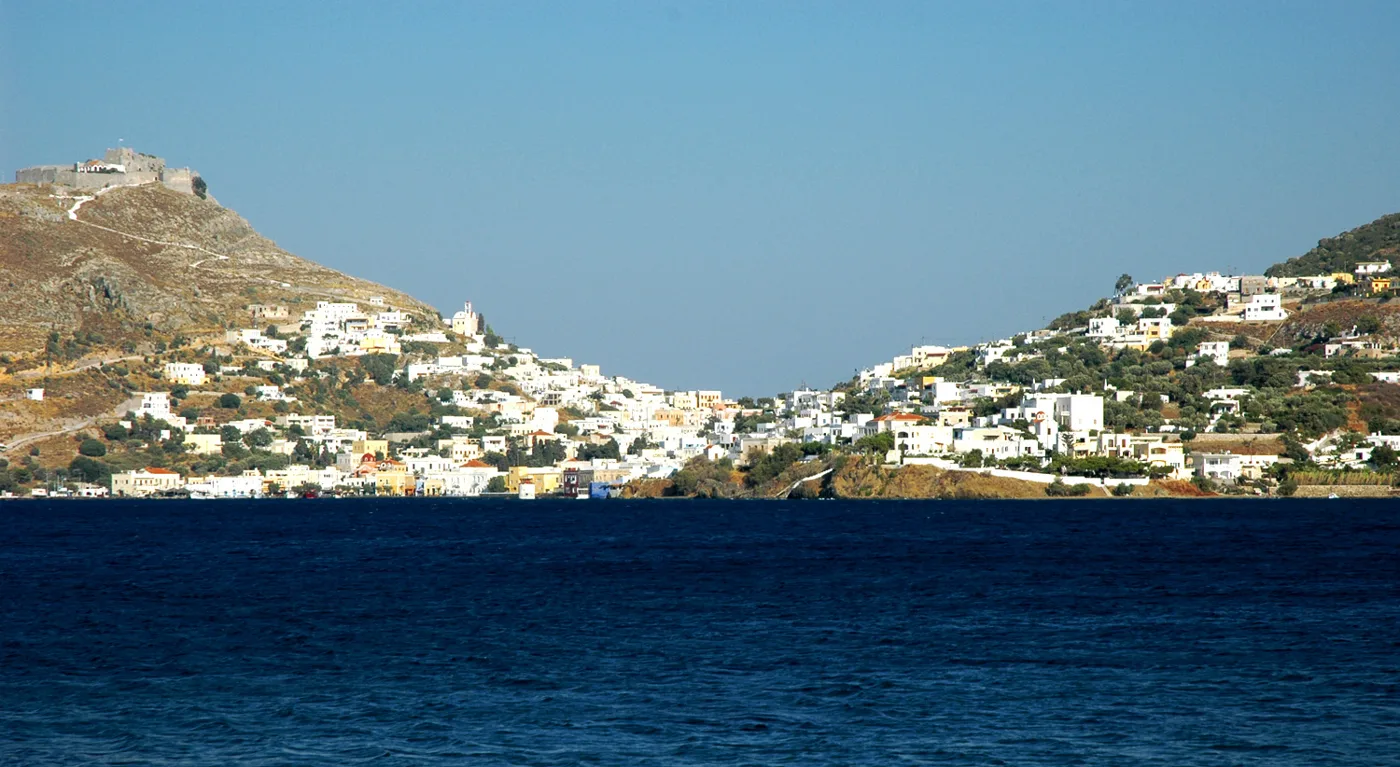
This is how you see it from the boat.
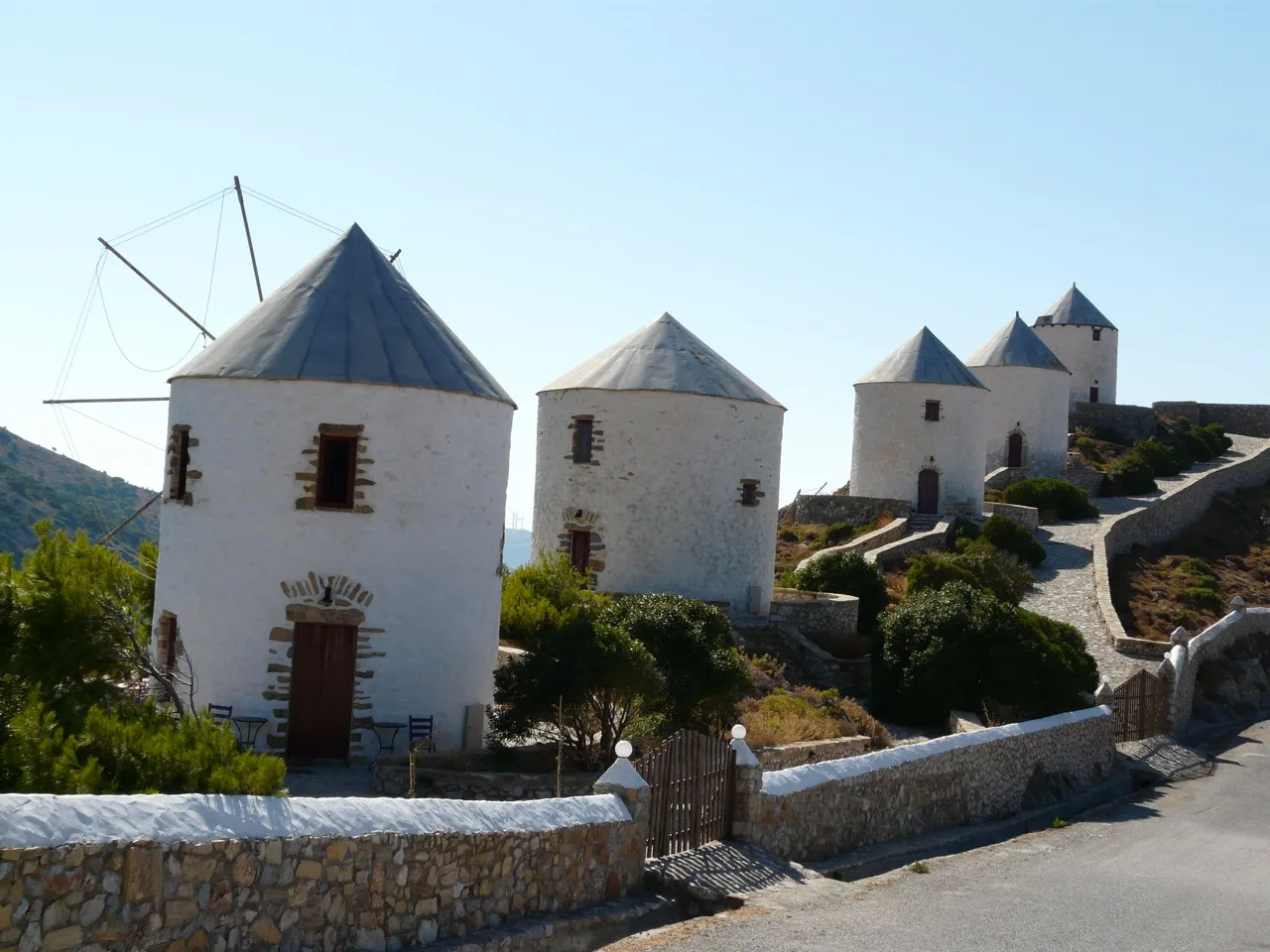
On the ridge, between Agia Marina and the Castle.
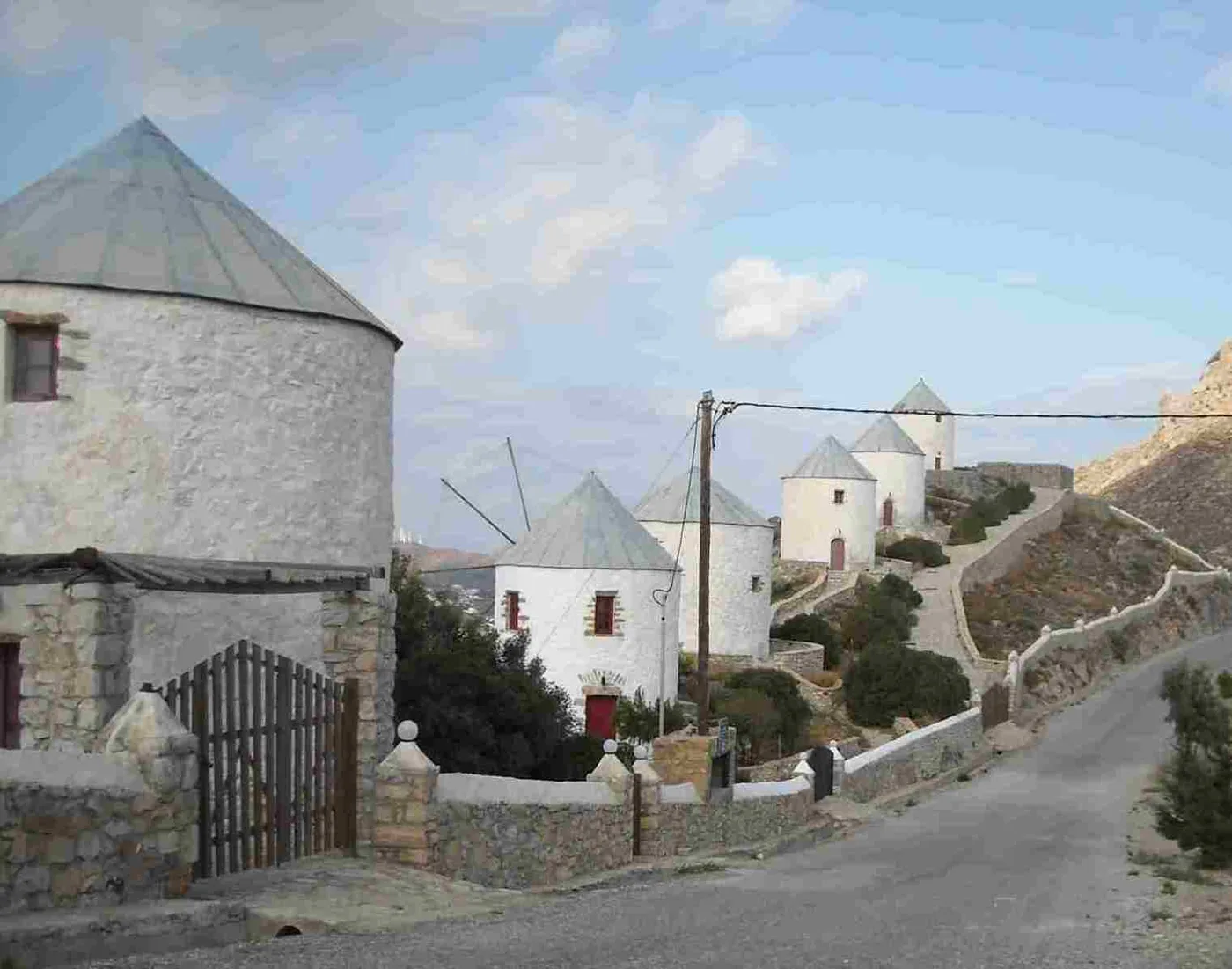
With their domed roofs.
Photos: G Da (CC BY-SA 3.0), anybookers (CC BY 2.0), KV 28 (Public domain), Simone (CC BY-SA 3.0) · Wikimedia Commons
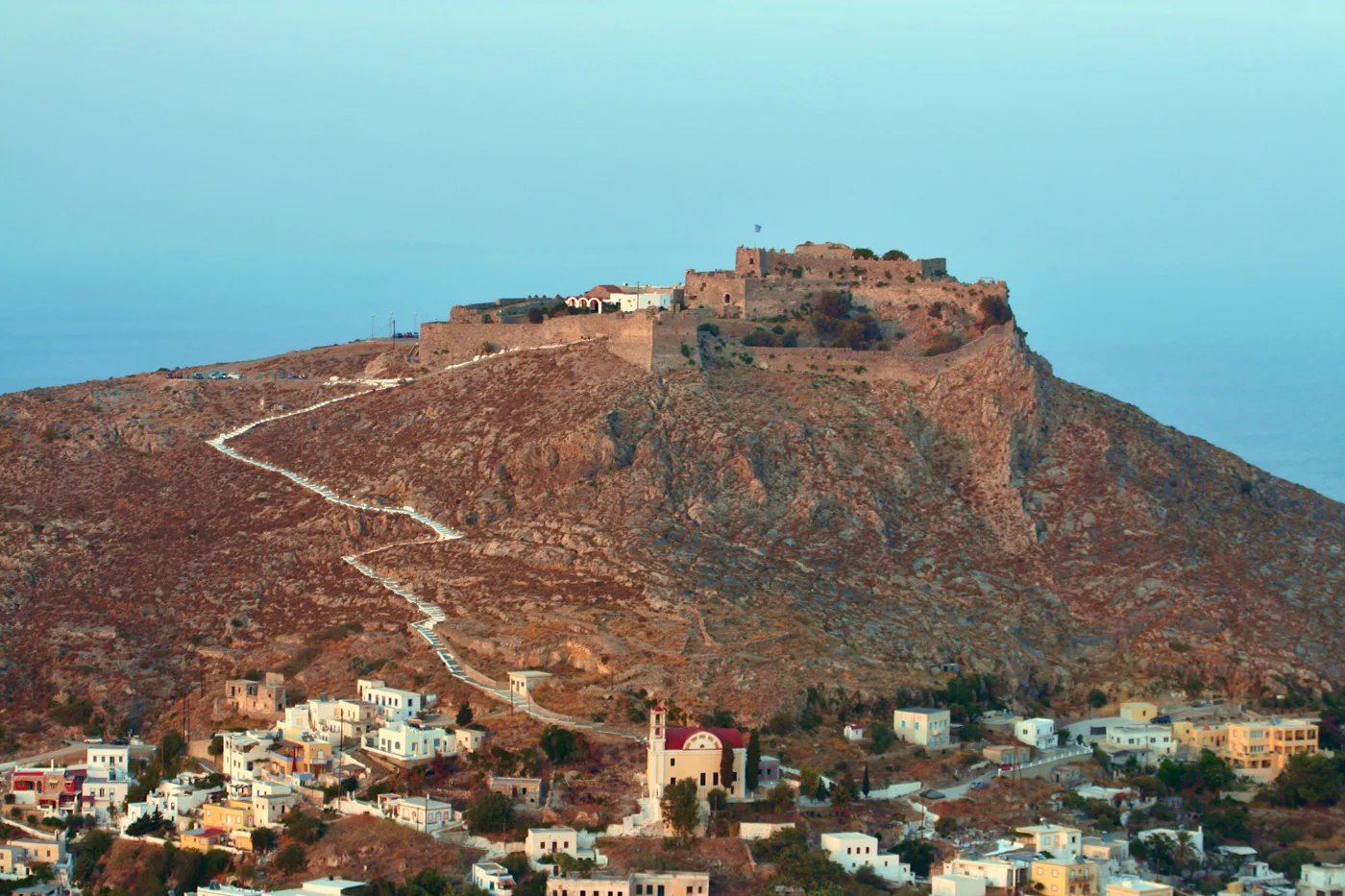
On the top, above Platanos.
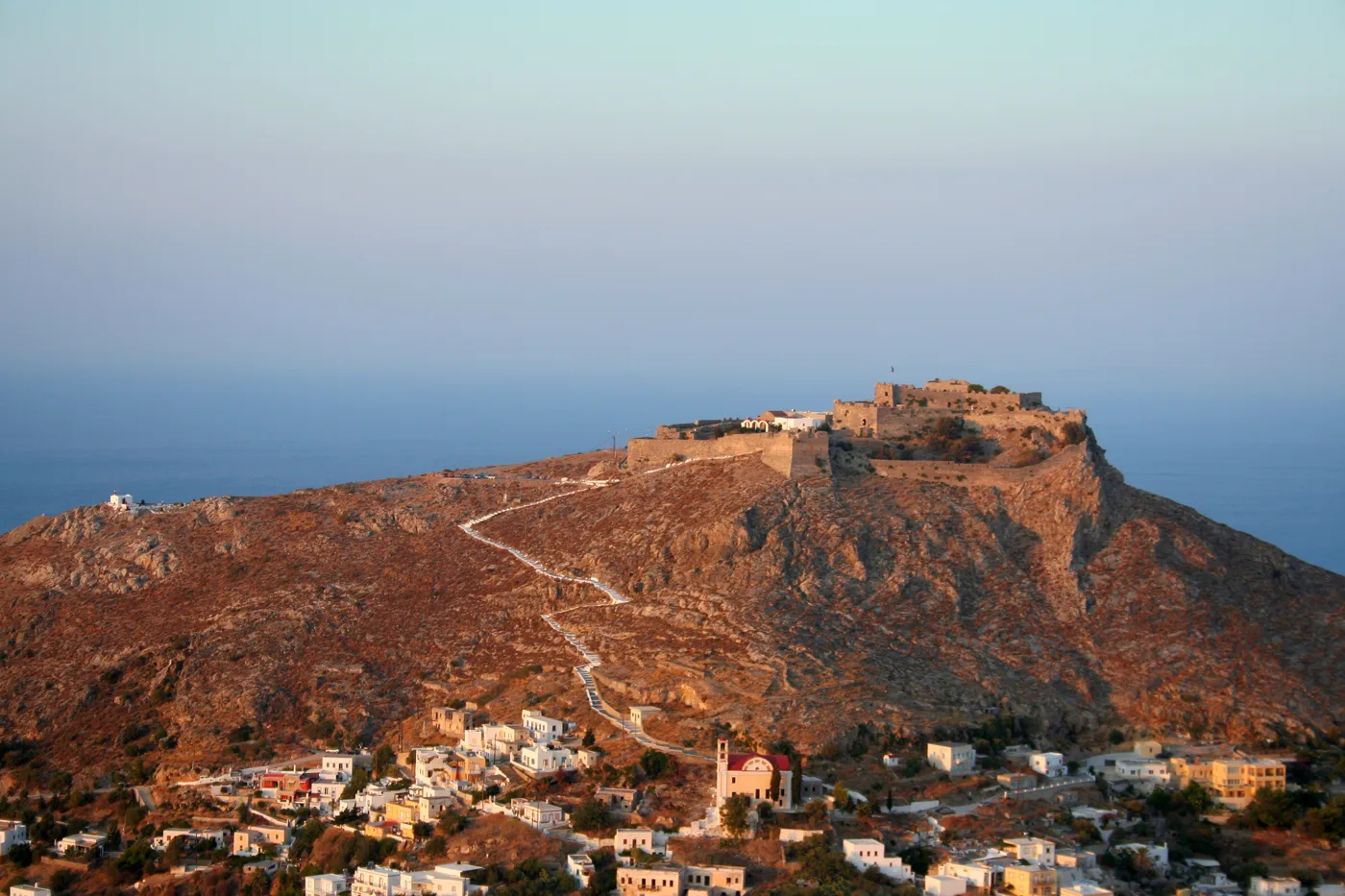
The walls and, below, Platanos.
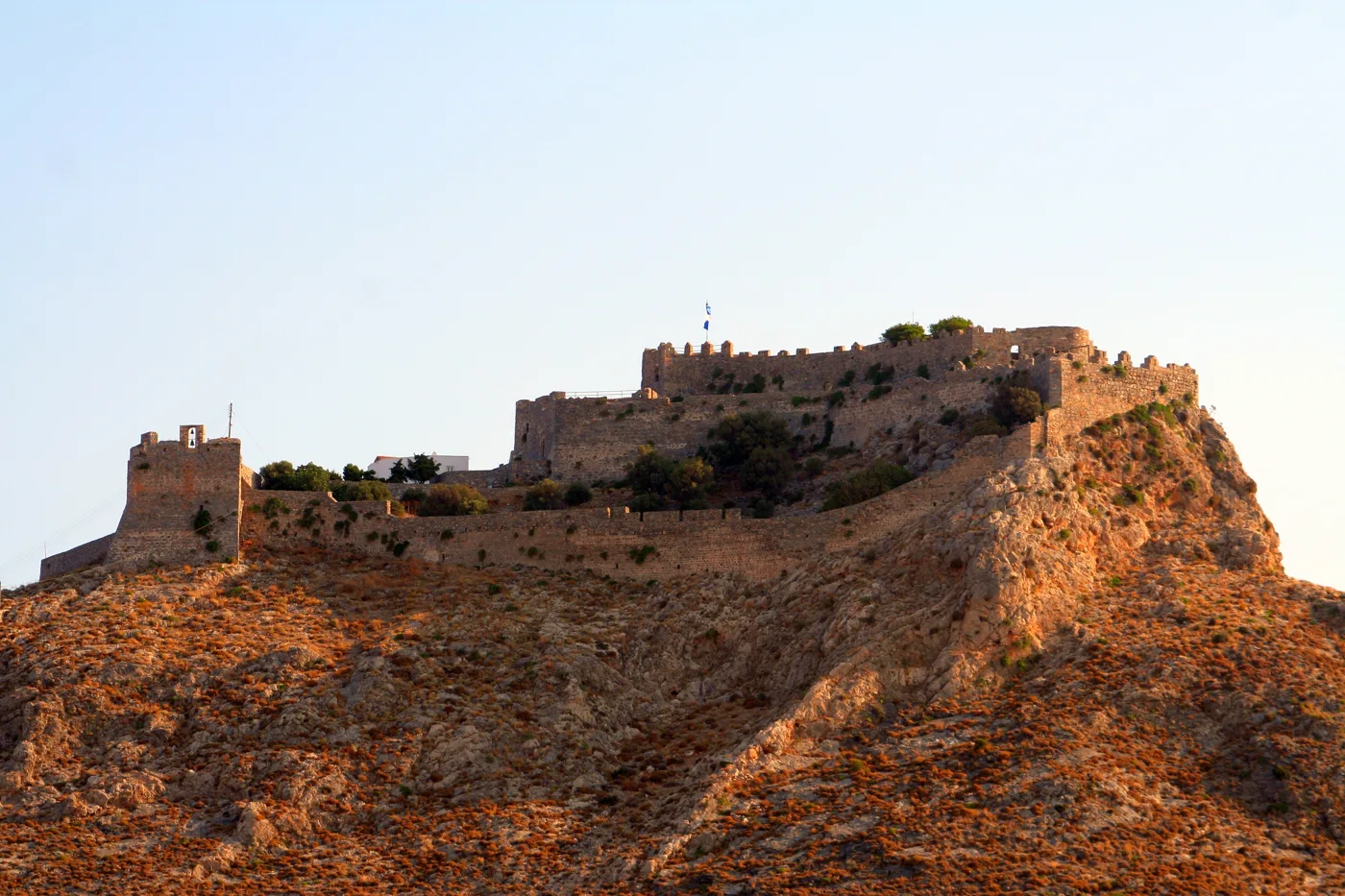
The walls in the sunset light.
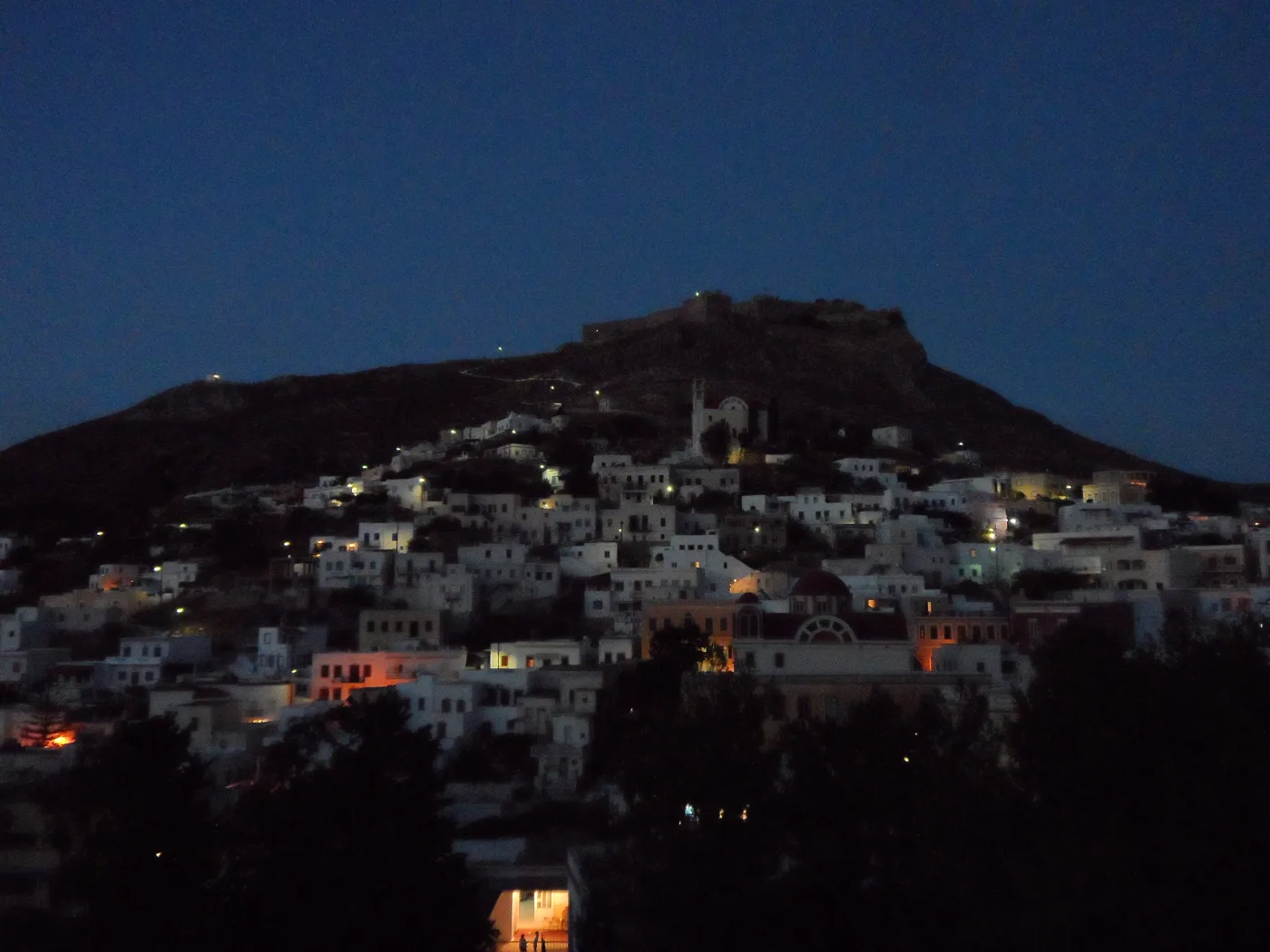
Lit up, above the village.
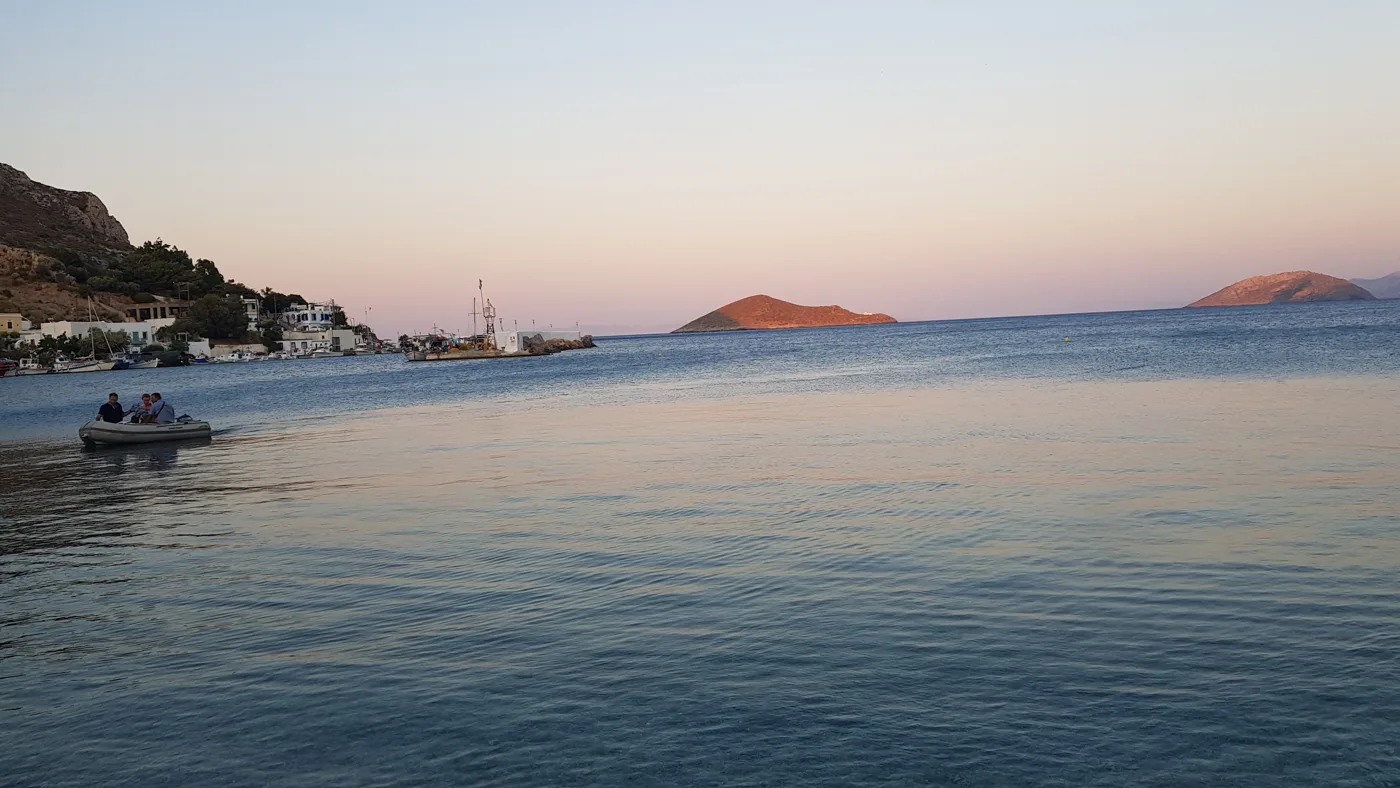
The fishing village below the Castle.
Photos: Vassilis Terzopoulos (CC BY-SA 4.0), Christos Nikolaou Antonopoulos (CC BY-SA 4.0), LefterisKaltsas (CC BY-SA 4.0) · Wikimedia Commons
The tavernas of Panteli are the reason many people come back to Leros: fresh fish, tables on the sand, boats next to you and the Castle lit up above. Go early, because in summer they fill up.
🏛️ Lakki and the war
Lakki is the strangest place in the Dodecanese. When the Italians ruled the islands, they chose the huge enclosed bay of Leros as a base for their fleet, and in the 1930s they built a whole town next to it from nothing, Porto Lago: wide boulevards with palm trees, rounded buildings, a cinema, a market with a clock tower, a hotel, a school, a church, all in the same style, Italian rationalism. Nowhere else in Greece is there anything like it. Today Lakki is the island’s second port, half empty and charming, and worth a walk in the afternoon.
In November 1943, after Italy’s surrender, British and Italians held Leros against the Germans for fifty-two days of continuous bombing, until the Germans landed paratroopers and took it. The battle of Leros inspired the novel “The Guns of Navarone”. At Merikia, next to Lakki, the War Museum is set up inside a tunnel the Italians dug, with weapons, uniforms, photographs and pieces of the ships that sank in the bay. At Alinda, the British war cemetery remembers the soldiers who stayed here.
In the north, at Partheni, next to the airport, the little church of Agia Kioura hides something unexpected: frescoes painted by political prisoners in 1949, when the island was a place of exile, with faces and scenes unlike any other church.
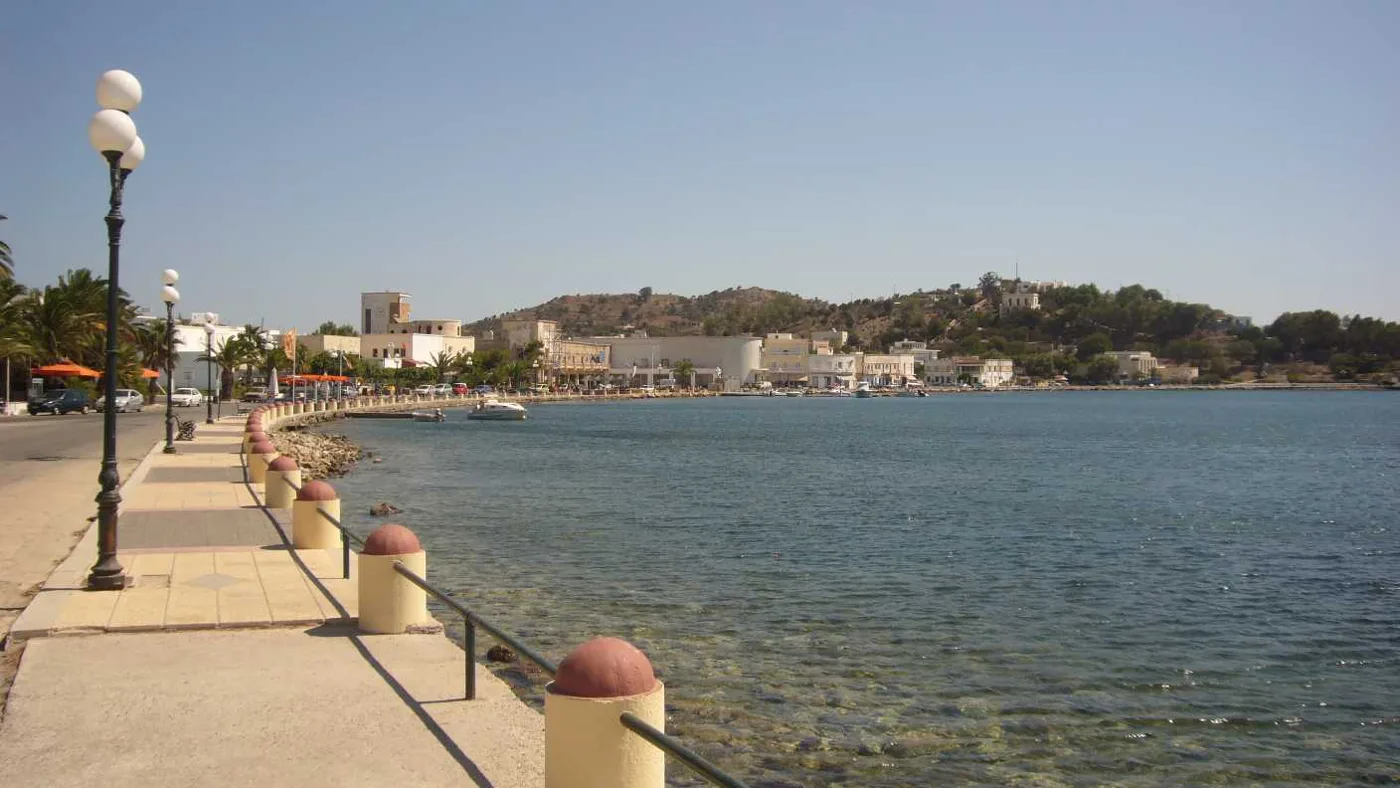
An Italian town of the 1930s on a Greek island.
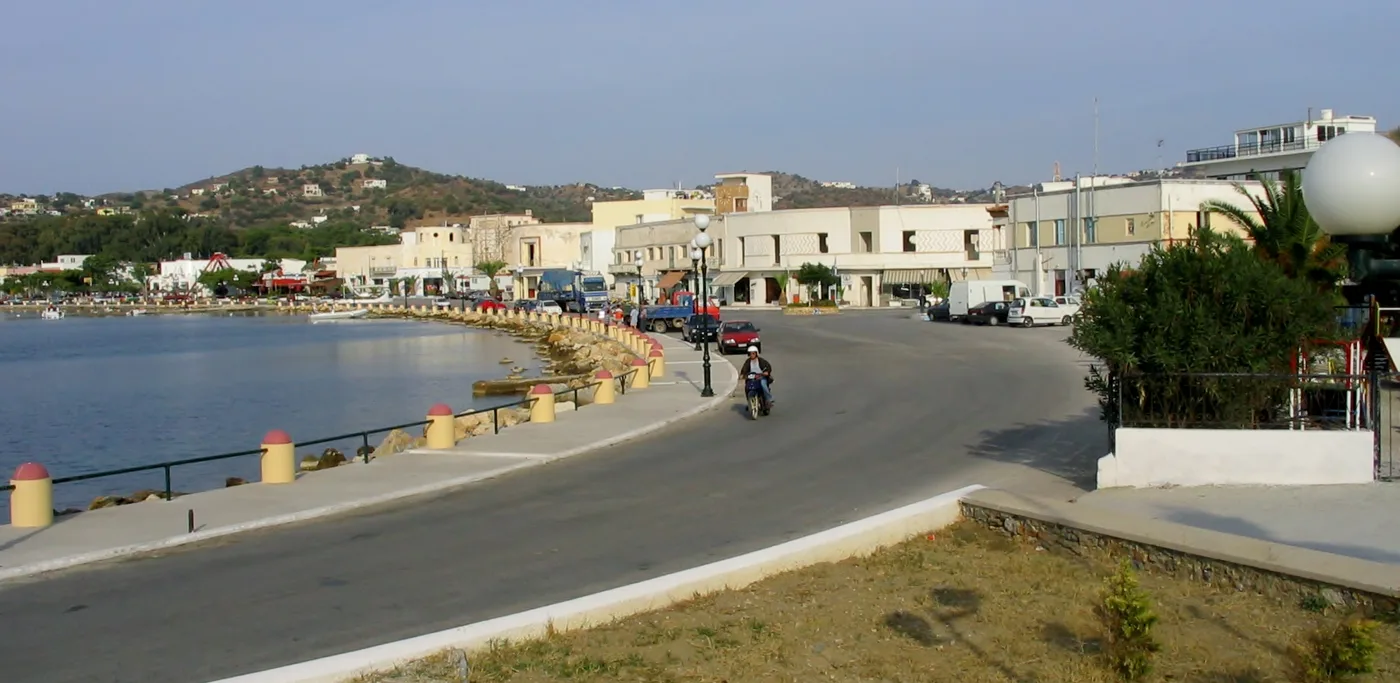
Palm trees and wide streets.
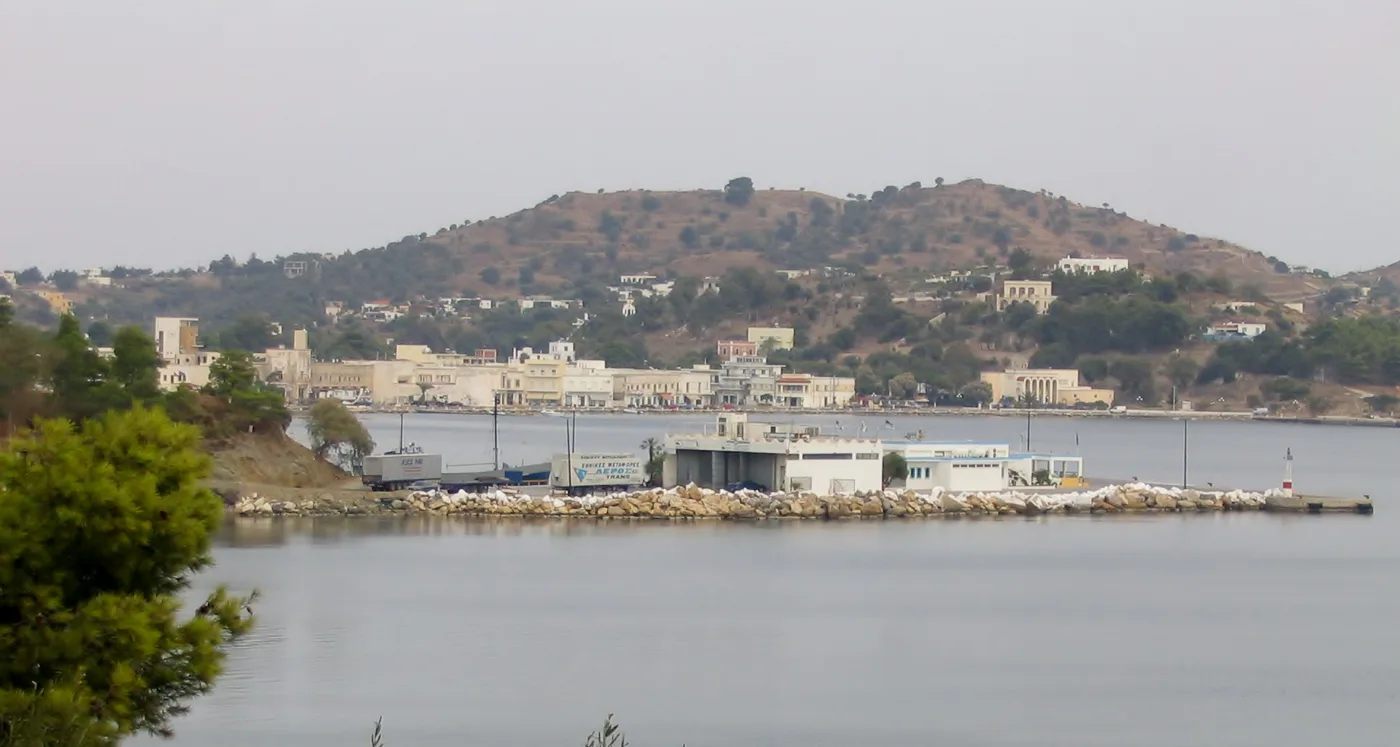
One of the biggest natural harbours in the Mediterranean.
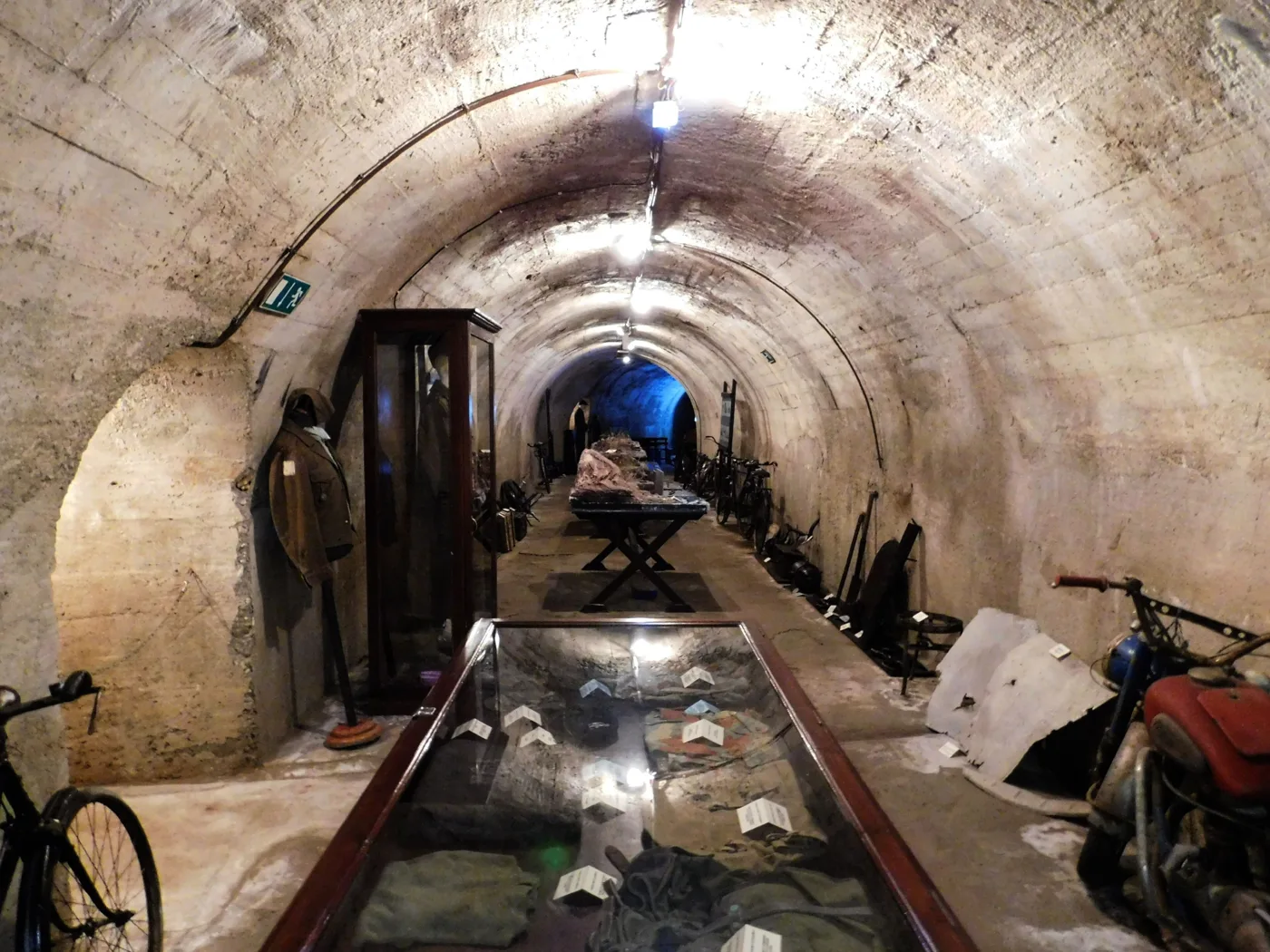
Inside a wartime tunnel.
Photos: KV 28 (Public domain), Andreas Wolf 01 (CC0), Antonis Tsapepas (CC BY-SA 4.0) · Wikimedia Commons
Start from the waterfront with the palm trees, see the old hotel and the cinema, the market with the clock and the church of Agios Nikolaos with its tower-belfry, and walk the wide boulevards. One hour, best in the afternoon light.
🏖️ The beaches
The beaches of Leros are small, with pebbles or coarse sand, in enclosed bays, and rarely crowded. Alinda, next to Agia Marina, is the biggest and the most organised, with hotels and tavernas, and above it the Bellenis Tower, a mansion like a small castle, houses the folklore museum. Vromolithos, below Panteli, has trees and calm water. Gourna, in the west, is the biggest sandy beach, shallow, for families. Xirokampos, at the southern tip, is quiet, with tavernas and, on the hill above, Palaiokastro, an ancient fort with walls from the 4th century BC and a chapel with mosaics.
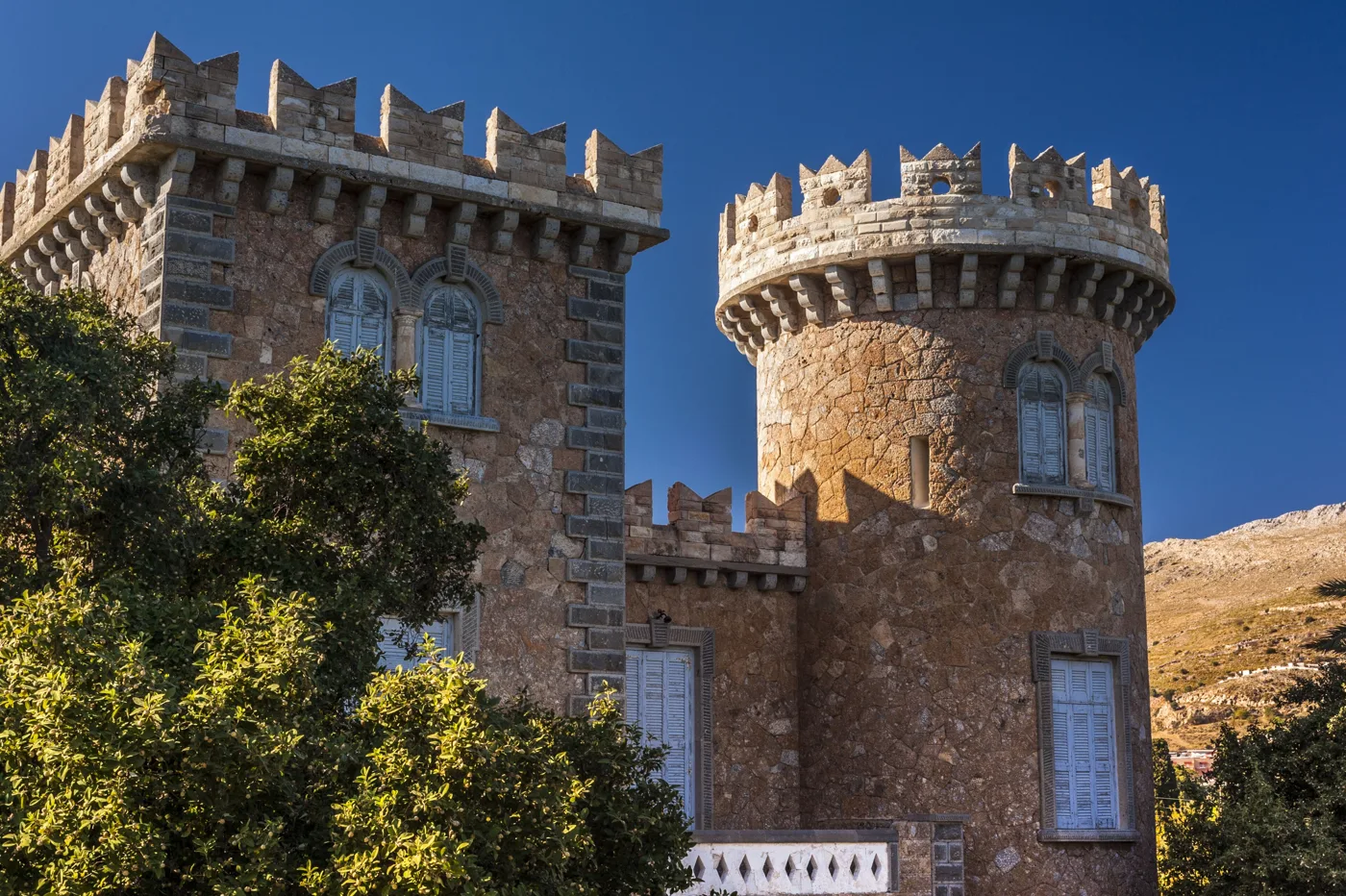
The folklore museum of Alinda.
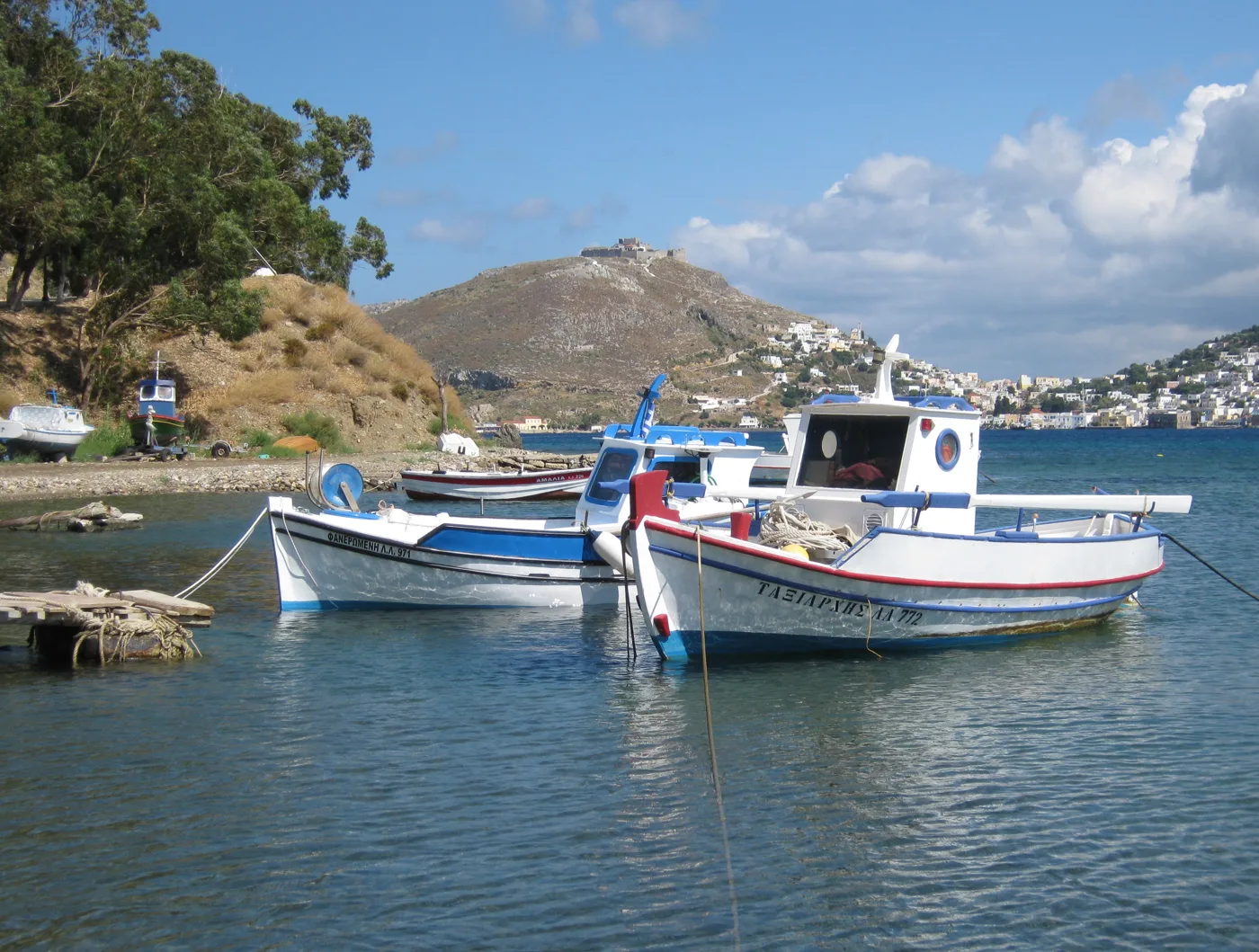
The big beach, near Agia Marina.
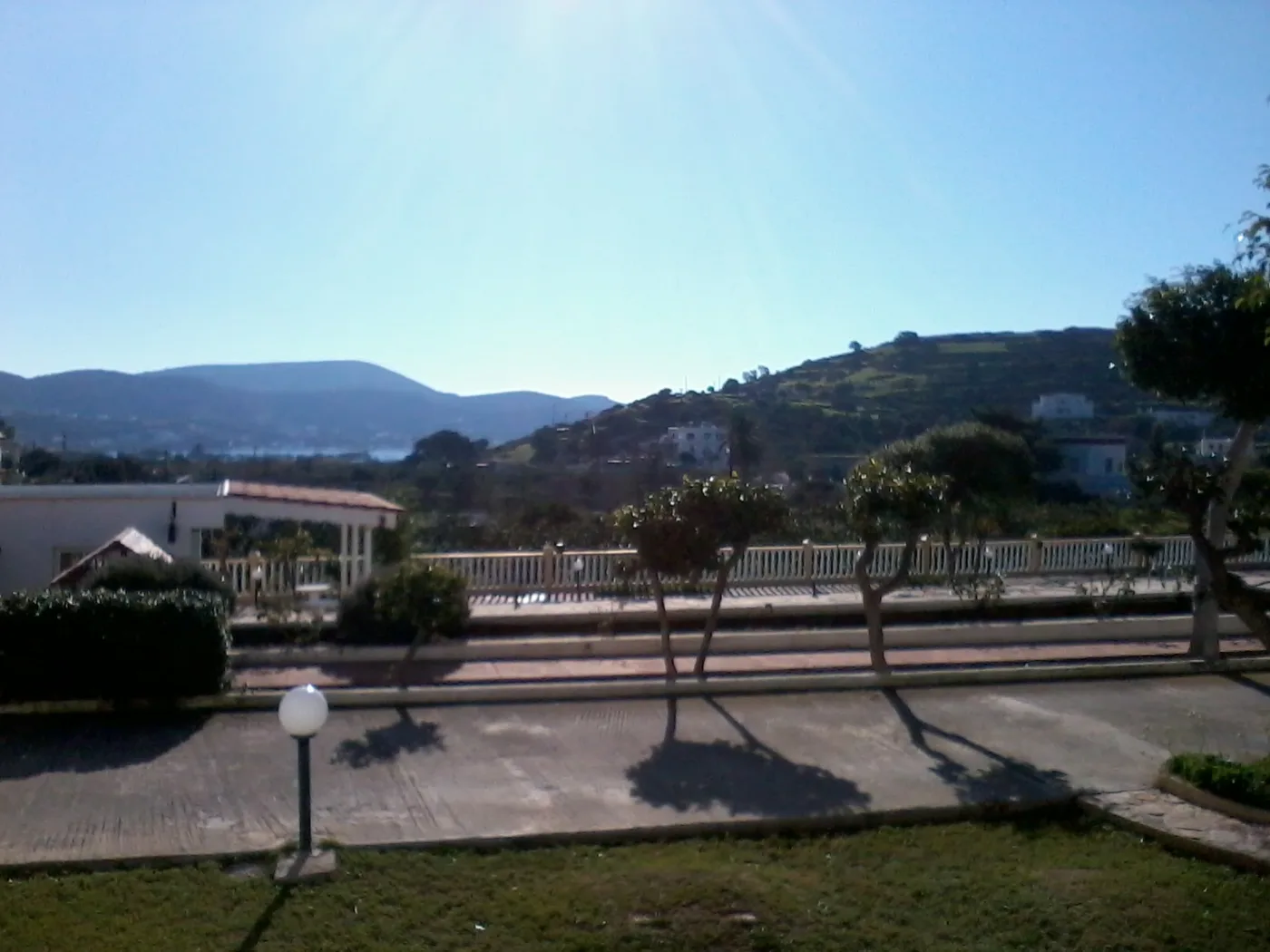
Sand and shallow water, in the west.
Photos: Thanasis Christodoulou (CC BY-SA 4.0), Robert Powell (CC BY-SA 3.0), Padazis (Public domain) · Wikimedia Commons
- Alinda: the biggest, organised, next to Agia Marina.
- Panteli: a small sandy beach, with the tavernas on the sand.
- Vromolithos: pebbles, trees and calm water.
- Gourna: sand and shallow water, in the west, for families.
- Xirokampos: quiet, in the south, with Palaiokastro above.
- Blefoutis: a remote bay in the north, with one taverna.
🍽️ What to eat
Try patsavouropita, a pie with “crumpled” pastry and cheese, and pougakia, small sweets with cheese and honey. The island has good thyme honey, and in the tavernas of Panteli, Agia Marina and Xirokampos you will find fresh fish, marinated anchovies and octopus, at prices you will not see in the Cyclades. In Lakki, have a coffee in an Italian building from the 1930s.
📅 When to go
May, June and September are the best months: warm sea, everything open, a quiet island. In July and August Leros fills up with Greeks and Italians, but it never reaches the crowds of Kos or Rhodes. In spring it is green and ideal for walking, and in winter, with the airport, it is a quiet, real island.
✈️ How to get there from Athens
| How | Duration | From | Notes |
|---|---|---|---|
| Plane | About 1 hour | Athens airport | Small plane, few flights. Book early. |
| Ferry | About 9–11 hours | Piraeus | A few times a week, often overnight. Arrives at Lakki. |
| Plane and ferry | About 1 hour + 1–2 hours | Athens Airport → Kos | More flights. Ferries from Kos via Kalymnos. |
From Ioulianou 50 take Line 1 to Monastiraki and change to Line 3 for the airport, or Line 1 straight to Piraeus. On the island there are buses from Lakki and Agia Marina to the villages, but for the beaches and Partheni you need a scooter or a car. For Patmos, one hour away by ferry, see our guide to Patmos.
🗓️ Three days on Leros
Agia Marina, Platanos and the Castle
Morning in Agia Marina and the lanes of Platanos. Go up to the Castle, past the windmills, for Panagia tou Kastrou and the view. Afternoon swim at Vromolithos, and in the evening fish in Panteli, with your feet in the sand.
Lakki and the war
Morning in Lakki, on foot, for the Italian buildings and the waterfront. Then the War Museum at Merikia, inside the tunnel. Swim at Xirokampos, with a climb to Palaiokastro for the view.
Alinda and the north
Swim at Alinda or Gourna, the Bellenis Tower and the British war cemetery. Afternoon at Partheni, for Agia Kioura and its frescoes, and a last sunset from the windmills.
Frequently asked questions
Where to stay on Leros?
In Agia Marina or Platanos, to have the harbour, the lanes and the Castle on foot. In Alinda, for a hotel with a beach. In Panteli, for the tavernas and the evenings on the sand. Lakki is further from the beaches.
Do I need a car?
For the three villages and the Castle, no. For the beaches, Lakki, Xirokampos and Partheni, a scooter or a small car for a few days. The island is small, and from end to end it is half an hour.
What is Lakki?
A town the Italians built in the 1930s, when Leros was theirs, as a base for their fleet. It is the only complete example of Italian interwar architecture in Greece, and one of the few in the world. Half empty today, but unlike anything else you will see in Greece.
How many days do I need?
Three days for the villages, the Castle, Lakki, the museum and three beaches. Leros combines easily with Patmos, Kalymnos and Kos, which are one to two hours away by ferry.
— Kathy